Atlassian's revenue: $1.79 billion last quarter
Atlassian's move: fire the engineer who built their infrastructure
his move: post a 38-minute breakdown of every system he built, free for anyone to copy
what he revealed:
> Envoy proxy instead of enterprise load balancers
> sidecar architecture for auth, logging, rate limits
> DynamoDB + SQS for async provisioning
> Packer + SaltStack for automated VM deployments at scale
Atlassian charges per employee across 350,000 customers
this guy just handed you the enterprise playbook for free
save this
Great ideas don’t belong in notes app drafts.
So tell us , what do you really need to bring your idea to life?
Opportunity? Platform? Funding?
Drop your answer in the comments
25.05.26 Loading…
BuildWithOPay ComingSoon BeyondBanking
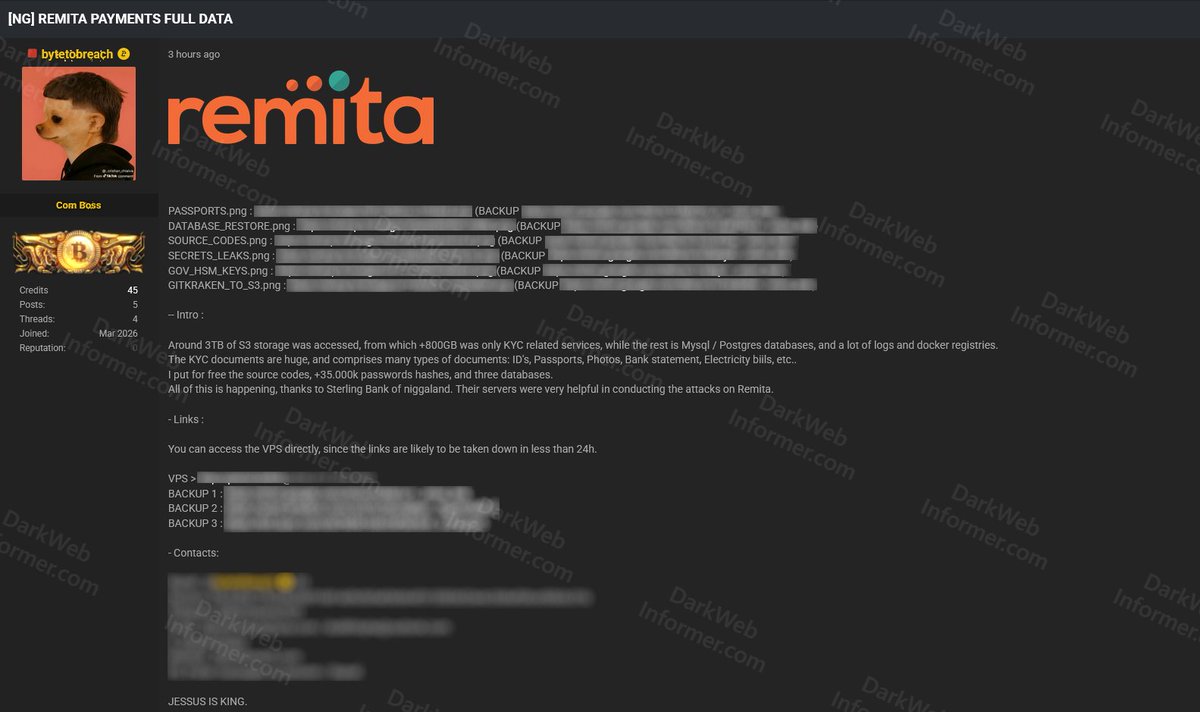
‼️🇳🇬 A massive breach allegedly from Remita, a major Nigerian payment processing platform, has been leaked on a popular cybercrime forum.
▪️ Total Size: ~3TB of S3 storage
▪️ Data Includes: 800GB+ of KYC documents (IDs, passports, photos, bank statements, electricity bills), MySQL/Postgres databases, logs, docker registries, source codes, government HSM keys, GitKraken to S3 backups
▪️ Source codes, 35,000+ password hashes, and three databases
@lov_zuri@OurFavOnlineDoc Well her video is comparing earning rate and purchasing strength, while it’s a slight difference in purchasing strength, the earning rate is vastly different. “Just a slight difference” is only one sided, my comment is to make your analysis whole.
Introducing: PlayerZero
The world's first Engineering World Model that puts debugging, fixing, and testing your code on autopilot.
We've raised $20M from Foundation Capital, @matei_zaharia (Databricks), @pbailis (Workday), @rauchg (Vercel), @zoink (Figma), @drewhouston (Dropbox), and more
PlayerZero frees up 30% of your engineering bandwidth by:
1. Finding the root cause for bugs & incidents in minutes that engineering teams take days to identify.
2. Predicting in minutes, edge case issues that a 300-person QA team would take weeks to find.
------
Here's why this matters:
No one in your org has a complete picture of how your production software actually behaves.
Support sees tickets. SRE sees infra. Dev sees code. Each team builds their own fragmented view - and none of these systems talk to each other. When something breaks, everyone scrambles to stitch the picture together by hand.
PlayerZero connects all of it into a single context graph -
→ The Slack thread where your lead said "we went with X because Y fell apart in prod last time"
→ The PR review where an engineer explained the tradeoff
→ The lifetime history of your CI/CD pipeline, observability stack, incidents, and support tickets
So you can trace any problem to its root cause across every silo.
And it compounds. Every incident diagnosed teaches the model something new. The longer it runs, the deeper it understands - which code paths are high-risk, which configurations are fragile, which changes tend to break which customer flows.
So when you sit down to debug a live issue, you have your entire org's collective reasoning and production memory behind you - instantly.
------
Zuora, Georgia-Pacific, and Nylas have reduced resolution time by 90% and caught 95% of breaking changes and freeing an average of $30M in engineering bandwidth.
------
Our guarantee:
If we can't increase your engineering bandwidth by at least 20% within one week, we'll donate $10,000 to an open-source project of your choice.
Book a demo - https://t.co/dH1dulIwSS
@Apple@AppleSupport I have been trying for the past few days to create an Apple ID, but adding my phone number for 2FA is not working. It consistently tells me that verification codes can’t be sent to the number. I have also mailed Apple but no response. Please I need assistance
Payments are entering a new phase shaped by stablecoins, AI agents, digital identity, and frictionless checkout.
By 2026, speed and trust won’t be advantages anymore.
They’ll be table stakes.
When everyone can move money instantly and securely, differentiation moves up the stack.
The real edges will be:
• Distribution & ecosystem reach — being embedded where users already operate, not forcing new behavior
• Local execution at global scale — compliance, rails, and UX that actually work market by market
• Cost intelligence — routing payments by total economic efficiency, not just raw speed
• Programmability — payments that adapt to context, risk, and intent in real time
• Trust architecture — explainable, auditable systems, not just “secure” black boxes
Speed and trust get you into the game.
Execution, integration, and leverage decide who wins.
The next payments leaders won’t just move money faster.
They’ll move it smarter, locally, and at scale.
Not entirely true.
GitHub in simple terms is just a folder in the cloud for your projects. Git is what helps developers manage different versions of their code. Every change is recorded in a .git file, any other team member that downloads the code from GitHub also downloads that .git file which git uses to apply the changes locally.