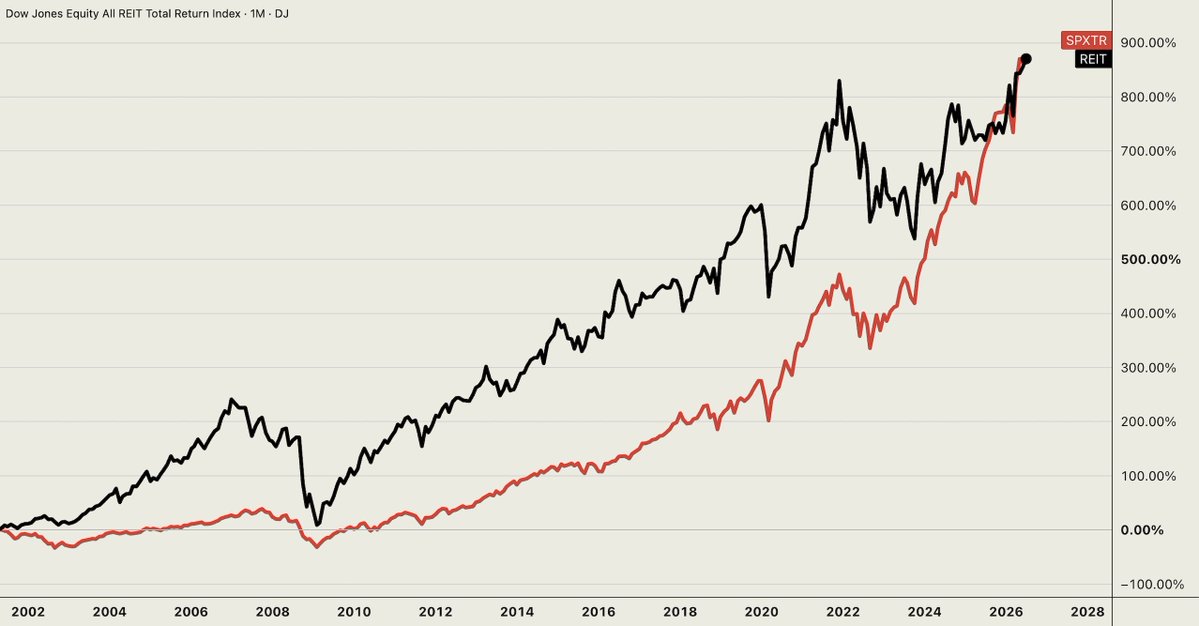
Since 1991, REITs and the $SPY have delivered almost the same total return, but the engine was completely different.
Most options traders never notice this. REITs are boring. Theta is not.
I used this week's earnings-volatility spike to get paid extra for buying real estate at my price, instead of whatever price the market hands me on a random Wednesday.
Active trading builds the war chest. Boring trades like this help build your net worth. You need both.
The US bombed Iran. The energy sector finished the week red. Its options still price 27% volatility. The tape has delivered low 20s for months.
Traders keep paying for a shock that never arrives. I sell it to them. The full trade went up on Patreon. Next to a second trade in a sector nobody is watching. Link in the comments.
Check out this week's issue of The Option Premium. And if you find the newsletter helpful, please share it with a friend, a group, or a forum. Word of mouth is the only way I grow this thing, and every share matters more than you know.
https://t.co/AbMMV5Npuc
Some trading lessons that only became clear after I learned them the hard way. 💡
When you catch yourself watching the news or obsessing over your positions more than the actual price action on the chart, it’s almost always because your size is too big. 📊
If you’re more focused on locking in quick profits while refusing to cut your losers, it’s usually because you’ve already taken too much damage — and you’re terrified of realizing even more loss. Oversized again. ⚠️
And if deep down you’re hoping a single tweet from Trump (or any headline) will magically rescue your account… you might be better off working at a casino.
Either way, your position sizing has left the building. 🃏
Buffett’s old line about people preferring to get poor fast rather than rich slow gets mocked by some. But it’s brutally accurate in trading. If you can’t make money consistently when your max risk on a trade is $30 on a $100 idea, you won’t magically become profitable at $100k or $1 million size. You’ll just go broke faster and louder. 📉
Here’s the dangerous part: We string together a few good trades, feel like we’ve finally “got it,” and decide it’s time to increase size. We step outside our process. Then the unexpected candle hits — the one nobody saw coming — and we blame the tweet, the Fed, the algos… anything but the real culprit: we abandoned discipline. ❌
When you actually respect your rules, you still get those beautiful days where a trade runs for 200% or more. But your losses? They stay capped at exactly what you were willing to risk that day. No surprises. No account-threatening draws. That’s how consistency is built. ✅
Stop setting dollar targets. Measure everything in percentages and daily improvement. One percent better each day — in your execution, your patience, your risk management, even in how you show up for the people you love — will turn small accounts into large ones over time. More importantly, it keeps you in the game. 🌱
You know you’re becoming a better trader when you can take a profit, close the platform, and actually go live the life that trading is supposed to support. 💼➡️🌴
You know you’re becoming a better trader when you can look at the market at 9:30 and decide, with zero guilt, that there’s no edge today — and do something else instead. ⏰
You know you’re becoming a better human when you pick up the phone when someone who matters calls, instead of letting it ring because “I’m in the zone.” ❤️
This Friday, do yourself a favor: write down what you’re actually feeling about your trading. Not what you think you should feel. What’s really there. Awareness is free alpha. 📝
These are lessons from a trader who finally learned how to lose properly — so he could stay around long enough to win. 🧠
Happy Friday. Trade small. Respect the process. And remember why you started in the first place. 🙏@Team2Trading@market_sleuth@Basssem666@BeardoTrader@MichaelPBento@Chartfest1@FrankCappelleri@TheProfInvestor@1769_alex@shentrades@SRxTrades@blondebroker1
#TradingPsychology #RiskManagement #TradingDiscipline #OptionsTrading #FinTwit #TradeSmart
$SLV hit $110 last year. It's $54 today. Most people see a chart like that and run.
$GLD ran the same play. All-time high in Jan, down 28%. Central banks are still buying gold hand over fist. Ask them where the price goes next and the answer is $6,000, not lower.
Nothing broke here. The panic sellers just ran out first. That's usually when the real move starts, long before the headlines catch up.
I'm building positions in both metals right now, ahead of the season that usually pulls them higher. Full trade breakdown just went up on Patreon.
Most traders think stock picking is skill. Most of it is tide.
There's a bay in Canada where the tide swings 16 meters a day. A few miles down the same coast, under the same moon, it barely moves.
Stocks work the same way. The same macro news hits every sector at once. Some sectors absorb it. Some get pulled completely off course.
A study in the Journal of Finance found that once you strip a stock of its industry, most of its own momentum disappears. Buy the winning industries, short the losing ones, skip individual stock picking entirely, and the edge still holds.
I built a free tool that shows you which sector is leading, lagging, or turning, before any of it shows up in a single stock's chart.
No login, no catch. Link in the comments.
$SPCX crashed right after its IPO to $147.
It's going under $100 first before ripping $1,000+
These 19 SPACE stocks will explode too:
1. $RKLB ~$87
Small-launch and satellite manufacturing filling the gaps Falcon can't serve efficiently.
2. $GILT ~$13
Satellite ground infrastructure scaling alongside enterprise and constellation broadband deployments.
3. $TWST ~$89
Synthetic DNA tools underpinning long-term space biology and life-support research.
4. $OUST ~$44
Digital lidar enabling autonomous docking, landing, and robotic space operations.
5. $ASTS ~$75
Direct-to-phone satellite broadband. Starlink's closest competitor and launch partner.
6. $POET ~$8.50
Photonic optical engines powering high-speed links across satellite and AI networks.
7. $BWXT ~$189
Nuclear propulsion and reactor tech aligned with deep-space and Mars power needs.
8. $SPIR ~$16
Space-based data analytics monetizing a growing orbital sensing constellation.
9. $IONQ ~$45
Quantum compute and quantum-secure comms expanding into orbital and defense applications.
10. $SATL ~$5
High-resolution Earth-observation imagery delivered cheaply through vertically integrated satellites.
11. $KTOS ~$50
Defense drones, propulsion, and satellite ground systems powering national security space.
12. $BKSY ~$25
AI-enabled Earth-observation satellites delivering real-time geospatial intelligence to governments.
13. $AEVA ~$24
FMCW lidar enabling precision sensing for landing, docking, and autonomy.
14. $MTSI ~$390
RF and photonic semiconductors powering satellite antennas and signal processing.
15. $ARQQ ~$20
Quantum-safe encryption securing government and classified orbital networks.
16. $LUNR ~$17.50
NASA lunar landers and cislunar infrastructure anchoring the emerging Moon economy.
17. $RDDT ~$193
Social data licensed for AI training adjacent to the Musk ecosystem.
18. $VIAV ~$47
Optical networking and test components critical for satellite ground-station upgrades.
19. $ACHR ~$5
eVTOL air-mobility networks integrating with low-latency satellite infrastructure.
♻️ RESHARE this post and write 1 comment, I'll share my favorite play for you! I called it out at $2!
It's just sector rotation.
Yesterday, mega-cap tech finished green while the Nasdaq closed red.
Today, Trump said the Iran ceasefire is over. Oil spiked more than 6%. Every sector turned red except energy and staples. Even yesterday's winners gave it back.
$PLTR is sitting on support, right in the middle of it.
$18 billion left tech funds. A week later, $14 billion came back.
Nobody moves money like that unless they're terrified of two things at once: missing the top, and being early to the crash.
This is the trade I put on because of that. It pays off in two separate spots instead of one, since I don't know which way this market breaks. It's called a Flyagonal.
I broke the whole thing down, along with the second trade that pays off if the fear wins. Link's in the replies.
#dłuższe
Według nowego artykułu SemiAnalysis $META nie ogranicza ambicji w AI, tylko robi coś dużo ciekawszego.
Buduje tak dużo mocy obliczeniowej, że rynek po ostatnim ogłoszeniu Bloomberga zaczyna mylić ją z neocloudem.
To jednak wydaję się być błędne określenie, ponieważ Meta nie chce być po prostu drugim $CRWV czy $NBIS . To raczej spółka, która zaczyna traktować compute jako strategiczny surowiec.
Co chyba najważniejsze to jest surowiec, który można wykorzystać na kilka sposobów.
Ostatnio dużo widać opinii w stylu:
"Meta w ostatnich miesiącach zakontraktowała ogromne ilości capacity, liczone w gigawatach. Teraz nagle ma nadwyżki i robi resell? Kolejny neucloud na rynku."
Stąd oczywiście reakcja na kursach akcji neoclodów takich jak Nebius czy Coreweave. Rynek nagle uznał, że Meta to ich główny konkurent i koniec sielanki...
Noooo tylko, że to nie takie proste jak się może wydawać 🤔
Meta może być jednocześnie:
-> klientem neocloudów,
-> konkurentem neocloudów,
-> arbitrażystą rynku compute,
-> i największym wewnętrznym konsumentem własnej infrastruktury (to dla wciąż jest IMO najważniejsze)
To jest zupełnie inna pozycja niż klasyczny GPU cloud.
Neocloud musi najpierw znaleźć klienta, najlepiej na kilka lat, żeby uzasadnić finansowanie data center i zakup GPU. Meta takiego problemu nie ma w tej samej skali, bo jej główny biznes generuje gigantyczny cash flow.
Poniżej wykres dotyczący segmentu Family of Apps. To przecież jest maszyna reklamowa. A jeżeli lepsze modele rekomendacyjne poprawiają:
- zaangażowanie użytkowników,
- jakość targetowania,
- ROAS reklamodawców,
to compute ma bezpośrednie przełożenie na core business.
To jest w tym wszystkim najważniejsze. Największą wartością compute dla Mety nie musi być wynajem na zewnątrz, ale poprawa systemów rekomendacji i reklam.
Przy skali przychodów reklamowych Mety nawet niewielka poprawa efektywności monetyzacji oznacza miliardy dolarów dodatkowego przychodu rocznie. Dlatego sprzedaż mocy obliczeniowej na zewnątrz to może być bardziej plan B albo dodatkowa opcjonalność, a nie główna teza inwestycyjna.
SemiAnalysis zwraca też uwagę na fakt, że SpaceX pokazał nowy segment rynku. Bardzo duża, krótkoterminowa moc obliczeniowa sprzedawana z ogromną premią (grafika poniżej).
Jeżeli klient potrzebuje setek tysięcy GPU teraz, a nie za dwa lata, to płaci premię. I SpaceX tę premię skasował (umowy z Anthropiciem i Googlem).
Meta również potencjalnie mogłaby to zrobić 🧐
Jeżeli ma chwilową nadwyżkę to może sprzedać ją na krótszy okres po bardzo wysokiej cenie. Jeżeli nagle potrzebuje tej mocy dla MSL, nie jest związana na kilka lat (jak neocloudy). Tam okres wypowiedzenia to np. 90 dni.
Piękna pozycja strategiczna, a co najważniejsze możliwość wyboru na co przeznaczyć compute:
-> użyć do trenowania własnych modeli,
-> do reklam i rekomendacji,
-> do produktów AI dla biznesu,
-> sprzedać część, jeśli rynek chce płacić grubą premią (why not? 🤷♂️)
I to właśnie zasługuje na premię i jest warte najwięcej. Co natomiast jest problemem? Z pewnością ten cały CAPEX.
Meta podobnie jak inne big techy przechodzić będzie powoli z asset-light w asset-heavy, a to dla inwestorów zmienia profil ryzyka. Wymaga też ogromną ilość pieniądza o czym pisał niedawno Financial Times (podlinkuje w komentarzu).
W scenariuszu pozytywnym Meta buduje największy prywatny silnik AI na świecie, poprawia reklamy, rozwija własne modele, monetyzuje agentów i w razie potrzeby sprzedaje nadwyżkowy compute.
W scenariuszu negatywnym (bardzo upraszaczając) rynek GPU się normalizuje, ceny compute spadają, zwroty z RecSys zaczynają maleć, a ogromny capex zaczyna ciążyć na FCF.
Na ten moment zbyt wiele kropek na niedźwiedzi scenariusz nie wskazuje, ale nie powinniśmy tego wykluczać. To przecież nie oto chodzi, że patrzeć tylko przez różowe okulary.
Natomiast nie patrzyłbym również na ten temat wyłącznie przez pryzmat „ile GPU kupuje Meta?”.
Ważniejsze pytania są inne:
-> Czy dodatkowe gigawaty serio poprawiają monetyzację reklam?
-> Czy Meta Superintelligence Labs rzeczywiście dowozi postęp?
-> Czy Meta może zbudować własny odpowiednik Bedrocka? (To jeszcze temat na osobny wątek)
-> Czy nadwyżkowy compute da się sprzedać po cenach premium?
I najważniejsze (na pewno najważniejsze dla spojrzenia na Metę przez rynek) to czy zwrot z AI capexu będzie wyższy niż koszt kapitału?
Moim zdaniem artykuł SemiAnalysis jest ważny, bo przesuwa dyskusję o Mecie trochę dalej niż tylko pytania czy Mark "znowu przepala pieniądze na AI".
Pewnie, że ryzyko nie jest małe, bo przy tak ogromnych Capexach błędy i pomyłki są bardzo kosztowne, aleeee..
Rynek patrzy na to wszystko trochę zbyt zerojedynkowo, a tutaj naprawdę jest wiele ścieżek monetyzacji.
Należy pamiętać, że Meta to jedną z niewielu spółek, które mają wystarczająco dużo pieniędzy, użytkowników, danych i dystrybucji, żeby compute monetyzować na kilku poziomach naraz.
Not all high IV is the same.
Compare Implied Volatility (IV) to Historical Volatility (HV).
IV > HV: Options may be relatively expensive.
HV > IV: Options may be relatively cheap.
The relationship between the two often provides more insight than looking at either metric alone.
@OptionsJive Your Patreon definitely deserves bigger audience because your trades and context knowledge beats everything else available in social media. 👏
One sector fell almost 5% today, another gained more than 2%, but the index barely moved.
That split is exactly why I walked away with three trades today that have nothing to do with each other.
Two are sitting in my personal account. One only shows up in our hedge fund book.
Full breakdown of all three, strikes and all, just went up. Link in comments.
Jade Lizard vs Iron Condor: Which to Trade
The jade lizard and iron condor look alike but bet oppositely on risk. One caps both tails, the other removes upside risk and owns the downside. A clear guide. https://t.co/U7snmz3MoM