Now out in Nature Human Behaviour 🚀
Why are humans prosocial?
Our new paper suggests two routes.
One is fast.
One is slow.
We ran a large experiment with more than 500 children aged 3 to 10.
Children completed a battery of decisions measuring different forms of social behaviour.
The key manipulation was simple.
Half of the children had to decide quickly: within 10 seconds.
The other half had to wait: at least 10 seconds before responding.
Here’s the main results.
Children as young as 3 were more prosocial under time pressure than after a delay.
In this sense, early prosociality appears to be intuitive.
But development changes the picture.
As children grew older, prosociality under time pressure remained relatively stable.
What changed was prosociality after deliberation.
Deliberative prosociality increased with age, gradually closing the gap with intuitive prosociality around age 8.
So prosociality does not seem to have a single developmental route.
It may begin as a fast, internalised response.
Then, with development, it may become increasingly available to reflection, reasoning, and self-control.
We do not yet know the precise mechanism.
One possibility is that children internalise prosocial responses very early, through a combination of biological predispositions and repeated cooperative interactions, especially in the family.
Over time, these responses may become rationalised, stabilised, and integrated into more reflective decision-making.
*
Full paper in the first reply
Took me a few minutes to realize this isn’t AI. Parliament really saw the state of the country and decided the urgent priority was geopolitical analysis of a cartoon bear
1. Today in Parliament I raised the growing concern over “Masha and the Bear” a Russian cartoon streamed to British children on Netflix and ITVX, and flagged by Ukraine’s Centre for Countering Disinformation as a Russian soft power tool.
I called on the Leader of the House to secure a statement from the Secretary of State for DCMS on what the Government intends to do.
Before you judge this man, may I introduce you to the public sector in Berlin?
There are 56.000 public employees in Berlin. (By comparison, the EU commission employs 33.000 people).
In 2025, they took, on average, 37 days of sick leave, compared to 22 days on average for German workers as a whole.
They also get 30 days of vacation, which are added on top of that.
So they do not work a whopping 67 days per year, out of 220 possible work days, which is around 30%.
This may not be the most elegant solution and it will be a huge headache for doctors, but the problem is real especially in the public sector.
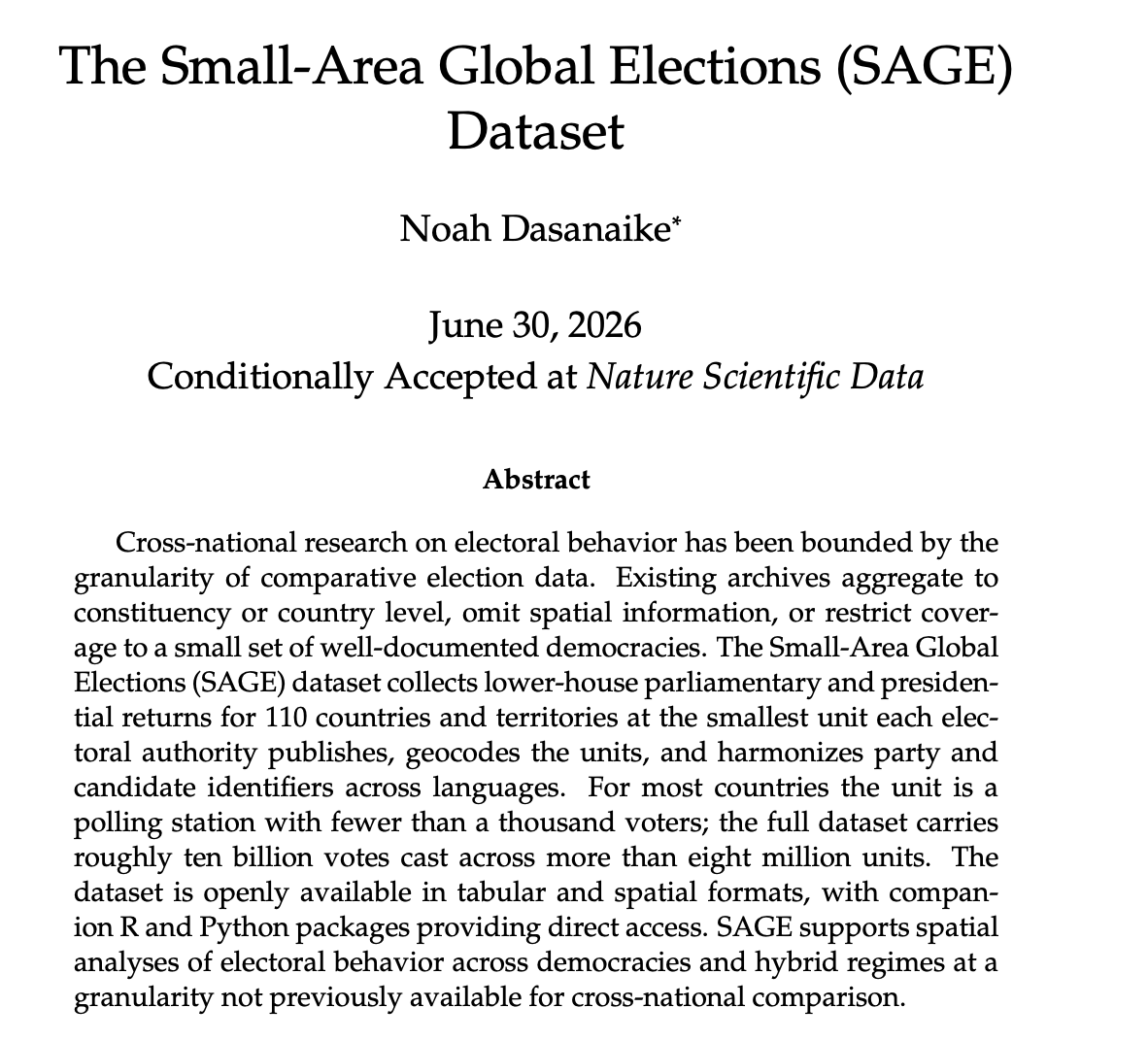
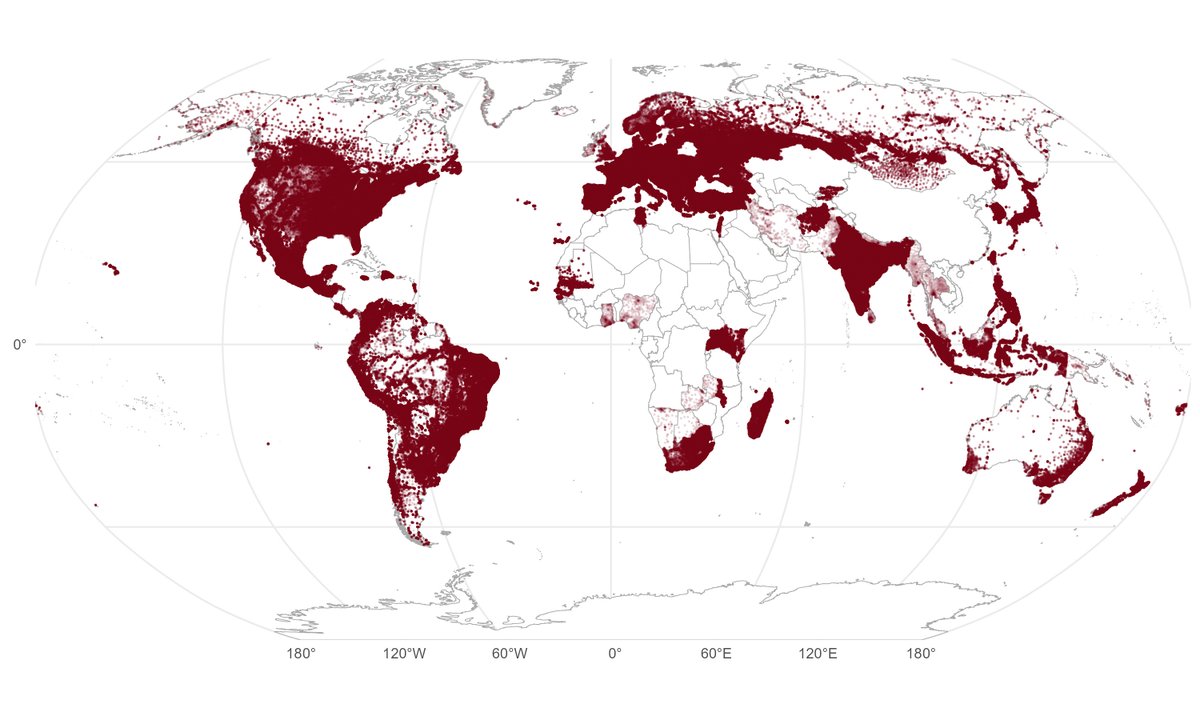
I'm proud to finally announce the first release of the Small-Area Global Elections (SAGE) dataset, encompassing global, granular, standardized, geocoded, polling station or equivalent-level election results for 110 countries, conditionally accepted at Nature Scientific Data. (1/n)
There is a growing divide on the political left and within the Democractic party between liberals and leftists. Leftists see themselves as a distinct and meaningful political identity group that lies outside the liberal-conservative ideology spectrum.
Rather than identifying as more extreme Liberals, Leftistist see themselves as a distinct group, defined by their anti-capitalist ideology, and desire for radical societal change.
This is part of a general moral opposition to the status quo, which negatively predicted support for Joe Biden right before the 2020 election, by committed Leftists but not convenience-sampled Liberals.
There is a lot of speculation on the differences between these groups (some of it accurate, but a lot of it bullshit), but very little research. Here is a fascinating research study on the two groups:
https://t.co/SHIRmiohPg
This is a post about lessons from the World Cup for ethnic integration and patriotism.
When the German footballer Deniz Undav, brought in as a sub in the second half, followed his first goal in the 68thminute, with a second in stoppage time to give his national side a 2-1 win over Ivory Coast, there weren’t many German fans who didn’t see him as the hero, epitomizing the spirit of their national team. Undav, the son of a Turkish-born and Syrian-born Kurdish Yazidi parents, didn’t have the classic German look. No matter. He was delivering an exciting victory to the German side and a glimpse of what makes the beautiful game so exhilarating.
Undav was also offering a rebuke to the obsessions of both the hard right and the hard left. Not just him but the entire German squad was a living demonstration that people of very different origins and appearances can be woven into a shared enterprise that, at its best, becomes a source of collective pride rather than a threat to it; and loving your country and welcoming newcomers into it are not incompatible impulses. The right insists the first half of that sentence is dangerous; the left often flinches at the second.
This isn’t the message from just the German team. The World Cup, played this summer across the United States, Canada, and Mexico, puts ethnically-mixed squads in front of billions of fans. Every serious contender in the tournament is fielding players whose families arrived a generation or two ago. And almost every one of them is generating a joyful patriotism shared by their team and supporters alike. The combination of diversity and pride, together, is precisely what the political extremes insist is impossible.
Consider the right first. Across much of the industrialized world, mainstream politics has become consumed by anxiety over the immigration of culturally and ethnically different peoples – and the supposed discord it brings. Ideas once confined to the darker corners of the internet, from the “Great Replacement” to “remigration,” are now aired and debated in respectable forums. In a recent YouGov poll, 45% of Brits, 50% of Danes, 51% of the French, 53% of Germans, 51% of Italians, 52% of Poles, and 46% of Spaniards expressed support for a scenario in which immigration stopped and many recent migrants departed. To be clear, the harshest version of such an agenda, which involves forced expulsion (sometimes bordering a modern version of ethnic cleansing) commands little support, and survey wording may be inflating softer concerns. But even allowing for those caveats, this is a striking reversal from less than a decade ago, when many of the same publics welcomed those fleeing war in the Middle East.
The left has traveled in a different but still troubling direction. Among some activists and philosophers, the world came to be read almost entirely through the lens of oppressor-oppressed dynamics, with Western nations placed firmly in the former camp. Patriotism – which at its best allows one to identify with the customs and history of one’s country while remaining free to criticize its failings – came to be viewed with suspicion, even disdain. The shift shows up in the data: the share of US Democrats reporting “extreme pride” in being American, according to Gallup, fell from the mid-60s in the early 2000s to just 22% in 2019 (even if it recovered somewhat since then).
That last figure deserves a caveat. Much of the collapse coincided with a presidency many Democrats sharply disagreed with, so some of it may reflect disaffection with who governed rather than a principled rejection of country. But the deeper trend is real: on parts of the left, the very vocabulary of national pride has become an embarrassment. This is troubling because without a shared identity it becomes harder for national politics to coalesce around policies that will watch out for and support those who are losing out – as the working classes, especially those without four-year college degrees, have been over the last several decades throughout the industrialized world.
Sport, of course, is not a perfect mirror of society. A national squad is a small, lavishly resourced, intensely managed group united by a single unambiguous goal-– hardly the same as integrating large populations into housing, schools, and labor markets. Nor is sporting integration as frictionless as the cheering suggests. England’s Black players were deluged with racist abuse after losing the Euro 2020 final; France’s “Bleus” are perennially dragged into arguments about who counts as truly French; and the US has an ugly history of racism not just in baseball but throughout many sports. Integration in sport is celebrated by the many and contested by a loud minority – exactly the pattern we see in the wider society.
The World Cup does not prove that integration is easy. What it nonetheless shows is something the extremes deny categorically: ethnic integration (rejected as impossible or even undesirable by the hard right) and patriotic pride (often looked down upon by the progressive left) routinely coexist. Most fans, watching their multi-ethnic team carry the national flag, simply experience both at once and think nothing of it.
If the hard right and the hard left could climb down from their high horses long enough to watch a few matches, they might rediscover what the rest of us already know: that integration and pride are not enemies. As on the pitch, they can be teammates.
One of the most important articles we've published. What it argues is that modern capitalism and industrialisation happened because the Glorious Revolution overturned centuries of 'vetocracy'.
• Farmland that had been kept as separate strips, dating back to the medieval open field system, could be consolidated and enclosed for the first time.
• Rules that required the consent of heirs to sell and improve land were overturned.
• Road, river and canal owners were enabled to form corporations and charge tolls if they invested in their infrastructure.
Put together, these made it vastly easier and more rewarding to invest in the land and transport goods from place to place.
And Ben's biggest insight is that this happened by buying in the landowners themselves. European countries with absolute monarchs tried to do this again and again and failed. It was only in England, where via Parliament the landowners could ensure that they benefitted from these reforms, that they actually happened.
The lesson: crushing the NIMBYs today could be as valuable as it was in 18th Century Britain. But doing so might need to take the same form of ensuring that they benefit from the changes too. Absolutism basically just doesn't work; well-designed democracy can.
Why do arguments often change people’s beliefs without changing their attitudes? In a new APSR with @PatrickPLiu and Scott Clifford, we point to belief relevance: arguments are more persuasive when they grapple with the idiosyncratic reasons people hold their political views.
Do you want to do a psychology experiment while following best practices in open science? My collaborators and I have created Experimentology, a new open web textbook (to be published by MIT Press but free online forever).
https://t.co/mNw33SXfqh
Some highlights! 🧵
Some people point out that Europe's hate of AC kills old people prematurely - fair. It's also idiotic even on climate grounds as hot days are sunny and hence, PV is abundant. One neglected issue is cognitive performance. There is good quasi-experimental evidence now that higher
Maybe AI could also be useful in the opposite direction: helping check whether references actually support the claims they’re attached to. A kind of citation-level replication: does this source substantively support the point, or idoing more ornamental / field-signaling work?
YES PLEASE MORE GATEKEEPING
Because what academia really needs is not less precarity, less patronage, or fewer status cartels but a formal mechanism for revoking people’s right to participate when the already-powerful disapprove 🫠
@CTMathewes Agreed, but I’m not sure AI adds a fundamentally new problem here. In the non-AI counterfactual, this would likely just be several instances of inappropriate or irrelevant references to pieces the author probably never read. AI mostly exposes a much more general academic vice.
YES PLEASE MORE GATEKEEPING
Because what academia really needs is not less precarity, less patronage, or fewer status cartels but a formal mechanism for revoking people’s right to participate when the already-powerful disapprove 🫠
This is, perversely, good news for Britain, Australia, Japan, Europe, and other countries being cut off that would once have seen themselves as close allies of the United States.
It shows us what the future may hold if AI is the strategically and economically decisive technology of the 21st century and is controlled by the US and China. It is good news because *it may be happening early enough to give us time to act.*
I think this will be rescinded pretty soon, but it’s a sign of things to come. In a future where frontier models cannot be used outside the US, our industries and economies will fall behind and American businesses may not be able to operate overseas. We won’t be able to defend ourselves militarily with defence systems built on obsolete software. Europe 2031 is a good scenario of what a future like this could mean: https://t.co/AMc5LrFJeS
Some of the things we need to do are ‘no regrets’ measures we should do anyway. But some are genuinely costly and risky.
We need cheap electricity – powered by gas, coal (this is costly, coal is very bad), deregulated nuclear fission – whatever can provide *cheap, reliable, 24/7* power. This almost certainly excludes wind power, which is enormously expensive and unreliable. We need projects to be able to connect to the grid in days rather than years by paying for fast-track connections.
We need to make it incredibly easy to build data centres, with the property taxes retained locally and hypothecated for local tax cuts so there is some direct benefit for locals. This doesn’t need to be nationwide.
We need to create new regulatory regimes for innovative businesses that give them the right to hire and fire staff with ease. The difficulty and cost of firing staff is one of the main reasons Europe has fallen behind so badly. We need to create a parallel employment regime that companies and workers can opt in to: https://t.co/YaNOXK1Po2
Even though I think it will probably fail, I think we should probably try to create a good, non-American frontier AI lab. I am quite pessimistic about this – even extremely well-resourced, innovative software companies are struggling to do this. But the stakes are so high that not trying seems foolish.
One thing that might work in our favour is the number of brilliant AI engineers who are not US citizens, who under the current export controls do not have access to Mythos/Fable even if they live and work in the US. What happens to Demis Hassabis, Ilya Sutskever, Andrej Karpathy, and the many other Europeans, Canadians, etc who are working on AI models in Britain and America who are affected by this?
I do not think we should force our own companies to use model, because this would exacerbate their economic weakness – this lab should have to compete on an even playing field. I am deeply sceptical that this can work, but we cannot rule it out. If we do it, it has to be able to pay US salaries, operate without political constraints. https://t.co/Um05rUF4Vq
It is cope to tell yourself that Trump is an aberration or that these export controls are a one-off. To repeat, I think these specific controls will be lifted quickly and it will be easy to move on and forget it happened. But this is a look into a potential future. Every one of us that is not a US citizen is at risk. The standard political divides do not apply here; the question is whether you grasp the enormity of AI as a technology. We have to act!
AAUP is such a pernicious organization. All it does is mobilize to promote and protect the majority opinions of faculty. It's a populist organization. Asking to rescind a report also shows they prefer censorship to speech.