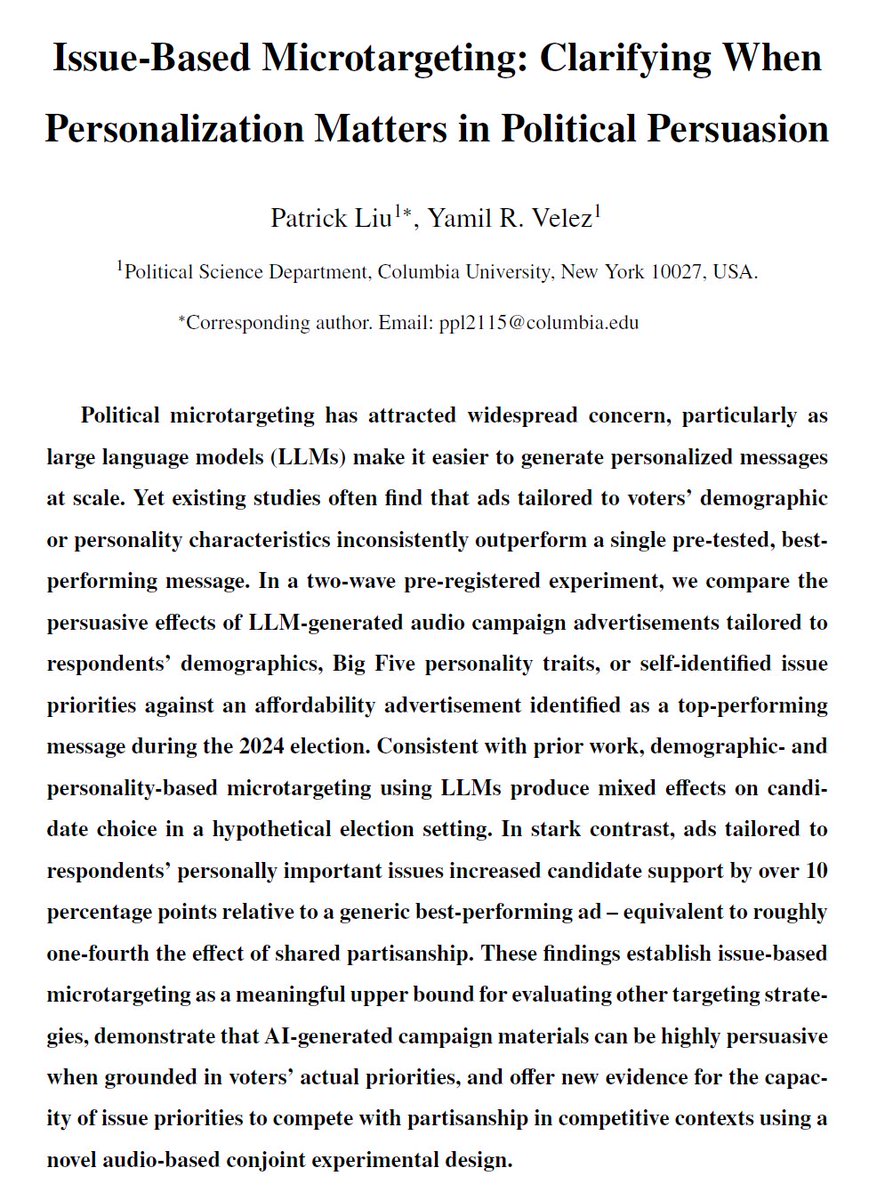
New paper w/ @YamilRVelez! A lot of great research on political microtargeting discounts personalization: tailored ads (using AI or not) rarely beat a single-best message. We define two types of microtargeting, clarify when tailoring matters, & showcase a novel audio-based design
2. Though elites rarely buck their party, candidates with counter-stereotypical or ambiguous platforms on an issue that matters deeply to opposing party voters may gain from targeted appeals. (The 2016 Trump campaign supposedly sought to do just this.)
1/ Will voters participate in the primary of a party they oppose to prevent the nomination of a candidate they fear?
In a new paper in AJPS with @HayleyCohen, we study crossover voting using surveys and a large field experiment (N=83,902) in the 2024 New Hampshire Republican presidential primary.
https://t.co/9QjZGpgyeM
After years of doubt, drafts, and disbelief, my first—and likely last—book is finally out. It’s about how entertainment media shapes American politics.
If you preorder (https://t.co/HNJ6t4nprG), I’d love to send a small token of thanks: https://t.co/Hz5BeJaRhk
Our study draws renewed attention to the distinction between beliefs and attitudes. It also showcases how LLMs can be used to peer into belief systems. We welcome any and all feedback!
🧵 Why do facts often change beliefs but not attitudes?
In a new WP with @YamilRVelez and Scott Clifford, we caution against interpreting this as rigidity or motivated reasoning. Often, the beliefs *relevant* to people's attitudes are not what researchers expect.
Across 2 studies, focal+distal counterarguments reduced focal+distal belief strength (respectively). But focal args had larger and more durable effects on downstream attitudes. We explore mechanisms in the paper, e.g., ppl recalled focal args better than distal args a week later.