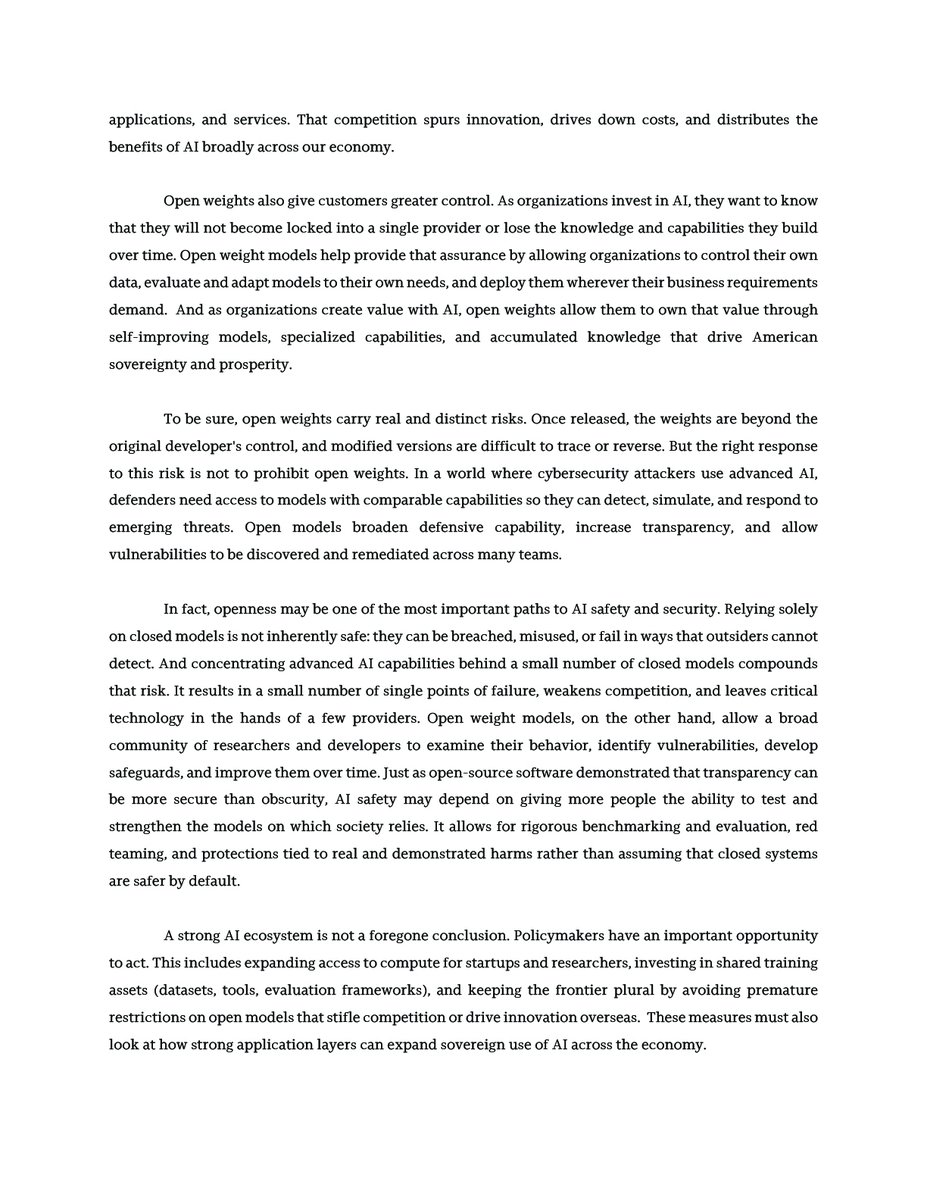
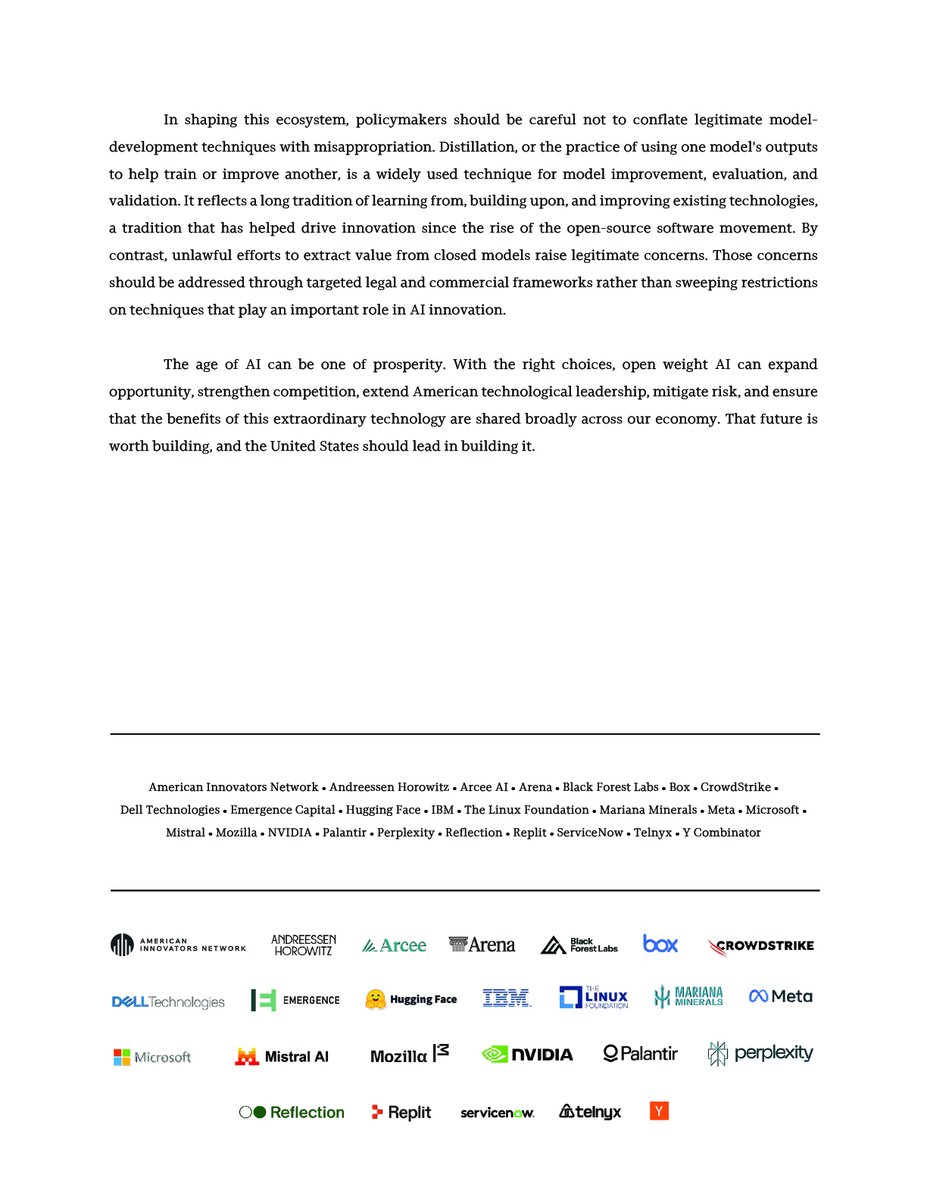
Open-weight models are essential to a healthy AI ecosystem. Together with others across our industry, we are outlining a path for open-weight models to strengthen American competitiveness and expand economic opportunity, while protecting national security. https://t.co/Tr0sAzAxTD
For my first post, I’m sharing a letter @NVIDIA signed on why open models matter.
AI will transform every industry, power every company, and be built by every country.
Open models strengthen safety and cybersecurity, accelerate innovation and diffusion, and enable sovereignty.
The world needs both frontier closed models and frontier open models.
https://t.co/AUKzoQ5Ikb
Kimi CEO Zhilin Yang:
"Claude didn't win on reasoning - they bet everything on agents
but the layer everyone skips - a great agent needs a great base model, that's all we do at Kimi 3 "
in 90-min workshop he explains why the smartest agent still fails - if you can't configure it correctly
his one big idea: most people are still solving the old one
"the real goal? we want K2 to help build K3 - without agent skills, that's impossible"
watch & bookmark - then learn the article on best agent system ↓
BREAKING: Iran officially and formally exits the Islamabad Memorandum of Understanding with the United States, with Iran’s Deputy Foreign Minister Gharibabadi saying, effective immediately, Iran is suspending all commitments and will not implement any of them after the US “violated and suspended all of its commitments” first, and is now purely focused on defending the country, per Tasnim.
Gharibabadi says Iran will “never start negotiations with the US under any circumstances.”
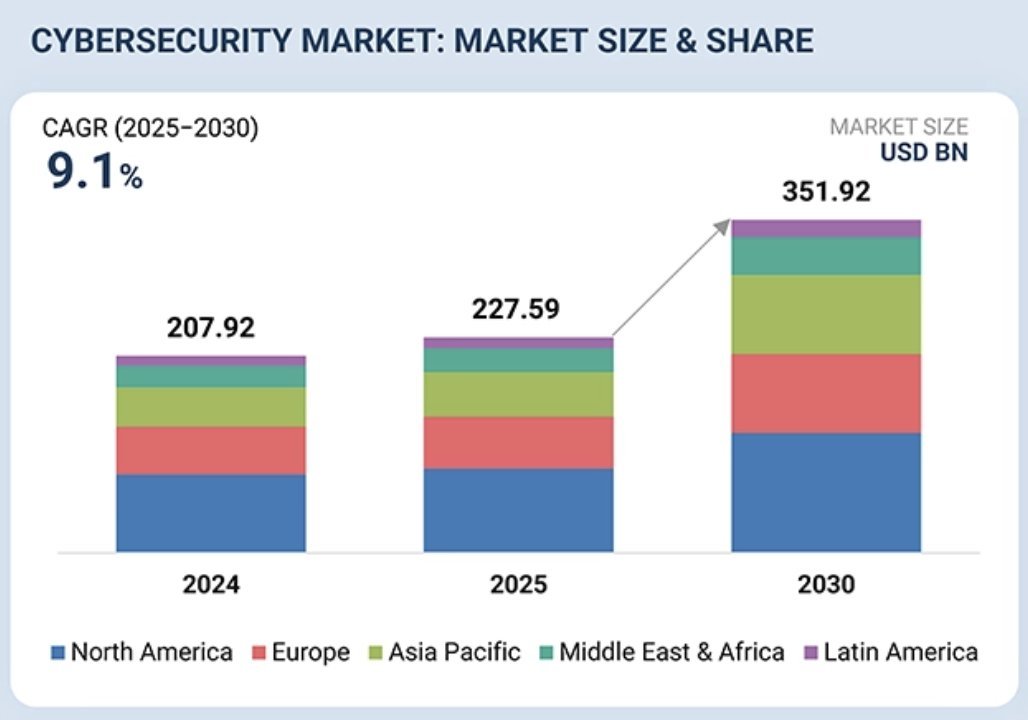
AI is driving a historic boom in the cybersecurity market.
Generative AI has dramatically lowered the barrier to launching sophisticated cyberattacks.
As a result, global cybersecurity market is now expected to exceed $350 billion by 2030.
This implies a 9.1% compound annual growth rate (CAGR) from 2025 through 2030.
Furthermore, the healthcare, financial services, and insurance sectors are experiencing the fastest growth in cybersecurity spending due to a rise in ransomware attacks.
This has prompted heavy capital deployment in the industry, including Google’s $32 billion acquisition of Wiz and ServiceNow's $7.8 billion purchase of Armis.
In the new era of AI, cybersecurity has become a top priority for corporations.
“Loop engineering” is a hot buzzphrase after mentions of it by Boris Cherny (Claude Code’s creator) and Peter Steinberger (OpenClaw's creator) went viral on social media. Loops are now a key part of how we get AI agents to iterate at length to build software. In this letter, I’d like to share my 3 key loops, shown in the image below, for building 0-to-1 products. These loops guide not just how I build software, but also how I decide what software to build.
Agentic coding loop: Given a product specification and optionally a set of evals (that is, a dataset against which to measure performance), we can have an AI agent write code, test its work, and keep iterating until the code is bug-free and meets its specification. This idea of closing the loop took off around the end of last year, and it has been a game changer in enabling coding agents to work longer productively without human intervention. For example, over the weekend, I was building an app for my daughter to practice typing, and my coding agent could easily work for around an hour, using a web browser to check what it had built multiple times before getting back to me, without needing my intervention.
The engineering loop executes quickly. Every few minutes, the coding agent might build and test a new version of the software. I hear frequently from developers who are finding new ways to engineer more effective engineering loops. This is an active area of invention!
Developer feedback loop: In this loop, a developer examines the current product and steers the coding agent to improve it. Last year, a lot of developers (including me) were acting as the QA (quality assurance) function for our coding agents, manually finding bugs and then asking the agent to fix them. But with coding agents much more able to test their own code, the amount of time we need to spend on this function has decreased significantly. This allows us to make higher-level product decisions, such as what key features to offer, where the UI needs improvement, and so on.
The developer-feedback loop operates over time intervals between tens of minutes and hours — that's how frequently a developer might review a product and give feedback. In the case of the typing app, I changed my mind a few times about the visual design, what cat costumes she can unlock as she learns (she loves cats), and the user flow for a grown-up to log in and steer the child's learning experience.
When a developer has a clear vision for what to build, it is still a lot of work to translate that vision into a specification for a coding agent to implement. Further, after the developer has seen an implementation, they might update (or perhaps clarify) the spec to steer it toward what they want. If you find that the system repeatedly runs into certain problems, building a set of evals for the agent becomes useful.
AI-native teams are increasingly using AI to help shape product direction, for example, automating the gathering and analysis of usage data, summarizing written and verbal customer feedback, or carrying out competitive analysis. However, for pretty much all the products I’m involved in, I see humans as having a significant context advantage over current AI systems — we know a lot more than the AI system about the users and the context the product has to operate in — and thus humans play a critical role. Many people describe this human contribution as “taste,” but I prefer to think of it as humans having a context advantage, since that gives us a clearer path to helping AI systems get better. This also speaks to why this step can’t be automated: So long as the human knows something the AI does not, human-in-the-loop is needed to to inject that knowledge into the system.
External feedback loop: This includes a wide range of tactics like asking a few friends for feedback, launching to alpha testers, or putting the code into production with A/B testing. These tactics are usually slow, rarely taking less than hours and sometimes taking days or even weeks. This data informs the developer vision, which in turn continues to drive the detailed product spec, which in turn drives the coding agent.
With coding agents speeding up software development, more engineers are starting to play a partial product management role. For many engineers who are growing into this role, the hardest part is shaping the product vision and striking a balance between building (bridging the gap between vision and spec) and getting user feedback to evolve the vision. It is important to do both!
I will write more about how to do this in future posts, but for now, I find it encouraging that engineers are playing an expanded role (just as product managers and designers now do more engineering).
[Original text: The Batch]
My friend makes $1.5 million a year as a Two Sigma quant researcher.
I asked him how he generates alpha using ML.
He sent me a video that was never supposed to get out. Their core team's full ML playbook.
You won't find anything better about ML for quants than this video.
I watched it last night.
Halfway through, I realized I could build a machine that prints alpha like hedge funds.
Bookmark and watch this before someone takes it down.
My friend makes $1.2 million a year as an Anthropic engineer.
I asked him how he learned prompting so well.
He sent me a video that was never supposed to get out. Their core team's prompting playbook.
You won’t find anything better about prompting than this video.
I watched it last night.
Halfway through, I realized I've been using Claude completely wrong for two years.
Watch it, then read the article below.
Ex-Google engineer explained AI agent loops, harness, evals in 20 minutes - better than 500$ courses.
trace every run → judge it with an LLM → diagnose → fix → ship.
That loop is how agents self-improve over time.
Agent loops + memory + harness + evals - thats the stack.
Watch it, then save the framework below.
If you’re looking for a long setup for call leaps or commons after this quarter end malaise wraps up the three strongest stocks of the MAG7 (daily chart) in order are as follows:
GOOG
AAPL
NVDA
All the rest are below their 200 DMA. No thanks. I’m going with GOOG.
$TEM $PLTR Why "The Palantir of Healthcare" Undersells Tempus: A Colossus in the Making
The "Palantir of healthcare" tag is a fair starting point and a ceiling the business has already cleared. Palantir built the integration and ontology layer for enterprise and government data, then deployed it as the decision system on top of information its customers already owned. Tempus does that inside healthcare and adds three layers Palantir does not have: 1) It manufactures the underlying data, 2) it owns the distribution rails that carry the insight back to the decision-maker, and 3) it runs frontier-scale compute to model the data itself. The honest description is that Tempus AI is a health care COLOSSUS in the making that fuses a data factory, a cloud provider, a foundation-model lab, and a clinical distribution network into one company.
The doctrine Lefkofsky constantly articulates is the spine. Durable AI businesses require two things, "vast amounts of proprietary data to build models" and "a distribution system to take those insights and deliver them to the hands of physicians and patients." His summary: "Tempus is unique in that it has both." He sharpens it into a warning that the model builders "all become largely commoditized within 6 to 12 months," while value accrues to whoever owns the data and "the distribution of the insight back to the client." Palantir lives on the distribution and integration half. Tempus owns both halves and the factory feeding them.
The factory is what the comparison misses. The data set runs more than 500 petabytes across over 45 million patients, with more than 9 million images, over 4.5 million sequenced samples, and more than 400,000 deep multimodal records that combine DNA, RNA, imaging, clinical notes, outcomes, and adverse-event data on the same patient. The footprint underneath is roughly 5,500 connected institutions and about two-thirds of all US academic medical centers, and Tempus is the largest sequencer across the National Cancer Institute (NCI) designated centers.
When the American Society of Clinical Oncology (ASCO) chose a partner to abstract cancer data at scale, Tempus was one of two. The generation rate is simply an astonishing number. Eli Lilly was touting 700 terabytes of data "collected over the past century," and Lefkovsky's retort was "I think we generate 700 terabytes of data every 12 hours." Tempus adds 20 to 30 petabytes a month and purges data because the storage cost is too extreme to keep all of it. Palantir does not generate proprietary data of this kind. It organizes what a client brings.
The distribution moat is the harder one to copy. Building it is "like mowing 3,000 lawns," the years of legal work, business associate agreements, and information-technology integration sitting behind thousands of hospital connections, and "the people that want to do what we do will have to in some way, shape or form, build all those connections." The stack riding those rails is its own fortress, and it helps to define the pieces.
Epic is the electronic health record (EHR) system most large US hospitals run on, the system of record for a patient's chart. Edge is the Tempus server that reaches past the EHR to pull in data the chart never holds: computed tomography scans and other medical imaging files (DICOM), digitized pathology slides, and the separate wave files a 12-lead electrocardiogram (ECG) produces. Edge structures all of it. Air is the platform that pushes the finished insight back to the physician inside Epic or whatever EHR they run. Locker is the security and protection layer that lets a provider open its data to Tempus "without it losing security and protection of that data." The relationship this produces becomes a triad, "patient to technology to physician," and the design goal is to "make good doctors great doctors, and great doctors superhuman."
This is the architecture behind one of his most aggressive claims, that the frontier model labs $GOOG, Anthropic, OpenAI, $SPCX via xAI, do not threaten Tempus and resolve into its customers. The general-purpose systems "were not trained on health care data, they were trained on Internet data," so they cannot natively handle raw sequencing files (BAM) or DICOM imaging.
Lefkovsky's conclusion: "even if big pharma wanted to build these models, or the big foundation model people wanted to build these models, they're going to have to come to somebody like Tempus that has this kind of unrestricted data."
The compute underwriting it is the part that should stop a skeptic. Tempus's capacity is "probably equal to all of pharma combined," including a GB200 cluster roughly four times the size of the 1,008 H200s running the foundation model built with AstraZeneca and Pathos, a model Tempus funded with about $200 million while $AZN AstraZeneca provided the majority. That model already cleared AstraZeneca's bar, hitting a survival-prediction benchmark (the C-index, a concordance metric) on both a public trial and a private trial that AstraZeneca's own tuned internal model had been trained on. The validation arrived without prompting when the chief executives of Merck and AstraZeneca each named Tempus as strategic to their AI initiatives within ten days, "one in an earnings report and one on CNBC," which "doesn't happen" in big pharma.
The customer roster reads like the field. Tempus works with 19 of the 20 largest pharmaceutical companies and more than 250 biotechs. AstraZeneca signed the first strategic partnership in 2021 and now funds the foundation model. $GSK came on as another large partner, $MRK Merck signed strategically and "is just starting to grow and prosper in every which direction," and expanded collaborations with Merck, Gilead, and Bristol Myers Squibb were announced over recent months. On the deployment side, Northwestern is the reference account, where Tempus spent years "building pipes" and now runs its ECG platform at scale (not to mention USC, Yale, and many other prestigious medical centers).
Demand has inverted the usual sales motion. The just-in-time trial network "has too many people that want in," with a waiting list, to the point where Tempus tells pharma "it's too many" and turns trials away. His framing of why pharma cannot opt out: "I can't be blindsided when I have a $1 billion franchise or a $5 billion franchise that unravels on me at the last minute." The summary line on the moat is the one to sit with: "Our data business is big and growing, and we have almost no competition," echoed by his data chief, "we don't see any competitors in our space."
The endgame is where the bull case gets even more bullish. "There will come a time when no Phase IIIs ever fail, and some company like Tempus will be responsible for that." The logic is that a large trial fails for one of two reasons, a misunderstood mechanism or a Phase II signal that does not reproduce, and real-world data at scale addresses both. Customers have already measured returns on investment in the 30 to 50 times range on single immunotherapy projects and net present values north of $500 million on individual go or no-go decisions.
The platform increasingly sells models rather than raw files, to the point where "it's rare that people just want our data," and one live deal involves "just licensing embeddings" with no files moving at all. On the diagnostic side his conviction is total: "I'm 100% convinced that old world of targeted therapy will die and this new world of precision medicine will show up." The algorithmic layer he expects to become "probably the largest of all of our businesses by far," where a single ECG algorithm could become a one-billion to two-billion-dollar product, and where "even if you spend $1 billion generating an algorithmic insight, you're likely going to save the U.S. health care system $50 billion or $100 billion of mistake."
The financials confirm the compounding. More than $2 billion in data licensing signed, 126% net revenue retention for 2025, more than $1.1 billion in total contract value, and roughly $87 million in data revenue last quarter growing faster than the company average. The customer base widened from 35 companies in 2020 to about 240 in 2025, and top-five concentration fell from 85% to 59%. The tumor-only FDA approval announced the morning of Investor Day brought essentially the entire DNA portfolio under Advanced Diagnostic Laboratory Test pricing, an estimated $75 million to $100 million of revenue at little incremental cost.
The clearest read on the embedded value is how Lefkofsky talks about it. "If we took our data business public under normal terms, it would probably be worth significantly more than Tempus in totality," and possibly at twice that, which implies the diagnostics business is being assigned close to negative value inside the current price. He blames an investor base where "the diagnostic investors hate the technology and data business they don't understand and the technology investors hate the diagnostic business." His starkest measure of the asset is the trade he says he could make today: walk into any sub-billion-dollar oncology biotech, offer data access for 20% of the company, and "almost every one of them would be like great."
Put it together. Tempus generates the molecular substrate of disease at petabytes a month, harmonizes it into the deepest multimodal records in the field, models it on compute rivaling all of pharma, and ships the answer back through rails into 5,500 hospitals that took a decade to lay. It is going after the largest pool in a $6 trillion system, which he identifies as "error and waste." Palantir built one layer of that stack brilliantly. Tempus is building the entire stack, and the layers it owns that Palantir never will are the data factory, the distribution network, and the compute. That is what a company outgrowing its own comparison looks like.
The deeper point is that the Palantir comparison does not go far enough. Palantir is a reference for how powerful a data and software moat can become inside a single company. Tempus is building something the market does not yet have a category for, the core infrastructure layer of precision medicine, generating the data, modeling it on frontier compute, and distributing the answer across the entire clinical and pharmaceutical system at once. Companies that define a new category and own its foundational asset do not stay mid-cap. They become titans. I expect Tempus to grow into a megacap in healthcare, and I expect the rerate to be dramatic once the market resolves the two-business confusion and prices the data engine for what it is. We are still in the first inning of the ball game. Re-ratings of that kind reward the investors who sized early and waited, and they tend to arrive faster and steeper than the models call for. That asymmetry is the reason Tempus is one of the largest and still increasing positions in my portfolio.
(This analysis is drawn from Eric Lefkofsky across three recent appearances: the May 29 Investor Day, the June 8 Goldman Sachs healthcare conference, and the February 23 Heart of Healthcare podcast. The quotes are his.)
CHINESE GIRL WITH CLAUDE 5.0 JUST DROPPED THE FULL 31-MIN TRADING BOT BUILD GUIDE
(Build Apps & Automations)
bookmark it and watch when you've got 31 quiet minutes, you will forget what losing manual trades are forever.
Thanks @tomkeene. So why did Rockefeller stop vertically integrating at the gas pump and never build the car? I knew you would come back on this...
Rockefeller followed one rule: never put a dollar where you're a price-taker. Only own the bottleneck where you set the price. It's the same rule the hyperscalers are breaking.
He stopped integrating beyond the pump, as owning Detroit would have meant pouring capital into a competitive, capital-intensive, price-taking manufacturing business. Gasoline and cars are complements, not substitutes, and you want your complement industry fragmented and competitive. Cheap, abundant cars from Ford and GM meant more fuel sold at higher margin.
The artificial muscle (AM) revolution was ultimately about oil, not the cars planes and trucks that did the heavy lifting. Decades ago, Buffet called them the worst kinds of businesses: ones that grow fast, devour capital and earn little on it. He said if he would have been at Kitty Hawk he would have shot Orville down because "Karl Marx couldn't have done as much damage to capitalists as Orville did." This is exactly the charge now being levelled at the hyperscalers: rapid growth, insatiable demand for capital, and returns that don't clear the cost of it.
But the key here is that Rockefeller wanted the cheap abundant trains, planes and automobiles as he controlled the choke point. The ability to turn crude into gasoline, diesel and aviation fuels.
Similarly, the AI revolution will likely be about atoms, not bits, as that’s where the choke point ultimately is. Chips, turbines, transformers – hence critical minerals. In the new AI race the actual chokepoint has moved off bits entirely, onto atoms: silicon, where Nvidia sets the price, and the commodity complex underneath it: copper, steel, gas, uranium, the metals and molecules.
With the exception Google’s TPU, they own very little of this. Think of Google with its TPU as the Gulf Oil/Mellons that became Chevron.
So who is the Standard Oil of the AI story: Its Nvidia. Both with c.85% market share. I am sure Jensen keeps a copy of Dan Yergin's The Prize for nighttime reading as he has played it to the tee.
But unlike Standard Oil, Nvidia doesn’t control its crude supply. It has TSMC and ASML to contend with. So what does the AM revolution tell you about what could happen to Nvidia, TSMC and ASML in the AI revolution?







![AndrewYNg's tweet photo. “Loop engineering” is a hot buzzphrase after mentions of it by Boris Cherny (Claude Code’s creator) and Peter Steinberger (OpenClaw's creator) went viral on social media. Loops are now a key part of how we get AI agents to iterate at length to build software. In this letter, I’d like to share my 3 key loops, shown in the image below, for building 0-to-1 products. These loops guide not just how I build software, but also how I decide what software to build.
Agentic coding loop: Given a product specification and optionally a set of evals (that is, a dataset against which to measure performance), we can have an AI agent write code, test its work, and keep iterating until the code is bug-free and meets its specification. This idea of closing the loop took off around the end of last year, and it has been a game changer in enabling coding agents to work longer productively without human intervention. For example, over the weekend, I was building an app for my daughter to practice typing, and my coding agent could easily work for around an hour, using a web browser to check what it had built multiple times before getting back to me, without needing my intervention.
The engineering loop executes quickly. Every few minutes, the coding agent might build and test a new version of the software. I hear frequently from developers who are finding new ways to engineer more effective engineering loops. This is an active area of invention!
Developer feedback loop: In this loop, a developer examines the current product and steers the coding agent to improve it. Last year, a lot of developers (including me) were acting as the QA (quality assurance) function for our coding agents, manually finding bugs and then asking the agent to fix them. But with coding agents much more able to test their own code, the amount of time we need to spend on this function has decreased significantly. This allows us to make higher-level product decisions, such as what key features to offer, where the UI needs improvement, and so on.
The developer-feedback loop operates over time intervals between tens of minutes and hours — that's how frequently a developer might review a product and give feedback. In the case of the typing app, I changed my mind a few times about the visual design, what cat costumes she can unlock as she learns (she loves cats), and the user flow for a grown-up to log in and steer the child's learning experience.
When a developer has a clear vision for what to build, it is still a lot of work to translate that vision into a specification for a coding agent to implement. Further, after the developer has seen an implementation, they might update (or perhaps clarify) the spec to steer it toward what they want. If you find that the system repeatedly runs into certain problems, building a set of evals for the agent becomes useful.
AI-native teams are increasingly using AI to help shape product direction, for example, automating the gathering and analysis of usage data, summarizing written and verbal customer feedback, or carrying out competitive analysis. However, for pretty much all the products I’m involved in, I see humans as having a significant context advantage over current AI systems — we know a lot more than the AI system about the users and the context the product has to operate in — and thus humans play a critical role. Many people describe this human contribution as “taste,” but I prefer to think of it as humans having a context advantage, since that gives us a clearer path to helping AI systems get better. This also speaks to why this step can’t be automated: So long as the human knows something the AI does not, human-in-the-loop is needed to to inject that knowledge into the system.
External feedback loop: This includes a wide range of tactics like asking a few friends for feedback, launching to alpha testers, or putting the code into production with A/B testing. These tactics are usually slow, rarely taking less than hours and sometimes taking days or even weeks. This data informs the developer vision, which in turn continues to drive the detailed product spec, which in turn drives the coding agent.
With coding agents speeding up software development, more engineers are starting to play a partial product management role. For many engineers who are growing into this role, the hardest part is shaping the product vision and striking a balance between building (bridging the gap between vision and spec) and getting user feedback to evolve the vision. It is important to do both!
I will write more about how to do this in future posts, but for now, I find it encouraging that engineers are playing an expanded role (just as product managers and designers now do more engineering).
[Original text: The Batch]](https://pbs.twimg.com/media/HMEtxp3bsAARJdi.jpg)


