PAU has inked pact with Ankur Seeds Pvt. Limited based at Nagpur, Maharashtra for licensing of PAU Armour 1 technology. Dr. AS Dhatt, Director of Research, PAU and Dr. R. K. Gumber from Ankur Seeds signed the Memorandum of Agreement on behalf of their respective organizations.
A recent survey of nearly 900 postdocs at the Max Planck Society reveals:
🔹 28% show signs of severe depression
🔹 25% struggle with severe anxiety
🔹 More than half oppose contract caps that force them out after 4–6 years
🔹 International researchers (75% of the cohort) face extra hurdles: bureaucracy, language barriers, even bullying
Postdocs carry much of the research load, yet remain overworked, undervalued, and uncertain about their future.
If global research institutions can’t retain talent, support mental health, and offer real career pathways, how sustainable is the system?
Link to the Nature article:
https://t.co/8CznV3dWb3
Time to head back to the lab—it’s Monday again. Came across this poem from गुप्त प्रेमपत्र by Prashant Sagar, which I received a few days ago from @Hindi_panktiyan
Sumanlata, 21 and pregnant, last spoke to her husband Shailendra, an auto driver in Gurugram, at 8.19 pm on July 9.
He told her he was dropping off a passenger and would be home soon. Around 9 pm, she called again. He didn’t answer. She kept calling, hundreds of times, but he never picked up.
Hours passed. Anxious, Sumanlata went to their landlord, Babulal, for help, who went to the police to report Shailendra missing.
The next morning, some delivery riders passing by found Shailendra’s body in an open sewer in Sector 47. That night, while trying to navigate a waterlogged street, his auto fell into the open manhole and overturned, throwing him inside.
Shailendra had moved to Gurugram from Kannauj five years ago. Here, he’d built a life in Sector 9, earning a steady income to support his family.
In a civilised country, his wife could sue the municipality for gross negligence and get millions in compensation to secure her and the children’s future, maybe even press for criminal negligence so the careless face jail. But in India, aap ek baal nahi ukhaad sakte, na sarkar ka, na sarkari aadmi ka.
Neelesh Rai (Left)
>26 year old
>Electrocuted to death on waterlogged road in Delhi- July 2024
Akshat Jain (Right)
>25 years old
>Electrocuted on waterlogged road in Gurgaon- July 25
No arrests then. No arrests now.
How long will we keep losing lives to poor infra?
Progress in biology is too slow. Even simple experiments often take several days of work to complete.
Software, by contrast, compiles in seconds. It's what makes programming "flow-inducing."
We need faster feedback loops in biology. Our latest article explains where to start🔻
Fieldwork today: Took data & captured Alternaria symptoms in #Brassica. 📊📸 Ending the day with a shot of an infected leaf against a stunning sunset. 🌿🌅 #Agriculture#Mustard
The spread of agriculture didn’t just change our diets—it altered our jaws as well, making it easy to pronounce "f"s and "v"s and opening a whole new world of words.
Learn more on #WorldAnthropologyDay: https://t.co/8h3uYtgJwg
In one year, I genetically engineered the boring Arabidopsis into a beautiful ornamental flower 🧬🌹
Here is how and why I gave this model organism a visual upgrade 🧵(1/7)
Domestication and engineering of pennycress (Thlaspi arvense L.): challenges and opportunities for sustainable bio-based feedstocks.
Lee, KR., Park, ME. & Kim, H.U. Planta 260, 127 (2024).
🎀https://t.co/kUH7D573or
How India failed its cotton farmers by blocking advances in biotech, putting price control in seeds, & restricting royalties. Its textile industry will have to start importing cotton again. https://t.co/ox01rvwBMH
I've been reading a lot about "plant biosensors" or "plant sentinels" lately, which are crops that have been engineered to sense molecules in the environment (like pesticides or toxins) and then change color in response.
I think they could be incredibly useful for farmers and help stop infections before they spread. Here's how they work...
About two decades ago, Sean Cutler (who I met last weekend at Lake Arrowhead) did seminal work to discover protein receptors that bind to a plant hormone called abscisic acid, or ABA. This plant hormone regulates how plants respond to stress during, say, droughts.
Now, plants sense ABA in a slightly complicated way: First, ABA binds to a protein called PYR1. This forces PYR1 to shift into a different shape, revealing a "binding pocket" that latches onto another protein called HAB1. Over time, this causes HAB1 levels to drop in the cell, which plants use as a signal to activate their stress response.
Okay, so those are the basics. Now how are these proteins actually engineered to sense *new* molecules?
That's the cool bit. Cutler's group at UC Riverside is basically really good at engineering the ligand-binding pocket in the PYR1 protein. They've solved its crystal structure, and they know exactly which amino acids are responsible for grabbing onto the ABA molecules. So in one of their papers (see here: https://t.co/0mABsRfEyl) they randomly mutated these amino acids and then searched for PYR1 mutants that were able to grab onto NEW molecules, rather than just ABA.
And it actually worked.
They found mutated PYR1 proteins that can grab onto lots of different things. Cutler's team has made PYR1 variants, for example, that can grab onto banned organophosphate pesticides, like azinphos-ethyl and diazinon, with nanomolar sensitivity and without grabbing onto ABA (in other words, the *new* proteins are orthogonal to the old ones.
But what about the RESPONSE? When a mutated version of PYR1 grabs onto a pesticide, how does that trigger the plant to physically change color?
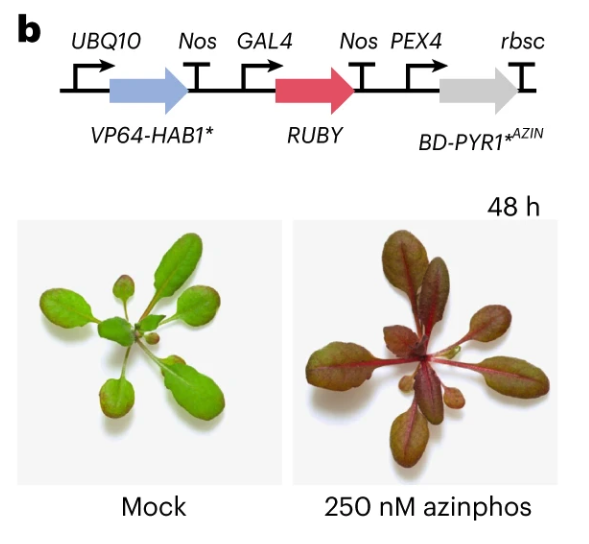
That's where the "synthetic biology" comes in. When the engineered PYR1 binds to the target molecule, it then grabs onto a MODIFIED VERSION of HAB1 (called HAB1*, and which is also orthogonal to the normal HAB1), which in turn activates genes of the scientists' choosing. For example, Cutler's team can encode the betalain biosynthesis pathway into these plants --- the same genes that give beets their dark red color --- and have the plants make those pigments after sensing a desired molecule. They've basically built orthogonal, programmable biosensors inside of plants.
So here's the breakdown:
- Engineer PYR1 to detect new molecules. The sky is the limit; this could be toxins, molecules associated with soil nutrient levels, pathogen proteins, and much more.
- Rewire the genetic output so that PYR1, when activated, triggers the production of red pigments or something else (and not drought response.)
- The plants change color when they sense the target molecules.
Hopefully there will be field trials for these plant biosensors soon. Regulations will obviously slow this work down, but the good news here is that farmers could plant JUST A FEW of these "plant biosensors" among the tens of thousands of plants in their fields. And these biosensors would not be sold as food! They could just act as sensors, and be discarded at the end of every growing season.
Thanks for reading!