A thread.
Search compresses good writing. AI rewrites it. Masthead cites it.
The premise · a concierge for readers, drawing from a curated archive of independent publishers. A composed dossier in three voices — body, pull, pencil. Every citation attributed.
1/
I agree that @mars_protocol is essential not only to @neutron_org & @osmosis but also @cosmos in general, without it #defi is pretty much dead on cosmos. It was the only lending platform worth using & the closest to being a killerapp.
This is why some members of $MARS dao & team along with ecosystem founders are actively looking at keeping @mars_protocol alive & securing its future growth.
Cosmos needs a win & saving MARS would be a huge win for the entire ecosystem.
@Php5Com@neutron_org@amberfi_io It wasn’t a hack. They exploited the low liquidity & looped a transaction a 100x to create bad debt for the protocol. Low liquidity on cosmos in general is a major risk for all platforms as prices can be manipulated.
@AirdropGlideApp There is also $300k in CP vault which should have taken the hit initially. These with safety fund bring the loss down to about 10-15% for the usdc depositors. So think the team is trying to cover the remaining 10-15% loss somehow for most depositors.
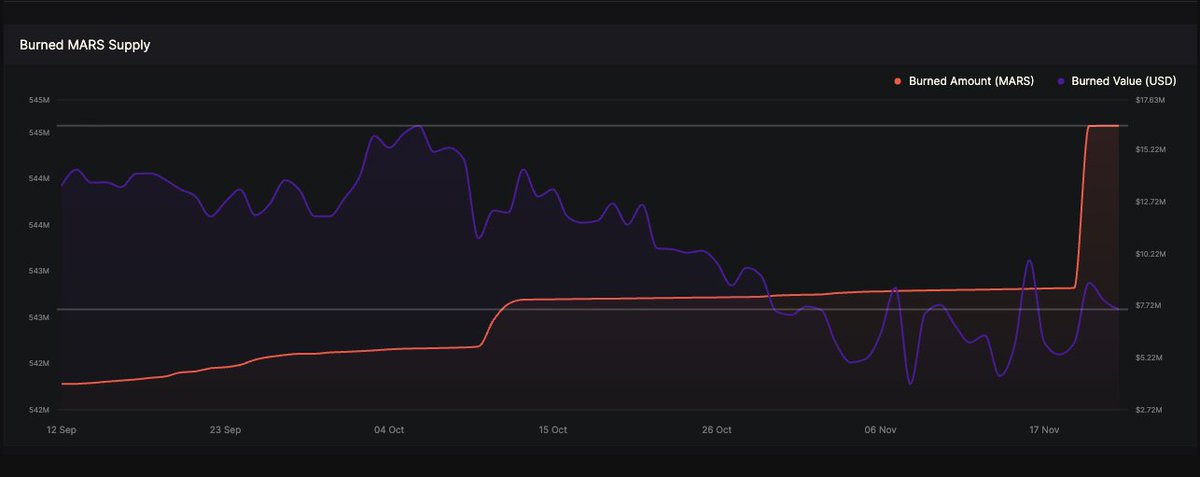
@0xAnhell@mars_protocol but what if this campaign brings in enough users & activity & $MARS buyback & burns are north of 45million in 12 months? I see on chart below they burnt almost 2mill $MARS last week alone that is already 5% of the 45mill🧐
@stabletuna@0xSpaydh BUT it also means going from $250mill to $1bill TVL will be a lot faster than $50-250mill 🧐
Now the question is what happens to $NTRN & ecosystem tokens like $MARS or $ASTRO when you hit $1bill TVL 🚀🔴🔵
We received backlash for the activated circuit breaker mechanism in our protocol during yesterday’s events. However, as someone who has personally witnessed the Terra crash, the FTX collapse, and the Covid market meltdown, it has always been my deep conviction to prioritize the security of user funds over the pursuit of protocol revenue.
The circuit breaker was triggered by a steep, market-wide decline across all major assets, temporarily pausing protocol activity for about an hour and a half. During this time, the market was free-falling but later began to stabilize in a new price range.
During this period, some users, particularly short sellers, expressed frustration that they couldn’t close their perpetual positions at peak profit.
However, thanks to this anti–price manipulation safeguard, we prevented approximately $6 million in user deposits from being liquidated.
I understand that not every protocol operates under the same ethos, and that some might prefer a “profit-first” approach. But I firmly believe that protecting user funds in moments of extreme volatility is more important than enabling opportunistic gains during a market crash.
Yes, we lost users because of this decision. But in a cross-collateralized environment like @mars_protocol, even a single instance of price manipulation can cause catastrophic losses. That’s why I continue to stand by the decision to integrate and maintain the circuit breaker since the adoption of our @PythNetwork oracle.
Going forward, we’ll improve transparency by adding a clear UI indicator whenever the circuit breaker is active. Still, I am not in favor of removing this protection merely to allow individual profits at the expense of broader market stability and user safety.
We received backlash for the activated circuit breaker mechanism in our protocol during yesterday’s events. However, as someone who has personally witnessed the Terra crash, the FTX collapse, and the Covid market meltdown, it has always been my deep conviction to prioritize the security of user funds over the pursuit of protocol revenue.
The circuit breaker was triggered by a steep, market-wide decline across all major assets, temporarily pausing protocol activity for about an hour and a half. During this time, the market was free-falling but later began to stabilize in a new price range.
During this period, some users, particularly short sellers, expressed frustration that they couldn’t close their perpetual positions at peak profit.
However, thanks to this anti–price manipulation safeguard, we prevented approximately $6 million in user deposits from being liquidated.
I understand that not every protocol operates under the same ethos, and that some might prefer a “profit-first” approach. But I firmly believe that protecting user funds in moments of extreme volatility is more important than enabling opportunistic gains during a market crash.
Yes, we lost users because of this decision. But in a cross-collateralized environment like @mars_protocol, even a single instance of price manipulation can cause catastrophic losses. That’s why I continue to stand by the decision to integrate and maintain the circuit breaker since the adoption of our @PythNetwork oracle.
Going forward, we’ll improve transparency by adding a clear UI indicator whenever the circuit breaker is active. Still, I am not in favor of removing this protection merely to allow individual profits at the expense of broader market stability and user safety.