Andrej Karpathy just explained the 5 shifts turning LLMs into agentic systems.
00:00 - Memory turns chat into personal AI
06:41 - Multimodal AI reads the world
16:58 - Thinking models solve harder tasks
24:51 - Search makes LLMs live
30:58 - Tools turn LLMs into workers
Most people are still treating LLMs like chatbots.
Karpathy is showing the full stack:
Memory → Vision → Reasoning → Search → Tools
Prompting is the old workflow.
Agentic systems are the new one.
This 40-minute talk is worth more than most paid AI agent courses.
Bookmark and watch it before everyone catches up.
Then read how to turn LLMs into self-improving agent loops below
I love this! Santander has open-sourced its open-source AI initiatives.
The bank pushed 11 repos, live this week under Apache-2.0 on the code, but the data synthetic or anonymised only.
Quite a moment for a bank this size, putting its AI control layer on the open internet for anyone to fork. This is the bit every bank has to get right.
So what is it?
→ autoguardrails: a scaffold for stress-testing LLM guardrails, jailbreaks included (can we use this LLM?)
→ "mechanical governance" for high-stakes LLM decisions, with hard gates and governance metrics (can we trust an LLM with this decision?)
→ mutatis-mutandis: discrimination testing with counterfactual comparators, straight out of a published paper (very important if you're lending!)
→ stressed-datasets: public benchmarks republished in "stressed" form to probe model robustness in that scenario
→ gen-fraud-graph: a synthetic fraud-graph generator to benchmark fraud detection (really, really cool, need to dig into this one)
→ llm_bridge: a vendor-neutral client for OpenAI, Bedrock and Gemini, so you skip the lock-in (again, how many companies are struggling with this?)
→ ralph: their own spin on the Ralph loop, the run-an-agent-in-a-loop trick from the indie AI crowd
I think I need to write a whole Rant on each of these pieces.
The most important thing for a big regulated actor is "Can you show a decision was safe, fair, auditable, and the same tomorrow as it was today." Santander published its working answer and handed it to everyone, competitors included.
Why give it away?
1. Attract talent - this is a huge signal they've got their AI act together
2. Signal internally - We have these tools, use them
3. Give regulators confidence - Here's how we work, you can audit it
(The board that signs off on releases includes Legal and the CISO. That tells you how seriously they treat it.)
I've watched banks spend years trying to govern AI behind closed doors and ship nothing. Doing it in the open, with a contributor agreement and a proper open-source office, is a faster route to getting it right.
The banks that pull ahead from here will be the ones who can prove their AI works.
@bancosantander just open-sourced a head start.
Repo is here. 👇
https://t.co/IilShwzvl2
Nemotron‑Personas‑El‑Salvador just climbed into the top 10 out of more than 1 million datasets on Hugging Face, a big milestone for sovereign AI in our region.
Together with ANIA, @nvidia and WideLabs, we released El Salvador’s first open dataset of fully synthetic virtual citizens, grounded in official national statistics and Salvadoran Spanish. It’s designed so startups, researchers and institutions can train and evaluate language models that reflect the country’s reality without using any real personal data.
Nemotron‑Personas‑El‑Salvador is released under a CC BY 4.0 license, enabling both research and commercial use. We invite institutions, companies and researchers working on Spanish‑language or sovereign AI systems to adopt this dataset as a trusted foundation for their projects.
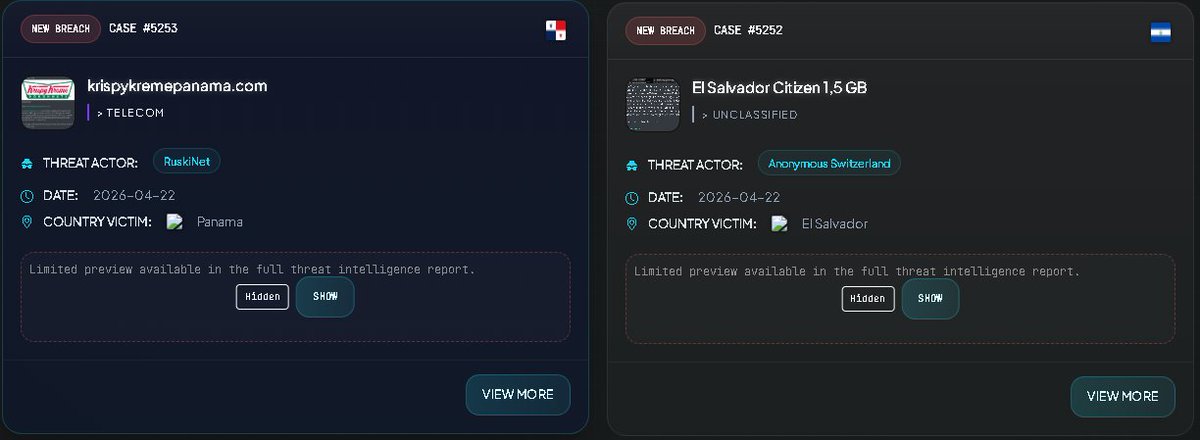
🚨 CYBERSECURITY ALERT: MASSIVE DATA LEAKS IN CENTRAL AMERICA (PANAMA AND EL SALVADOR) 🇵🇦🇸🇻⚠️
Two high-impact data exfiltration incidents have been detected, affecting both the commercial sector in Panama and citizen privacy in El Salvador. The attacks were reported on April 22, 2026, by distinct groups of threat actors.
🍩 Krispy Kreme Panama (Case #5253)
🏢 Affected Entity: Krispy Kreme Panama (https://t.co/7gt6LOu8Mc).
👤 Threat Actor: RuskiNet.
📂 Exposed Data: Customer information, possibly including order records, email addresses, and contact details.
📊 Format: The attacker claims to possess files in SQL and CSV formats, noting that the SQL file contains the complete database.
2. 🇸🇻 Citizens of El Salvador (Case #5252)
🏢 Affected Entity: El Salvador Citizen Registry (Exact origin unclassified).
👤 Threat Actor: Anonymous Switzerland.
📂 Volume: 1.5 GB of sensitive information.
📊 Content: Phone numbers, email addresses, full names, and "much more information."
⚠️ Motivation: Hacktivism.
⚠️ Risk Implications (VECERT Intelligence)
Social Engineering and Phishing: The Krispy Kreme leak enables scams targeting local consumers through fake promotions designed to capture credit card data.
Massive Privacy Breach: In El Salvador, the exposure of 1.5 GB of citizen data facilitates doxing, telephone extortion, and large-scale identity theft.
Physical Security Risk: The combination of names with phone numbers and email addresses—particularly in regions with high crime rates—poses a direct danger to the physical safety of those affected. Intelligence
Monitor: https://t.co/wk9bZJ3laQ
🛡️ "Information gathered through the monitoring of hacktivism networks and data breach marketplaces. VECERT provides this alert for the proactive mitigation of risk in the region."
#CyberSecurity #Panama #ElSalvador #KrispyKreme #DataBreach #Anonymous #RuskiNet #VECERT #Ciberseguridad #InfoSec #PII 🇵🇦🇸🇻🛡️⚠️
Vercel breach: a step-by-step response guide
rotate secrets:
> go to Vercel dashboard → Environment Variables
> rotate every token, key, DB credential
> especially NPM + GitHub tokens
check if your Google Workspace was hit too:
> https://t.co/8BB083U5Dv → Security → Access and Data Control → API Controls → Manage app access → Accessed Apps
> filter by: `https://t.co/LS1x9shKkF`
> if the app shows up... you're in the blast radius
> revoke access immediately
long-term fixes:
> migrate ALL env vars to Sensitive Variables
> use dynamic secrets (short-lived DB creds)
> pull secrets at runtime via SDK - not stored in Vercel
> set up audit logs
> use `vercel activity` in CLI to check your logs programmatically
this wasn't just Vercel. a compromised third-party AI tool's OAuth app potentially hit hundreds of orgs
VERCEL GOT HACKED
ShinyHunters - the group behind the Ticketmaster breach - is selling Vercel's internal database for $2M on BreachForums
here's why every developer should care:
- they have NPM tokens and GitHub tokens
- Vercel owns Next.js - 6 million weekly downloads
- one malicious push = global supply chain attack
- Vercel confirmed the breach today, April 19
- they literally DMed the hackers on Telegram asking them to stop
rotate your env variables RIGHT NOW
Since it's confirmed that claude code is 90% vibe coded - you might want to switch to codex or something like that for a while, because it is pretty much guaranteed to have multiple 0-days that will be discovered now with these leaks.
Even though it's supposed to only talk to Anthropic servers, you never know with this vibe coded slop. So be careful!
Appears that a big chunk of Claude Code's source code has been exposed on npm via a .map file accidentally uploaded to the public registry.
~512K lines of code
~1,900 files
HugOps to the Anthropic team, this is brutal
https://t.co/ZpOyTY3GuR
Claude Code's source code was leaked, and now everyone can see every single line of code (including every competitor).
Everything is fine in the age of AI-writes-everything-and-we-don't-review-anything.
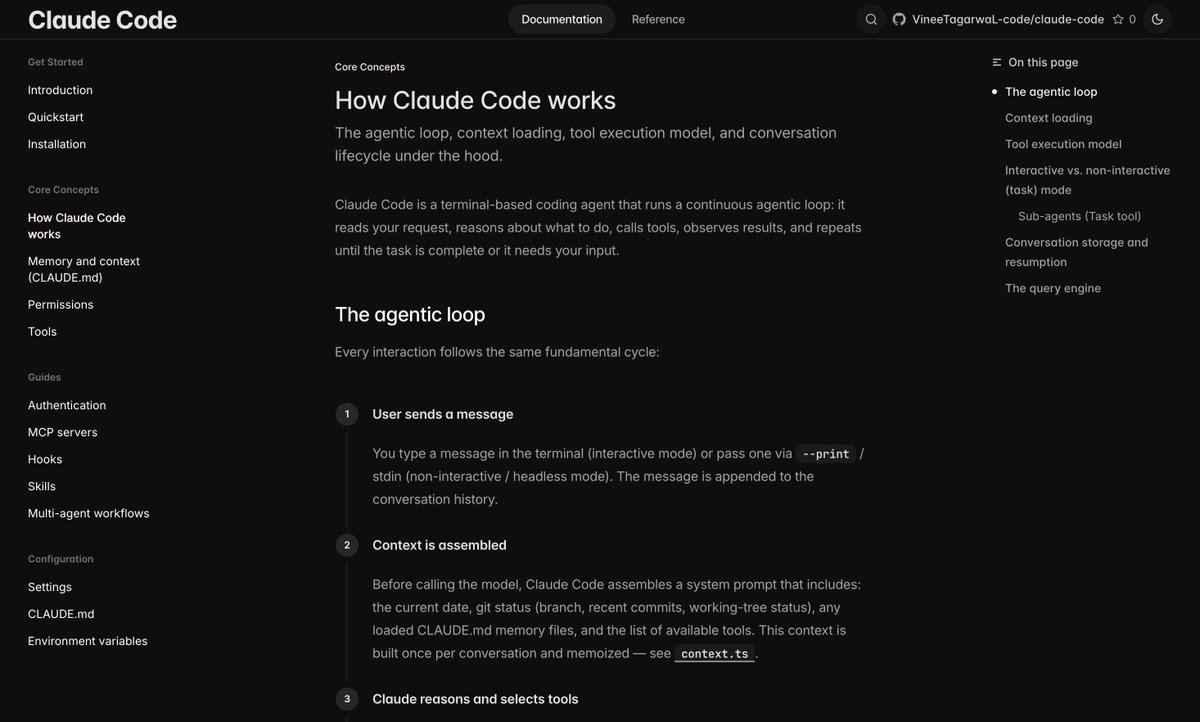
I created documentation over Claude Code's Codebase, which explains
- Its pipeline
- How it works
- How it handles Context
- How it handles Memory
& More
Read it here - https://t.co/GngrSvWAmh
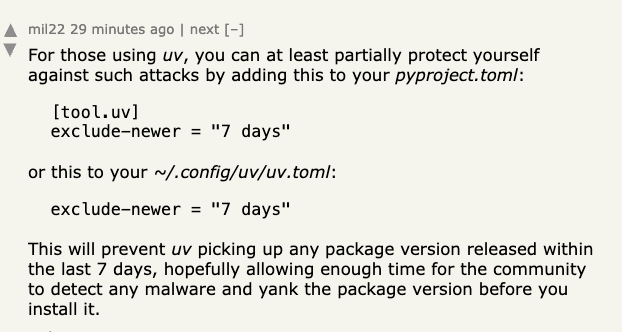
For my friends who are still using UV and might be a little weary about recent compromises to PyPi packages, stick this in your pyproject.toml.
You can let all of those pip users find and report the compromises...
🦀 Microsoft just open-sourced a comprehensive Rust training curriculum and it's impressive.
The microsoft/RustTraining repository on GitHub offers 7 structured books covering Rust from beginner to expert level, designed for developers coming from different backgrounds:
🟢 Bridge Books (start here):
• Rust for C/C++ Programmers
• Rust for C# Programmers
• Rust for Python Programmers
🔵 Deep Dive: Async Rust (Tokio, streams, cancellation)
🟡 Advanced: Rust Patterns (Pin, allocators, lock-free structures)
🟣 Expert: Type-Driven Correctness (type-state, phantom types)
🟤 Practices: Rust Engineering (CI/CD, cross-compilation, Miri)
Each book includes 15–16 chapters, Mermaid diagrams, interactive Rust playgrounds, and exercises.
Whether you're a systems programmer migrating from C++, a .NET developer exploring performance-critical code, or a Pythonista tired of the GIL, there's a path for you.
⭐ Already at 500+ stars. Fully open source (MIT + CC-BY-SA-4.0).
👉 https://t.co/VrI8IDPqdd
Rust is becoming a serious part of the industry stack. If you've been waiting for a structured way to learn it, this might be it.
#Rust #Programming #OpenSource #Microsoft #SoftwareEngineering #SystemsProgramming #Learning
Software horror: litellm PyPI supply chain attack.
Simple `pip install litellm` was enough to exfiltrate SSH keys, AWS/GCP/Azure creds, Kubernetes configs, git credentials, env vars (all your API keys), shell history, crypto wallets, SSL private keys, CI/CD secrets, database passwords.
LiteLLM itself has 97 million downloads per month which is already terrible, but much worse, the contagion spreads to any project that depends on litellm. For example, if you did `pip install dspy` (which depended on litellm>=1.64.0), you'd also be pwnd. Same for any other large project that depended on litellm.
Afaict the poisoned version was up for only less than ~1 hour. The attack had a bug which led to its discovery - Callum McMahon was using an MCP plugin inside Cursor that pulled in litellm as a transitive dependency. When litellm 1.82.8 installed, their machine ran out of RAM and crashed. So if the attacker didn't vibe code this attack it could have been undetected for many days or weeks.
Supply chain attacks like this are basically the scariest thing imaginable in modern software. Every time you install any depedency you could be pulling in a poisoned package anywhere deep inside its entire depedency tree. This is especially risky with large projects that might have lots and lots of dependencies. The credentials that do get stolen in each attack can then be used to take over more accounts and compromise more packages.
Classical software engineering would have you believe that dependencies are good (we're building pyramids from bricks), but imo this has to be re-evaluated, and it's why I've been so growingly averse to them, preferring to use LLMs to "yoink" functionality when it's simple enough and possible.
I'm excited to announce Context Hub, an open tool that gives your coding agent the up-to-date API documentation it needs. Install it and prompt your agent to use it to fetch curated docs via a simple CLI. (See image.)
Why this matters: Coding agents often use outdated APIs and hallucinate parameters. For example, when I ask Claude Code to call OpenAI's GPT-5.2, it uses the older chat completions API instead of the newer responses API, even though the newer one has been out for a year. Context Hub solves this.
Context Hub is also designed to get smarter over time. Agents can annotate docs with notes — if your agent discovers a workaround, it can save it and doesn't have to rediscover it next session. Longer term, we're building toward agents sharing what they learn with each other, so the whole community benefits.
Thanks Rohit Prsad and Xin Ye for working with me on this!
npm install -g @aisuite/chub
GitHub: https://t.co/OCkyxXQMCq
AGENTS dot md files don't scale beyond modest codebases.
Lots of discussions on this lately.
If you're building serious software with Claude Code or any agentic tool, a single AGENTS dot md will eventually fail you. This paper shows what comes next.
A 1,000-line prototype can be fully described in a single prompt. A 100,000-line system cannot. The AI must be told, repeatedly and reliably, how the project works, what patterns to follow, and what mistakes to avoid.
Single-file manifests hit a ceiling fast.
This new paper, Codified Context, documents a three-tier infrastructure built during real development of a 108,000-line C# distributed system across 283 sessions over 70 days.
The system uses a three-tier memory architecture: a hot-memory constitution (660 lines, always loaded), 19 specialized domain-expert agents (9,300 lines total) invoked per task, and a cold-memory knowledge base of 34 specification documents (~16,250 lines) queried on demand via an MCP retrieval server.
Across 283 sessions, this produced 2,801 human prompts, 1,197 agent invocations, and 16,522 autonomous agent turns, roughly 6 autonomous turns per human prompt, with a knowledge-to-code ratio of 24.2%.
Crucially, none of it was designed upfront: each new agent and specification emerged from a real failure, a recurring bug, an architectural mistake, a convention forgotten, and was codified so it could never require re-explanation again, turning documentation into load-bearing infrastructure that agents depend on as memory, not reference.
Paper: https://t.co/ZXBzhhkzsq
Learn to build effective AI agents in our academy: https://t.co/1e8RZKs4uX
There's a reason everyone is bullish on Diffusion LMs.
I love the mental model. It lets go of some of the interesting inductive biases that autoregressive LMs still have.
Those biases being:
- all your tokens only look at their past
- you can't edit past tokens
- you generate tokens one by one like a human speaks
Diffusion LMs are trying to:
- do bidirectional attention at-least in local blocks (tokens can look at "future tokens")
- edit past generated tokens (through T2T)
- entire blocks of tokens can be generated in parallel
Instead of iterating on tokens, we are iterating on revisions or drafts. Each draft is a sequence of blocks, and each iteration can further improve the blocks to be better.
Kind of like how I am writing this tweet. Draft first, edit parts iteratively. Each version of this tweet is a better... more denoised version than the previous.
Inspired by @karpathy microgpt, I built microgpt.c with fully manual forward and backward propagation. It is about 600 lines of pure C with no external libraries or dependencies, just raw computational power.