Interesting. By replacing the embedding layer with a low-rank bottleneck, I managed to *improve* my model's test loss while reducing parameter count by from 163M to 131M. Only two runs, so far from proven, but it's a surprising result!
https://t.co/xAdEP7wPRI
The real winner was using built-in PyTorch normalisation classes -- both nn.LayerNorm or nn.RMSNorm are *way* faster than hand-rolled versions, and weirdly (in these tests) got better loss too -- though I think that must be chance.
A (relatively) quick post on RMSNorm: how it works, and does it really speed up training for minimal loss in performance when compared to LayerNorm? In my tests on a GPT-2-like model, loss stayed the same (within the noise) but training speed hardly changed.
https://t.co/CQV27quwfe
So basically, today PHP got two critical bugs that let anyone run code on your server without even logging in, which is bad, and then the details leaked before the patch was even out, which is worse, and it works on WordPress and MediaWiki and Magento and Joomla and Laravel, and Censys says like 1.5 million servers are running a version with no fix, so the NSA was like "take your system offline," and the FBI was like "take your system offline," and CISA and the UK and CERT-EU were all like "take your system offline," and then the Prime Minister of Japan, the actual Prime Minister, posted at 5:55 in the morning telling 48.8 million people to take their system offline, so everyone took their system offline, like the Dutch cybersecurity agency took its own website offline, and the Dutch parliament went offline, and the Port of Rotterdam went offline, and Finland and France and Denmark started pulling government sites, and Wikipedia went down, and https://t.co/QlOXb3COq3 went down, and Asana and GOG and Something Awful went down, and the University of Vienna's webmail went down for some reason, and that's just PHP. Because GitLab also dropped a CVSS 10.0, which is the highest score they give out, for a bug that's been there since 2014, so that's every self-hosted GitLab for twelve years, and then LiteLLM 1.107.0 got hijacked and shipped a credential stealer and a remote access trojan in every single wheel and the Docker images, including latest, and you didn't even have to import it, just installing it was enough, and it's the second time this year, and then Railway paused every deployment on the entire platform because someone got into the environment variables, so now everyone has to rotate every secret they've ever stored there, and TiDB Cloud said someone was walking around inside with stolen credentials for basically a month and an extortion group says they took 10.6 terabytes, and Zeabur got breached for the second time in two months and is just shutting down, like the whole company, and Node.js patched remote code execution and a TLS bypass, and CISA says Plex is being actively exploited, and someone took over 300 Tor exit relays to steal SSH passwords, and SafePay ransomware has hit over 600 critical infrastructure orgs, and India's biggest bank filed a data loss incident, and Japan has been in an official state of emergency in cyberspace since October 9, which honestly explains the 5:55 AM post. Oh, and eMudhra, a certificate authority that's issued over 60 million certificates, whose entire job is proving websites are who they say they are, was supposed to be using private keys that are random numbers over a hundred digits long, and one of them was 4. Just 4. And the others were like 66 and 237. Anyway, it's Wednesday.
@BoboLinNotes Yes, absolutely. If a few more runs on GPT-2 show the same effect it would also be interesting to see if other models have similar effects.
Interesting. By replacing the embedding layer with a low-rank bottleneck, I managed to *improve* my model's test loss while reducing parameter count by from 163M to 131M. Only two runs, so far from proven, but it's a surprising result!
https://t.co/xAdEP7wPRI
@fwiles Yikes, thanks for writing that one up. While the red flags are obvious in retrospect (why share a git repo on Dropbox, and if it's a shared folder, why don't they check out the branch?), I think I might have fallen for it
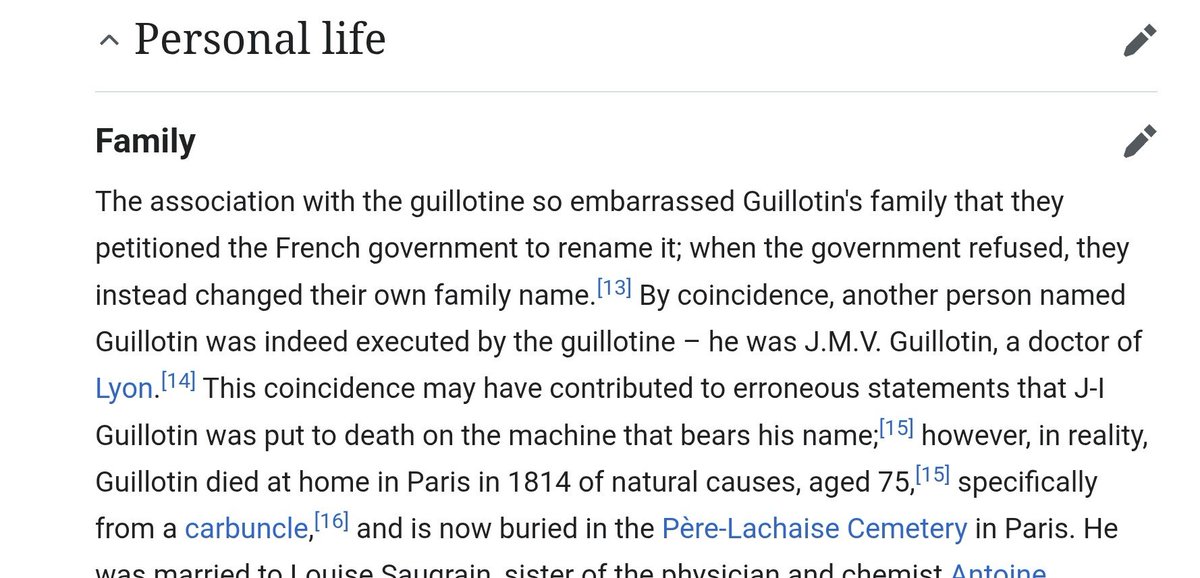
@woke8yearold@ExpatCajun I was going to reply here with the often-made comment that he ironically died on the guillotine, but decided to check Wikipedia first, and was surprised to read that it's not true!
@thomasknox@pakar_ai@grok@slimer48484 Grok is partially right in that the YouTube version seems to be the original source of the lyrics, but yeah, the tune is completely different.
The most annoying thing about what's going on right now is that so much of it could be handled by normal liability/criminal law. If I hacked into Hugging Face for any reason and they tracked me down, the police would turn up on my door the next day. If I caused damage, HF could sue.
Is it just me, or do these proposed penalties for "rogue AI developers" seem a tad extreme? The comments regarding the death penalty in particular.
https://t.co/BHlf8PuIOr
I trained the fly on the entire corpus of human knowledge predating 1905.🪰
I was not ready for what happened when I prompted it to see if it could come up with the theory of relativity on it's own.. Also asked about NS... 🤯
We have to pace the flyntier!
(sounds on!)
@ethereaglehq@rasbt The one they call alpha? They recommend 0.01 but their "perfect" number for unscaled aux loss was 1, while mine was 2. I did a sweep over 0, 0.001, 0.005 and 0.01 and found that 0.005 worked -- which is different to theirs but matches nicely with the change to f_i.
Not with this kind of mixture of experts -- the experts in an MoE model have expertise in what I think of as "weird and alien" aspects of language modeling rather than in a real-world topic. There are setups people have looked into where different LLMs answer different kinds of questions based on something closer to human expertise (search for Sakana Fugu, for example) but they're a different kind of thing.
I extended the GPT-2-style code from @rasbt's "Build a Large Language Model (from Scratch)" so that it was a 6-expert (2 active) mixture-of-experts, and trained it from scratch over 8 days. It worked well! Full writeup with maths and code at https://t.co/7YsQifjWDk
The model was GPT-2 small expanded with the experts, so that made it 446M parameters with 220M active per token. Trained it on an RTX 3090. I did one short-ish (2-day) run with no aux loss to see if I got expert collapse (I did) then added on a version of the Switch Transformers aux loss generalised to >1 active expert -- with that, and alpha (in the Switch notation) set to 0.005, it behaved very nicely over an 8-day run over just less than 9B tokens (Chinchilla number for the active params, so overtrained for an MoE).