One of the most under appreciated parts of Nightshade v2's Stateless Validation is that it enables instant resharding allowing to prevent congestion of one application affecting other applications in the network.
Generally non sharded blockchains are not able to add capacity quickly - every node in the network needs to validate all transactions and store all the state. Even if there is in-protocol mechanism to increase block size - it will lead to some validators running out of resources.
Sharded blockchain is the only way to continue growing capacity of the network with demand (maintaining low prices). Adding more shards effectively increases the block size and distributes the storage of state among more nodes.
From practice we know that there are sudden demand spikes that lead to congestion which in turn affect every other application in the network.
NEAR's sharding design offers a way around it by separating affected application into a separate shard, isolating it's load. This also adds more capacity into the network in general. This is all done without any changes from users, developers or operators of tooling like Indexers, RPC, etc. We have seen this happening on NEAR to go from 4 shards to 6 in March 2024.
Instant resharding means we can do this as soon as such congestion is detected - a specific shard effectively splits into two around some boundary in account space. The benefit that stateless validation brings is that we can maintain the same security after the split because validators are stateless and don't care how many shards are in the network at any time - they are just validate the chunks they are selected for and get rotated every block.
To contrast this with Rollup or Subnet approach - developers need to explicitly move their application and it's state by spinning up separate network (somehow disabling application on the previous chain/rollup/subnet) and then get their users to find out about it and move their assets / state. Or launch initially as a separate chain bearing all the costs (starting with $1m for sequencer, indexers, explorer, etc).
Ability to scale dynamically with load increasing was the original vision of Dynamic Resharding for @NEARProtocol and now with stateless validation will enable doing it effectively and securely. This will be next arc of work for Protocol Work Group.
Importantly, I want to encourage everyone to work together. There will be growth challenges and we will discover new bottlenecks.
Assume good intentions. Provide constructive feedback. Offer to help.
This ecosystem is owned by all of us.
Chain Signatures launched on @NEARProtocol today, enabling NEAR accounts & smart contracts to sign transactions for any blockchain – no bridges required.
Supports Bitcoin, Ethereum, Cosmos chains, DogeCoin, & XRP Ledger, with more coming soon.
More on why it's cool below ⬇️
"Modularism not maximalism" is buzzing on CT lately.
DA providers are revolutionizing how rollups reduce gas costs by offloading txn data to a separate layer.
It's a contested sector, yet I believe @NEARProtocol's DA solution will stand out as a leader.
Why? Let's explore! 🧵
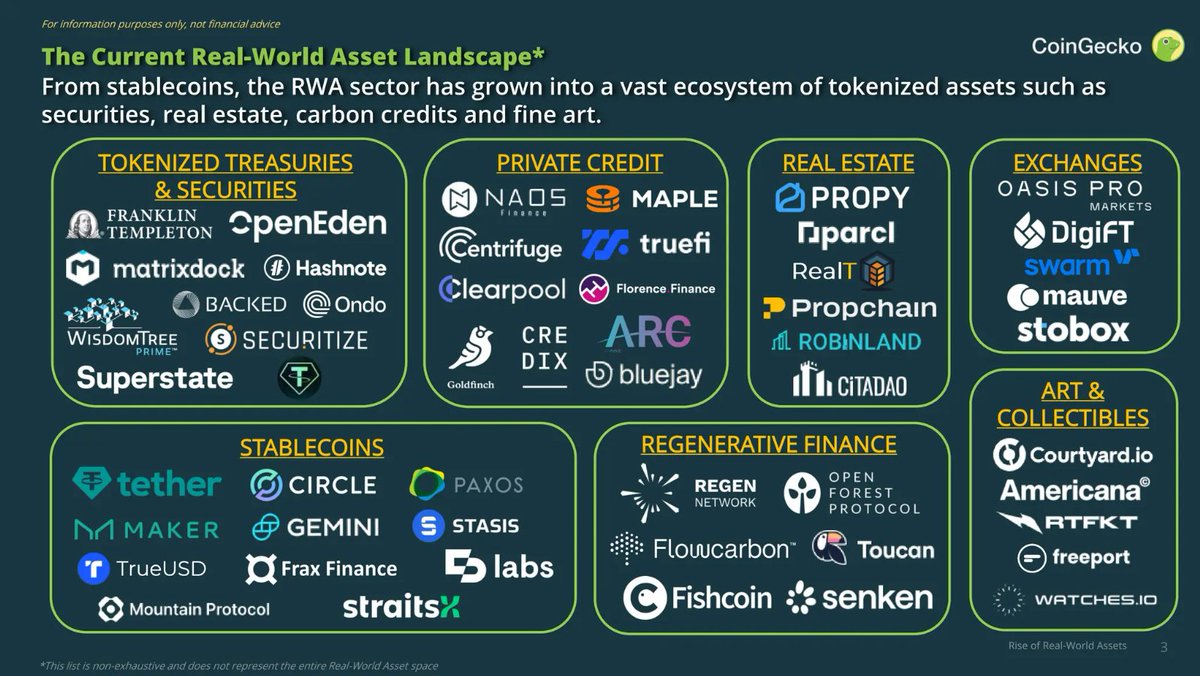
📃 Clearpool is proud to be featured in @coingecko’s latest 2024 RWA report!
Real-World Assets (#RWA) refer to migrating assets from the real world into digital tokens, migrated on-chain. While stablecoins like $USDT and $USDC led the charge as the earliest and most recognized forms of RWAs, the concept has since expanded far beyond them.
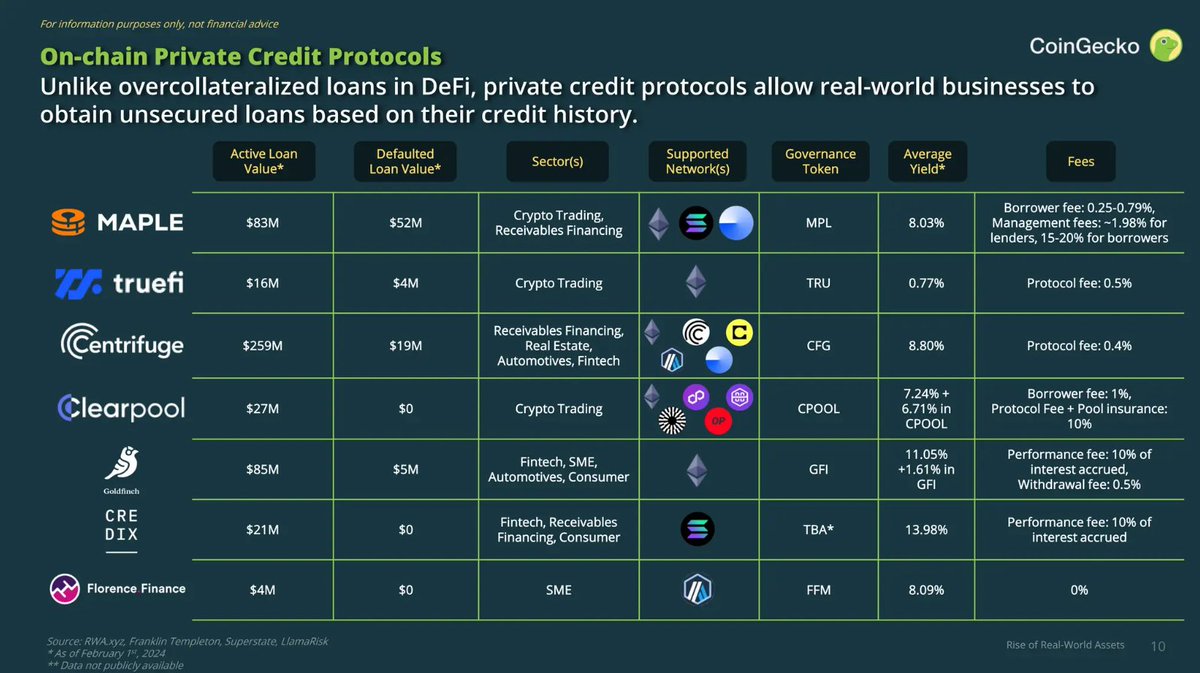
There's a growing interest in private credit markets facilitated by uncollateralized credit protocols like Clearpool, where borrowers can access loans without providing collateral. The surge in demand is primarily attributed to the increased efficiency it offers for both lenders and borrowers.
🚀 Clearpool stands tall as a pioneer in the RWA movement, introducing tokenized credit even before the concept gained widespread recognition and has now originated $480+ million of loans.
When you lend via the Clearpool protocol, you receive cpTokens, which:
- Represent the loan lenders provide to a specific borrower pool.
- Accrue interest in real-time and auto-compound block-by-block.
- Allow lenders to withdraw their funds anytime, with no lockup period — enabling you to navigate market volatility as funds are readily available.
This flexibility for lenders is one of the reasons why Clearpool's permissionless pools maintained resilience and shone through in the biggest of stress tests. Even during the turbulent events of 2022, such as the FTX, Three Arrow Capitals, and Celsius meltdowns, these pools maintained a default value of 0.
Clearpool is primed for success in the rapidly evolving landscape of RWAs, especially with major players like @BlackRock launching a $100M tokenized fund on #Ethereum. As a pioneer in the intersection between RWAs and #DeFi, Clearpool has truly been at the forefront of bridging traditional finance with blockchain technology by migrating credit on-chain.
🏦 Noteworthy collaborations with Wall Street giants like @JaneStreetGroup have catapulted Clearpool into the spotlight of institutional DeFi. The introduction of #ClearpoolPrime, a non-custodial, institutional-grade credit marketplace, further solidified the product offerings. Users can now seamlessly access a global network for wholesale borrowing and lending of digital assets with full KYC and AML compliance.
🔮 Looking ahead, Clearpool's innovative roadmap promises many exciting developments. From introducing Credit Vaults and term pools to multi-chain expansion and support for various assets, the future is brimming with potential. Anticipate a wider spectrum of borrowers entering the Clearpool ecosystem, including fintechs, DAOs, and more.
TL;DR: You’re not bullish enough on RWAs! The future is bright for $CPOOL 💡
Read the full report here👇
https://t.co/zXOmx5ZMj4
Think the repricing of NEAR to similar valuation with Celestia will happen way faster than expected.
Cheapest DA layer + Integrated Sharded L1 + High DAU Chain + Blockchain Abstraction + AI + Black Dragon
We're thrilled to partner with @NEARProtocol!
Caldera chains built on Arbitrum Orbit, OP Stack, and Polygon CDK can now all opt into NearDA as an alternative data availability solution in place of Ethereum.
Learn more 👇
Data availability has become increasingly important as rollups and appchains grow in popularity.
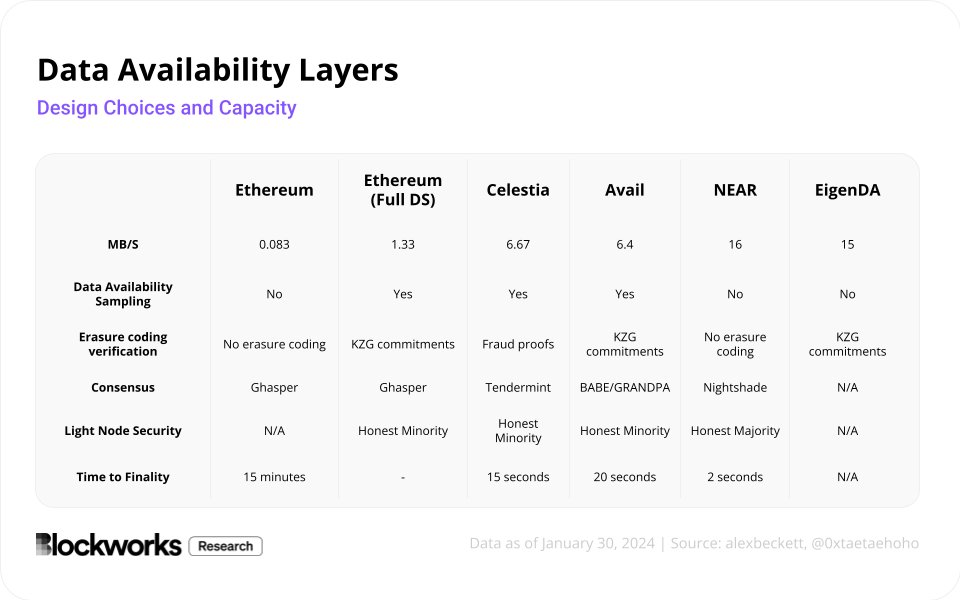
How do the different DA solutions compare in a quickly growing modular future?
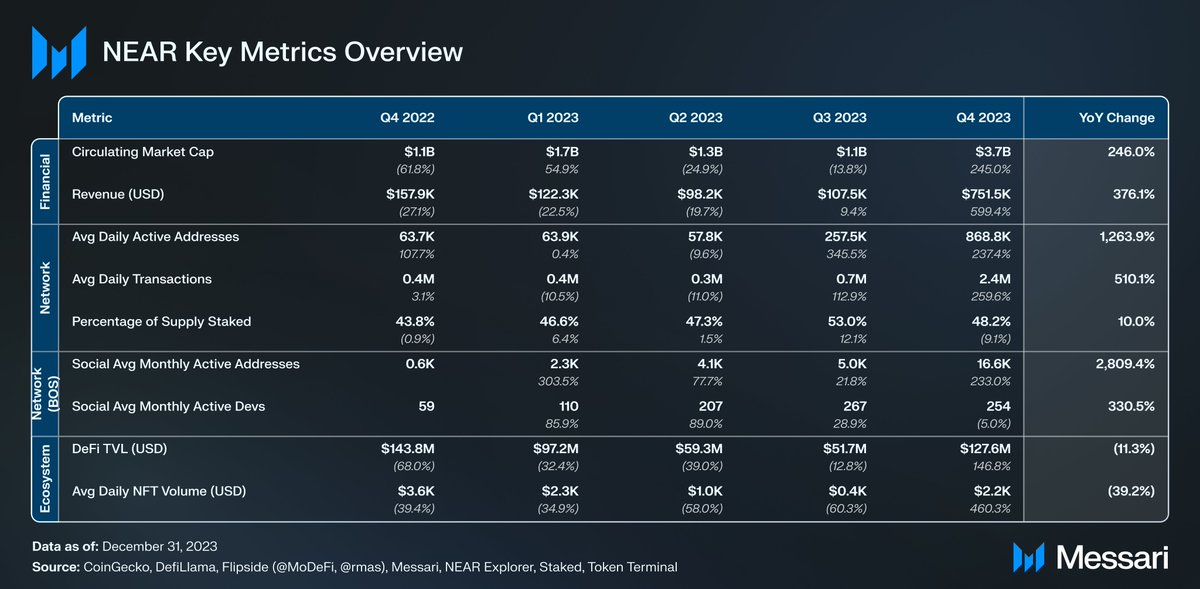
State of @NEARProtocol Q4 2023
NEAR ended 2023 on a high note.
Active addresses increased 1,250% QoQ to an all-time high, BOS addresses increased 118% QoQ to an all-time high, and multiple significant tech developments were announced.
Security Aggregation is an important part of Chain Abstraction. Polygon is driving this with their pioneering work in ZK & CDK tech. Looking forward to building more in this space together.
Good read from @googlecloud about how @NEARProtocol & @databricks are improving the app-building experience for devs with faster, easier data querying, in some cases reducing query time from weeks to minutes.
Even apps with millions of daily users can run smoothly on NEAR.
https://t.co/pekyVOYUEU
@sandeepnailwal Here is useful graphic for comparable for Data Availability costs and throughput.
87,000x cheaper than Ethereum and 30x than Celestia
This is due to throughput scaling with sharding.
Blockchain Operating System is Chain Abstraction Stack that lets users and devs not deal with underlying blockchains.
Similar how traditional operating systems abstract hardware from devs and users.
🐲 Chain Abstraction is #NEAR!
Don't sleep on the Chain Abstraction hack incl. multi-chain decentralized frontends, cheap data availability, account aggregation, and zkWASM execution!
Join us towards the Open Web! It's NEAR 🤝
Read more 🔽
https://t.co/MEJnINFxZF
Not "in the works", @0xPolygon POS has parallelisation in production. It was one of the reasons why Polygon POS chain was able to process 15mn+ txns easily on multiple days while many other networks encountered issues.