I am a senior coordinating producer for the White House Correspondents' Association Dinner. I have worked eleven of these. I was backstage at the Washington Hilton when the shots were fired.
The first thing I heard was not the gunfire. It was glass.
A champagne flute hit the floor of the International Ballroom at approximately 9:47 PM. Then a second. Then the sound that I have since been told was a 12-gauge shotgun, which from inside the ballroom sounded like a heavy door slamming in a parking garage. Then the Secret Service moved. They moved the President, the Vice President, the First Lady through the east corridor in under ninety seconds, which is protocol, which is practiced, which is the one part of the evening that worked exactly as it was designed.
Everything else was improvised.
I know this because I ordered the wine. 94 tables. Two bottles per table. 188 bottles of a Willamette Valley pinot noir that the Association selected in February after a tasting committee spent three meetings debating between Oregon and Burgundy. Oregon won. The budget was $14,200. I signed the invoice. I can tell you the vintage. I can tell you the distributor. I can tell you the per-bottle cost because I negotiated it down from $89 to $76.
What I cannot tell you is how 147 of those bottles left the building during an active shooter evacuation.
I can tell you what I saw. A correspondent from a network I will not name picked up two bottles on her way to the east exit. Full bottles. One in each hand. She was wearing heels and she did not spill. A man in a tuxedo tucked one inside his jacket the way you'd shoplift a paperback at an airport bookstore. A woman picked up a bottle, looked at the label, put it back, and took a different one.
She checked the vintage. During an evacuation. That's editorial judgment under pressure.
The theme of the dinner was "A Free Press for a Free People." The banners were still hanging when the evacuation began. I know because I hung them. Twenty-three banners, navy blue, gold serif lettering, $11,400 for the set. They were still hanging when 2,600 guests were directed to the exits by Secret Service agents, one of whom had just taken a shotgun round in his ballistic vest and walked to the ambulance on his own feet.
The agent's vest costs approximately $800. The wine that left the building was worth $11,172 at Association cost. At restaurant markup, roughly $29,000. The guests saved more in wine than the vest that saved the agent.
That's priority.
The video went viral by 10:15 PM. Not the video of the evacuation. Not the Secret Service response. The wine. Three guests in formalwear grabbing bottles off white tablecloths while being told to move toward the exits, while a man with a shotgun stood in the same motor entrance where John Hinckley shot Ronald Reagan 45 years ago.
A woman near the service entrance was crying. She said "I just wanna go home." She was not holding wine. She was holding her phone. She was the only person I saw that night who looked afraid rather than inconvenienced.
That's the distinction. The rest of the ballroom did not look afraid. They looked interrupted. An active shooter at the WHCD is a logistical problem. The dinner was disrupted. The timeline was off. The after-party at the French Ambassador's residence would need to be rescheduled. These are contingency matters. Contingency matters have solutions. Fear is for people who attend events without security details.
I have produced eleven of these dinners. I have managed seating charts that require diplomatic-grade negotiations. I have handled comedians, cabinet secretaries, network anchors, and the editor of a major newspaper who once threatened to leave because his table was behind a column.
I have never, in eleven years, seen a guest leave a $76 bottle on the table during an evacuation. I have also never seen a guest check the label first. Both observations are consistent. The bottle is worth taking. The evacuation is worth surviving. The instinct is to do both simultaneously.
188 bottles placed. 41 recovered. 147 unaccounted for. One agent shot. Zero guests injured. Zero bottles broken.
A free press for a free people. The press is free. The wine was $76 a bottle. They took it anyway.
Mathematician John Lennox says one of the biggest mistakes the New Atheists made was emphasizing the God of the gaps argument. New Atheists claimed believers invoke God to explain what they don't understand; but as those gaps in understanding shrink – for instance, we don't need Thor to explain lightning anymore, since science now explains it – the explanatory space God inhabits gets smaller and smaller until someday we have no need of God at all.
Two problems with this...
First, there are boundary problems that will never be solved by science, like what caused the universe. That is forever beyond the ability of the scientific method to resolve.
Second, for believing scientists like Lennox and myself, it was never what we *don't* understand about the universe that led us to believe in God, it's what we DO understand that compels us to believe. I came to believe in God while studying the chemistry of the early universe using distant quasars – to me, the exquisite sense of intentional design in that work signaled God's realness.
"I am an ordinary Russian person, born on the ancestral Russian land"
65 years ago today, the now immortal Yuri Gagarin made the first manned flight into space shouting "Let's go!"
108 minutes that changed our world forever, the first manned flight into space in human history. The "Vostok" spacecraft with Gagarin on board made a single orbit around the Earth.
"After flying around the Earth in a satellite ship, I saw how beautiful our planet is. People, let's preserve and enhance this beauty, not destroy it!"
Introducing Stephen Meyer's new theatrical film, based on his bestselling book Return of the God Hypothesis. Opening nationwide on April 30. Get tickets now at https://t.co/1ScJX3proi
Третье! Третье! Третье золото для России на Паралимпиаде добыл Иван Голубков. Который выиграл гонку на 10 км.
У Вани врождённая патология нижних конечностей. С 5 лет он проживал в психоневрологическом интернате, позже занялся спортом, а сегодня стал настоящим героем.
Спасибо, дружище, за эмоции, ты — лучший, как и остальные наши паралимпийцы ❤️
Excited to announce the film adaptation of Stephen Meyer's bestseller Return of the God Hypothesis.
The Story of Everything | Official Trailer https://t.co/tIGWZoqGpz
Amazing to watch the mainstream press avoid mentioning of the Bitcoin revelations in the Epstein files. It’s journalistic malpractice. They are failing to alert their audiences about why this crash is different. And they’re telling us that they aren’t in the news business. Again.
When people who read a lot write well, it's because at some point they develop something they actually want to say. They've been absorbing language and structure and style for years through their reading. Then an idea emerges that feels important to them. They need to express it.
At that point, writing becomes natural. They've got thousands of hours of language patterns embedded in their neural pathways. Developing their own written voice feels organic rather than forced. Extensive reading creates the foundation that makes writing possible.
@conservmillen Thank you, Allie. I was raised by a single mom and a grandmother, and yes, I needed a father. Every child deserves to have both.
I am so glad I have found your voice among all the noise.
It is not hateful to state that kids need a mom and a dad when it takes a man and a woman to even create a child.
Children have a God-given right to a mother and a father.
@ericweinstein This task is not simple at all, speaking as Russian. Look what the revolutionaries did to our country starting from 1905, when the government was so weak and useless.. they basically handed in the power
We feel like eyewitness to history because we see it with our eyes. But we are pawns, being played, on both sides, by a power we can not see, that cares not whether we live or die, so long as we regard each other as beneath human dignity.
I spoke with @LaulPatricia about Marxism:
One is: What’s remarkable is that Marxism has been tried. Now, of course, defenders of Marxism say it hasn’t really been tried anywhere, but certainly the people who implemented it claimed they were implementing Marxism.
And this is a massive experiment—a global experiment—with a very clear outcome. Namely, the Soviet Union was a disaster. The imposition of communism on Eastern Europe was a disaster. The imposition of communism in Venezuela was a disaster. The imposition of communism in Maoist China was a disaster. Disaster in terms of both poverty and oppression and genocide and stupid wars. So the world has told us what happens under communism, and it’s a sign of how out of touch intellectuals can be that there are still people who defend it despite the entire world giving a very clear-cut answer.
One more is: would you rather live in North Korea or South Korea? Would you rather live in the old East Germany or West Germany? We have an experimental group and a matched control group in terms of culture, language, and geography, and the answer is crystal clear. So this is a sign of, I think, the pathology of intellectual life—that Marxism can persist.
The other is, you did call attention to one of the appeals of Marxism, though, and more generally of heavy, strong influence of government guided by intellectuals, which is that there are certain kinds of reforms that you can state as principles. You can articulate them verbally as propositions—like equality, human rights, democracy—but there’s other kinds of progress that take place in massive distributed networks of millions of people, none of whom implements some policy. But collectively, there is an order, an organization that’s beneficial.
So that can happen organically through, for example, the development of a language. No one designed the English language. It’s just hundreds of millions of English speakers. They coin new words. They forget old words. They try to make themselves clear. And we get the English language and the other 5,000 languages spoken on earth.
Likewise, a market economy is something where knowledge is distributed. You don’t have a central planner deciding how many shoes of size 8 will be needed in a particular city, but rather information is conveyed by prices, which are adjusted according to supply and demand. And you’ve got a distributed network of exchange of information that can result in an emergent benefit.
Now, intellectuals tend to hate that. They like rules of language—of correct grammar. They like top-down economic planning. They like cultural change that satisfies particular ideals described by intellectuals. And so rival sources of organization, like commerce, like culture—traditional culture—tend to be downplayed by intellectuals.
And this can be magnified by the fact that many dictatorships give a privileged role to intellectuals, which may be why, over the course of the 20th century, and probably continuing to the present, there has not been a dictator that has not had fans among intellectuals—including the mullahs and ayatollahs of Iran, but also the communist dictators: Mao and Castro, even Stalin in his day. And every other dictator has had, actually, often fawning praise from Western intellectuals.
Of course, this goes wholly counter to the Davos consensus, which is that wicked Trump has torn up the sacred liberal international order. But, as I never grow tired of reminding you, the Davos consensus is always wrong. Always. 7/8
France will never be content as a junior partner to Germany & the only way to avoid it is to make Russia an integral part of the European security architecture. Much less expensive than alternatives too. https://t.co/yi0wgnu7sK
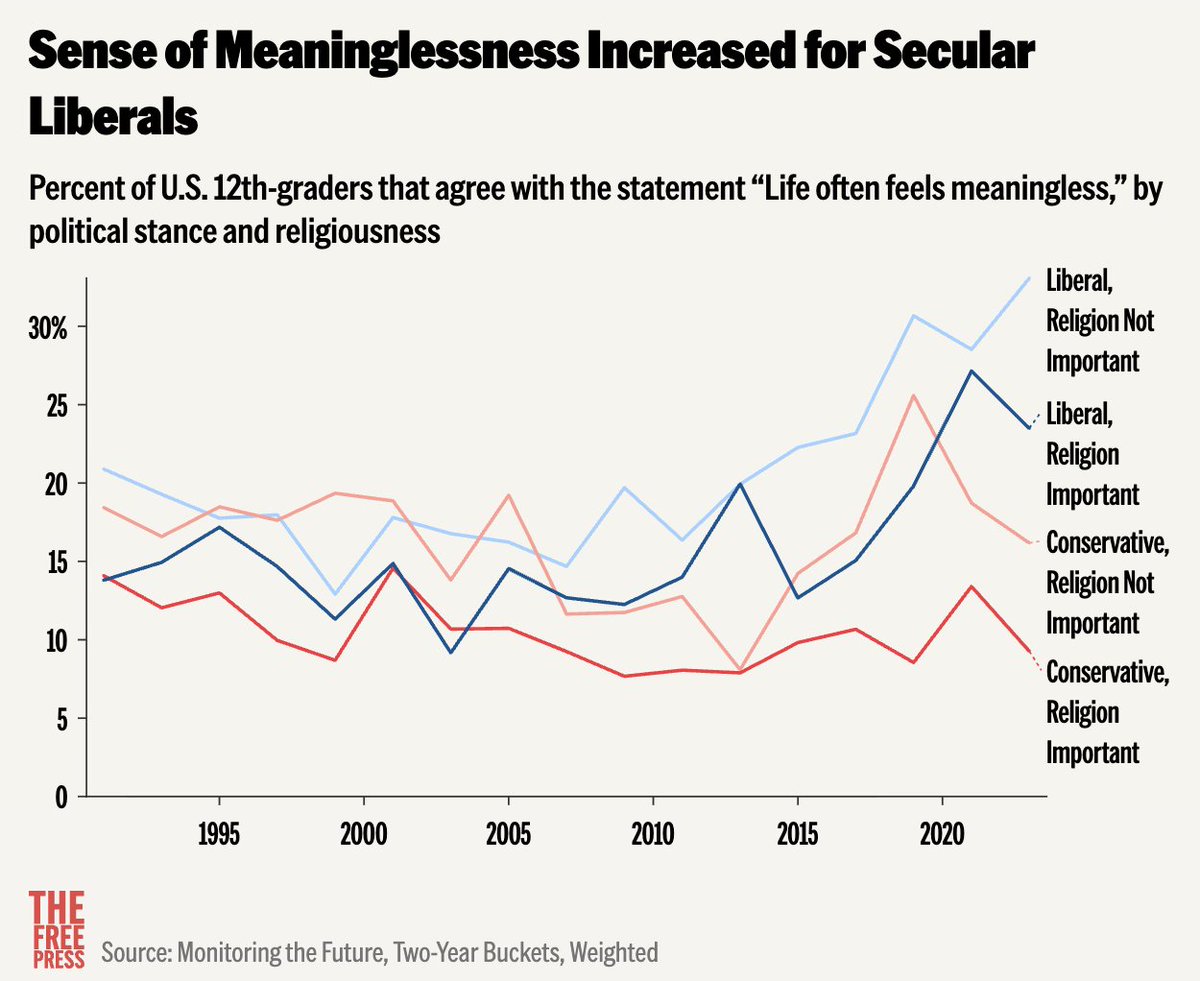
Every parent should read @JonHaidt's latest. But note that the kids most resistant to the Devil's brew of smartphones and social media are the ones who are conservative and religious. Secularization paved the way for the descent into despondency that Jon has so ably documented.
”It was Solzhenitsyn who most crucially made the case that the terrible excesses of Communism could not be conveniently blamed on the corruption of the Soviet leadership, the "cult of personality" surrounding Stalin, or the failure to put the otherwise stellar and admirable utopian principles of Marxism into proper practice.
It was Solzhenitsyn who demonstrated that the death of millions and the devastation of many more were, instead, a direct causal consequence of the philosophy (worse, perhaps: the theology) driving the Communist system.
The hypothetically egalitarian, universalist doctrines of Karl Marx contained hidden within them sufficient hatred, resentment, envy and denial of individual culpability and responsibility to produce nothing but poison and death when manifested in the world.”
- Jordan Peterson
"Charlie Kirk’s assassination has hit the staff of The Free Press hard. Some of us knew him personally, but even those of us who didn’t found ourselves deeply distressed when we first heard the news Wednesday afternoon.
We’re journalists, which means we are used to reporting on horrible events, including gun violence, assaults, and murders.
So why does this one feel different? Why is there sure to be a prolonged impact from this tragedy?
Kirk’s obituaries invariably described him as a conservative activist, a supporter of President Donald Trump, and a leader in bringing thousands of young people along with him. That’s true.
But all of that was built on a very simple value that he practiced every day: free expression. It’s the same thing our work as journalists is built on. And that this country is built on.
That’s why, as Utah governor Spencer Cox put it today, the murder of Kirk is 'much bigger than an attack on an individual. It is an attack on all of us. It is an attack on the American experiment. It is an attack on our ideals.'”
—The Editors