I want to explain to constituents why I’m supporting resident doctors who are taking strike action.
I know strikes are unpopular with many people. I understand that. When doctors strike, it can feel worrying or frustrating, especially when it affects patients and their families. No one takes that lightly, least of all doctors themselves.
But if we care about the NHS and want it to survive and improve in the long term, we have to understand why this is happening.
Resident doctors are fully qualified doctors. They do much of the day-to-day work in our hospitals. They diagnose illness, treat patients, work nights and weekends, and keep services running. From the moment they enter medical school to becoming fully qualified specialists, they train for around 10 to 15 years.
Most leave university with £70,000 to £100,000 or more in student loan debt. That debt builds interest and, for many, follows them for much of their working lives. We are asking people to take on enormous personal financial risk in order to serve the public in one of the most demanding professions there is. That should give us pause.
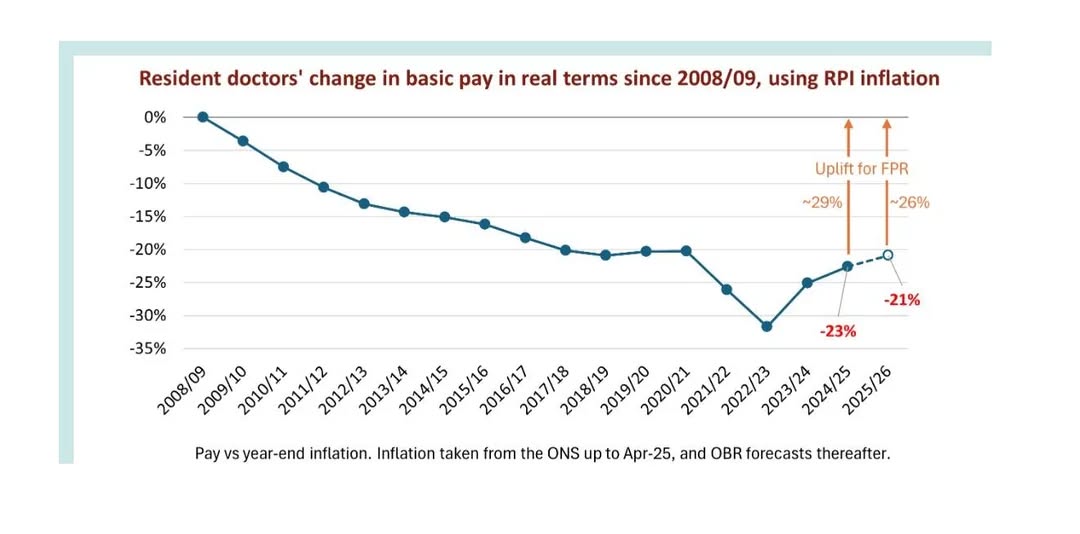
For the past 15 years or so, resident doctors’ pay has fallen sharply in real terms (see the attached graph), while workloads and pressures have increased. This is not disputed. Many are exhausted, burnt out, and struggling with housing and childcare costs. Unsurprisingly, growing numbers are leaving hospital medicine, moving abroad, or leaving the profession altogether.
That is not just a problem for doctors. It is a problem for patients.
When doctors are overstretched and exhausted, risks increase. When doctors leave the NHS, waiting times lengthen. When staff turnover is high, continuity of care breaks down and trust suffers. And when training becomes unattractive, we end up with fewer experienced doctors in the years ahead.
In other words, doctors’ working conditions shape patients’ care.
Doctors do not strike lightly. They would far rather be caring for patients. But many feel this is the only remaining way to protect the future of the NHS and prevent it being hollowed out by burnout and staff shortages.
Supporting resident doctors is not about taking sides. It is about recognising that a safe, publicly run health service depends on valuing the people who keep it going. That means doctors, nurses, cleaners, porters, anaesthetists, and administrative staff alike.
But this dispute also reflects something bigger.
Since the 2008 financial crash, many working people have seen real-terms pay cuts while public services were brutally underfunded or completely cut. The public paid the price for a crisis they did not cause, while the rewards at the top recovered far more quickly. It is not unreasonable for people to question whether that settlement is fair or sustainable.
Rather than seeing this strike as an inconvenience, we might see it as something to reflect on. When working people organise to demand fair treatment, it forces politics to confront how our economy works and who it works for.
Because right now, workers, small businesses, sole traders and many others are not getting their fair share of the nation’s considerable wealth, while large corporations, banks and those who already hold assets take far more than their share. That is not the politics of envy. It is simply a statement of reality. And crucially, it is not inevitable. It is the result of political choices, and different choices are possible. This ultimately is what 'change' should mean when it's promised by a Labour government.
Thus, backing resident doctors is about protecting the NHS for the long term. It is also a reminder that if we want a fairer and healthier society, we need an economy that properly values the people who hold it together.
And that's, you.
@kotikukr@CarlMalkin6@DrCharlesL Practices are paid £115 per patient per year regardless how many appts/consultations they have. Therefore underfunded regardless the type of appt provided based on that data.
@fergustp@MalachiJaiEmet@DrCharlesL Most I see logged in on their day off working away - reviewing results and letters, f/up pts sent back from 2ndary care, doing scripts, reviewing patient reqs etc etc not a single GP I know works PT to then top up earnings from private GP consultations.
@HelenaHandcart0@LeRef5 @mjphillips2000 @DrCharlesL Wonder if the VET or dentist would take 115 quid a year per person/animal for unlimited appointments/treatments per year.
According to the letter, practices in the poorest areas have 14.4% more patients per fully qualified GP than practices in wealthy areas, but they receive 7% less funding after accounting for the additional needs of their local populations. https://t.co/0gTycjXWGq
When I need to call out a plumber I’m grateful to pay £40/h because I don’t have the first clue how to fix my boiler, or the skills to fix a burst pipe
Doctors are asking for half of that, to fix your kids
In life we get the health services we pay for
I (@CraigNikolic) often post about the NHS's "Same day" plans for in-hours general practice hubs being dangerous, and why ICBs are misusing them to fill an unfunded gap, I rarely take time to explain WHY. So, here we go
They forgot to ask what patients really need. 1/28
@DrHFRyan Perhaps he backfilling with locums support which wouldn't be advertised on practice website, this would enable him to do the supervision as locums can't.... let's not forget getting salaried GPs is hard!!
Why do GP receptionists/care navigators ask the reason for your contact with the practice?
This thread will go deeper into the topic than a recent thread that I will tag later, but have a read down below and see if you agree. 🧵⤵️
The NHS has an abusive relationship with its workforce. Under the guise of "professionalism" & "vocation", many staff are expected to work long hours, often antisocial ones (nights/weekends/bank hols), & work over & above their contracted hours. Staff feel guilty if they don't...
Two years ago this month, Klinik was up and running at @HaxbyGroup. Now, 100s more healthcare centres are using our #GP technology. 😃🩺
It's great to be a growing part of the dynamic #digitalhealth community in UK #primarycare. 💓HT @MobiHealthNews https://t.co/W6Q197YI8G