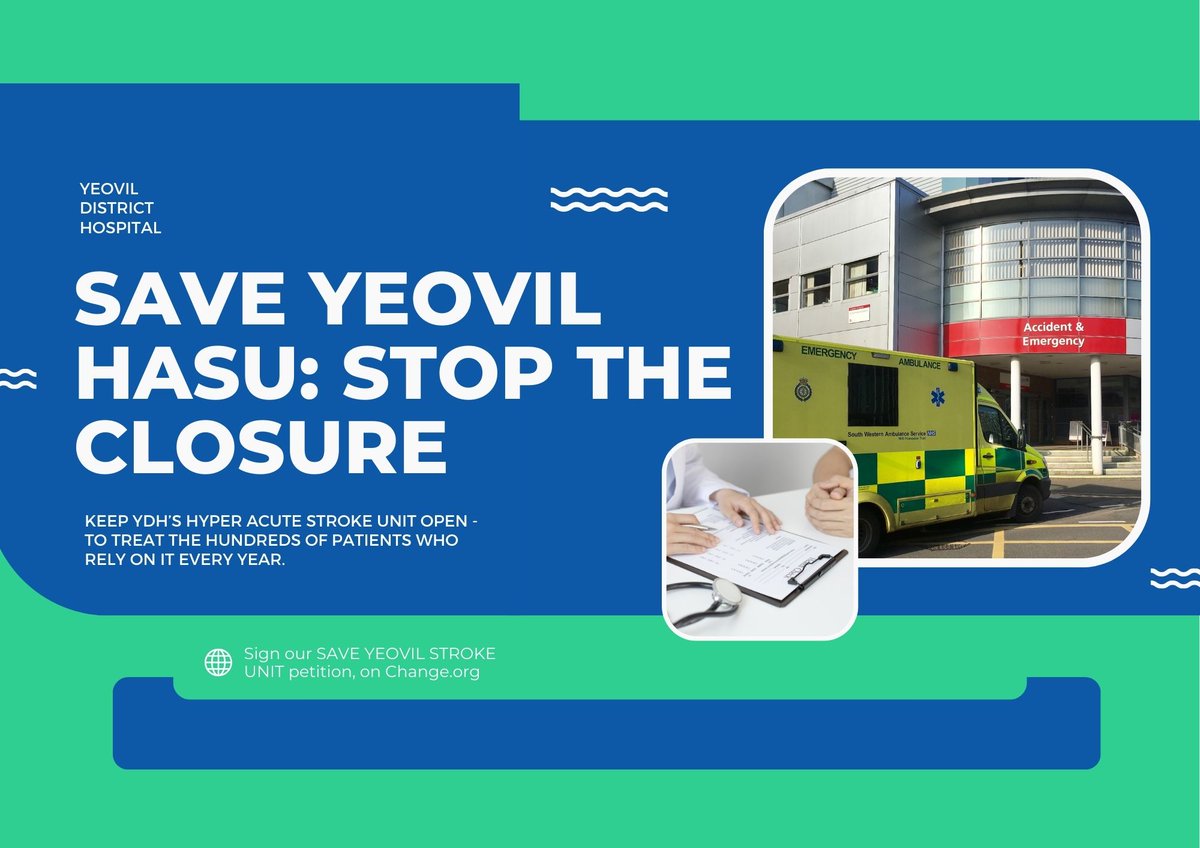
TODAY - Join the COMMUNITY LOBBY AGAINST CLOSING Yeovil Hospital's Hyper Acute Stroke Unit. Outside NHS Somerset ICB, THURSDAY 25 JANUARY, from 10am onwards, Lufton Way, Yeovil, BA22 8HR📷📷 Sign and SHARE the Petition:
https://t.co/KNoOqxlxUD
I was too Jewish for the BBC and too BBC for the Jews.
That's why I welcome Lord Mann's review into antisemitism at the BBC and what I said when asked about it in @TimesRadio breakfast this morning.
And I'm not alone. Since it was announced, quite a number of former colleagues have contacted me. They welcome it too, and they're looking forward to talking honestly about their experiences in a confidential, safe space.
The BBC's internal processes failed me. After a series of horribly antisemitic comments, I went to my bosses for advice. Instead of helping, they made me put in a formal complaint. That set off a process lasting the best part of a year, during which I was sidelined, banned from the office and, over time, banned from doing many parts of my job.
The isolation and loneliness made me very unwell. It didn't stop management deciding, when it was over, to 'reorganise' me out of the organisation. Same job, different title. I was made to reapply while I was still unwell, then told I wasn't good enough. That was the same year my films won an Emmy, a BAFTA and an Oscar for the BBC.
That's the trap Jewish staff are caught in. At home, friends and family give them a hard time for working there, because they think the BBC is antisemitic. At work, some colleagues have decided that all Jews and Zionists are evil baby killers.
I love the BBC. I gave it most of my career. But it will only be the BBC it should be when Jewish staff can do their jobs without fear. This review is the chance to make that happen.
https://t.co/QgXjdIJyqu
Robin Williams had a deep, lifelong passion for cycling that served as both a creative outlet and a source of peace. An avid rider and collector, he amassed a curated collection of dozens of custom and rare bicycles—many of which were later auctioned to support charities
For years I couldn’t tell my children what was really wrong with me, or why. Ive written about it on substack.
While my complaint about antisemitism at work went through the BBC’s internal process, I was warned not to talk about it. So I kept it from almost everyone, even my mum in her care home.
The stress made me more and more unwell, until I almost withered away. I told my two adult children it was some mystery illness and that everything at work was fine. They knew I was lying. I knew they knew.
People keep calling me brave for speaking up now. I don’t feel it.
I never signed an NDA. I didn’t need to. The warning came from the people who held my job in their hands. I was frightened of being seen as a troublemaker and of losing my job, and that fear is what kept me quiet.
The law on NDAs is changing, and that’s welcome. But it only covers the agreements people sign. It doesn’t touch the silence imposed while a complaint is being heard.
One of the changes I'm calling for: anyone who raises a complaint should be told, in writing, that they’re free to talk to their family, their doctor and the people supporting them.
Confidentiality should protect the people who complain. Not silence them..
My latest substack piece
https://t.co/WapkBLZywV
#BBC #NDAs #antisemitism #bbcharter #MentalHealthAwareness.
When I first came across @MNobodyAgainst Putin, it was a Russian schoolteacher with a camera and a story nobody could guarantee.
At BBC Storyville, I was the first broadcaster to commit to it. It went on to win an Oscar, a BAFTA and a Peabody.
The first money is always the hardest to find. Once someone says yes, others follow.
With everyone at @IDFAindustry this week talking about how documentaries get funded, it’s worth remembering that someone has to go first.
That’s what I’m doing now: helping filmmakers find their first backers and the right partners. If you’ve got a film that needs them, do get in touch.
#IDFA2026 #Documentary #FilmFunding #CoProduction
Last October I sat on a BAFTA stage talking about a film I’d commissioned.
A few months later it won an Oscar.
What the audience couldn’t see:
The BBC was making me redundant.
I weighed almost nothing.
The next morning I was being admitted to an eating disorders unit.
I was desperately clinging on to my job, because I genuinely couldn’t see any point to me without it. For thirty years, if you’d asked me who I was, I’d have reeled off my CV.
The photo on the left is me that night. The one on the right is me last weekend.
Anorexia isn’t just a teenage girl’s illness. It nearly took everything from a woman my age with three decades in journalism behind her. And I hid it from almost everyone, including myself.
This week someone asked me to finish the sentence “I am a...” and I couldn’t.
So I’ve written about it. About losing my job, nearly losing myself, and finding out who I am without the BBC.
If you’ve ever felt your job was the only thing holding you together, this one’s for you.
https://t.co/iTnzTKwiQU
#Morethanmyjobb #EatingDisorders #MentalHealth
So I had a bit of a slip on the frost the other day coming down the Tor and managed to pull my hamstring quite badly. So I'm stuck to the lanes at the moment until it gets a bit better. So if anyone has got any spare sympathy can you send it my way please as feeling a bit sorry for myself after two years of on and off health problems. 😭💜🙏 Image taken this morning shortly after sunrise here in Glastonbury.
@Glastomichelle Bless you Michelle. I’m laid up myself after hip surgery. So empathise with you. Be kind to yourself. Wishing you complete recovery and restoration 😎
It is a basic principle of American democracy that the government can’t selectively target individuals simply because of their political beliefs or what they say. But that’s exactly what the Trump Administration is doing to Congresswoman Ilhan Omar of Minnesota.
To understand why this is so appalling, it’s important to know the facts. Congresswoman Omar came to this country with her father when she was 12 years old. Five years later, her father became a naturalized citizen. If Ilhan had been 18 at the time, she would have had to apply for citizenship separately. But because she was 17, she became a naturalized citizen automatically.
Congresswoman Omar went on to graduate from college, work as a community organizer, become the first Somali-American legislator elected to public office in the U.S., and win a seat in Congress. There, she has been one of the Trump Administration’s fiercest critics, which has led the president to repeatedly single her out as someone who he believes does not belong in this country.
Now the Administration is actively trying to deport Congresswoman Omar, seemingly based solely on the unsubstantiated theory that she was actually 18 when her father was naturalized, and therefore is not a citizen. Federal agents have raided her home, confiscated personal records, and seized her phone — all to try and uncover a nonexistent smoking gun from 20 years ago that will somehow make their case.
Think about that. The full weight of the federal government is being brought down on a law-abiding elected official because she has dared to criticize the president. And it’s not the first time this has happened. Under President Trump, the Justice Department has repeatedly gone after those he considers his political enemies — from the Attorney General of New York, to the former head of the FBI, to members of the Federal Reserve.
In those cases, the prosecutions either stalled or were dismissed for having no basis in law, and the same is likely to happen in this case. But not before Congresswoman Omar’s life has been turned upside down, her legal bills have piled up, and she’s been forced to spend time fighting unsubstantiated charges instead of serving the people of Minnesota.
The fact that any president, or any administration, is willing to engage in such transparent efforts to intimidate someone should outrage all Americans, regardless of how they feel about Congresswoman Omar’s political views. Because if this becomes the new normal, there’s no reason to believe it will stop with her — or that future presidents, in either party, won’t do the same.
A British biologist looked at 200,000 years of human history and found that the entire reason humans broke out of poverty was not intelligence, not language, not even agriculture, but one mechanism so simple a 6-year-old could explain it.
His name is Matt Ridley.
He is a zoologist by training, an evolutionary biologist by career, and in 2010 he wrote a book called The Rational Optimist that quietly argued the most important fact about human progress had been hiding in plain sight for the entire history of economics.
Naval Ravikant has been telling people to read everything Ridley has ever written for the last 15 years. The reason is the argument inside this one book.
For 200,000 years, anatomically modern humans walked around with the same brain you have right now. Same skull size. Same neural architecture. Same raw capacity for language, planning, and abstract thought.
For roughly 190,000 of those years, almost nothing happened. Generation after generation lived and died inside the same Stone Age toolkit their great-great-grandparents had used. Then somewhere around 50,000 years ago, the line on the chart of human progress started to tick upward. Then it bent. Then it exploded.
The question Ridley spent years on was the only question that mattered. What changed.
It was not the brain. The brain had been the same for 190,000 years. It was not language, which had existed long before the takeoff. It was not even agriculture, which arrived only 10,000 years ago and was actually preceded by the upward bend, not the cause of it.
What changed was that humans started trading with strangers.
This sounds too small to be the answer. Ridley argues that it is the answer to almost everything. The moment one human exchanged a useful object with another human from a different group, something happened that no other species on earth had ever done.
Two ideas that had developed in isolation came into contact. The flint knapper learned what the spear maker had figured out. The fisherman from the coast learned what the hunter from the forest had figured out. The two pieces of knowledge fused into something neither side could have produced alone.
Ridley calls this ideas having sex. The phrase sounds frivolous and it is meant to. The point is that ideas, like genes, get better when they combine with other ideas from different lineages.
An idea sitting inside one head, no matter how brilliant the head, eventually hits a ceiling. The same idea exposed to ten thousand other ideas does something genes do under sexual reproduction. It mixes. It recombines. It produces offspring nobody planned.
The cleanest proof of this argument is the most uncomfortable case study in the book. Tasmania.
Around 10,000 years ago, rising sea levels cut Tasmania off from mainland Australia. A population of roughly 4,000 humans was now isolated on an island, with no possibility of contact with the rest of humanity. They had the same brains. The same language. The same starting toolkit as their cousins 150 kilometers north. The natural experiment was now running.
What happened next is something no economist or geneticist had ever predicted.
The mainland Australians kept inventing. Boomerangs. Spear-throwers. Fishing nets. Bone needles for sewing fitted clothes. Watercraft with paddles. Their technology compounded slowly across the centuries.
The Tasmanians went the other way. They did not just fail to invent the new tools their cousins were developing. They started losing the tools they already had. Fishing was abandoned within a few thousand years. Bone tools disappeared. Fitted clothing disappeared. They forgot how to make fire from scratch and started carrying lit firebrands from camp to camp instead, relighting their fires from a neighbor's whenever their own went out.
By the time European explorers arrived in the 17th century, the Tasmanians had the simplest toolkit of any human society ever recorded. Their material culture had gone backward for 8,000 years.
The archaeologist Rhys Jones called it a slow strangulation of the mind.
Joseph Henrich at Harvard later proved with formal mathematical models that there was nothing wrong with Tasmanian brains. There was something wrong with their network. A toolkit requires a critical mass of people exchanging skills to maintain itself.
The act of teaching a skill is imperfect. Every generation loses a small percentage of what the last generation knew. If your population is large enough and trading widely enough, those losses get caught and corrected by someone else who still remembers.
If your population shrinks below a certain threshold and stops mixing with outsiders, the small losses compound until entire technologies disappear.
This is the part that should haunt anyone reading this in 2026.
Intelligence is not a property of the individual brain. Intelligence is a property of the network the brain is connected to. A genius in isolation will produce less than a mediocre thinker inside a dense exchange of other mediocre thinkers.
The thing your ancestors needed in order to break out of 190,000 years of stagnation was not better brains. It was better connections between brains they already had.
The implication for any individual is direct and uncomfortable. If you are smart and isolated, you will be outproduced by people half as smart who are connected.
The most successful people in any field are almost never the smartest people in it. They are the ones positioned at the intersection of the most idea flows. They are reading more authors than their competitors. They are talking to more people from more disciplines. They are in the rooms where ideas from different lineages bump into each other.
Ridley ends the book on the line that sounds optimistic but is actually a warning its this "The future will be invented by people who connect ideas, not by people who guard them."
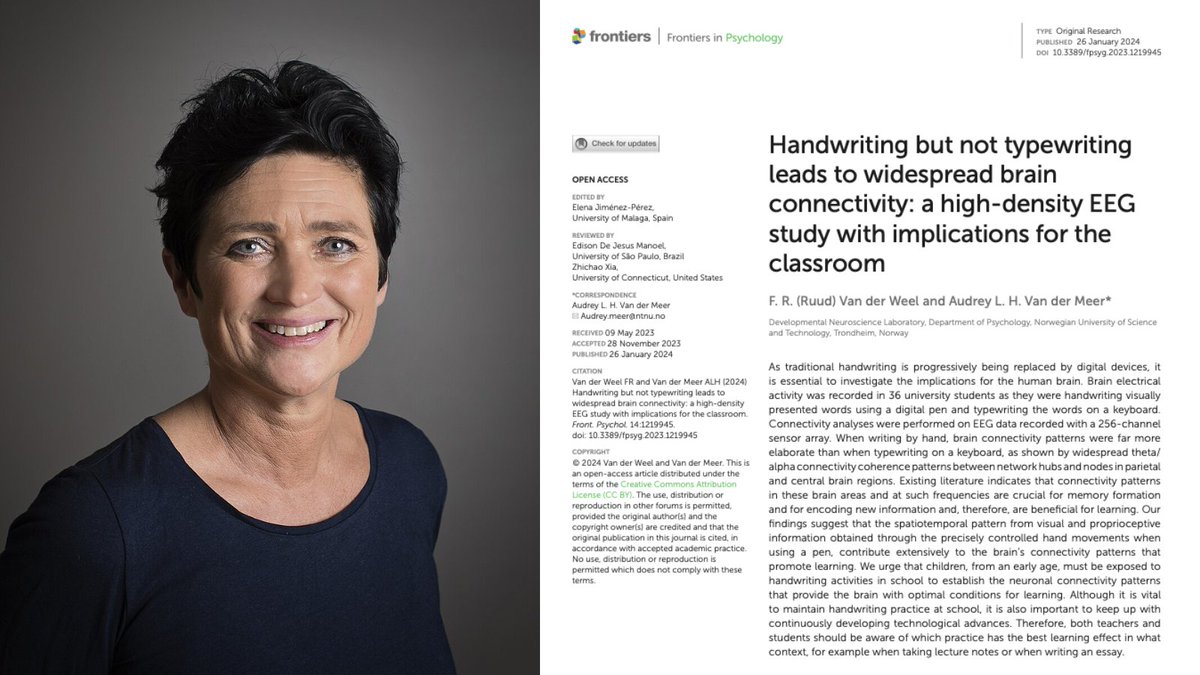
A Norwegian neuroscientist spent 20 years proving that the act of writing by hand changes the human brain in ways typing physically cannot, and almost nobody outside her field has read the paper.
Her name is Audrey van der Meer.
She runs a brain research lab in Trondheim, and the paper that closed the argument was published in 2024 in a journal called Frontiers in Psychology. The finding is brutal enough that it should have changed every classroom on Earth.
The experiment was simple. She recruited 36 university students and put each one in a cap with 256 sensors pressed against their scalp to record brain activity. Words flashed on a screen one at a time.
Sometimes the students wrote the word by hand on a touchscreen using a digital pen, and sometimes they typed the same word on a keyboard. Every neural response was recorded for the full five seconds the word stayed on screen.
Then her team looked at the part of the data most researchers had ignored for years, which is how different parts of the brain were communicating with each other during the task.
When the students wrote by hand, the brain lit up everywhere at once.
The regions responsible for memory, sensory integration, and the encoding of new information were all firing together in a coordinated pattern that spread across the entire cortex. The whole network was awake and connected.
When the same students typed the same word, that pattern collapsed almost completely.
Most of the brain went quiet, and the connections between regions that had been alive seconds earlier were nowhere to be found on the EEG.
Same word, same brain, same person, and two completely different neurological events.
The reason turned out to be something nobody had really paid attention to before her work. Writing by hand is not one motion but a sequence of thousands of tiny micro-movements coordinated with your eyes in real time, where each letter is a different shape that requires the brain to solve a slightly different spatial problem.
Your fingers, wrist, vision, and the parts of your brain that track position in space are all working together to produce one letter, then the next, then the next.
Typing throws all of that away. Every key on a keyboard requires the exact same finger motion regardless of which letter you are pressing, which means the brain has almost nothing to integrate and almost no problem to solve.
Van der Meer said it plainly in her interviews.
Pressing the same key with the same finger over and over does not stimulate the brain in any meaningful way, and she pointed out something that should scare every parent who handed their kid an iPad.
Children who learn to read and write on tablets often cannot tell letters like b and d apart, because they have never physically felt with their bodies what it takes to actually produce those letters on a page.
A decade before her, two researchers at Princeton ran the same fight using a completely different method and ended up at the same answer. Pam Mueller and Daniel Oppenheimer tested 327 students across three experiments, where half took notes on laptops with the internet disabled and half took notes by hand, before testing everyone on what they actually understood from the lectures they had watched.
The handwriting group won by a wide margin on every question that required real understanding rather than surface recall.
The reason was hiding in the transcripts of what the two groups had actually written down.
The laptop students typed almost word for word, capturing more total content but processing almost none of it as they went, while the handwriting students physically could not write fast enough to transcribe a lecture in real time, which forced them to listen carefully, decide what actually mattered, and put it in their own words on the page.
That single act of choosing what to keep was the learning itself, and the keyboard had quietly skipped the choosing and skipped the learning along with it.
Two studies. Two countries. Same answer.
Handwriting makes the brain work. Typing lets it coast.
Every note you have ever typed instead of written went into your brain through a thinner pipe. Every meeting, every book highlight, every idea you captured on your phone instead of on paper was processed at half depth.
You did not forget those things because your memory is bad. You forgot them because typing never woke the part of the brain that would have made them stick.
The fix is the thing your grandmother already knew.
Pick up a pen. Write the thing down. The slower road is the faster one.
"Every record has been destroyed or falsified, every book rewritten, every picture has been repainted, every statue and street building has been renamed, every date has been altered. And the process is continuing day by day and minute by minute. History has stopped. Nothing exists except an endless present in which the Party is always right"
– George Orwell, 1984
@MartinSLewis You're not a proper adult until you've got a four drawer metal filing cabinet with suspension files for banks, council tax, car documents, credit cards, house maintenance etc.
@ALCS_UK - Hi, what's the latest on this campaign? Have ALCS issued a more recent update on efforts to force the government to re-think its plans on AI & Copyright - https://t.co/ZWaFVKC3ky
@graceproduction Thanks for your patience, Ray. While the exact percentage can vary depending on the specific configuration of the vehicle, the cobalt content typically ranges between 10% and 15%. You can find more useful information about our batteries here 👉 https://t.co/UHWs6Lr6ME ^MT
Hey @NissanUK have you had chance to consider my message from last week? (copied below). I'll cc in @NissanUKPR in the hope someone will spot this, and provide a reply to a genuine question from a long-standing Nissan customer. Thanks in advance. 😎
.@NissanUK - how do i get a straight answer to the question of how much cobalt is present in the battery of my Nissan LEAF 2020? Customer service have sent me a general response, about moving towards EV batteries with no cobalt at some unspecified point in the future??
.@NissanUK - how do i get a straight answer to the question of how much cobalt is present in the battery of my Nissan LEAF 2020? Customer service have sent me a general response, about moving towards EV batteries with no cobalt at some unspecified point in the future??