studying food choice to inform policy|@ageconomics,@hbltamu, @iha_tamu at @TAMU|formerly at @AgroyForestalUC |@uga_aaec @EAPZamorano alumni|life is a dance
I'm stepping down as dept head after my term ends in July 2025 - so we are looking for new department head at TAMU @ageconomics. See https://t.co/r3tRdqAtpx. Please help us spread the word. Thank you.
Clubs and networks in economics:
Authors with connections to editors via same PhD program, work relationships or co-author networks more often avoid desk rejection.
Referee decisions influenced by PhD, employment matches, signalling.
Great connectivity papers get fewer citations
TAMU @ageconomics invites applications for a new leader of our top ranked Master of Agribusiness (MAB) program - at associate/full prof level, tenure track/tenured. See https://t.co/vDdz94WiF5. Please help us spread the word. Thank you.
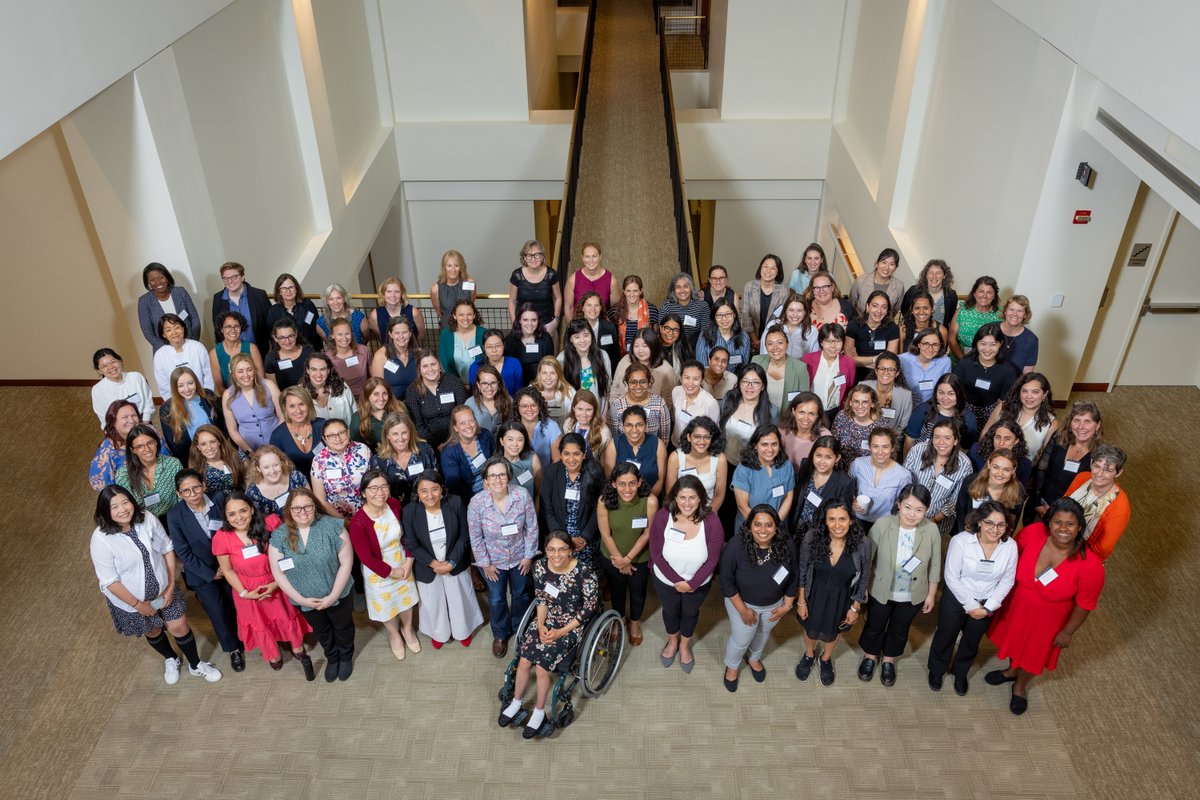
Excited to welcome CeMENT mentors and mentees to the Chicago Fed this week. The CeMENT program by @AEACSWEP focuses on mentorship of women and nonbinary faculty in tenure-track positions in economics departments and other institutions. #CSWEP https://t.co/byHUDFoW1R
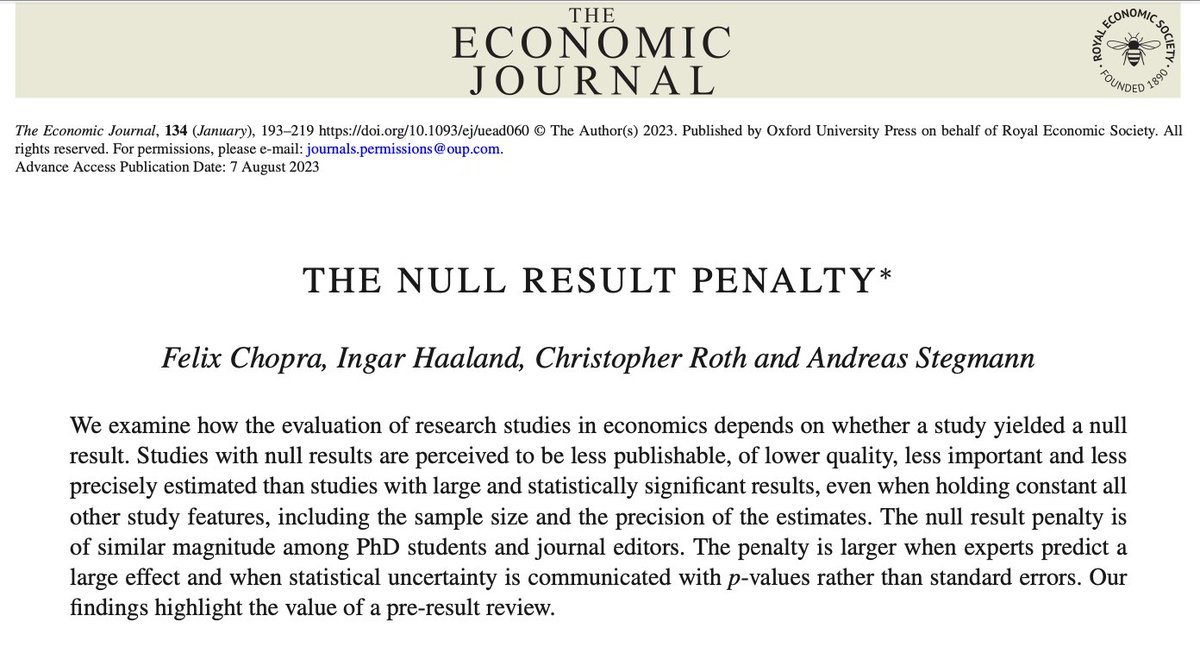
On the topic of null results, this paper is absolutely fascinating. Holding all else constant (precision, p-values, etc.), studies are deemed much less publishable, *lower quality* and less important when results are null vs. significant 😳
CC: @carlislerainey
TAMU @ageconomics has a new assistant/associate professor & extension specialist position opening. Please help us spread the word: see https://t.co/sgZNXFsZaP. Thank you.
This study analyzes whether, following the implementation of Chile's Food Labeling and Advertising law targeting highly processed, households improved their fruit purchase decisions: purchase participation (i.e., buying likelihood) and purchase quantity.
Considering that households in Chile do not meet health recommendations for daily fruit intake, additional policy efforts targeting healthy, unprocessed food consumption could be considered.
After controlling for socioeconomic factors (e.g., prices and income), results indicate that only purchase participation increased, providing weak support for positive spillover effects of a comprehensive food policy on fruit purchases.
Our latest work: The expansion of the online purchasing pilot has helped address barriers to in-person shopping for low-income families during the first few months of the pandemic. https://t.co/pRbAKwSaUl
I applaud that editor. I believe there is a bias in editorial decisions in econ journals in favor of papers that “look hard” to produce. Degree of difficulty should be used to judge gymnastics and figure skating, not scientific contributions.
Some people falsely believe that papers using RCTs can only test whether something works or not, but cannot shed light on the underlying mechanisms.
What are great papers to use as examples to illustrate that this is not the case?
#econtwitter#followerpower
Interested in behavioral science?
Imagine you are a manager between a framing intervention (lives lost/lives saved ), or set a default (one option preselected). Which changes choices more?
We tested 6000+ online participants in 11 samples. Which was more effective?
More thoughts on “academic” mothers:
- Most PhD students don’t want kids in their 20s. In my 20s and early 30s I wanted to be as care-free as male colleagues
- Outsourcing? Many of us want to enjoy our kids
- Travel & weekend work is v. hard for women with kids under 2 (1/2)
I fully endorse this.
In fact, I think all my students (including undergrads discussing papers in class) must be tired of me asking:
1) “but…what is the question?”
2) “why is it important?”
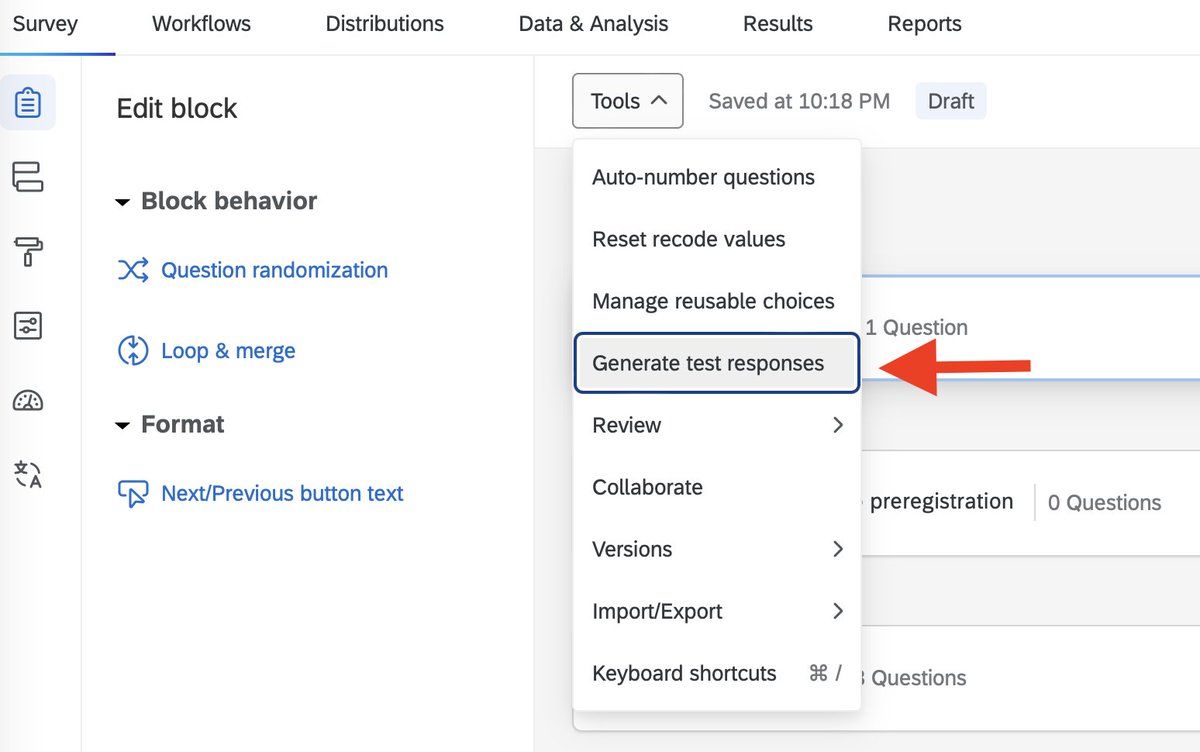
Tip for folks who do survey research with @Qualtrics : before fielding (or pre-registering), highly recommend generating test responses first. Two big reasons. 🧵