The mandatory Canada Pension Plan contribution rate for self employed is 11.9% of the first $74,600 of pensionable net business income, plus an additional 8% on the next earnings up to a max of $85,000 income
🚨🇨🇦 Why the Canadian dollar keeps falling. The actual reasons.
📌 Recession: only G20 nation in one
📌 Rate differential: Bank of Canada cutting, US holding
📌 Capital flight: $1 trillion out in a decade
📌 Trade risk: CUSMA uncertainty, China EV friction with Washington
📌 Productivity collapse: less machinery than a decade ago
📌 Energy handicapped: carbon tax kills competitiveness
📌 Debt expanding: $3.2B grocery announcements with no funding source
Currency markets don’t watch press conferences.
They watch fundamentals.
Every Canadian fundamental is pointing the wrong direction.
Your grocery bill isn’t just inflation.
It’s a falling dollar making every import more expensive permanently.
#CdnPoli #CAD #Recession #Carney
Milton Friedman on inflation:
“Inflation is just like alcoholism. In both cases when you start drinking or when you start printing too much money, the good effects come first. The bad effects only come later.”
“That’s why in both cases there is a strong temptation to overdo it: to drink too much and to print too much money.”
“When it comes to the cure, it’s the other way around. When you stop drinking or when you stop printing money, the bad effects come first and the good effects only come later.”
“That’s why it’s so hard to persist with the cure.”
So what exactly is the problem with letting citizens have a say?
Oh right.
Control. Power. Greed.
And it is no surprise who is paying for articles like these.
What I do not understand is how these people sleep at night. Is the money really worth it?
Is it worth undermining public debate?
Is it worth dismissing citizens?
Is it worth sacrificing the interests of future generations?
Is it worth trying to convince people that democratic participation is somehow dangerous?
Judging by the full-blown fear and disparagement campaign now underway, I think we are getting our answer.
So thank you for coming out and showing everyone exactly what you stand for.
Minister MacKinnon also pushed failed billion dollar EV subsidies, the failed Canadian Infrastructure Bank, Firearm Buyback Program which was originally projected to cost taxpayers $200 million but now cost $1 billion, and the cancelled 2 Billion Trees Program after it fell 89% short of its tree-planting target - taxpayer expenses totaled $487.8 million, including $44.6 million entirely lost to administrative costs.
Outrageous
PBO reported yesterday that FM Champagne misled Cdns on the true size of the 2025–26 federal deficit.
In the Spring Economic Update Champagne projected a deficit of $66.9B for the 2025–26 fiscal year. However, the PBO now estimates the actual deficit will be significantly higher at $72B — higher by $5.1B.
More: PBO projects that deficits will average $4.6 billion higher per yr than the government’s projections through 2030–31.
BREAKING: U.S. dairy industry argues Canada is using its supply-managed system to generate surplus dairy proteins and exporting them through product categories not explicitly capped under CUSMA, want that addressed during the next trade review.
This will get ugly.
If the cost of a new 1MM Bbl/d pipeline is Pathways, a $30BN project conceived in a vastly different world that erodes our competitiveness, then I say nay. It took me 4 hours to get my 6 year old an ankle x-ray last night...we do not have to live like this, yet choose to. Sad.
The Bank of Canada now faces the same trap confronting central banks globally. If rates remain elevated, households continue cracking under debt burdens and mortgage renewals. If rates fall aggressively, inflation risks accelerating again while the currency weakens further. Years of artificial monetary policy distorted housing values, encouraged leverage, and created an economy overly dependent on debt-fueled consumption.
- Martin Armstrong
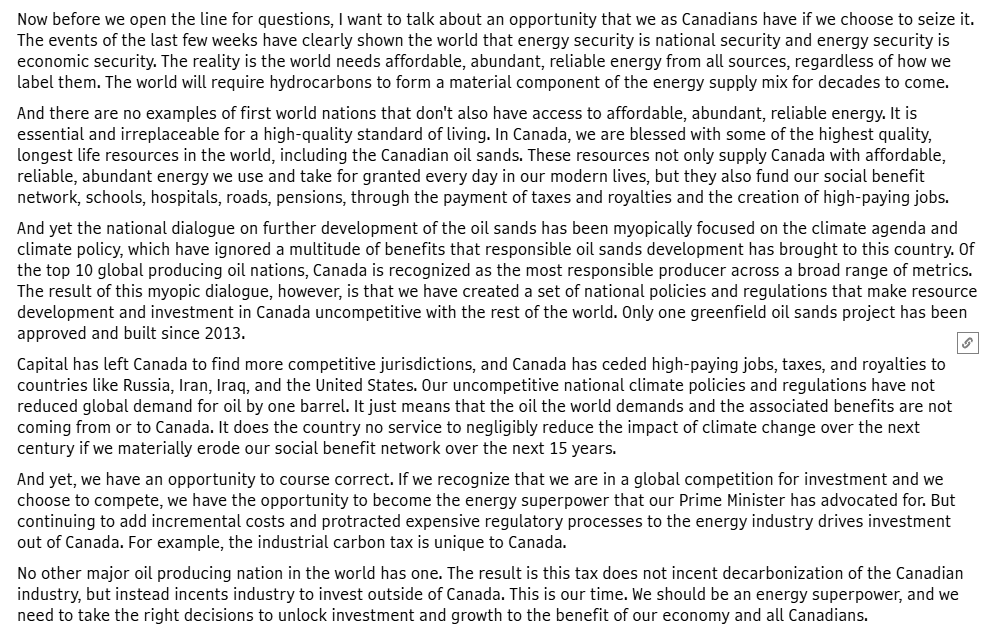
Not a single purchaser of crude oil in the world asks nor cares about the carbon footprint of the barrel, instead is 100% focused on accessibility, affordability, and reliability. I do not see how we overcome this massive misunderstanding which underpins all ongoing negotiations.
Jon McKenzie, CEO of Cenovus, came out swinging on their Q1 conference call today. Great to see CEO's becoming more vocal about our squandered opportunity! To summarize: no other oil producing country is doing this to themselves...time for Canada to wake up!
The printing press is on fire. 🖨️🔥
Canada’s money printing surged 32% YoY:
•This year: $25.5B
•Last year: $19.3B
More "money" = less value. That’s why your cost of living is in a death spiral. 🇨🇦📉
U of T economist, Josef Steinberg responds: "I get that this elbows-up crap plays well politically within Canada, but as Kevin A. Bryan, Chief Economist, CDL Toronto states, it's "economic malpractice." Our physical proximity to the US isn't a weakness---it's one of our most valuable endowments.
The post is false.
The nominal number being used is not accounting for inflation.
The real (inflation-adjusted) number of 2025 inflows are equivalent to roughly $67 billion when expressed in 2007 purchasing power terms.
So investment is much lower now than 2007.
ALSO:
It’s a net number, not gross inflows. Flattered by a sharp slowdown in Canadian investment abroad and coming off an unusually weak 2022 base.
In other words, the improvement is as much about Canadians pulling back as foreigners leaning in. A reversal from a very bad year does not equal a boom.
How much new, long‑term, productivity‑enhancing capital is Canada attracting?”
The answer is far less impressive:
• Business investment remains weak
• Productivity growth is poor
• Capital deepening is lagging peers
• Domestic firms are very cautious, not exuberant
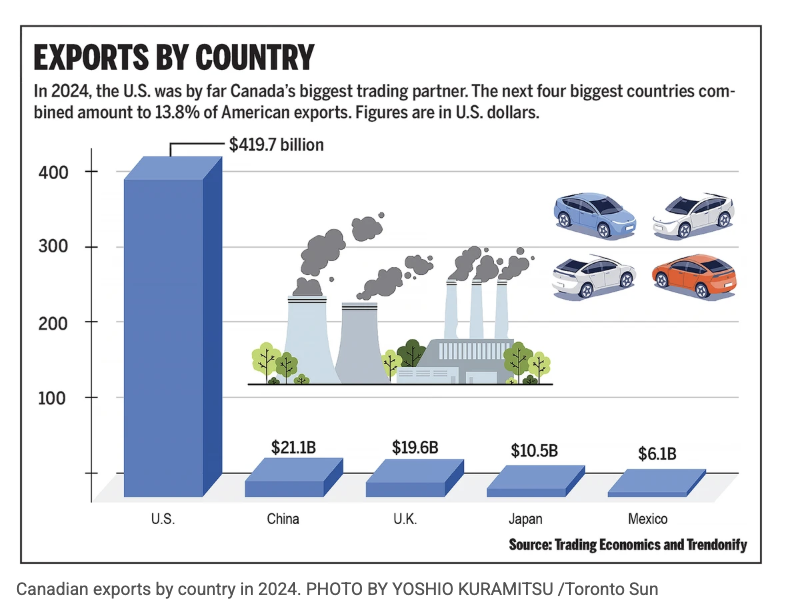
You really think we can pivot quickly on trade to replace the United States.
Here are Canada's exports by dollar value and country for 2024. The annual exports to the next four largest markets don't equal two months of trade with the Americans. Diversifying trade will take time.
I'm telling you folks, Canada is simply not open for business. Excessive regulations, high taxes despite having a relatively small market that is widely dispersed. If you want efficient, low-cost scale, choosing the US over Canada is a no-brainer for start-ups.
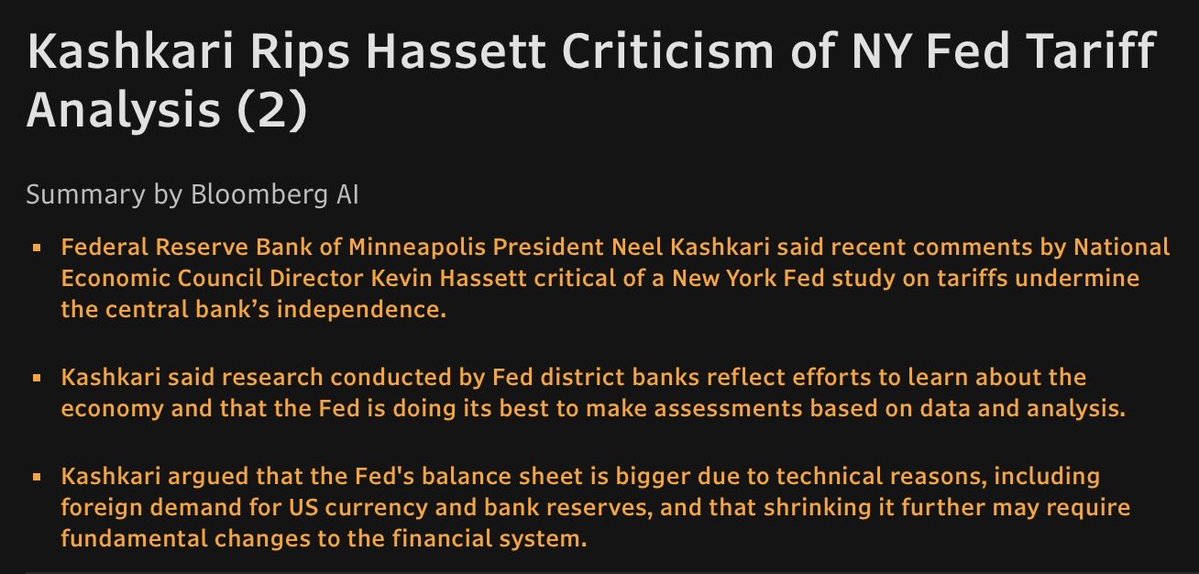
In my 40+ years of being an economist, I have never seen the Fed more overtly political. Nor have I seen a battle like this errupt between the Fed and Whitehouse. The Fed has always had an unwritten rule about commenting on fiscal policy issues. It quietly supported TARP. It ignored the Obama tax hikes, and the massive Biden deficits. It ignored millions of illegal immigrants crossing the border. It ignored hundreds of billions in spending and subsidies being shifted toward solar and wind, which are less productive than fossil fuels. It also monetized that spending with Quantitative Easing. It cut rates before the 2024 election (which it has always tried to avoid). Now some on the Fed are saying they want to raise rates due to fears of inflation even though inflation was higher in 2024 when it cut rates. And the Fed can’t shut up about tariffs. It is patently obvious that the Fed has decided to play politics. They will argue that Trump started it. But QE actually started it. The Fed funded big growth in government and deficits. For Kashkari to blame Hassett for undermining Fed independence is laughable. No one should know the names of the people on the Fed…but these people are trying to be controversial. They want to be political. The Fed’s balance sheet must be trimmed…along with many thousands of Fed staff. It is absolutely untrue that the world is safer because of the massive increase in the size of the Fed’s balance sheet. The Fed is full of itself. I want a smaller, humble, quiet and much less active Fed.
Yep - Jack Mintz and I are totally aligned on this:
“So much for affordability. At the rate at which federal and provincial governments are spending and running up deficits these days, at some point politicians will raid our bank accounts. If the federal government has a majority — maybe after winning a snap spring election — it will be easier for it to hike taxes afterwards on unsuspecting voters...
With surging, deficit-financed public spending, pressure will mount to raise, not lower, taxes. In just the past two weeks, the federal government, already carrying a forecast deficit of $78.3 billion, has introduced two new costly programs. The first is another Liberal social program — the Canada Groceries and Essentials Benefit — expected to cost $12 billion over six years. The second is the reinstatement of subsidies to purchase EVs — $2.3 billion over the next five years — and Canada Infrastructure Bank funding for EV-chargers ($1.5 billion).
…As the federal debt grows, so will debt charges, already expected to reach $61 billion this coming year — more than the $58-billion Canada Health Transfer…
How do whopping tax increases mesh with the affordability agenda? They don’t.
What are the average family’s most important expenditures?
…As you might have guessed by now, the biggest household expenditure is tax paid to governments. On average, income taxes are $23,681, almost 22 per cent of the $108,000 spent on average in 2023 on goods, services, taxes and government fees...
If we really want to address affordability, tax cuts are the place to start. Many household budgets are already stretched. Higher taxes will only make it worse...
In the past year, several governments have offered token tax cuts. The Carney government reduced the lowest marginal income tax rate from 15 to 14 per cent. Alberta cut its 10 per cent tax rate for people with taxable income less than $60,000 to eight per cent...
What we haven’t seen so far is a focus on reducing the most harmful taxes in the economy, those that are holding back Canada’s growth. High marginal and average income tax rates discourage work and saving. Complex corporate income tax provisions and business subsidies favouring slow-growth industries like forestry and manufacturing come at the cost of keeping corporate taxes high on growth sectors like technology, finance and communications.
If there is room to cut taxes, we should focus on reductions that would improve affordability while growing the economy. A sharp increase in the working benefit would encourage low-income Canadians to participate in the work force; expanding the GST credit, which is what the government decided to do, will have the opposite effect.
Governments may soon find themselves in a box as deficits grow in a weak Canadian economy. If they raise taxes and make life more unaffordable, voters will show up at the ballot box and let them know about that.”
https://t.co/5KrJIrzLAN