If AI mapped a cure for terminal pancreatic cancer I don't think anyone would dare complain about its effects on medical unemployment.
But people are upset that AI can solve math problems and cause unemployment in performative mathematics.
Fuck them.
It can not be stated enough just how bad this messaging is from GHL:
- the FF+ is a natural ally of the DA, not a foe
- it is well known that the DA has lost support to the FF+ because of Steenhuisen’s behaviour, but this will not convince a return
- opinions vary but many consider Groenewald to be the best Minister in the GNU and not any of the DA Minsters. Attacking him comes across as jealous and petty
- the issue being raised by GHL was not created by Groenewald or the FF+, but he is trying to sort it out. Imagine this logic of attack being applied to Macpherson who still has no control over thousands of assets of state owned infrastructure, or Schreiber who has numerically done nothing to stem/reverse illegal immigration
- criticizing someone outside the DA for holding a “talk shop” is very rich when the DA does this exact thing often
- lastly is that Helen Zille will likely be the Mayor of Johannesburg by year end. Just imagine all of the things she will not be able to fix in her first 2 years - GHL just opened the floodgates on hammering her without rebuke
Whomever advised this as a strategy needs to be fired immediately, and the DA really needs to learn how to predict the future consequences of their words and actions better. My goodness.

MEDIA STATEMENT - 05 DECEMBER 2025
SAFTU Statement – Condemnation of the Killing of Witness D – 05 December 2025
The South African Federation of Trade Unions (SAFTU) is deeply disturbed and outraged by the reported killing of Witness D — a courageous individual who testified under oath before the Madlanga Commission, providing critical evidence of alleged murder, torture, and a subsequent cover-up by officers of the Ekurhuleni Metropolitan Police Department (EMPD).
We extend our heartfelt condolences to his wife — who, according to police reports, witnessed his killing at their family home in Brakpan — and to his entire family and loved ones. His death is not only a devastating personal tragedy but a grave blow to justice, transparency, and the rule of law in South Africa.
This killing sends a chilling message of intimidation and threatens to discourage other witnesses from coming forward with information essential to stopping the deep rot exposed at the Madlanga Commission.
South Africa has a painful history of whistle-blowers and truth-tellers being assassinated for their courage. Witness D’s killing now joins that shameful list.
According to his testimony, Witness D stated that former EMPD acting deputy chief Julius Mkhwanazi allegedly ordered the disposal of the body of a suspect — tortured and killed by EMPD officers — by dumping it in a dam to conceal the murder. That a person who chose to speak truth to power should be murdered is a direct attack on efforts to root out corruption and lawlessness. It is a message to every potential whistle-blower that telling the truth may cost them their life.
SAFTU demands urgent and concrete action:
1. Independent, transparent and swift investigation
• Witness D’s killing must be prioritised and investigated independently of any institution implicated in the Madlanga Commission.
• All facts — including motive, perpetrators, and any connection to his testimony — must be established publicly and without delay.
2. Immediate activation and strengthening of witness-protection mechanisms
• Authorities responsible for the Witness Protection Programme must urgently review and strengthen protection measures for witnesses before, during and after commissions or court proceedings.
• Witnesses must be guaranteed adequate security, anonymity where necessary, and properly resourced protection.
3. Urgent review of institutional culture within EMPD and law-enforcement
• The alleged involvement of a senior EMPD officer in a murder-scene cover-up must trigger a comprehensive investigation into institutional corruption, abuse of power and the culture of impunity.
• Oversight structures must ensure that no officer, regardless of rank, is above accountability.
4. Public commitment by government and justice-system actors to uphold witness safety
• Government and all justice institutions must publicly reaffirm that witnesses who cooperate with lawful inquiries will not be left vulnerable.
• Clear timelines and practical measures must be announced to ensure this killing marks a turning point in witness protection, not another unsolved crime.
5. Support for families of slain or threatened whistle-blowers
• The family of Witness D must receive appropriate support, including safety measures, legal assistance and psychosocial services.
• Broader, permanent mechanisms must be created to support families of whistle-blowers who face danger for acts of public service.
In Closing
SAFTU mourns the brutal killing of Witness D — a man who bravely stepped forward to expose serious wrongdoing and paid the ultimate price.
His death must not be in vain. It must become a catalyst for real accountability, stronger witness protection, and the cleansing of institutions that have been allowed to decay into impunity.
We call on all civil-society organisations, human-rights institutions, the media and government to unite behind this urgent demand: Witnesses must be protected. Institutions must be cleaned up.
‘We shed as we pick up, like travellers who must carry everything in their arms, and what we let fall will be picked up by those behind. The procession is very long and life is very short. We die on the march. But there is nothing outside the march so nothing can be lost to it.’
When Mthokozisi Mvelase,27, was shot, and his body burned to ashes inside his car outside Maponya Mall in Soweto on Wednesday night, he had been working as an e-hailing driver for just three days, after years of looking for a job. @Nandile_Ntini https://t.co/9IOXy3HGNl
My God, the waffle coming out of these people. On what planet? Dreams? The problem is reality. Water doesn't come out the tap. Prediction: This dialogue is going to produce the greatest collection of vacuous cliches and platitudes ever seen. https://t.co/zQzJq9pwS4
Is the Rand undervalued – or just honest?
I was taking a long, well for me at least, 7km solitary walk down an isolated and beautiful empty beach earlier this morning, contemplating the rand, as one does at such moments in nature 🤣
The tide was going out, and it made me think: Is the rand doing the same? Or is it simply where it needs to be right now?
At around R18.70 to the dollar and R25 to the pound, some argue the rand is heavily undervalued. The Big Mac Index and purchasing power parity models suggest its “fair value” might actually lie somewhere between R8–R12/$.
But as we know, the currency consistently trades at a significant discount, not due to mispricing, but because of South Africa’s elevated risk premium and persistent structural issues: high debt, slow growth, and policy uncertainty.
In other words, the rand isn’t just undervalued, it’s also probably honest.
If you care deeply about the poor, as I do, you might ask: would a stronger or weaker rand serve those struggling, any better?
A stronger rand brings down the cost of fuel, food, and medicine. It stretches every rand further for low-income households. It eases survival.
But a weaker rand, when leveraged cleverly and wisely, stimulates exports, manufacturing, and tourism. These are industries that create jobs, especially for people without degrees or formal networks.
So, the answer is: both can help, and both can hurt, all depending on the policies behind them.
And growth?
Growth doesn’t come from exchange rates. It comes from:
•Policy certainty
•Investor-friendly conditions
•Efficient infrastructure
•Less red tape
•Zero tolerance for corruption
•Leadership that inspires belief
These aren’t luxuries. They’re the scaffolding for a stronger economy and a stronger rand.
We’ve become too used to asking what the rand is doing to us.
But perhaps we should be asking: What are we doing to deserve a stronger rand?
Because as economist and Professor Barry Eichengreen said, and I believe it deeply, “Currencies don’t shape countries, countries shape currencies”.
#SouthAfrica #ZAR #EconomicGrowth #Leadership #Rand #CurrencyTruths #GrowthWithIntegrity #PolicyMatters #ExchangeRates
Q (for business people): Is Ramaphosa - the “sensible, reasonable business-friendly president” - who has passed NHI, EWC, Bela, VAT increase, and proposed these mad race laws - actually the most ideologically radical President the ANC has ever had?
SA is regressing because, as society, we tolerate poor leadership in schools, universities, clinics, hospitals, municipalities and SOEs. Instead of holding our leaders accountable, we worship them. Respect must be earned. #LeadershipMatters
I get that business wants the stability of the GNU, but it needs to understand the GNU for its own sake is of no use. SA must reform economically. It must grow. No growth and the country is finished. It’s not about renegotiating the GNU to appease. It’s a fight for the future.
ENOCH IS ENOCH
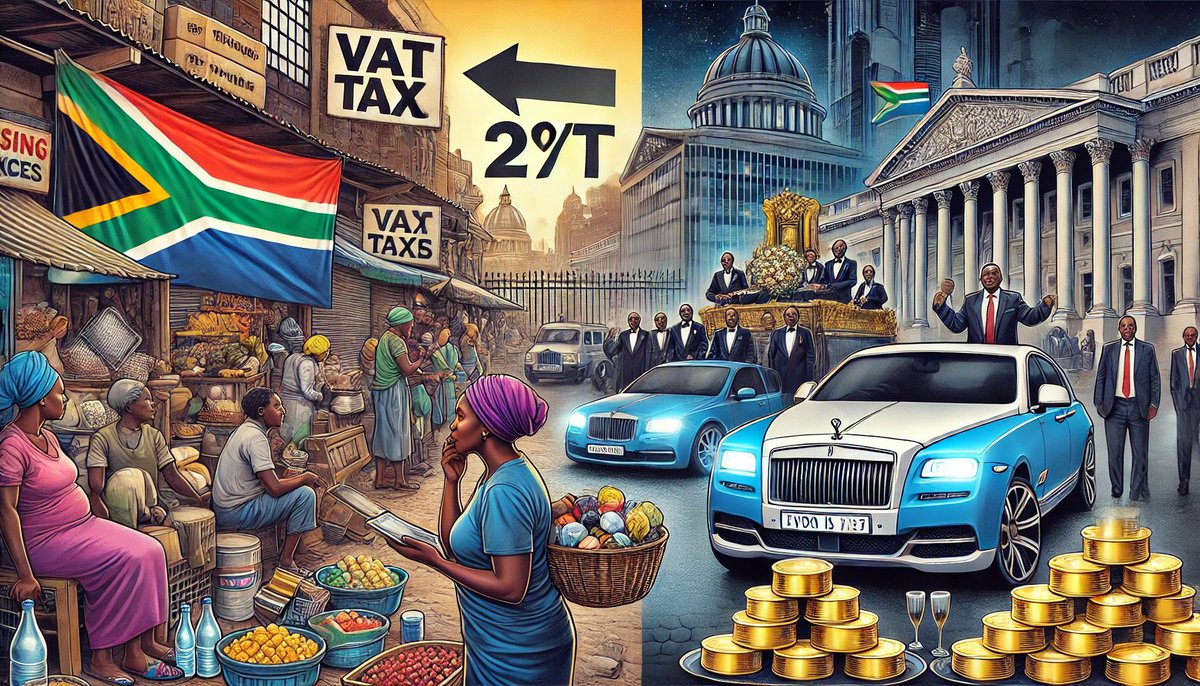
Two weeks ago, South Africans watched yet another glitzy, mega-expensive State of the Nation Address (SONA). Horses. Marching bands. Blue-light convoys. Lavish receptions. It looked more like a Hollywood red carpet event than the opening of Parliament in a country teetering on the edge of financial crisis.
And yet, here we are, being told by Finance Minister Enoch Godongwana (and I do feel for him) that we, the people, must dig even deeper to fund government spending through a proposed VAT hike from 15% to 17%.
Sorry, but Enough is Enough.
Let’s talk about where we really are. South Africa’s official unemployment rate is hovering around 31.9%. The expanded definition? A soul-crushing 41.9%. That means nearly half the country has no job, no income, no financial give at all. 13.2 million South Africans live in extreme poverty, scraping by on less than $2.15 a day (in a global perspective). And the response from government? Let’s hike VAT and make basic goods even more expensive for the people who can least afford it.
Meanwhile, instead of tightening the public purse, we’re expanding the number of ministers, bloating perks, and continuing to waste billions through endemic corruption and incompetence. If you were in financial trouble at home, what would be your first step? You’d cut unnecessary spending before running to borrow or squeeze more from those who already have nothing left to give. But not here it seems... No, first-class flights, luxury vehicles, and inflated salaries must remain untouched.
The argument that “we had no other choice” is nonsense. We always have a choice. And that choice must be economic growth, not suffocating an already struggling economy with more taxes. The only way out of this mess is through investment - both domestic and foreign (retaining AGOA too 🤯).
So here’s a novel idea: Instead of killing off consumer spending, let’s focus on creating wealth.
•Slash the fat. Cut government excess, reduce waste, and start treating public money as sacred, not a personal slush fund.
•Attract investment. Make it easy, safe, and attractive for local and global businesses to put their money here. Policy certainty, infrastructure investment, and crime control are non-negotiables.
•Back business. The private sector is the real job creator. Support SMEs, streamline regulations, and get out of the way.
•Prioritise growth. A bigger, stronger economy generates more revenue naturally - without punishing those already struggling to survive.
The truth is simple: We don’t have a tax problem. We have a growth problem. And until that is fixed, raising VAT is just putting a Band-Aid on a bullet wound.
@GovernmentZA if you’re listening: It’s time to change course. The country can’t afford for you to get this so wrong.
Orange sunset
in the deep shell of summer
a long silence reaching
across the dry pastures
in the distance a dog barks
at the sound of the door closing
and at once I am older
~ W.S. Merwin
Died #otd, in 2019