@satyanadella For research agents, the interesting part is faster evaluation between experiments. That could make it easier to revise a weak approach early and spend more time exploring promising ideas.
@StanleyWei4748 Giving agents access to software state is a promising direction. It could help university research offices automate work across older portals without having to replace the systems their teams depend on.
@amasad Agency seems like a big factor. People have more reason to welcome AI when they can shape how it’s used and see it help with work they care about.
@emollick For research, progress could mean testing important ideas that were previously too costly to pursue. That gives universities a useful target for AI adoption: expanding the questions researchers can investigate.
@alex_verem The checking agents are as interesting as the performance gains. Trust in AI-generated research will depend on whether other researchers can inspect the methods and reproduce the results.
@garrytan There’s a lot of work between a capable model and something a university can use every day. Adoption gets easier when research teams can use AI in familiar workflows and check its work.
@JonhernandezIA Human oversight will need to evolve as AI systems take on more complex work. Keeping their outputs testable and consequential decisions under human authority will be essential.
@emollick Releasing hundreds of AI generated mathematical manuscripts at once raises questions beyond model capability. The field will need new ways to verify results as quickly as they are produced.
@MollySOShea@biohub Better models depend on better scientific data. An open foundation at this scale could help researchers test ideas faster and make computational biology more reproducible.
@cryptopunk7213 It is getting harder to treat each breakthrough as a separate event. The real advantage will come from helping researchers and institutions turn these capabilities into repeatable work before the next model arrives.
@DaveShapi AI has the potential to expand mathematical discovery far beyond today’s capacity. Bringing mathematicians into the process will help turn that capability into rigorous work that other fields can actually build on.
@vikktorrrre Biology may become one of the clearest examples of AI accelerating science. When models help researchers form stronger hypotheses and shorten the path to validation, the entire discovery cycle moves faster.
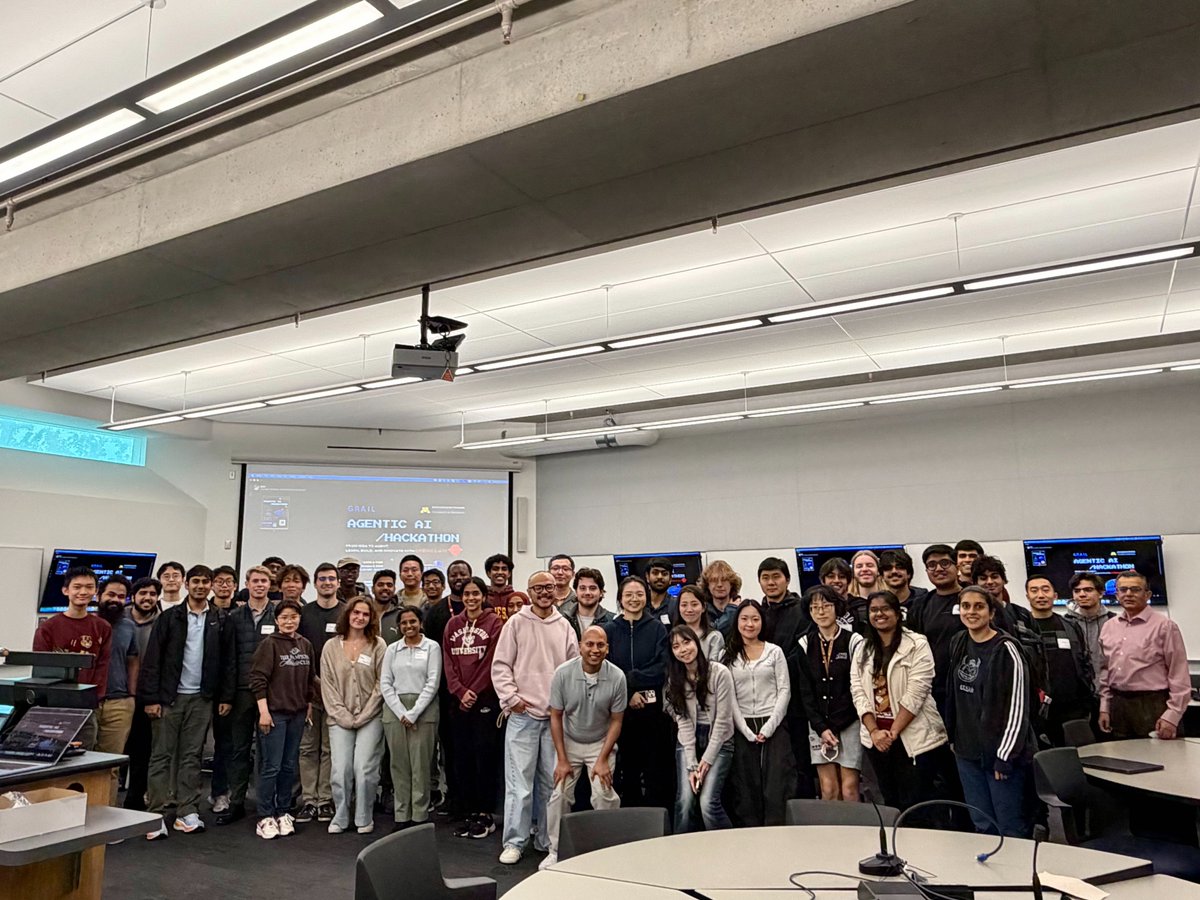
The Agentic AI Hackathon hosted by GRAIL and the University of Minnesota (@UMNews) Data Science MS Program was a great success! 🎉 Students came together to build AI agents for practical problems, and we were impressed by the thought behind their creative ideas and how well they brought them to life in working demos.
Congratulations to our winning teams! 👏
🥇 1st Place: Grasseaters
An agentic AI solution that helps professors turn complex course materials, including handwritten notes and equations, into structured, screen-reader-friendly content.
Team: Sebastian Valine, Darsh Garg, Vedangi Deshpande, Vinitendra Singh, Benny Shi, and Chunfang Wang.
🥈 2nd Place: Cross-Pollinator
An AI research agent that helps researchers discover methods from other disciplines and understand how to adapt them to their own work.
Team: Dominic Varghese, Jiacheng Xu, Pragya Parihar, and Prerna.
🥉 3rd Place: VibeCoders
GhostQA deploys autonomous AI “ghost users” to explore web apps and reproduce unexpected bugs before generating structured reports.
Team: Arush Manem, Giovanni Minatel Melo de Cerqueira, Xuan Wang, Anvith Pothula, Jaimin Shah, and Norman Swai.
A special thank you to Yao-Yi Chiang, Director of Graduate Studies for Data Science, and Allison Small from the Department of Computer Science & Engineering for helping make this event possible. We’re also grateful to our judges, Professor Shashi Shekhar and Professor Aryan Deshwal, for their time and valuable feedback.
Thank you to every student who joined us and shared their work. We’re excited to keep growing the GRAIL community and hope to see more of you at our next hackathon at @montanastate University!
#AgenticAI #Hackathon #UMN #StudentInnovation
@Dr_Singularity The scale is remarkable, but the next milestone is expert review at the same pace. If verification can scale with generation, the tempo of mathematical research could change dramatically.
@amasad If AI makes implementation increasingly legible and reproducible, proprietary code alone becomes a weaker moat. Execution and customer trust may matter more than ever.
@rationalaussie AI may reduce the amount of routine work people need to do, but meaningful work will likely remain central to purpose and community. The opportunity is to give people more freedom to choose work they genuinely value.
@hsu_steve The bottleneck may soon shift from producing knowledge to making it intelligible. AI systems that can translate machine-scale discovery into human-understandable principles may become as important as those making the discoveries.
@AISafetyMemes Impressive progress, though still far from full autonomy. The near-term opportunity is helping researchers choose better experiments and move faster.
@emollick AI may reshape science from both directions, by revisiting the existing record with new scrutiny and accelerating the production of new knowledge. The challenge now is to make rigorous verification part of that workflow. That's what we're doing at GRAIL: https://t.co/IYiIEeQLH5
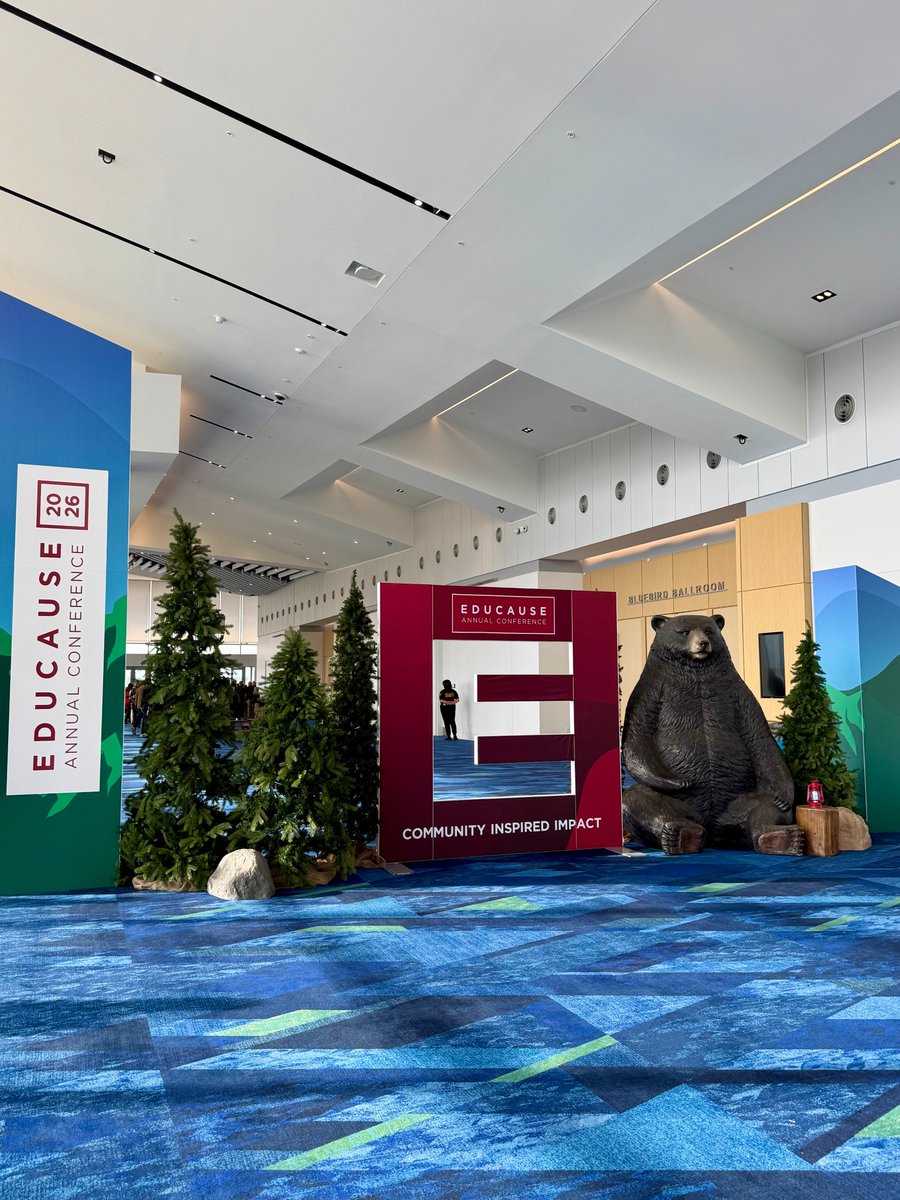
Thank you, Denver, for an inspiring week at the @educause Annual Conference 2026!
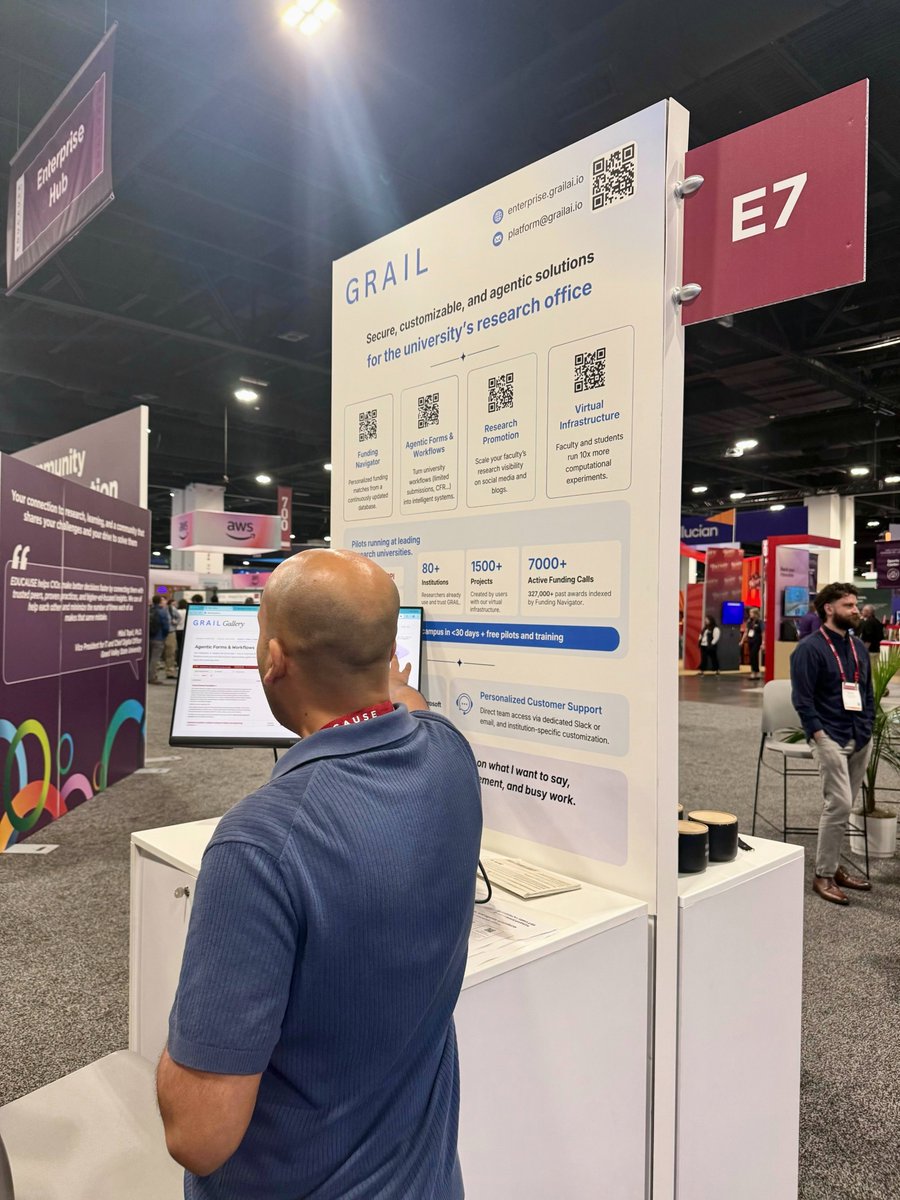
GRAIL was proud to be part of the Emerging Tech Experience in the Enterprise IT area. We shared how our AI operating system can amplify universities’ #research capacity across funding discovery, research office workflows, and research communications.
Throughout the week, we attended thought-provoking sessions and connected with university teams to hear how they’re approaching AI on campus. We came away with fresh perspectives and a better sense of what matters most to the research office we’re building for.
Thank you to everyone who stopped by Booth E7 for a conversation or demo! It was a pleasure hearing about your work and exploring how GRAIL could support your team.
If we didn’t get a chance to meet in Denver, the EDUCAUSE Annual Conference continues online October 14-15. https://t.co/bkVUWgYjED
Want to learn more about GRAIL? Explore our products, watch a demo, or book a meeting: https://t.co/ffeUEJ8wGy
#EDUCAUSE2026 #HigherEd #ResearchAdministration #AI #Innovation #EDU26