The program for #FUNARCH2024 is up! We have a diverse lineup, ranging from experience report on applied functional software architecture to formal methods! https://t.co/4bJTKtg4GY
Welcome @MatsKoester to our network - we are looking forward to future cooperations with @ceu - check out Mats' Twitter profile https://t.co/SvWkby81z7 https://t.co/u3Fm9IVICW
ChatGPT has crossed 1M+ users in just 5 days.
To compare, it took Netflix 41 months, FB - 10 months, and Instagram - 2.5 months.
But many haven’t yet realized its full potential.
Here are the 10 mindblowing things you can do using it right now:
Genau jetzt ist die Zeit für Hochschulen, Schulen, Journalismus, Marketing, Kommunikation, GPT-3 ernst zu nehmen. Ich fange mal mit Hochschulen an, da von Job her Hochschulpräsident ;D
@GaborBekes @StatStas @ceu@Stata@korenmiklos@arieda_muco@martonfleck@AsjadNaqvi Yep, and good points on some of the trash talk (*cough* by me). Next time we should have a clear cut between debating points and our honest (if still not accurate) opinions.
@kennedymwavu@arieda_muco@korenmiklos@AsjadNaqvi Thanks, that works for the use case as I stated it. The problem is there is actually more text after 'Team R', e.g. 'Team R ...'. In the end, I used a regex, but this approach is nice for one-to-one custom matchings.
@adriaaaaaaan@arieda_muco@korenmiklos@AsjadNaqvi Thanks, that works for the example I gave - although in the actual example there is additional stuff after, e.g. "Team R ...". But that made me think of regex, which works:
mutate(
convincing = str_match(
convincing, "Team ([A-Za-z]+)")[,2]
)
)
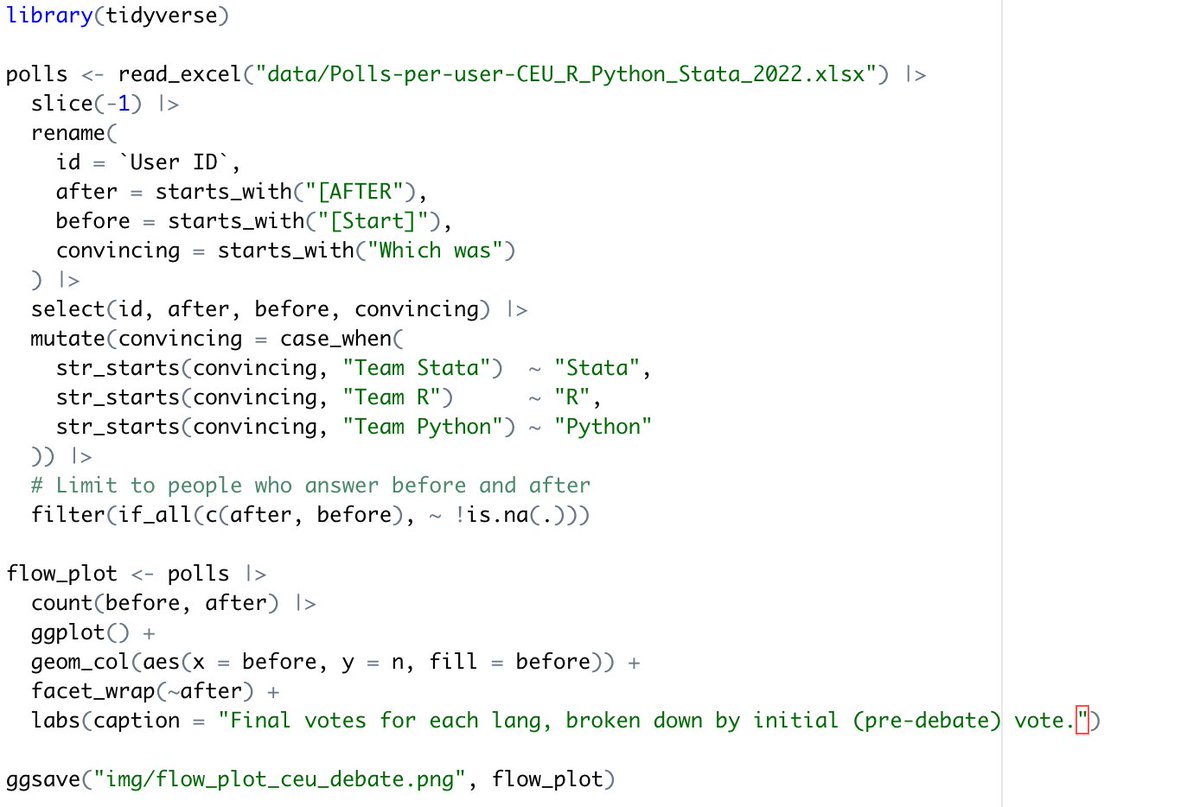
@arieda_muco@korenmiklos@AsjadNaqvi Question to #RStats: what is a clean way to replace the `case_when` in `mutate` by a single line (function call or otherwise)? Assume that `convincing` is a column of "Team R", "Team Stata", or "Team Python" strings. My attempt defines a non-trivial function `get_lang`.
@arieda_muco@korenmiklos@AsjadNaqvi I don't think so, since for loops in R don't return their values. I found a way using `detect` and defining a vectorized function so that it can be applied inside a `mutate`, but it was really finicky and hard to read. (You refer to the `case_when` in my code, right?)
@korenmiklos@AsjadNaqvi The R code's pretty nice in my opinion (said the proud father). Still beat you by a silly line of code while packing more info! 😀
@GaborBekes @ceu@Stata@korenmiklos@arieda_muco@martonfleck@AsjadNaqvi And congratulations to @GaborBekes for the Inaugural 'Data Analysis Book of the year Rated R' prize for @Gabors_Data!! The prize was given in the category of best DA book in 2022 with #Rstats code by a person present at yesterday's debate.
@korenmiklos Re: LoC (silly metric, but OK). My code is 18 LoC (5 lines are to relabel data I am not yet using, but might later). I could shave off more by putting a lot of `ggplot` code in one line (😉 @AsjadNaqvi).
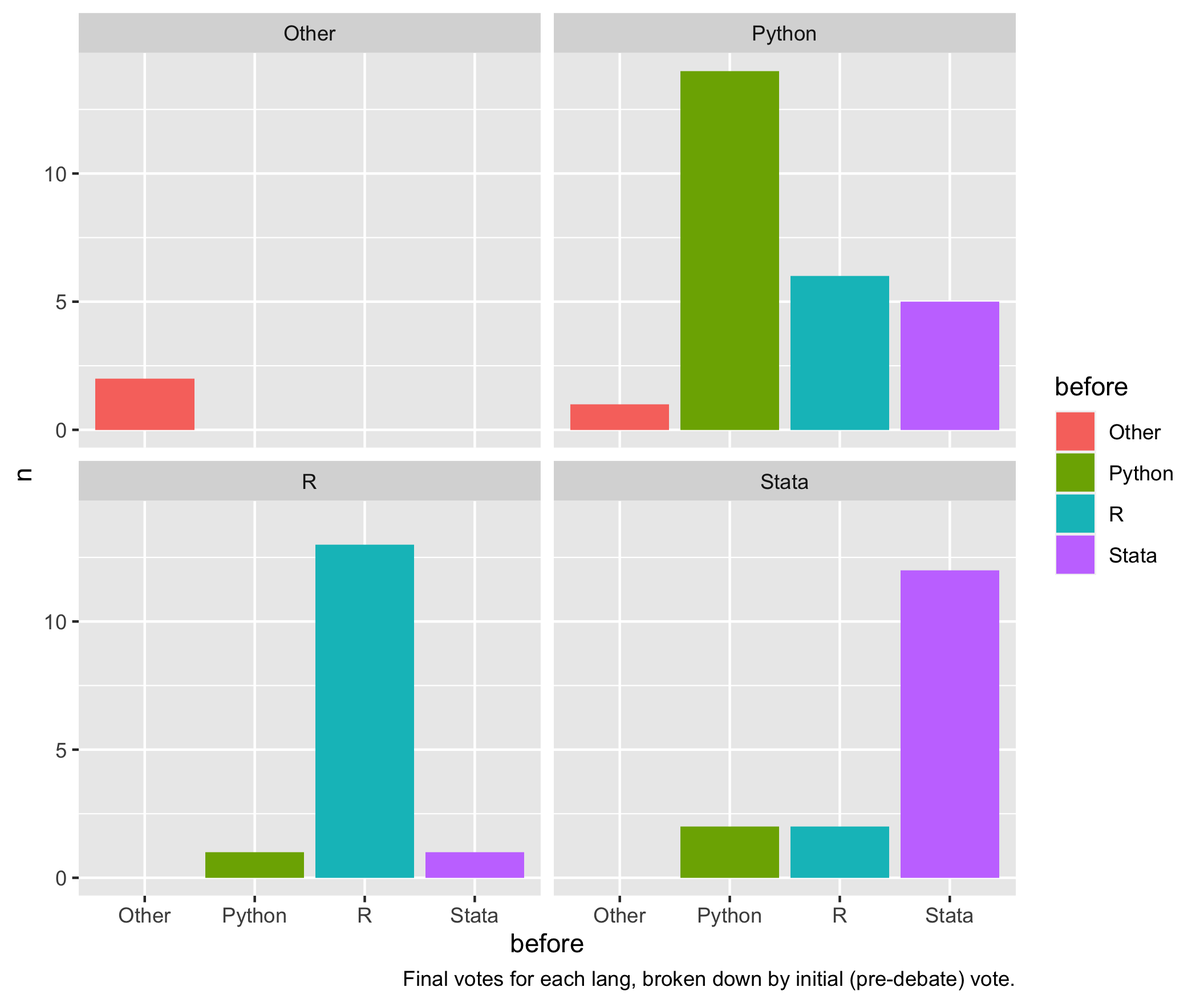
@korenmiklos I plotted the breakdown of final votes: did they come from initial @Stata, #RStats, #Python, or Other voters? Conclusion: The Snake snacked on R and Stata. (Despite Team R winning the "Convincing Team" race!) See https://t.co/zOYA9VTngH.
@thomas_neitmann I’d say that’s totally ok. I have R version 4.1 at work for quite some time now and I haven’t used the native pipe in any of my workflows yet.
Python, vs. R vs. Stata: Who wins? With my colleagues, we are going to have a heated debate on the merits of each language... Moderated by @GaborBekes.
Spoiler alert!!! Python will win✌️: 4/6 debaters are Python users. Short 🧵
Calling all educators & faculty members 📢
Our data analytic competition is an event where your students can utilize their analytical skills, while also reinforcing their soft skills. Join us and register NOW! https://t.co/JI3PDYY481