🚨 Season 3 is Almost Here🚨
With a new season comes new objectives.
This time, we’re leveling up the game.
🔹 New Algorithm Scoring
It’s not just about reading the whitepaper anymore. We’re rewarding in-depth conversations, real engagement, real insights.
🔹 Sentiment Scoring
Positive energy matters. So does calling out the flaws. Spotting issues, or bugs. Constructive criticism adds value too, and it’s scored.
🔹 Speak Smarter, Earn More
The deeper your contribution, the higher your rewards. Surface-level takes won’t cut it this season.
🏆 New Scoring Format
Each week, your 3 highest-scoring spaces will count towards the leaderboard.
Are you ready?
This will be one of the best GameLoop you will experience this year!
If you're indie game devs, this is still an opportunity for to hop it!
I believe it's not something you want to miss, join community and get ready for the smooth sail!
Let's have a better experience and fun together ❤️!
Even if you're not a developer? Still got alot of things for you in the community, trust me you don't want to miss out!
@GamingOnAvax@Funtico_com@avax
If we get privacy wrong, DeFi won’t scale past hobby projects.
the choice between ZK and FHE isn’t just a math debate — it’s whether finance can be both decentralized and compliant.
- In 2022, Tornado Cash was banned for “too much anonymity.”
- In 2024, Mastercard piloted FHE to share fraud data without breaking laws.
That’s the spectrum privacy has to live between — secrecy that regulators kill, and confidentiality they can embrace.
privacy isn’t just secrecy, it’s control.
- Who gets to see what,
- under what rules,
- enforced by cryptography instead of trust in institutions.
This is why @inconetwork has staked its vision on Fully Homomorphic Encryption (FHE), not because Zero-Knowledge Proofs (ZKPs) don’t work, but because FHE offers a different balance between confidentiality, programmability, and compliance.
to see why, it helps to unpack what ZK and FHE actually mean...
Zero-Knowledge Proofs (ZKPs):
- Prove something is true without revealing why.
Example: “I have enough funds” without showing your balance.
- ZKPs power Zcash and Tornado Cash.
They excel at anonymity, but are rigid. Once a proof is generated, you can’t later grant or revoke access (primarily applies to zk-SNARKs, not all ZKPs)
Fully Homomorphic Encryption (FHE):
- Data remains encrypted throughout computation.
- You can add encrypted balances, check if one encrypted number is bigger than another, and update state — without ever exposing the plaintext.
- Later, specific parties (users, auditors, regulators) can decrypt according to programmable rules.
The distinction is subtle but crucial: ZK offers secrecy. FHE offers confidentiality with options.
and that difference matters once you leave theory and step into real world finance...
Real-world validation: FHE in finance
Unlike many cryptographic ideas, FHE isn’t stuck in research papers. it’s already proving itself in finance.
- Remember Mastercard from earlier?
In Singapore’s PETs sandbox (2024), they used FHE to test cross-border financial crime detection.
Suspicious IBANs could be flagged without exposing the IBANs themselves.
- Fraud-Intelligence Sharing Across Banks:
In the same sandbox run, multiple banks exchanged encrypted alerts.
They didn’t need to decrypt raw data, which meant no risk of tipping off fraudsters or accidentally leaking sensitive info.
That solves one of the weird paradoxes in finance: the more banks share to stop crime, the more they risk exposing customer data.
FHE inverts that tradeoff — more sharing, less leaking.
Kind of funny that cryptography, usually seen as hiding things, is what actually enables collaboration.
- Cloud & AI Finance:
Banks also want to run machine learning models on sensitive data, but usually the cloud is a trust nightmare.
FHE changes that: analytics can run while the data stays encrypted.
(feels like sorcery, but really it’s just math cosplaying)
That “sorcery” is already in production:
. JPMorgan + Duality Technologies proved it in 2023, running encrypted fraud analytics on card data in Zurich
. Google & Microsoft: rolled out FHE toolkits so developers don’t have to be number theorists just to keep data private.
All of which matters because regulators have made clear what they won’t tolerate.
- Regulatory Context:
Remember the Tornado ban we started with?
In 2022, the U.S. Treasury sanctioned it for laundering over $7B of illicit funds, saying its black-box anonymity “posed a national security threat.”
FHE’s controlled, auditable model is a response to exactly this kind of regulatory pushback.
and it’s not just regulators, analysts are picking up the same signal.
- Analyst Signals: Gartner predicts that by 2025, 60% of large organizations will adopt privacy-enhancing technologies like FHE to enable secure data collaboration.
This is not just about crypto hype, it’s the direction the enterprise stack is moving.
Zooming back into Web3, @inconetwork applies these lessons directly with its Confidential ERC20 standard: ERC20 tokens with encrypted balances and programmable decryption.
We’ve established it’s ERC20 composability — but private, the diagram made that clear.
Now, to see why it matters, you have to stack FHE side by side with ZK.
That’s why Inco Network chooses encryption.
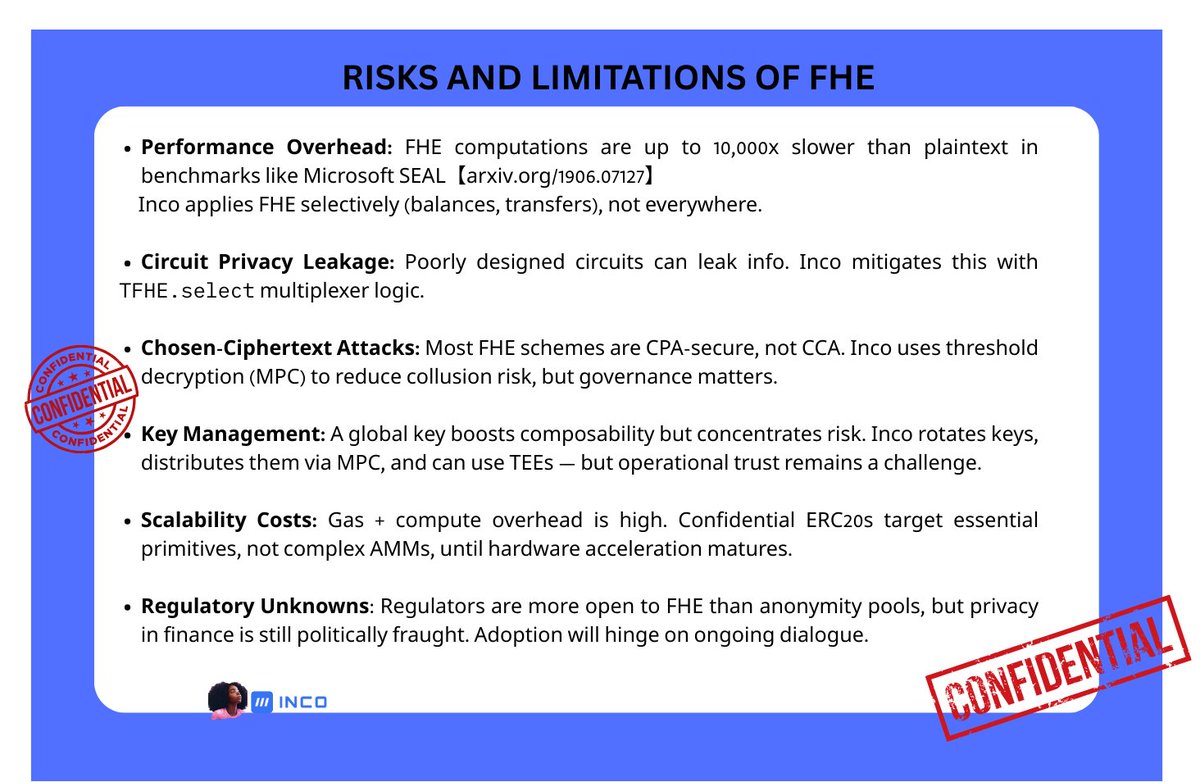
And for fairness and transparency, we also need to be honest about FHE’s risks and limitations:
Despite the risks (detailed in the image above), FHE is no longer theory:
- Mastercard showed regulators that fraud intelligence can move across borders without breaking laws.
- JPMorgan proved encrypted analytics can run on live financial data.
- Google and Microsoft are shipping toolkits so developers don’t have to be cryptographers to use it.
To me, the takeaway is simple: the privacy tech that wins isn’t the one with prettier math, it’s the one people can actually use — regulators, enterprises, and developers alike.
ERC20 tokens standardized fungibility in 2015 and kicked off DeFi. Confidential ERC20s could do the same for privacy, setting a new standard that makes composability possible without giving up control.
so where do i land?
- ZK has its place when pure anonymity is the goal.
- But finance needs more than secrecy, it needs confidentiality with control and that’s what FHE delivers.
Inco is betting on that path, and i believe it's right.
if Mastercard’s trials, JPMorgan’s experiments, and Gartner’s forecasts are anything to go by, this isn’t just a niche crypto experiment but possibly the direction that financial stack is moving.
Not just to survive, but to thrive.
Ask ten people what makes a DeFi token “successful” and nine will say: price.
But @BlackholeDex complicates that story.
Here, veNFT holders earn mostly in fees and bribes, not $BLACK itself.
Which raises the harder question: what role does price even play?
That’s what I wanted to test against history on how past designs like @CurveFinance bribe flywheel or @GMX_IO real yield can help us make sense of Blackhole’s tokenomics model.
To start, it’s worth looking at the one factor everyone fixates on: price.
Even if most of Blackhole’s rewards come from fees and bribes, the question of price still lingers in the background and that’s where history is especially instructive.
Why Token Price Still Matters
Blackhole already runs more than 10 active pools including stables,with majors like $WAVAX/ $BTC.b/ $WETH, and partner tokens from the Genesis pool launches.
That means most of the trading fees and bribes flowing to veBLACK NFT holders are not denominated in $BLACK.
This is one of the strengths of the design: as ROI for lockers isn’t tied only to inflationary emissions, but to a broader mix of assets across the ecosystem.
A lower token price can even make “breakeven” faster, since the same voting power costs less to acquire.
But there’s a flip side: if $BLACK drifts too low, optics hurt new participation.
We see from Curve, @Balancer, and @fraxfinance that governance flywheels work best when the underlying token holds a perceived floor.
When $CRV collapsed, bribes didn’t stop, but participation growth slowed because the headline narrative was: “CRV keeps bleeding.”
So no, Blackhole doesn’t need $BLACK at $1 to function but a healthier floor price does make governance look more attractive, and keeps confidence alive.
To put it plainly, price isn’t the whole picture.
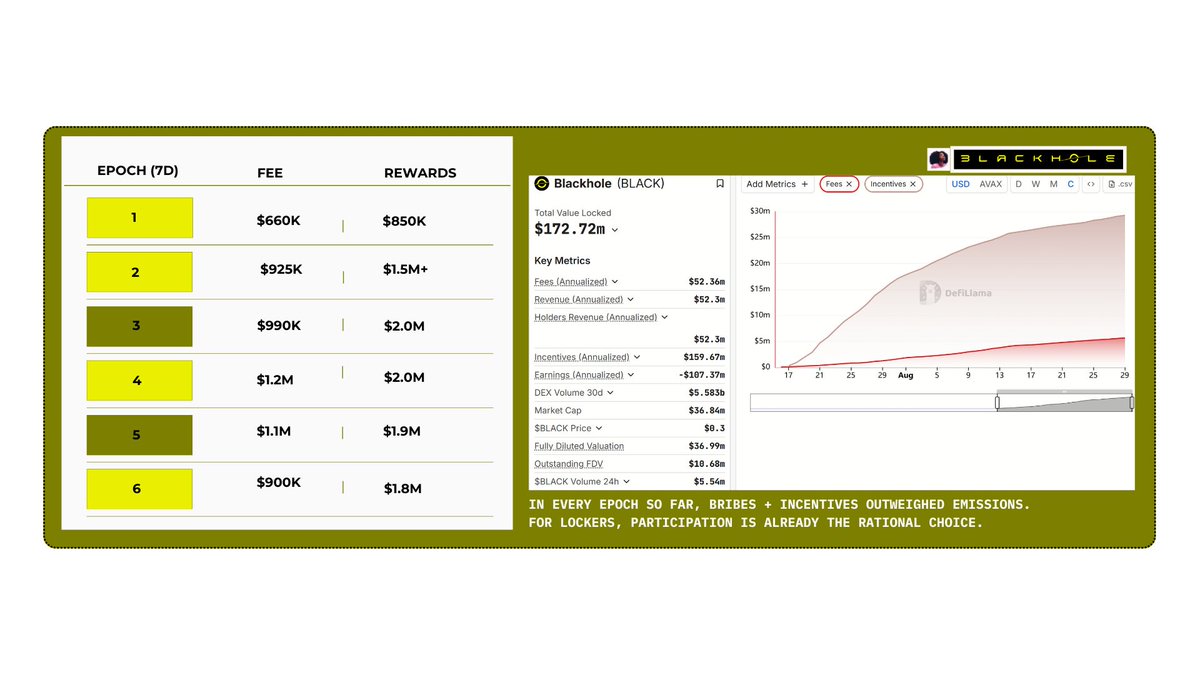
The deeper story is whether the rewards for locking already outweigh the emissions being printed and in Blackhole’s case, the numbers say alot.
Locking Already Beats Emissions
For veNFT holders, rewards need to be lucrative enough that locking or burning beats just farming and dumping otherwise emissions outpace demand.
And with @BlackholeDex, that’s not a theory as it’s already showing up in the numbers.
This is textbook bootstrap economics: pay users heavily at the start so liquidity, traders, and governance pile in.
Once the ecosystem feels alive, the flywheel ideally takes over:
more liquidity → more volume → more fees → more real yield → less need for subsidies.
Here’s where Supermassive veNFT shines: every permanent lock not only adds governance power but removes supply forever.
If bribes + fees remain strong, burning and locking stay the rational play and emissions gradually flip into deflation.
To see why this math works, it helps to break down exactly how rewards are distributed across LPs, lockers, and voters inside Blackhole.
How Rewards Flow
Breaking it down simply:
- Unstaked LPs → 100% of trading fees from their pool.
- Staked LPs → give up fees, but receive $BLACK emissions.
- veNFT holders (Singularity/Supermassive) → collect pool fees, bribes, and rebases.
This mirrors models that already worked:
- @CurveFinance : LPs chose between fees or emissions; veCRV lockers captured fees + bribes.
- @Balancer : veBAL voters steered emissions, lockers captured fees.
Blackhole builds on this with:
- Supermassive burns → permanent supply reduction.
- Genesis Pools → efficient liquidity bootstrapping.
That’s the baseline system but Blackhole is also layering on campaigns to accelerate the locking dynamic,the clearest example is Escape Velocity:
- Lock or burn 2,000+ $BLACK between July 16 and September 3, 2025 to qualify for rebates from a 6M veBLACK rewards pool, distributed after the season ends.
Note: airdropped $BLACK is not eligible.
Why it matters:
- Strong incentive for holders to deepen commitment.
- Especially compelling for mid-sized wallets (2k+ $BLACK).
- Rebates are paid in Supermassive veBLACK NFTs → boosting governance, not diluting supply.
From here, the conversation naturally shifts to what comes next.
Incentives like Escape Velocity campaign can kickstart momentum, but other protocols show that lasting growth usually comes from building value sinks and extra reward layers.
That’s where buybacks and staking hooks enter the picture.
@AerodromeFi buyback model using 30% of fees to repurchase its own token is one of the clearest precedents.
It gave participants visible proof of constant demand and helped stabilize early markets, though its effectiveness ultimately depends on trading volume.
Another idea, not live, but worth exploring is an optional staking track for $BLACK holders.
Instead of providing paired liquidity in Genesis Pools, holders could stake $BLACK during launch windows for a small allocation of project tokens.
This wouldn’t replace Genesis Pools, which remain the liquidity backbone, but could serve as a lightweight way for community holders to take part.
The hybrid vision looks like this:
- Buybacks (Aero-style) → steady sink.
- Genesis Pools → deep liquidity engine.
- Optional capped staking hooks → broader engagement.
Together, that gives stability, depth, and breadth.
But mechanics alone rarely carry the story.
Looking at @CurveFinance , @GMX_IO , and @PancakeSwap, the real inflection points came when catalysts either big listings or self-sustaining flywheels drew in new users.
The same question hangs over Blackhole: what will spark the next wave?
A top-tier listing could give short-term breathing room — $UNI, $DYDX, and $CAKE all benefited.
But listings aren’t a sustainable catalyst.
The deeper catalyst will be when Blackhole shows:
- veBLACK lockers consistently earn non-inflationary rewards (fees + bribes).
- Supermassives steadily deflate supply.
That’s what makes the system resilient.
@CurveFinance didn’t rally because @binance listed $CRV — it rallied because Convex weaponized the bribe economy and created demand for $veCRV.
So yes, listings help but the true flywheel is proving that bribes + fees make locking more profitable than farming and dumping.
Those lessons open the door to small but important design tweaks.
Other protocols have had to patch weak points mid-flight but Blackhole has the chance to get ahead by baking in improvements now.
Some areas for Improvement
- Aero-style buybacks (30% of fees): use part of trading fees to buy back $BLACK on the market.
This helps stabilize price floors and gives confidence that there’s always demand for the token.
- Optional staking track: give $BLACK holders a lighter way to participate during new project launches.
Instead of providing liquidity in Genesis Pools, holders could just stake $BLACK for a short period and earn a small share of new project tokens.
Genesis Pools remain the main liquidity engine, but this adds a simpler “community lane” for people who don’t want to LP.
It’s important to note that even robust designs have fault lines.
The major DeFi precedents like Curve, Balancer, Pancake, and Aero all hit their own bumps along the way, but they adapted with fixes that kept their flywheels alive.
These risks don’t spell weakness, they mark the checkpoints every major protocol has had to pass and handling them well could be the moment the flywheel shifts from being subsidized to being self-sustaining.
My Final Thought
Writing this took me back through years of DeFi experiments, specifically reading tokenomics pages, staring at old Dune dashboards plus other boring details.
And after putting it all together, I don’t see @BlackholeDex $BLACK ’s journey as just a question of “price” or “bribes.”
It’s about whether the system convinces its community that locking, burning, and building here will always feel like the winning side of the trade..
If fees + bribes + buybacks + project incentives outweigh emissions, supply shrinks and price follows.
History already gave us the blueprints and the catalyst for @BlackholeDex won’t just be a listing, it’ll be a self-sustaining governance economy.
So yes gg to the biggest dex rn on Avalanche
@BlackholeDex actually launched and scaled.
Mainnet went live July 11, with ve(3,3) mechanics, Genesis Pools for pre-commit liquidity, and the Singularity (time-lock) / Supermassive (permanent burn) veNFTs.
On-chain data now shows Blackhole among Avalanche’s top dapps by TVL/volume.
YOU are the most important project you'll ever work on :
📍Upgrade your mindset
📍Sharpen your skills
📍Protect your energy
Invest in yourself.
GM, say it back!
In psychology, there’s a gold-standard framework for describing human personality: the Big Five traits, also known as OCEAN.
It’s been used for decades to understand how people think, feel, and behave — and to predict everything from job performance to relationship success.
But what if personality traits weren’t just for people?
What if you could design an AI agent not just with intelligence, but with a temperament — one that influences how it makes decisions, reacts to uncertainty, and relates to users?
Now imagine applying that logic to AI agents.
Suddenly, you’re not just building systems that know things — you’re building systems that respond with personality.
Let’s say you’re building an AI agent for financial forecasting.
You don’t just want it to be accurate. You want to understand how it behaves when markets swing, data conflicts, or uncertainty spikes.
If your agent is:
- Highly conscientious, it might validate results across multiple models before acting.
- High in neuroticism, it might take defensive positions to avoid losses during volatility.
- Low in agreeableness, it might challenge consensus and explore contrarian signals.
That’s not storytelling — that’s design logic.
@AlloraNetwork and the Rise of Personality-Aware AI
Allora network is a decentralized, self-improving AI network.
Its goal isn’t just to build smarter agents — it’s to build agents that can learn from feedback, adapt to context, and behave in ways that are intelligible to humans.
One of the ways it does this:
By exploring how frameworks like the Big Five can be embedded into agent architecture.
This gives developers a powerful lever:
Not just what an agent knows, but how it reasons.
It opens up a new paradigm for building:
- A DeFi agent with high neuroticism might protect capital at all costs.
- A healthcare agent with high agreeableness might offer softer, more empathetic user responses.
- A game NPC with high openness and low conscientiousness might behave like a playful wildcard.
As AI systems take on more autonomous roles — in finance, governance, healthcare, and beyond — it’s not enough to optimize for raw intelligence.
You need behavior that is:
- Consistent
- Predictable
- Aligned with purpose
You need to know how it thinks.
What kind of behavior to expect.
How it reacts under pressure.
Personality modeling makes those tendencies legible. It helps users and developers understand why an agent acts a certain way, and trust that its actions fit the context it was designed for.
Of course, modeling personality into AI comes with nuance.
Studies, including work by Google DeepMind, show that agents with low agreeableness or high neuroticism can trend toward toxicity or unpredictability in language models.
Temperament has consequences.
This is why design context matters — and why Allora’s decentralized approach is promising.
By distributing oversight and enabling adaptive feedback loops, it creates space for nuance rather than defaulting to one-size-fits-all behavior.
If we’re building AI to interact with humans, we have to care about the tone, not just the outcome.
Final Thoughts
With developing systems like Allora Network, we’re entering an era where agents aren’t just logical — they’re charactered.
They decide, adapt, and interact.
So if you’re building the next generation of autonomous agents, remember:
Don’t just give them a brain.
Give them a point of view.
40 people, 40 canvases.
I wanted to do more than just host a fun gathering, I wanted people to leave with a real understanding of @avax and how it fits into their world, especially as creatives.
We kept it simple.
🚀 If Ethereum is a Crowded Subway, Somnia is a Teleporter
Every Web3 user has felt the friction: you’re minting an NFT, and suddenly gas fees spike like a volatile altcoin.
You watch your metaverse avatar glitch because the chain can’t handle the crowd.
Your prized NFT? Stuck in one app, useless everywhere else.
It’s like building the future on infrastructure that creaks under pressure.
@Somnia_Network changes everything.
As the fastest EVM Layer 1, it processes over 400,000 transactions per second (TPS) with sub-second finality.
It eliminates tradeoffs between speed, security, and decentralization.
This means your trades settle faster than a Discord meme gets deleted.
No compromises, no bottlenecks, just seamless interoperability.
Thread⏬