love this. we’ve been doing formal verification at graphify too, just from the opposite direction.
instead of modeling your system in tla+, we use the previous version of your code as the spec. on every pr, each changed function is checked against its old version: an smt solver either proves they’re equivalent or finds the exact input where behavior changed.
for rust and c we use kani and cbmc, and when a proof can’t reach, we fall back to symbolic execution and real inputs from your own tests.
if you’re new to this, think of it as differential verification. instead of writing a separate model and proving your code matches it, you treat the last version of the code as the relative specification. the question becomes “does this change preserve behavior, or did something shift?” an SMT solver either proves they’re the same or hands you the exact input, old value, and new value.
historically formal verification never reached mainstream status because of the difficulty in modeling and writing proofs. it’s quite difficult to model your business requirements and keep them in sync! but using the previous version as the spec sidesteps that. there’s nothing extra to maintain.
in the meantime we’ve been running this on real prs and it’s already catching behavior changes, with the input, old value, and new value right in the review.
been thinking about this a lot.
a year ago id open a PR and force myself to read every line even when i was tired. now the agent writes the change, runs the proofs and can push to main before ive even finished the thread.
easy path is cognitive surrender. you stop tracking what the systems actually doing and just approve whatever comes back coz the tests passed.
harder path is staying in cognitive engagement. not scanning diffs. holding the longer picture in your head and deciding which direction was actually worth taking before the agent even starts.
thats the real shift. not whether code review disappears. whether we stay engaged or slowly check out.
I was just watching this kaparthy video about how LLMs is bad at counting and math cuz it has to compute everything in a token. I think about graphify and what makes it work is you are looking at code.
Code is truth and you are turning it each a semantic roadmap for the LLMs. This is what makes it work. You’re taking the part LLMs are bad at and making it magical. Same logic why Jev is taking off and why people mix markdown with scripts. Graphify is that trust layer for agents. But people have to trust it before they can give into it. Actionable insights, finding bugs, making migrations faster, reducing tokens. Each delivery is one more trust item
Sometimes I wonder how this happens.
You ship a tool that actually solves a real problem and your users just start becoming the marketing.
One post using Graphify just cleared 300k views. There are 1000+ videos about it across social media. I’ve spent $0 on ads.
Open source got us the initial distribution. Users are now doing the rest.
We implemented a direct flywheel enhancement. Learn A -> Fix A -> Metrics movement B, keep repeating and it compounds
Recorded our maximum DAU yesterday - > 1,771 and max retention of 7.27% with 600 signups in single day
An agent's real bottleneck is cross-repo context, not how your code is organised.
Graphify surfaces that context with a code graph showing which repos change together.
Add incident memory on top and you can govern the agentic SDLC
Graphify is now available on the @Vercel Marketplace!
With this integration, your coding agents get a live knowledge graph of your Vercel app’s codebase, so they understand your code before they change it, at a fraction of the token cost.
Graphify is growing fast, we had our maximum all time DAU yesterday (1500+) and maximum signups in a single day (500+)
94k+ code reviews in last 30 days and 67k+ Formal proofs runs on PRs
6 enterprise deals in motion
23.5k+ users signed up on https://t.co/0B1iwKRo8k
All with a lean team, a solo founder and 7 weeks since launch with a free GTM ( our Open Source)
Graphify is celebrating the milestone of reaching 125,000 GitHub stars!!
This is an achievement of our whole community! Thank you for every star, every pull request, and all the time you put into making Graphify better. We are lucky to build this open source project with you all ♥️
The reason we hit 22,000+ users in 7 weeks is open source traction turning into real product users. All bottoms up PLG.
Biggest advice to founders: build in public and get the distribution. It compounds.
Oh btw we’ve hit another milestone on open source of @graphify with 125k GH stars
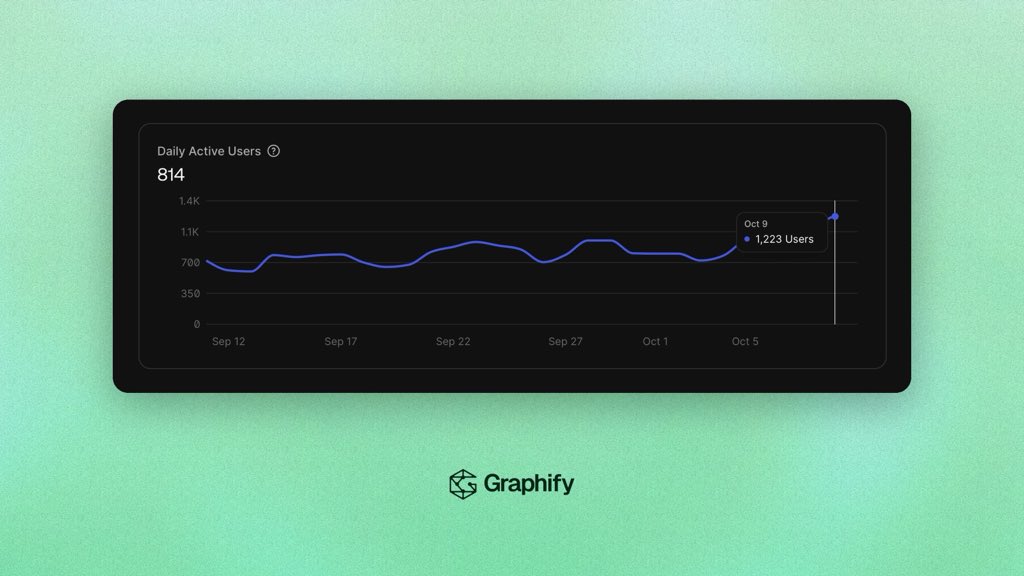
7 weeks in and this is our highest daily active users so far.
1,223 yesterday.
To mark the milestone, annual plans are 30% off.
Onboard: https://t.co/YCxbz4A7F4