a typical flow of an aggrag application;
1/. split your business use case into multiple atomic AI usecases, where each flow benefits from its own measurable eval metrics.
This increases accuracy, consistency and repeatability of LLM generations.
The SINKING SHIP checklist :
Run this before you ship anything built with AI.
SECURITY
[ ] No API keys or secrets in frontend code
[ ] Every route checks authentication (audit all endpoints, not just the obvious ones)
[ ] HTTPS enforced everywhere, HTTP redirected
[ ] CORS locked to your domain — not wildcard
[ ] Input validated and sanitized server-side
[ ] Rate limiting on auth and sensitive endpoints
[ ] Passwords hashed with bcrypt or argon2
[ ] Auth tokens have expiry
[ ] Sessions invalidated on logout (server-side)
DATABASE
[ ] Backups configured and tested (test restore, not just backup)
[ ] Parameterized queries everywhere — no string concatenation
[ ] Separate dev and production databases
[ ] Connection pooling configured
[ ] Migrations in version control, not manual changes
[ ] App uses a non-root DB user
DEPLOYMENT
[ ] All environment variables set on the production server
[ ] SSL certificate installed and valid
[ ] Firewall configured (only 80/443 public)
[ ] Process manager running (PM2, systemd)
[ ] Rollback plan exists
[ ] Staging test passed before production deploy
CODE
[ ] No console.logs in production build
[ ] Error handling on all async operations
[ ] Loading and error states in UI
[ ] Pagination on all list endpoints
[ ] npm audit run, critical issues resolved
Can't check every box? You're not ready to ship.
The post-launch patch costs 10x more than the pre-launch fix.
Bookmark this. Use it every time.
Going to leave you with this tonight:
The best thing you can do for yourself is actively increase your surface area for luck to hit you.
Go outside, travel more, go to new cafes, museums, events, take a new route home, go for hikes, see cities, countrysides, take your notebook, speak to people, ask questions, start businesses - go on more side quests.
You can literally just do things, and the more you do, the more serendipity and synchronicity will find you.
Night gang.
Mark Cuban on the next job wave.
Customized AI integration for small to mid-sized companies.
"Software is dead because everything's gonna be customized to your unique utilization. Who's gonna do it for them... And there are 33 mn companies in the US."
Mark Cuban on the next job wave.
Customized AI integration for small to mid-sized companies.
"Software is dead because everything's gonna be customized to your unique utilization. Who's gonna do it for them... And there are 33 mn companies in the US."
I'm Boris and I created Claude Code. I wanted to quickly share a few tips for using Claude Code, sourced directly from the Claude Code team. The way the team uses Claude is different than how I use it. Remember: there is no one right way to use Claude Code -- everyones' setup is different. You should experiment to see what works for you!
we just raised another $25M after 10x'ing our ARR in 5 months. the crazy part is this almost never happened.
17 years ago, I watched Iron Man as a 10-year-old kid in Delhi. that night, I pulled my first all-nighter teaching myself to code. not because I wanted to build apps or make money.
because I wanted to build Jarvis.
my parents gave me 1 hour of screen time per day. so I coded in secret, sleeping every alternate night through middle school and high school. built 50+ apps. got a cease and desist from Google at age 12.
all for this one obsession: making computers understand us like humans do.
fast forward to today:
- we've raised $81M total to build the voice operating system
- growing revenue 40% month-over-month this year
- 70% user retention after one year (unheard of in consumer)
- teams at 270 of the Fortune 500 use Wispr Flow daily
our Series A2 was led by @hanstung at @notablecap (who was an early investor in five companies that made it to $100B valuation like Slack, Tiktok, and Airbnb). we also brought on @StevenBartlett as an investor and partner.
but here's what matters more than the money:
we cracked voice input. not transcription - actual understanding. our users hit "send" in under 0.5 seconds without checking. they trust it blindly. that's never existed before.
in a recent benchmark, Wispr came out as 3-4x more accurate than OpenAI, ElevenLabs, and Siri.
and we're just getting started. voice input was step one. now we're building the assistant that actually does things for you.
to my co-founder @SahajGarg6 - there's no one else I'd rather build Jarvis with than my college roommate and closest friend.
to our team pulling all-nighters and shipping magic - you're the reason that 10-year-old kid's dream is becoming real.
we're hiring cracked engineers and growth marketers who want to build the future of human-computer interaction.
the keyboard had a good 150-year run.
time to build what comes next.
PS: like, retweet, and bookmark to get wispr flow for free for 3 months ❤️
— Written with @WisprFlow
two ai ux idea I see happening or I want to work on.
1. multiple threads in single ai conversation mode where agent smart enough to categorise it later for viewing/searching; currently its hard to go back to some context said in 'n - 2' message unless I fork the conversation.
EulerSwap is where trading meets lending.
here's how it works and what's innovative about it.
TLDR:
It’s a new kind of AMM that turns idle liquidity into productive capital earning fees, lending yield, and supporting leverage all at once.
GENERAL ARCHITECTURE
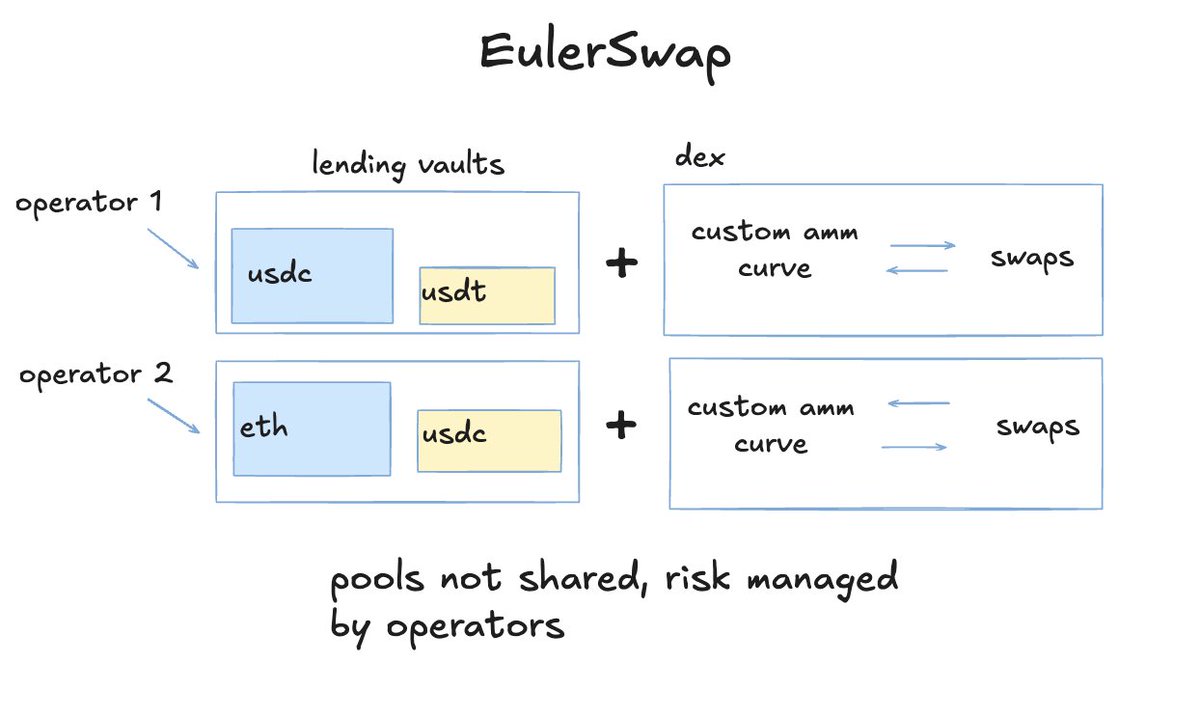
Every asset is earning yields in lending vaults and can be used to fill swaps based on a custom AMM curves.
Each market is composed by a lending vault and an AMM. Operators manages these markets, deciding the risk exposure of vaults and the type of AMM curve.
Euler has innovated lending by splitting the lending infrastructure from the execution and risk management (done by curators). The same thing is happening in EulerSwap.
In particular, markets can have a variety of custom amm curves (asymmetric, concentrated etc) and update them based on market conditions, allowing for better risk management.
EXAMPLE OF A JIT SWAP
Euler allows JIT swaps, which in essence refers to borrowing liquidity to fill a swap in exchange for a fee.
Operators can employ looping techniques (e.g. getting extra leverage from their lending vaults) to create deep virtual liquidity. Again, the amount of virtual liquidity compared to real reserves is a parameter for the operator to set, allowing different risk profiles.
In this case, operators need to balance:
- the trading fee
- the borrowing cost
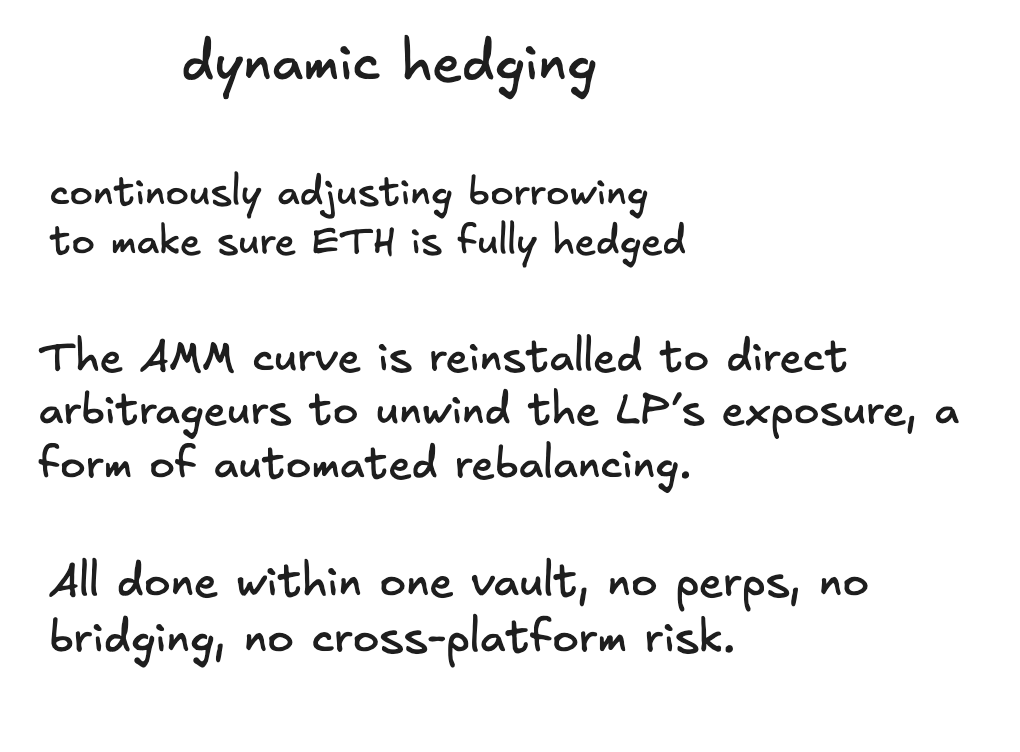
DYNAMIC HEDGING
Market makers do delta neutral LPing in dexes by offsetting the DEX exposure in pertuals or lending markets.
Euler allows this process in the same protocol:
when the operator needs to adjust exposure, it can just update the amm curve and have the market rebalance.
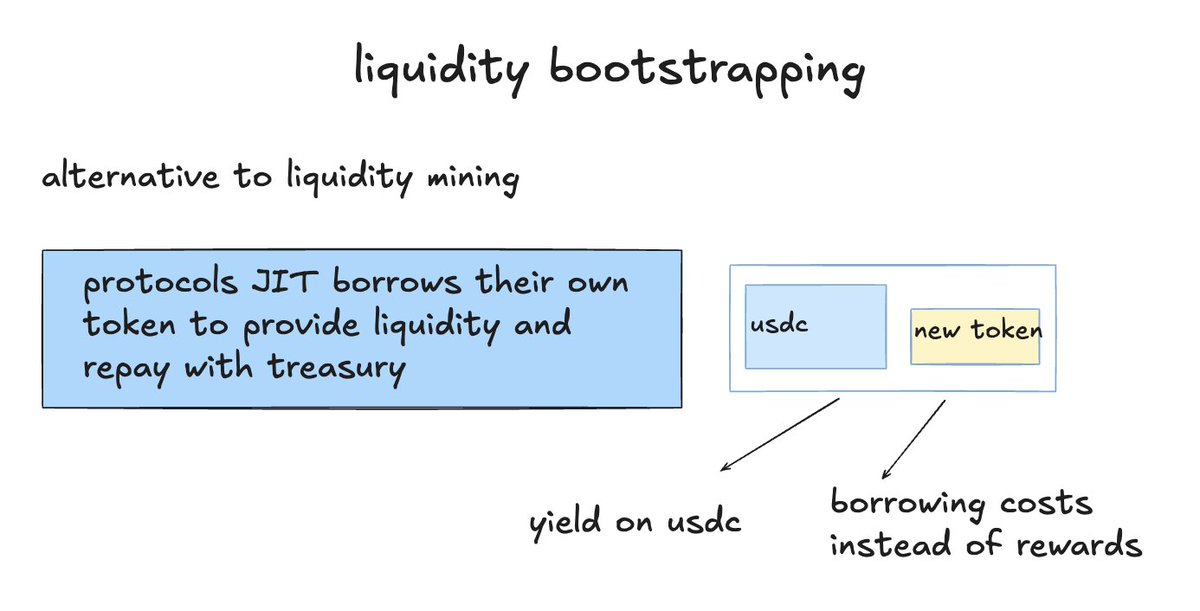
USE CASES - LIQUIDITY BOOTSTRAPPING
Instead of paying external LPs to provide liquidity, protocols can create liquidity by borrowing their own tokens and repaying with treasury.
In this way, they would get yield on usdc and extra control on the price via the custom AMM curves.
THE DIFFERENTIATION
EulerSwaps is built on Uniswap v4 hooks and can use already existing solvers / filler.
This design has some similarities to Fluid (for the lending layer), Bunni (for the rehypotecation and custom curves).
But it is very innovative in the way risk is managed across the protocol, making it an onchain playground for market makers and LPing.
Euler team has been grinding during the bear and endured an hack. Its lending market has been growing from 10m to almost 1b in TVL in the last 8 months.
Excited to try it and see what can be built on top!
Has @cursor_ai's code generation gone from good to very bad?
I am unable to pass my context with cmd+enter, and while the agent uses search feature to see whats implemented, and often ends up ignoring existing code and rewriting the same thing in a different directory 😭