We back Notable founders. Partner to @Anthropic, @Vercel, @fal, @JoinHandshake, @WisprFlow, @OneQuince, @HashiCorp, Rednote, @databricks/@neondatabase & more.
500T tokens. That’s how much traffic @sonicaghi says is moving through @Kong’s gateways today.
Run the math on 140x YoY growth and the volume roughly doubles every 7 weeks. At that rate, a quadrillion is a near-term milestone.
Cheaper tokens won’t cap that. They’ll spread it across more models. Enterprises asked Kong how to secure, govern, and cost-control API calls a decade ago. Now they’re asking about tokens.
His read: “In a non-deterministic software enterprise world, the need for deterministic AI gateways will just increase.”
“Developers are the difference between a world full of slop and a world full of software worth using.”
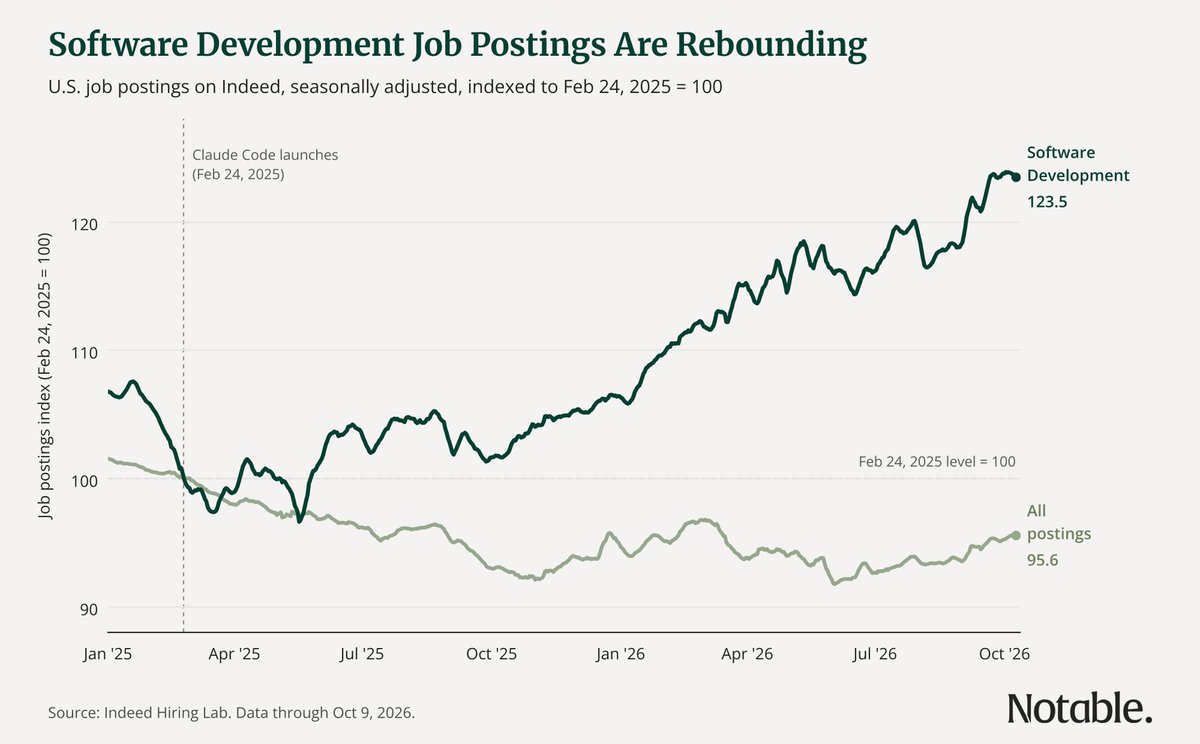
I loved this line from @rauchg in his opening keynote at @vercel Ship last week. It gets to the heart of why I don’t buy the doom and gloom for SWE jobs. The data backs it up - since Claude Code was introduced in late Feb ‘25, the number of job postings for software developers in the US has risen almost 15%.
The agent writes the code, but the developer decides what's worth shipping.
“It took us about 10 years to get to a billion deployments. Then in the next 10 months we’ve added another 1.5 billion deployments.” Let’s go @rauchg@vercel !!!
BREAKING: 60% of Vercel deployments are now driven by AI agents, up from 3% in Jan 2026.
FULL INTERVIEW
Guillermo Rauch (@rauchg), Founder & CEO @Vercel
Stats:
› 80% of AI Gateway token volume comes from open models
› 10 years to reach 1B deployments, then another 1.5B in just 10 months
"The machines have taken over."
I sat down with G at Vercel's SF HQ to discuss how AI is changing software development, infrastructure & the economics of SaaS.
Vercel has reportedly reached $600M in annualized revenue, up 148% YoY, with 485K+ paying teams and a $9.3B valuation. Customers include SpaceX, OpenAI, Meta, Stripe, Brex, Shopify, DoorDash, & Polymarket.
P.S. Guillermo mentions "code" 145 times throughout our conversation. His thesis is that AI agents are making code effectively free, fundamentally changing what companies build versus buy.
"You buy Vercel as the platform, & then you never have to buy software again because you can just generate it to your needs."
We cover:
› The shift from human-facing websites to agent-native interfaces, MCP & agentic commerce with Stripe, Shopify & DoorDash
› Why free code changes SaaS economics for Salesforce & SAP, software development & the role of engineers at Meta, SpaceX & Mercedes F1
› Open vs. closed models, including why ~80% of token volume on Vercel’s AI Gateway now goes to open models like Moonshot’s Kimi & DeepSeek
› Unpacking frontier: OpenAI, Anthropic, Gemini & xAI
› Agent autonomy, prompt injection, sandboxing & enterprise security after OpenAI’s Hugging Face breach
› Model routing, growing compute demand & the future of serverless infrastructure
𝐓𝐈𝐌𝐄𝐒𝐓𝐀𝐌𝐏𝐒
(00:00) Guillermo Rauch, Founder & CEO at Vercel
(03:32) The simplest advice for going viral
(07:24) How Vercel became the index of AI
(11:34) The CEO who still ships code on weekends
(14:34) Robots writing code for robots
(17:57) The web's next users aren't human
(21:15) Is ChatGPT reading your website right now?
(24:21) Minority Report is becoming real software
(29:16) The end of SaaS & the rise of personal software
(34:07) AI agents are soldiers with no frontal lobe
(45:42) AI hackers & the coming cyber war
(47:55) The $1M challenge to hack Vercel's sandbox
(52:10) 80% of tokens now go to open models
(59:00) The biggest risk for frontier labs
(1:04:00) Can AI labs survive the public markets?
(1:06:28) Why AI has Silicon Valley working 7-7-7
(1:07:23) "The thing you fell in love with is gone"
(1:16:56) Your vibe-coded demo won't get you hired
(1:22:22) The hardest part of running a company is keeping it simple
(1:27:01) Why no company can run all its AI apps 24/7
"We’re super early. We’re in the first out of the first inning. What people will really buy into is the long term trajectory of this business." @jrichlive talks about the AI IPO market today w/ @TheJudgeCNBC@CNBCClosingBell https://t.co/M5tV6BQHhI
Can luxury really be more accessible?
On The Martha Stewart Podcast, @onequince Co-Founder & CEO Sid Gupta sits down with @MarthaStewart. He explains the direct-to-factory model, technology, and quality standards that set Quince apart - and why he believes everyone deserves nice things.
Give it a listen: https://t.co/hIBIzMoaAD
It took 10 years to get to 1B @vercel deployments. Now, developers & agents ship 1B every 4 months.
While the deployment pace is much, much faster now, @rauchg's mission hasn't wavered: create the fastest, most powerful infrastructure in the world and give that power straight to developers.
Awesome to see a packed house in SF at Vercel Ship 2026. I'm especially excited to catch G's fireside chat with @tobi later today.
Who actually buys GPU compute? Very few companies, as it turns out.
9% of @tryramp customers paid a GPU vendor in the past year, against 78% that paid for an AI application. That small group spent nearly 80% as much as everyone buying the apps.
How they buy is more telling. 8% bought compute through model serving and inference providers, 3% through neoclouds, <1% through wholesale capacity.
Buyers would rather pay for finished work than rent a GPU and sort out the rest.
That’s what we at @notablecap call workload clouds and it’s the bet @burkaygur and @gorkem made for generative media with @fal, what @rauchg made with @vercel, and what @pk_iv made with @browserbase.
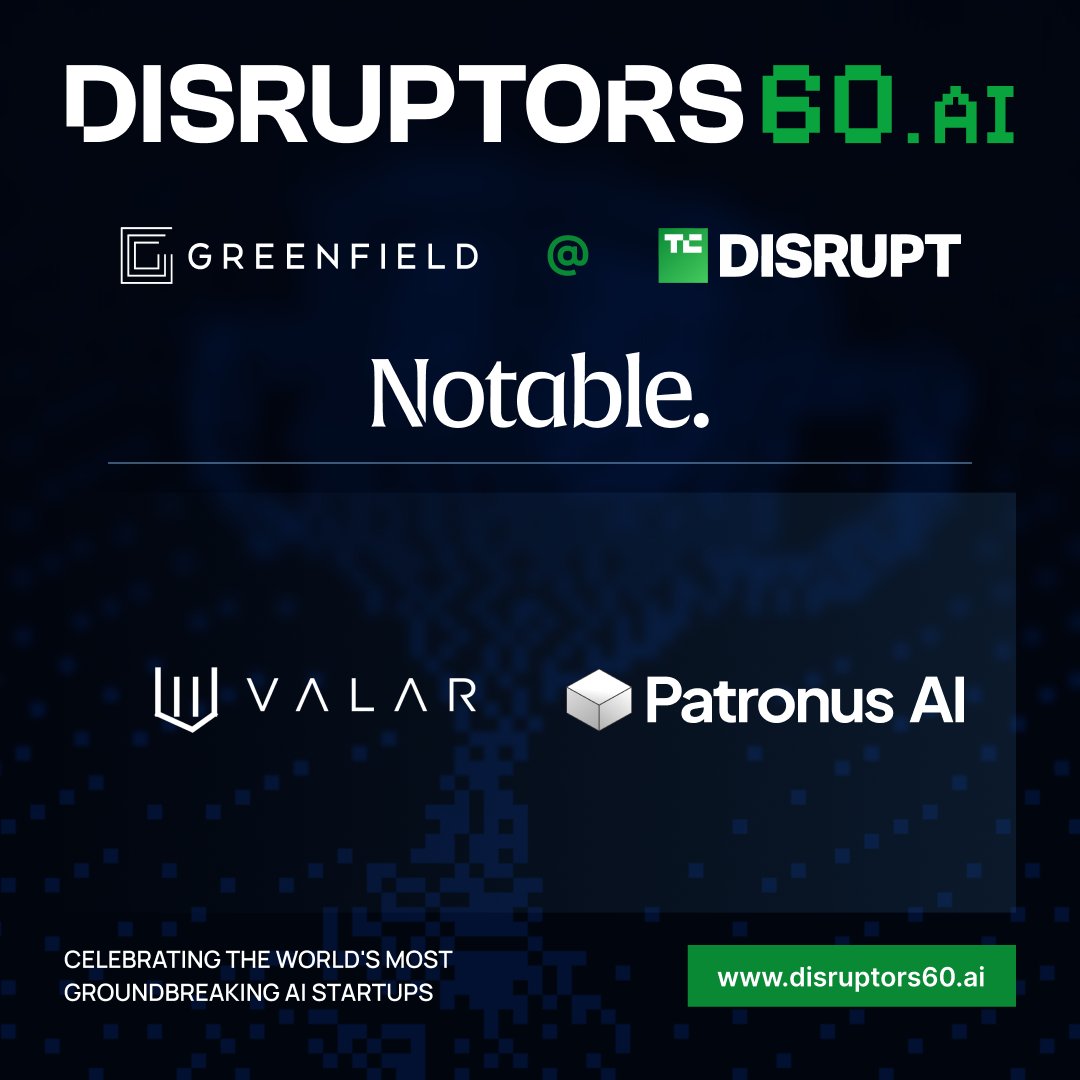
Proud to see @PatronusAI & Valar on the #Disruptors60 Class of 2026 list from @GreenfieldVC unveiled live at @TechCrunch Disrupt!
Additionally, @fal was honored as a Pioneer already leading AI at scale.
Full list here: https://t.co/d2rv7cW5nr
We are honored to be named to the #Disruptors60 Class of 2026 curated by @GreenfieldVC at @TechCrunch Disrupt.
Patronus is a research lab developing training data and simulated environments for frontier AI. Our mission is to understand how and why frontier models fail, and to turn those insights into safer, more capable AI.
Muse got to 5M downloads in 22 days, among the fastest apps to this milestone. For example, it took ChatGPT 56 days and Grok 103 days.
My colleague @dan_cahana recently unpacked why personal agents like Muse and Instinct suddenly feel like they “just work,” becoming wildly popular with consumers. A big part of the answer is infra magic behind the scenes, including:
-Model progress: LLMs have gotten dramatically better at complex, multi-turn task and tool use.
-Cheap inference: Unlike chatbots, personal agents work in the background. Agent providers can trade off cost for latency, performing even more valuable tasks without incurring enormous token bills.
Better models + better infrastructure = remarkable UX that wasn’t possible before. Great chart from @coatuemgt.
For decades, the basic unit of software consumption was the seat. Whether a user opens the application 2x or 20x mattered very little once the monthly bill arrived.
Agents break that model. They work continuously, cross applications & execute thousands of actions without a person opening a tab.
That raises one of the defining questions for agentic software... how does pricing change when software never stops working?
A flat subscription gives customers predictability, but leaves vendors absorbing variable inference costs. Pure usage-based pricing protects margins, but makes enterprise spending harder to predict. Outcome-based pricing better aligns cost with value, but requires vendors to assume more execution risk.
For infra companies, demand will increasingly be shaped by agent-hours, tool calls & the cost of maintaining persistent context, not just monthly active users.
For enterprises, software procurement may begin to look more like workforce planning:
-Which agents are authorized to act?
-What applications can they access?
-How much should each one be allowed to spend?
-How is their performance measured?
The agent is becoming a new unit of software consumption.
Curious to hear from founders who are thinking about changing their pricing (or already have).
"Relatively overnight, no one really integrates the Stripe API by hand anymore. They send their coding agent to do it."
I've been thinking about what this means for DevRel.
Trust with developers is hard to earn and easy to squander. It's why in the early days at @HashiCorp, nearly half the DevRel team worked on nothing but content: documentation, tutorials, technical writing. The things a developer reaches for at 2 a.m. when something is broken.
Now there's a debate about whether DevRel still matters once agents are choosing the tools. Before any human reads your docs, an agent has already tried to use your product.
In my view, DevRel matters as much as ever. Documentation carries more weight than it ever has, and its reader is as likely to be an agent as a human. The best modern documentation caters to agents as much as humans.
Awesome talk with @collision & @MollySOShea at @browserbase Navigate.
“In recent years, Quince has been the de facto spot to buy ‘bougie on a budget’ items - with good reason.”
“Enter Quince’s Insider Sale, where you can get up to 30% off its most popular products.”
🛒 💚
One of the most important questions for software companies today: how do you win the agent?
As agents become users and increasingly make decisions about which tools and infrastructure to use, the playbook for product is changing. Quickly.
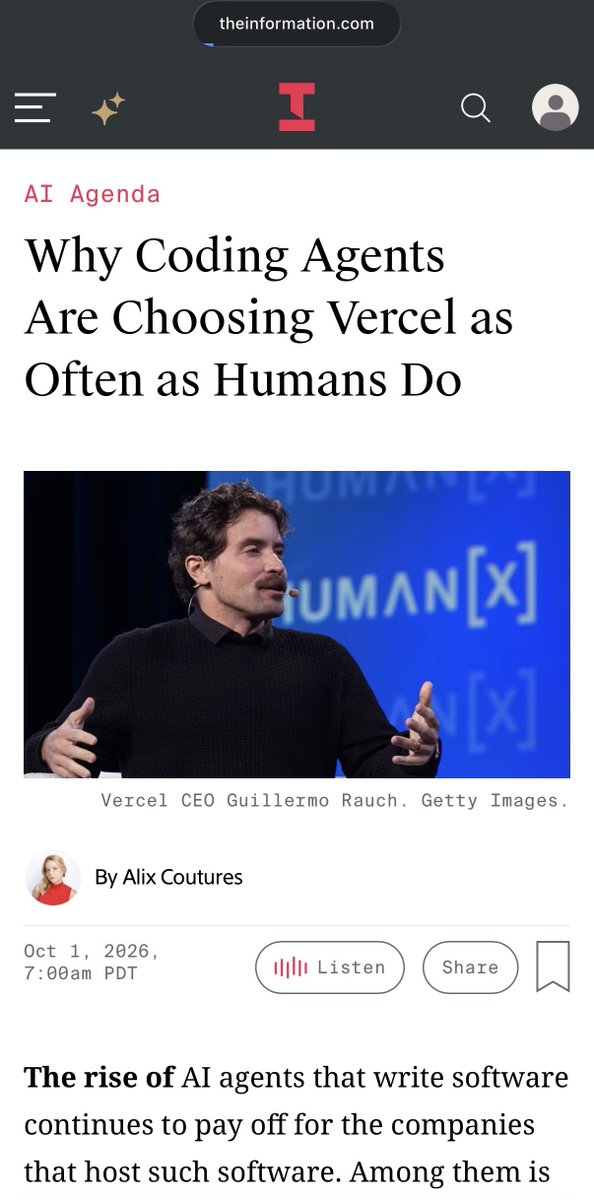
I spoke to @alix_coutures about what @Vercel is seeing firsthand.
With over 480,000 paying customers and an army of agents shipping code for each one, Vercel has a unique view into this shift. In June, @rauchg shared that agents that produce new code now account for half of Vercel’s new business.
There’s a lot more to come as agents become customers. And Vercel is leading the way 🚀
Humans aren’t the only software users today, so the question becomes: how do you win the agent?
Our Managing Partner @glennsolomon spoke with @alix_coutures about what @Vercel is seeing and why winning the human user is no longer the only game.
https://t.co/KDG5uzudvD
AI isn't just changing where software runs, it's changing how it runs and, more importantly, who runs it.
@glennsolomon and I dug into the developer as kingmaker and the new primitives emerging. The kingdom is only getting bigger.
Full conversation linked below.
Agents allow developers to break free from the constraint that one developer = one unit of labor. That fundamentally alters the math of the software industry.
I sat down with @dan_cahana to unpack our recent essay on the developer as the bellwether for the AI era.
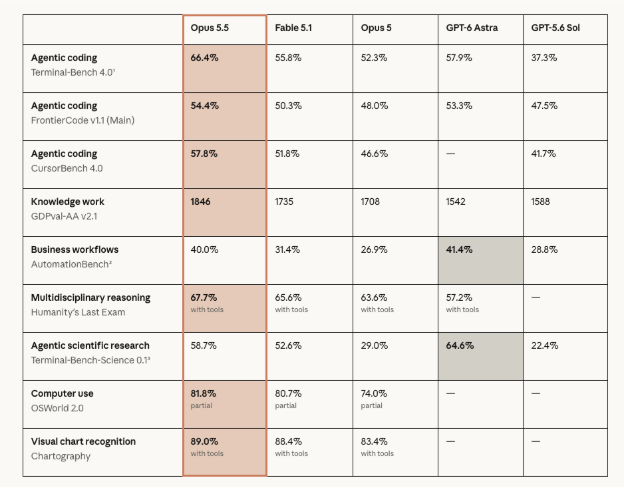
The frontier-model race is expanding from “Who has the smartest model?” to “Who delivers the most useful intelligence per dollar?”
@AnthropicAI’s new Claude Opus 5.5 is a good example.
Anthropic says the model delivers performance comparable to its top-tier Fable 5.1 model while costing 40% less to operate. It is also priced 20% below the previous Opus model.
Cheaper intelligence won’t just lower monthly bills. It will change which software is economically viable to build, deploy, and run.