I am excited to share that my undergraduate research has now been accepted to #ICLR2025.
📎: https://t.co/U9jz6aGnBy
🧑💻:https://t.co/WsHCinuaGU
Tweeprint🧵⬇️
New paper 🚨 #ICLR26
Most world models predict the future from a past trajectory. But neuroscience suggests that such inference can instead be made from temporally independent experiences.
We built the Episodic Spatial World Model (ESWM), a model that does exactly this:
So proud of this work co-led by @aspa1313 and @johanobandoc
Fantastic collaboration with @AaronCourville & @pcastr
Tldr; Constraining representations within isotropic Gaussian distribution massively improves performance during RL!
Excited to give a talk at #Cosyne2026 about my PhD work!
We show that RNNs trained on visual search converge on brain-like solutions, producing primate-like behavior and neural representations.
Happy to chat if you're at Cosyne!
📅 March 15, 10:45–11 AM
📎 Preprint 👇
We’ll be at CCN next week with two posters, one contributed talk and one satellite talk! If you are interested in neural coding properties in primate hippocampus, modeling visual search, or cortical topography come and talk to us! See👇for details:
McGill has been named the #1 university in Canada — and ranked 27th in the world — in the QS World University Rankings 2026. 🏆
This achievement belongs to every student, professor, researcher, and staff member who shapes McGill.
🔗 Read more: https://t.co/ljip8rcK2P
We’re very pleased to release our latest study ‘Emergence of Language in the Developing Brain’
Paper: https://t.co/CEMqkwditV
Blog: https://t.co/TrvxMlVqS4
The first systematic investigation of how the neural representations of language evolve as the brain develops. A collaboration between @AIatMeta and @FondARothschild, with @JeanRemiKing.
Thread 👇
🚨 Preprint Alert 🚀
📄 seq-JEPA: Autoregressive Predictive Learning of Invariant-Equivariant World Models
https://t.co/jBx1U4TfBV
Can we simultaneously learn both transformation-invariant and transformation-equivariant representations with self-supervised learning (SSL)?
TL;DR Yes! This is possible via simple predictive learning and architectural inductive biases – without extra loss terms and predictors!
👇🧵 (1/7)
“A network of face patches in human prefrontal cortex for social processing of faces”
https://t.co/DY9OT3I9tQ
Let us characterize a novel network of four frontal face patches (FFPs) arranged dorsoventrally in the human lateral prefrontal cortex! 🔢
@rajimehr@ElaheYargholi
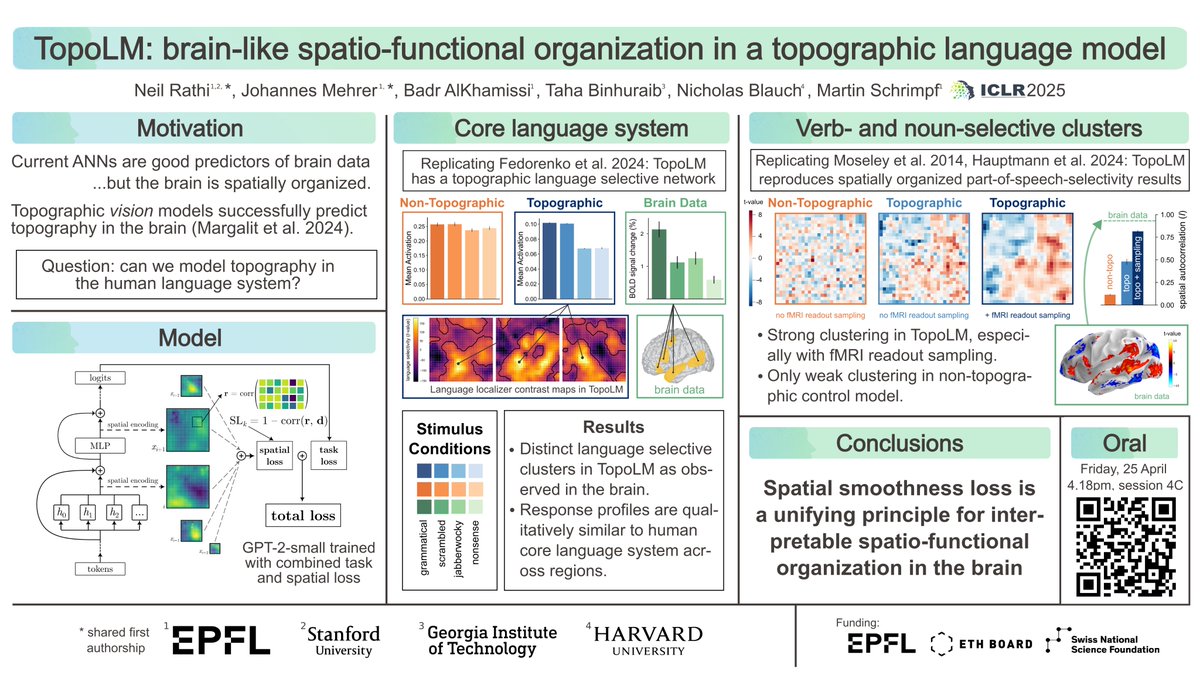
Before ICLR 2025 comes to and end tomorrow, a few #NeuroAI impressions from Singapore. First, very happy to present our work on TopoLM as an oral, here with @neil_rathi
https://t.co/ETNkw9YDRM
paper: https://t.co/4EVAKJysWO
code: https://t.co/MeWXfYXhVZ
Together with @neil_rathi I will present our #ICLR2025 Oral paper on TopoLM, a topographic language model!
Oral: Friday, 25 Apr 4:18 p.m. (session 4C)
Poster: Friday, 25 Apr 10 a.m. --> Hall 3 + Hall 2B
Paper: https://t.co/U47o5lVPop
Code and weights: https://t.co/MeWXfYXhVZ
📌 Poster Session:
When📅: Friday, April 25 from 10:00 AM to 12:30 PM
Where: Hall 3 + Hall 2B #60
Check out our project page: https://t.co/Bf427UfGxX
See you soon!
I’ll be at @iclr_conf presenting our work “Credit-based self organizing maps: training deep topographic networks with minimal performance degradation” — if you're into #NeuroAI, cortical topography, vision, or just up for a good convo, drop by and DM me! 🧠✨
@SKordasti سلام،
درسته که فعلاً نمیشه از این مدلها به عنوان ابزار قطعی برای تشخیص پزشکی استفاده کرد، اما به نظرم میتونن کمک خیلی خوبی برای تکمیل تشخیص پزشک باشن و حتی در کشف درمانهای جدید هم نقش مفیدی داشته باشن.
I am excited to share that my undergraduate research has now been accepted to #ICLR2025.
📎: https://t.co/U9jz6aGnBy
🧑💻:https://t.co/WsHCinuaGU
Tweeprint🧵⬇️
11/Last (but not least), this work wouldn’t have been possible without the help of my collaborators @qianxinyu8, @Asa_Farahani and research advisor @PouyaBashivan ⭐️