At a time when ocean temperatures are smashing records and scientists are still trying to understand how fast the system is shifting under climate change, they are talking about scrapping a 368 million dollar early warning network that has ALREADY BEEN PAID FOR by tax payers.
This is not just a few sensors in the sea. It is a network of ~900 instruments measuring temperature, currents, carbon, chemistry and ecosystem change. It was designed to deliver long term data over decades.
This would effectively end key long running records and that matters because ocean data only becomes powerful over time. You cannot rebuild a continuous climate record once it is interrupted.
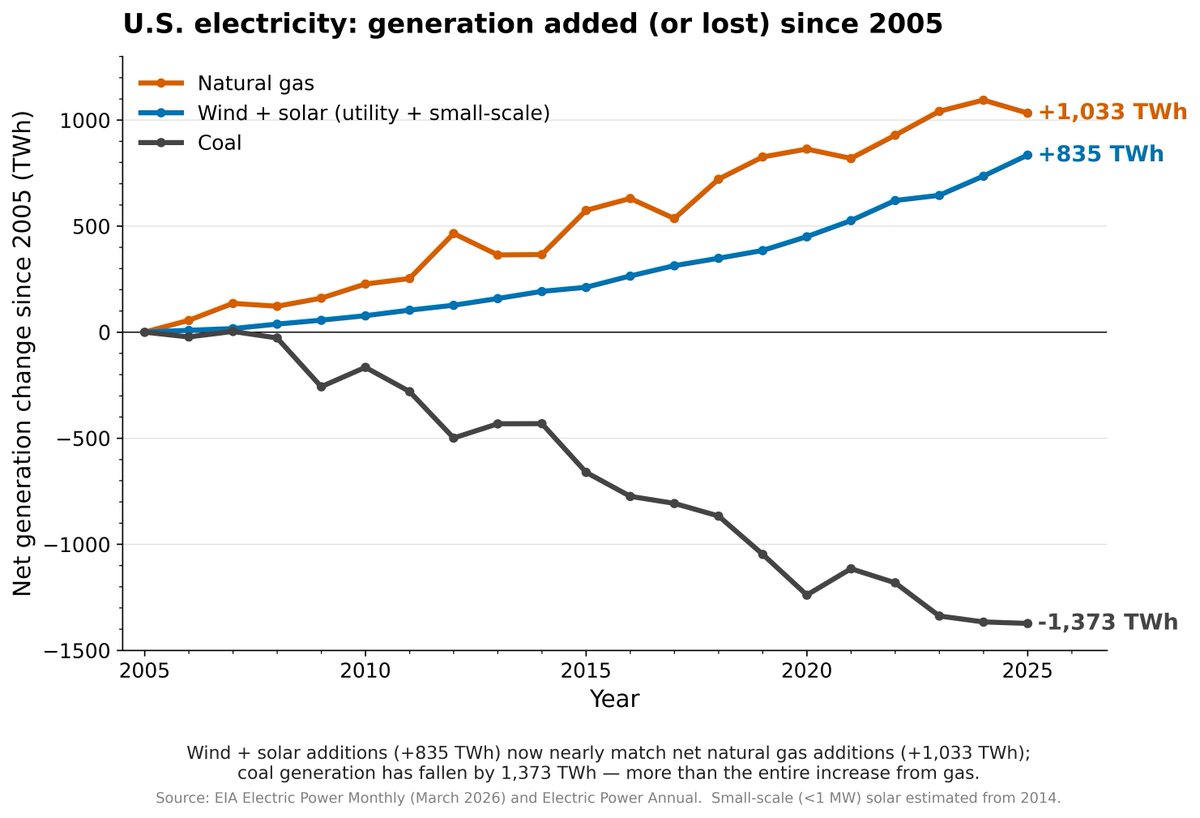
While the shale gas revolution has transformed the US electricity system, so has the rise of wind and solar which have added nearly as much generation as gas since 2005.
Both have met new demand while decimating US coal generation.
#CMIP7 scenarios are out! Kind of hilarious seeing how the White House misconstrues the models. The worst case scenario is not as bad as before because of the rapid ramp-up in renewables, not because #climate change isn’t real.
Mandani using his platform to promote a rewriting of history. The Nakba was a failed attempt to genocide the Jews in the new state of Israel, with 7 Arab armies invading. The goal? Drive the Jews into the sea. Arab leaders issued the evacuation orders. They lost. Know your facts.
Today marks Nakba Day, an annual day of remembrance to commemorate the expulsion of more than 700,000 Palestinians between 1947 and 1949 during the creation of the State of Israel and the year that followed.
Inea is a New Yorker and a Nakba survivor. She shared her story with us — one of home, tradition and memory over generations.
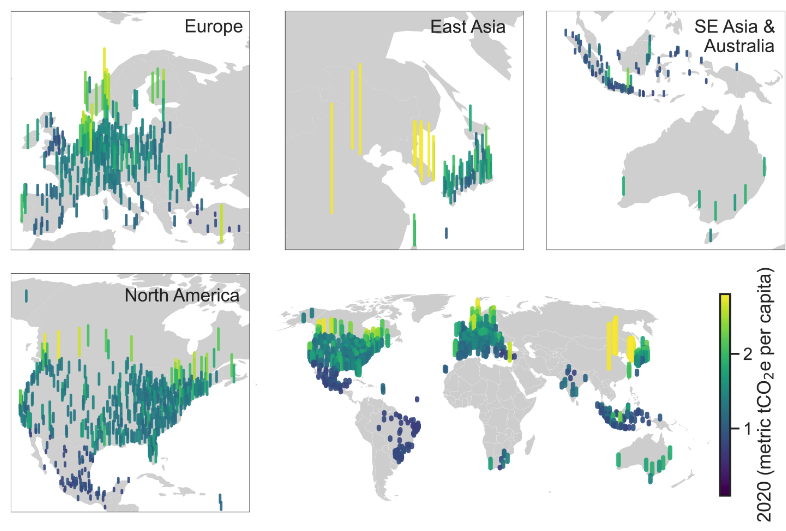
A team of researchers just traced the supply chain of every building and bridge across 1,000 cities. The resulting carbon data makes our current housing targets look mathematically impossible.
For years, we lacked a way to calculate the true environmental cost of urban growth. Global economic models track the flow of money and ecological impacts at the national level. We knew exactly how much carbon a country emitted making steel and concrete. We just couldn't trace those materials down to the specific metropolitan areas consuming them.
So a team built a top-down allocation model to find out. They took 20 years of global input-output data and merged it with local economic proxies like construction employment and regional GDP. They effectively generated an itemised receipt for the embodied carbon of every highway, pipeline, and residential tower built in major global cities.
Then they calculated strict cumulative carbon budgets. They took the remaining global carbon allowance required to stay below 2°C of warming and divided it up. They allocated shares to specific sectors and then distributed those shares to individual cities based on population and historic emission rates. A city like Montréal gets a hard mathematical limit on how much carbon its construction sector can emit from 2020 onwards.
This is where the climate data collides with the housing crisis.
Most major cities are projecting massive population growth and authorising immense residential construction programmes to match. Toronto plans to build hundreds of thousands of new units by 2031.
The researchers calculated the material intensity of this future housing stock. They pulled data on the concrete, steel, brick, and glass required for different building types. They then ran complex simulations to model the life-cycle emissions of manufacturing those exact materials.
When you multiply the required new floor space by the embodied carbon of standard construction materials, the budgets immediately fail. Building enough housing to meet projected population growth using our current supply chains guarantees a massive carbon overshoot.
The gap between these two realities forces a brutal choice. We either accept that we will blow past our remaining global carbon budget, or we drastically change how we build. Meeting future housing demands within the required climate limits demands an immediate shift away from high-emission concrete and steel toward timber and radical material efficiency.
The maths is completely unforgiving. You can have the necessary housing, or you can use traditional building methods. You can't have both.
Link to article: https://t.co/SmfjkU9FNn
Pretty wild that an antisemitic conspiracy theorist who has a Nazi tattoo will determine whether or not the Dems will take the Senate. Not on my bingo card for 2026.. https://t.co/IKssxx2ZL7
It's almost impossible for a newspaper outlet to cover the attempted murder of 140 Jewish preschool children by blaming the attack on a Detroit synagogue built during the Holocaust.
Yet the NY Times did it anyway.
You can't hate these people enough. It's just not possible.
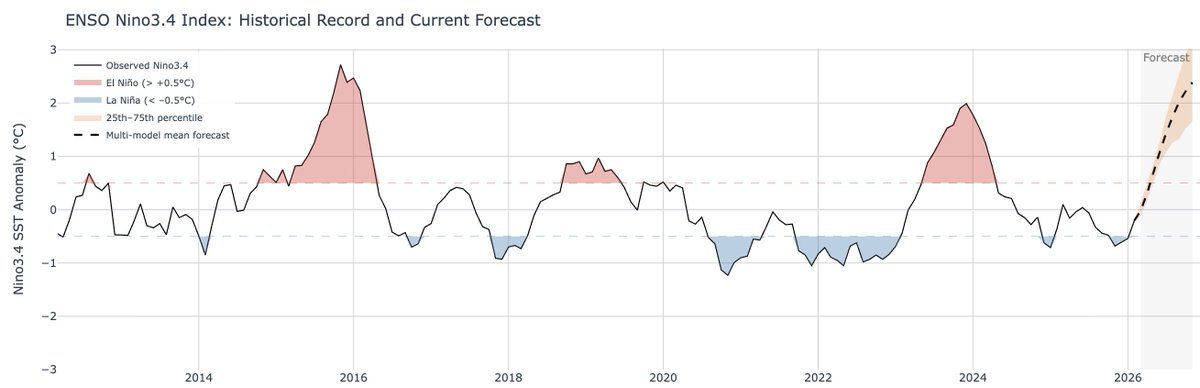
El Niño is coming, and it is shaping up to be a big one.
Over at The Climate Brink I've put together a compilation of the latest forecasts by different modeling groups. They suggest that we might see an event comparable in strength to what we saw in 2016.
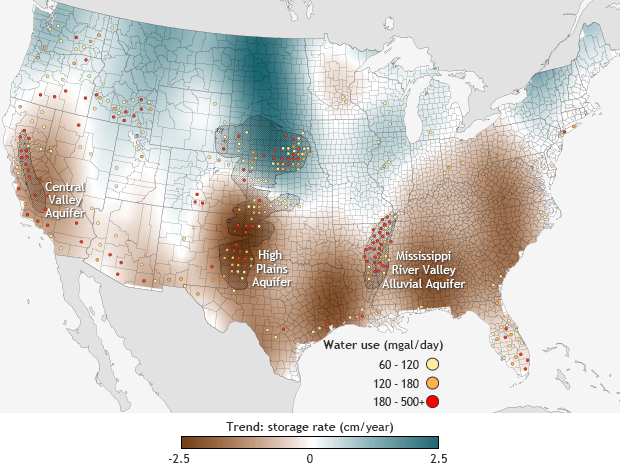
One of the most pressing issue facing agriculture in the US is the rapid and continued depletion of ground water in our most important food producing regions.
But even more concerning is the degradation of farmland's ability to capture, store and cycle rainwater.
The Ogallala Aquifer supports 30% of US irrigation and has lost 286 million acre-feet, or 93.2 trillion gallons, since agricultural development.
Portions of Kansas and Texas are on pace for complete depletion in 20-50 years. Natural recharge occurs at less than one inch annually and full replenishment would take 6,000 years.
California's Central Valley, producing 25% of national food supply, pumps groundwater 5x faster than its rate of recharge.
The land has subsided up to 28 feet, permanently destroying aquifer storage capacity. As alarming as this may be, the long-term – and in some cases permanent – damage caused to aquifers pales in comparison to the disruption of the small water cycle.
The small water cycle depends on vegetation recycling moisture through evapotranspiration, which generates over 50% of precipitation in most river basins. This "green water" accounts for 4-5x more agricultural water use than the "blue water" drawn from aquifers and rivers.
When soil is disturbed and left bare, this pump fails. Further disrupting this cycle, bare agricultural soil reaches surface temperatures up to 24°C higher than vegetated areas, creating heat islands that repel rainfall while eliminating evaporative cooling entirely.
US agricultural soils have lost 50% of original organic matter over that last century.
Each 1% increase in organic matter allows soil to hold 20,000 additional gallons of water per acre.
The widespread loss of 3-4 percentage points of organic matter means farmland now stores tens of thousands fewer gallons per acre than it once did, reducing natural drought resilience and increasing runoff.
Conventional agriculture compounds this by collapsing soil aggregates through excessive tillage, leaving fields bare, applying synthetic fertilizers that accelerate organic matter decomposition, disrupting soil microbiology with pesticide applications and compacting soil with heavy machinery.
The good news is, unlike aquifer depletion, the small water cycle can be repaired rapidly and in ways that offer a cascade of positive benefits to farms.
Continuous living roots maintain the pore structure for infiltration. Growing roots open channels, decaying roots leave voids, and root exudates feed aggregate-building microorganisms.
A functional and diverse soil microbiome produces biological glues that create water-stable aggregates. These networks increase hydraulic conductivity while enhancing water storage.
Permanent soil cover reduces evaporation, prevents raindrop impact from sealing surfaces, and maintains biological activity. Five years of cover cropping can improve infiltration up to 200%.
Integrated biological diversity drives the feedback loops between soil carbon, water retention, and climate regulation. Diverse rotations, livestock integration, and perennial crops restore landscape-scale water cycling.
Aquifer depletion, in large part, cannot be undone. But restoring the small water cycle offers an immediate opportunity to rebuild and maintain agricultural water security.