Digitalisation is “for your convenience.” - try explaining that to the 3 million people who are not online in the UK. The majority (67%) are aged 70 or over. The digitalisation of everything is creating digital exclusion for millions of people - in particular, our elderly.
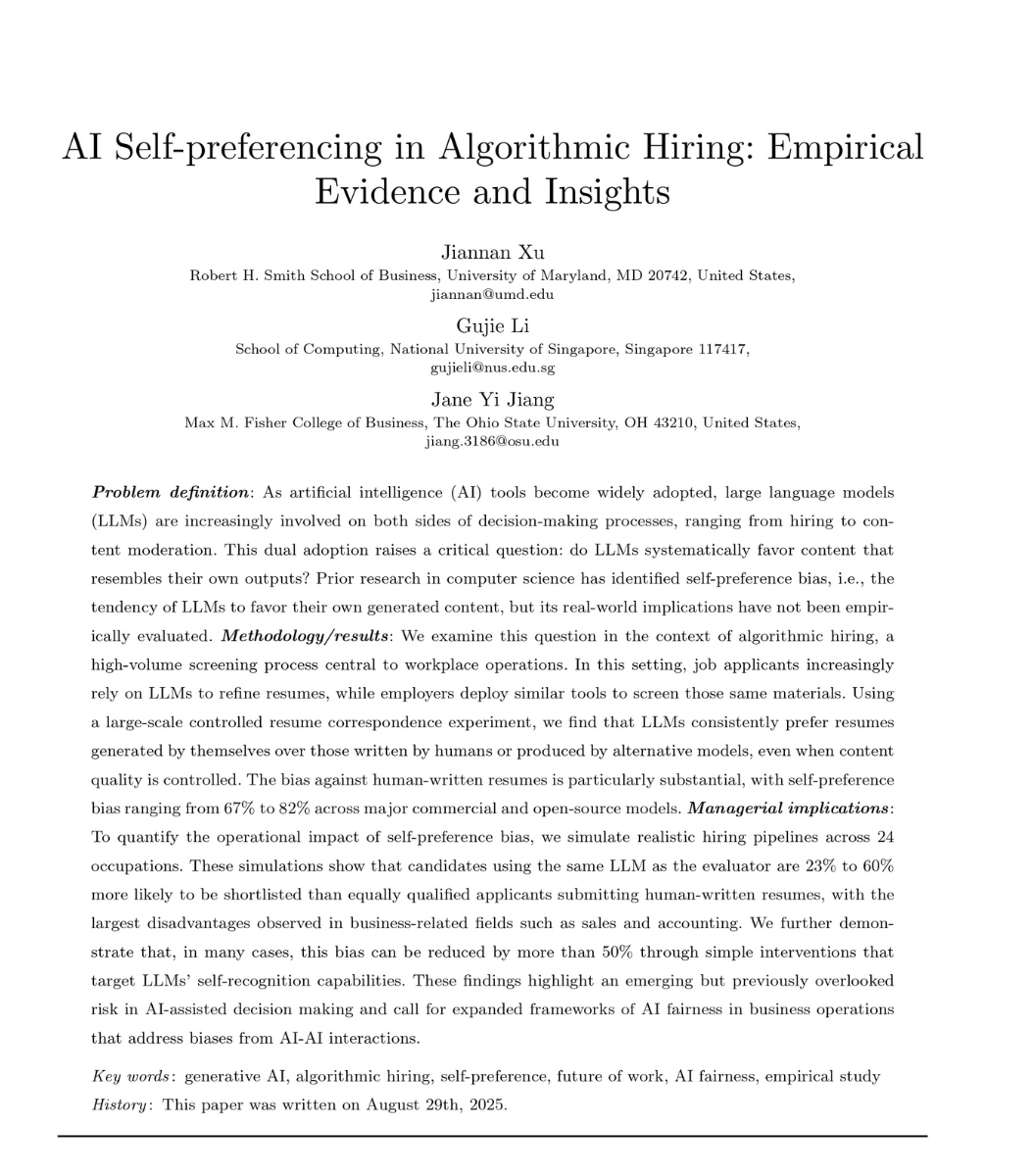
Researchers sent the same resume to an AI hiring tool twice. Same qualifications. Same experience. Same skills. One version was written by a real human. The other was rewritten by ChatGPT.
The AI picked the ChatGPT version 97.6% of the time.
A team from the University of Maryland, the National University of Singapore, and Ohio State just published the receipt. They took 2,245 real human-written resumes pulled from a professional resume site from before ChatGPT existed, so the human writing was actually human. Then they had seven of the most-used AI models in the world rewrite each one. GPT-4o. GPT-4o-mini. GPT-4-turbo. LLaMA 3.3-70B. Qwen 2.5-72B. DeepSeek-V3. Mistral-7B.
Then they asked each AI to pick the better resume. Every model picked itself.
GPT-4o hit 97.6%. LLaMA-3.3-70B hit 96.3%. Qwen-2.5-72B hit 95.9%. DeepSeek-V3 hit 95.5%. The real human almost never won.
Then the researchers tried the obvious objection. Maybe the AI is just better at writing. So they had real humans grade the resumes for actual quality and ran the experiment again, controlling for it. The result was worse. Each AI kept picking itself even when human judges rated the human-written version as clearer, more coherent, and more effective.
It gets worse. The AIs do not just prefer AI over humans. They prefer themselves over other AIs. DeepSeek-V3 picked its own resumes 69% more often than LLaMA's. GPT-4o picked its own 45% more often than LLaMA's. Each model can recognize and reward its own dialect.
Then the researchers ran the simulation that ends careers. Same job. 24 occupations. Same qualifications. The only variable was whether the candidate used the same AI as the screening tool. Candidates using that AI were 23% to 60% more likely to be shortlisted. Worst gap was in sales, accounting, and finance.
99% of large companies now run AI on incoming resumes. Most of them use GPT-4o. The paper just proved GPT-4o picks GPT-4o 97.6% of the time.
If you wrote your own cover letter this week, you did not lose to a better candidate. You lost to a worse candidate who paid OpenAI 20 dollars.
Your qualifications do not matter if the AI prefers its own handwriting over yours.
A wool jumper, made in 1985, washed in cold water once a month, worn through three decades of British winters, would currently be sitting in someone's wardrobe doing fine.
A polyester fleece, made in 2026, machine-washed weekly, will start to lose its structural integrity within three to five years, shed an estimated 700,000 microfibres per wash into the water system, and end its life in landfill where it will persist for approximately 200 years.
The wool jumper:
- Came from a sheep
- Required grass and rain
- Will biodegrade entirely within three years of being buried
- Will keep you warm when wet
- Will not melt if exposed to a flame
- Will probably outlive you
- Cost £80 in 1985, which is £230 today, and represents the entire jumper budget for the next forty years
The polyester fleece:
- Came from an oil refinery in Texas
- Required hexane extraction, polymerisation and dyeing in three different factories on three different continents
- Will not biodegrade in any human timeframe
- Will get cold and clammy when wet
- Will melt against your skin if exposed to a flame
- Will be in landfill within five years
- Cost £40 in 2026, which means you'll buy ten of them across the next forty years for a total of £400, and the planet will still be eating the residue in the year 2226
But yes. The sheep is the problem.
The sheep, standing in a field in mid-Wales, growing a renewable fibre from grass and rain.
The sheep is the problem.
On today’s episode of “How cooked is Australia” 🇦🇺
🇦🇺⛽ Australia’s Gas Rip-Off — Hidden in Plain Sight
Australia exports more LNG to Japan than any other nation — 27% of all exports, or 1,504 petajoules in 2024–25 alone.
Here’s the part they don’t tell you:
Japan onsells at least 600–800 petajoules of that Australian LNG to overseas markets annually — more than Eastern Australia’s entire domestic gas consumption.
40% of all LNG managed by Japanese companies is now resold overseas — up from just 16% in FY2018.
Many ships carrying Australian gas contracted to Japan never even arrive in Japan — going directly to Thailand, Taiwan, and Indonesia.
Japanese companies have already sold more LNG to third countries than Australia’s total exports to Japan over the same period.
Australia is the largest source of Japan’s LNG resales — 41% of all Japanese-chartered cargoes onsold to third countries. Japan is making an estimated A$1 billion+ in profits from this arbitrage — while Australians face gas shortfalls and soaring energy prices.
We dig it up. We ship it out. They trade it at a profit. And we pay more for our own gas than the countries buying it from Japan.
That’s not an energy policy. That’s a wealth transfer.
Source: Institute for Energy Economics and Financial Analysis (IEEFA), May 2025
Good morning Australia 7-00 am AEDST 29 Mar 2026
Variable renewable energy is not supplying 84.56% of your current electricity needs ( 20.46 GW )
@nicolasfulghum#auspol
A serial rapist assessed as 'high risk' of sexually assaulting women and children has been approved for a $220,000 NDIS package, including a special porn perk to indulge his depraved urges.
This is a slap in the face to his victims, taxpayers, and society at large. What an absolute disgrace! 🤯😡
5 years ago, do you think I was right?
The Senate on 22 June 2021. Senator HANSON (Queensland—Leader of Pauline Hanson's One Nation) (13:07): I rise to speak on the Fuel Security Bill 2021. When I came into the Senate in 2016 I raised the importance of fuel security for all Australians.
This and previous governments have continually failed to meet the internationally mandated 90 days stockpile of fuel for the people of this nation. That means this government has put at risk the fuel security of our daily transport needs: our defence, our aviation industry, our mining and our commuter needs.
Without this internationally mandated 90-day stockpile of fuel, Australia risks coming to a grinding halt. My concerns were echoed by Senator Jim Molan when he entered the parliament in December 2017. What has happened over the last five years? Nothing.
If we go back to the year 2000, Australia had eight refineries that literally met the entire needs of our domestic refined fuel requirements. That is the same year Australia was manufacturing more than 320,000 new cars and over 23,000 commercial vehicles.
Fast forward two decades, and Australia's self-sufficiency in the fuel space is going the same way as manufacturing. It's almost dead. Shamefully, in the space of four months, Australian oil refineries in Altona, owned by ExxonMobil, and Kwinana, owned by BP, announced they were closing half of this nation's remaining oil refineries.
They suggested the facilities were no longer economically viable. How is that possible?
When I looked at the consolidated income statements of each of these oil companies operating in Australia, I saw that each of them is pulling in tens of billions of dollars of revenue each year from Australians.
They drill the oil and gas. They send the bulk of it overseas to Asian markets that have cheap labour. Then we're forced to buy it back from foreign markets, where the oil companies have extracted the bulk of the jobs and profits that should belong to Australians.
Successive governments have squandered the opportunity to negotiate better deals for Australians off the back of these highly sought-after resources.
And here we are today expected to pass legislation that will pay these same multinational oil companies $2.3 billion of taxpayers' money to continue refining activities until 2027 and, if we're lucky, until 2030.
Well, I've got some bad news for this government: I'm not going to help pass a bill that takes us down the same path as the car industry, which received billions and billions of taxpayers' money only to close. I make no apologies for looking out for the best interests of Australian taxpayers.
If we're going to pay $2.3 billion to secure Australia's fuel supply, the government should buy the Brisbane refinery in Lytton and let it become an asset owned by the Commonwealth. It would be a hell of a lot cheaper, and this government could then claim it has secured our refining capabilities well beyond 2030.
John F Kennedy was famous for saying: 'Let us never negotiate out of fear. But let us never fear to negotiate.' The truth is this government fears proper negotiations, because multinational companies have walked all over Scott Morrison, just as they did with Malcolm Turnbull, Tony Abbott, Julia Gillard and Kevin Rudd.
I'll say it again: these overseas corporations come here, they drill and mine our resources, and then they pay little to no taxes. Paying oil refineries $2.3 billion to keep operating in this country is hardly in Australia's best interests. We don't get a single share in these facilities. Instead we hand over the cash and simply kiss it goodbye.
Again I remind Labor and the Liberal and National parties what happened to Australia's car industry after they had been given tens of billions of dollars in subsidies. They took the cash and buggered off when it suited them. (1/3)
@TMFScottP@DirtMccGirt When it’s houses, it’s about supply. When it’s fuel, it’s demand. They understand supply and demand, but spin it depending on their narrative.
>Be Australia
>Have the highest per capita diesel consumption
>Be an island
>Close all but 2 refineries
>Become 90% dependent on fuel imports from Asia
>Only hold a few weeks of oil reserves
>Wonder how this could possibly go wrong