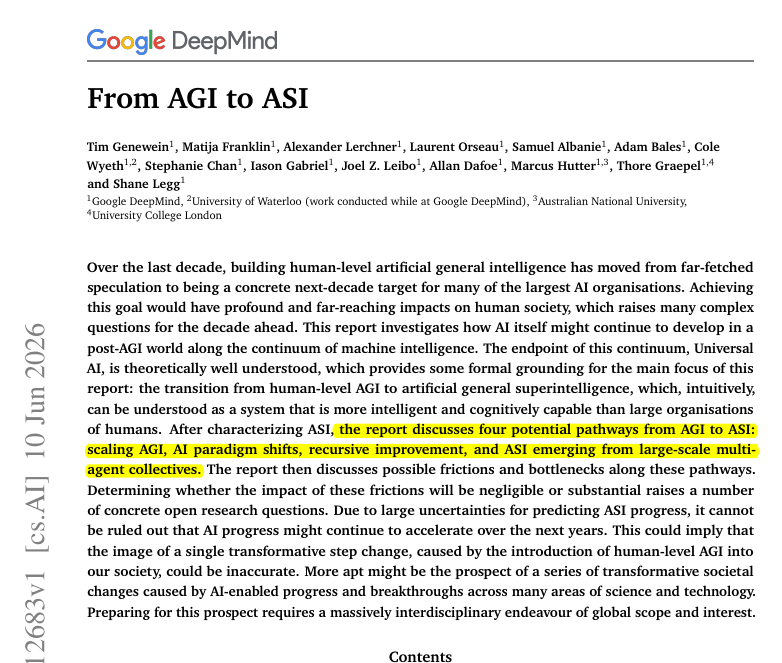
Beautiful paper from Google DeepMind.
Explains the pathways from AGI to ASI, and why that jump could happen through several routes.
The authors frame the AGI-to-ASI transition around 4 technical pathways:
- continued scaling of compute, model size, data, and test-time inference;
- algorithmic paradigm shifts beyond today’s transformer-based foundation-model stack;
- recursive self-improvement, where AI accelerates AI R&D and improves future systems; and
- multi-agent collective intelligence, where large populations of specialized agents coordinate into a superhuman group agent.
Scaling may work for a while, but it could hit limits in data, compute, energy, or weaker returns from making systems larger.
Recursive improvement is the most uncertain path, because AI could speed up AI research, but that loop may also slow if hard research problems need real-world testing, scarce hardware, or new ideas.
Multi-agent collectives may be the most underappreciated path, because a society of competent digital workers could outperform a brilliant individual model through specialization, speed, and coordination.
The big point is that ASI may not arrive as 1 sudden event, but as a chain of faster changes as AI helps create better AI and stronger scientific tools.
----
Link – arxiv. org/abs/2606.12683
Title: "From AGI to ASI"
OpenAI was served with subpoena tonight by a coalition of state AG's asking for documents on advertising, user engagement/retention, handling of consumer data and health data, activities related to minors and seniors, deep learning models, model sycophancy and company policies.
The US government, citing national security authorities, has issued an export control directive to suspend all access to Fable 5 and Mythos 5 by any foreign national, whether inside or outside the United States, including foreign national Anthropic employees.
The net effect of this order is that we must abruptly disable Fable 5 and Mythos 5 for all our customers to ensure compliance.
Access to all other Claude models is not affected.
We apologize for this disruption to our customers. We believe this is a misunderstanding and are working to restore access as soon as possible.
Read our full statement: https://t.co/bwn0sximKZ
Jeff Bezos talking to the NYT about his startup Prometheus: 'All societal wealth is driven by invention. Six thousand years ago, somebody invented the plow, and we all got wealthier. Then, much later, somebody invented the steam engine, and we all got wealthier. What Prometheus seeks to do, is to offer a set of tools that dramatically accelerates that invention loop.'
Today I'm publishing a new essay, Policy on the AI Exponential. AI is progressing extremely fast—much faster than the policy process was built to handle. The essay lays out where I think the technology is now, and the action needed to close the gap: https://t.co/Lh6PWae178
BREAKING NEWS: Anthropic's latest model will NOT help you if it thinks your ML research/ML engineering is interesting, and/or will secretly degrade its IQ so that the average engineer won't notice. We are already seeing Anthropic's latest model's moderation filters our GPU inference research and programming 😭
So I gave Fable 5 the watchmaker benchmark: a full Swiss lever movement in Three.js. Real gear ratios (18,000 bph), working escapement, breathing hairspring — and the hands tell actual time. It verified its own work with vision, in a loop, until done. ⌚
We’re very excited to announce that Anthropic’s Fable 5 is a SOTA model at mechanical engineering tasks!
It can generate intricate working assemblies and mechanisms in a single prompt.
what is agent looping
for the last two years we prompted agents one task at a time. that is starting to change
instead of asking an agent to build the landing page and then driving every step yourself, you set up a loop that handles discovery, planning, the work, checking, and iterating until the goal is met
looping is a setup you build. almost any agent harness can run it, it just depends on how you wire it up
at its simplest, looping is one agent working on itself:
> researches
> drafts
> checks the draft against a goal
> fixes what is weak
> runs that cycle again until the work clears the requirements
you are not prompting each step anymore. the agent repeats the cycle for you
the bigger version is a fleet looping. you give an orchestrator agent a goal, it breaks the goal into pieces, hands each piece to a specialist agent, and those specialists hand smaller jobs to their own subagents
the whole tree keeps looping through discovery, planning, execution, and verification until the goal is met
one agent looping is like a person redoing their own draft. a fleet looping is a whole team running a project end-to-end
you create a goal, and the system runs the loop until it finishes within the reqs you set
open and closed looping:
OPEN LOOPING is exploratory. it still has conditions and a goal, but you give the agent or the fleet a wide space to move in. it can try different paths, discover things, build something you did not fully spec out
this is the exciting end, it is what Peter and others are doing, and tbh it is where I want to spend more time
the catch is cost, an open loop with real room to explore burns an insane amount of tokens. for the 90 percent of people without an unlimited budget it is not runnable yet, and pointed at projects with a loose standard it turns into a slop machine
CLOSED LOOPING is bounded. a human designs the end-to-end path first:
> clear goal
> defined steps
> an eval at each step
> a point where it stops or hands back to you (and feeds back performance data)
the agents still loop, but inside framework you built. it gets better every run because each pass feeds the next, and it runs on a normal budget because the path is tight.
for most marketing work, closed is the one that pays off today.
> the orchestrator owns the goal
> the specialists own the steps
> the subagents do the narrow work
> an eval gate make sure its not slop
We recently submitted a confidential S-1. We expect it to leak so we’re just announcing it. We have not decided on timing yet; it may be a while because there are things we want to do that are likely easier as a private company. But it’s a complicated set of tradeoffs and this gives us the option to go public sooner if that ends up being best.
This announcement is being made pursuant to Rule 135 under the Securities Act of 1933, as amended, and does not constitute an offer to sell or the solicitation of an offer to buy any securities. Any offers, solicitations of offers to buy, or any sales of securities will be made in accordance with the registration requirements of the Securities Act.
It is a really good time to store up a few of your hardest, most valuable, and most unusual ideas - whether for work, hobbies, or a new venture.
Thanks to AI, really good & unique ideas are getting extremely cheap to implement, but not necessarily easier to find. Big opportunity
Demis Hassabis's new interview:
"Society needs to hear that because we don't have long to prepare for what that means. We are standing in the foothills of the singularity now.
..which is AGI. I believe that we are only a few years away from that, maybe around 2030, plus or minus a year. "
~ Demis Hassabis, Co-Founder and CEO of Google DeepMind
It is going to be enormously profound, I think. The future, in my view, is still to be written. But these next few years are going to be very critical as to which way that will go, and how we collectively want that to look.”
---
IMO, The real disruption is not whether AGI arrives exactly in 2030, plus or minus a year, but whether institutions can adapt, as in post-AGI world, technology will change much faster than human systems can respond.
Schools still train people for stable professions, companies still organize work around human bottlenecks, and governments still regulate after harm becomes visible.
AGI, if it arrives anywhere near the frontier-lab timelines, compresses that lag into a dangerous gap.
----
From "Stanford Graduate School of Business" YouTube channel, (link in comment)
Today, we are officially launching the Sakana AI RSI Lab in Tokyo to build open-ended, adaptive AI systems that collectively self-improve. I am incredibly proud of our team’s work over the past 2 years, shipping the breakthrough research that laid the foundations for this moment.
Building in Japan provides us with the ultimate design constraint. Just like Japan’s historical dominance in manufacturing was achieved by fundamentally redesigning the factory floor to do more with less, we are focused on compute-efficiency.
We are not building the most compute-hungry self-improvement engine. We are building the most sample-efficient one.
If you are entirely unsatisfied with the brute-force status quo and ready to build the self-improving future in Japan, come join us.