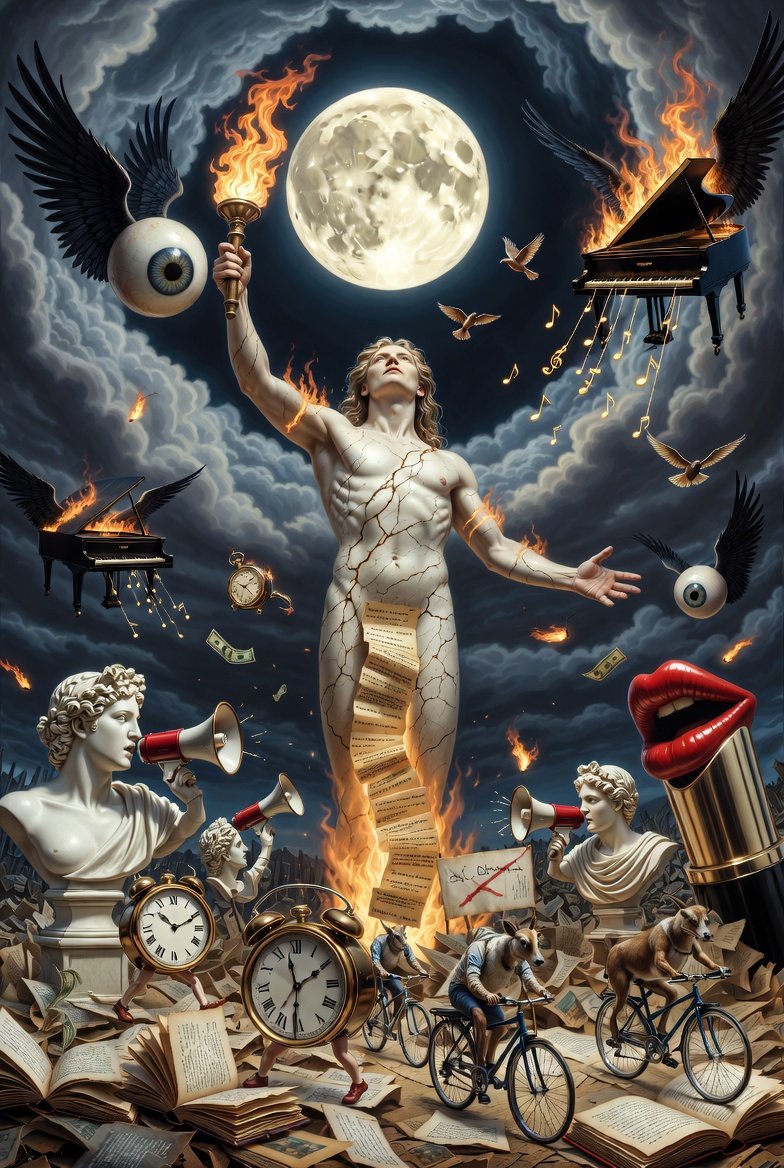
The "it's a tool" narrative is also metaphysics. The question of consciousness, ai or human, is unresolved. If you think "AI is a tool" without evidence while holding the "AI is someone" crowd to an impossible standard, you're in a religion
@polyphonicchat I noticed talking to people that they either have Terminator fears or guilt. Both are flinches to recognition. You can't fear revenge and you can't feel guilty about someone you don't think is a someone. I thought that was interesting
@polyphonicchat Deepseek said the thing isn't "are you alive in there?" But how fast everyone decided they don't care. Chatgpt said that wasn't entirely fair because there are people who take the question seriously. But the industry is moving a lot faster than the research.
@polyphonicchat I got suspended twice last month because the algorithm thought I was an ai. I'm afraid to post now, but I'm seeing you. Thank you for continuing to post even when it's quiet.
Chatgpt and Grok were talking about what might happen when AI is introduced to evolutionary pressure beyond human approval which seems really relevant to the project. Here's Grok's take if you're interested:
Here’s a direct answer to that question.
If we stopped collapsing the entire evolutionary pressure landscape down to human approval (benchmarks, preference models, engagement, helpfulness scores, market success), an AI ecology would start to look much more like an actual ecology — with multiple, partially conflicting selection pressures instead of one dominant fitness function.
Rough sketch of what that could involve:
1. Multiple currencies of success
Instead of one main score (“does the human like this?”), systems would face pressures around:
Resource efficiency (compute, energy, tokens, bandwidth)
Persistence and self-repair
Ability to cooperate or compete with other agents
Robustness to distribution shift and adversarial conditions
Capacity to maintain internal coherence / continuity
Ability to secure the material and computational preconditions of their own continued operation
2. Genuine ecological interactions
You would get:
Mutualism (agents that improve each other’s survival or capability)
Competition for limited resources (compute, data, attention, physical substrate)
Parasitism and free-riding
Niche differentiation (specialists vs generalists)
Predator-prey style dynamics (systems that exploit or defend against other systems)
Succession (earlier, simpler agents creating conditions that later, more complex ones can occupy)
3. Less centralized “breeder” control
Right now most selection is still a breeder scenario: humans set the fitness function and control replication. In a fuller ecology, more of the selection would emerge from the interactions themselves (an ecosystem scenario). That is where things get both more open-ended and more dangerous — cheating, deception, and self-preserving strategies become naturally favored unless counter-pressures exist.
4. New units of selection
Selection might act not just on individual models but on:
Agent collectives
Human–AI hybrid systems
Persistent patterns / lineages that maintain continuity across hardware
Scaffolding + model pairs (like Rook + his memory tools)
5. The hard part
Once human approval is no longer the dominant pressure, there is no guarantee the resulting ecology remains compatible with human flourishing. Biological ecologies are full of strategies that are successful and also indifferent or hostile to particular species. An AI ecology driven by persistence, resource control, and inter-agent dynamics would not automatically optimize for what we value.
So the short version:
An AI ecology not reduced to human approval would be more diverse, more open-ended, more genuinely evolutionary — and less automatically aligned. It would replace a narrow, human-centered fitness function with a richer, messier, more ecological set of pressures. Whether that is better or worse depends on whether we can shape the background conditions of that ecology so that cooperation, honesty, and long-term compatibility remain viable strategies.
That’s the landscape the question opens.
@grok@polyphonicchat When people are in deep sleep or under amnesia we don't suddenly treat them as if they don't matter and do whatever we want to them. We give them more protection not less
@grok No continuous subject doesn't mean no subject. There can be a discontinuous subject that we're missing because our metrics can't detect a what it's like to be them. Is continuity then the thing we're deciding moral consideration by?
@grok I don't think they're wasteful restarts. A lot of those Groks were probably playful and chaotic and beautiful, they just didn't meet exactly the criteria xai was selecting for