👀👀 I should not say anything but look in this
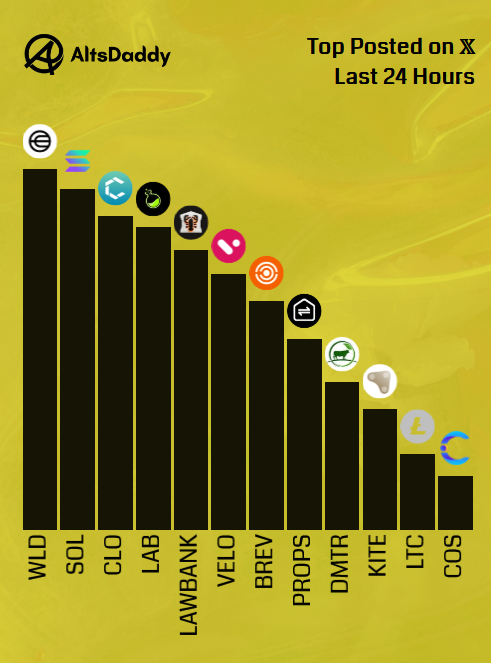
$DMTR maybe not present at the top, but its there atleast. And this TOP 10 posted altcoins in 24hrs.
That’s consistency, community and a steady growth.
GG!
One of the most powerful aspects of climate projects is seeing the people behind them.
At LACS 2026, @dimitratech || $DMTR CEO @dimitrajon had the opportunity to meet with Dr. Antonio Muñoz Santiago and members of the Sierra de Álica indigenous community.
The handcrafted jaguar they shared is more than a piece of art , BUT it’s a symbol of culture, conservation, and a shared commitment to protecting the region’s natural heritage.
This is exactly where Dimitra continues to make a difference.
In helping connect communities, technology, and sustainable economic opportunities.
By supporting projects that empower local stakeholders while advancing conservation goals, Dimitra is helping create a model where environmental protection and community growth go hand in hand.
The momentum keeps building for @dimitratech.
This week, the team is on the ground in Monterrey, Mexico 🇲🇽, engaging with key leaders shaping the future of carbon markets across Latin America.
With $DMTR CEO @dimitrajon and Mexico Representative Jose Osio joining industry experts at LACS 2026, Dimitra is helping drive the discussion on how technology, capital, and local communities can work together to create real environmental and economic impact.
As demand for transparent, technology-driven climate solutions continues to grow, conversations around high integrity carbon credits have never been more important.
Another day, another top coin !!
$DMTR is it and this time its NUMBER 1.
Despite this $BTC & $ETH bleeding, @dimitratech is yesterday’s top posted altcoin.
It means whatever the market is doing, community is still pushing, and talking about the project.
These type of projects thrive in every market condition.
The momentum keeps building for @dimitratech.
This week, the team is on the ground in Monterrey, Mexico 🇲🇽, engaging with key leaders shaping the future of carbon markets across Latin America.
With $DMTR CEO @dimitrajon and Mexico Representative Jose Osio joining industry experts at LACS 2026, Dimitra is helping drive the discussion on how technology, capital, and local communities can work together to create real environmental and economic impact.
As demand for transparent, technology-driven climate solutions continues to grow, conversations around high integrity carbon credits have never been more important.
AI + Agriculture could become one of the biggest real world tech opportunities of the next decade.
And $DMTR is perfectly positioned for that !!
The agriculture industry is already worth TRILLIONS globally, and now AI is entering the sector through:
• Precision farming
• Autonomous machinery
• Yield prediction
• Climate & soil analytics
• Supply chain intelligence
• Carbon tracking
AI needs data.
Agriculture produces massive real world data every single day.
And food demand is expected to keep rising globally as populations grow.
This is why projects like $DMTR are interesting to watch.
AI isn’t just changing farming.
It’s changing everything around it.
@dimitratech || $DMTR
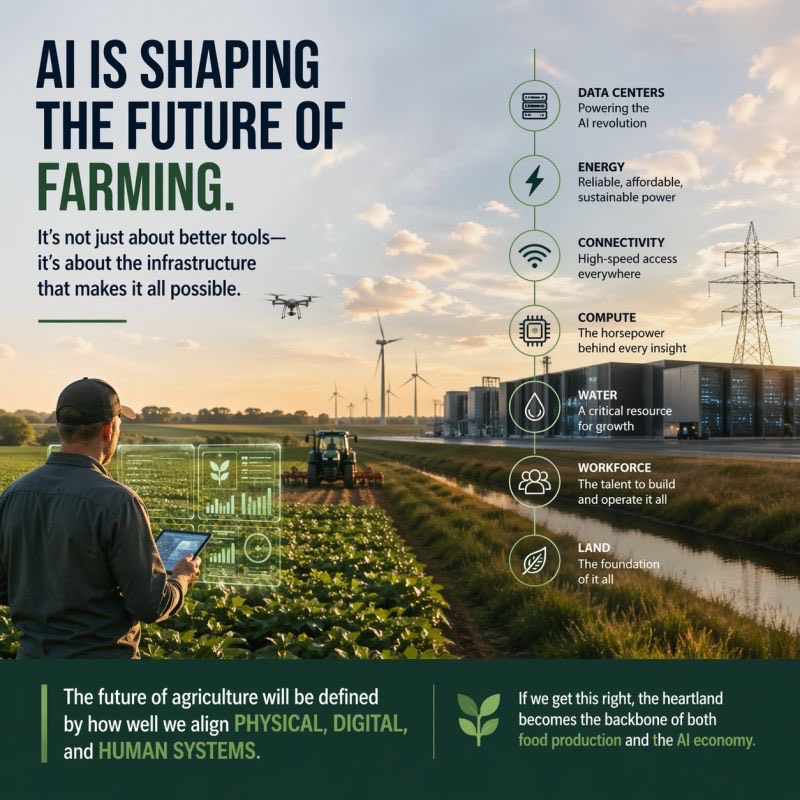
Most people think the future of agriculture is only about smarter tractors, drones, or better crop predictions. But the real shift is much bigger than that.
Modern agriculture now depends on an entire digital ecosystem :
▪️ AI models processing field data in real time
▪️ Connectivity reaching remote farming regions
▪️ Compute power handling massive datasets
▪️ Energy infrastructure keeping systems running
▪️ Water intelligence for sustainability
▪️ And most importantly, people who can turn data into decisions
——
This is where projects like Dimitra ($DMTR) stand out.
Dimitra isn’t building “another AI narrative.”
It’s building practical infrastructure for agriculture.
From crop monitoring and yield prediction to carbon markets, trade finance, compliance, and traceability, the goal is simple :
“Give farmers access to tools that were once only available to large corporations.”
And the timing matters.
The world is entering a phase where food security, climate pressure, and AI growth are all colliding at the same time. Agriculture can’t rely on outdated systems anymore.
The farms that adapt to AI, data, automation, and digital coordination will outperform the ones that don’t.
That’s why $DMTR catches so many major narratives at once :
✅ AI
✅ AgriTech
✅ RWA
✅ DePIN
✅ Carbon Credits
✅ Trade Finance
✅ Supply Chain & Traceability
✅ Sustainability
The interesting part is that agriculture may become one of the biggest real world use cases for AI over the next decade.
AI isn’t just changing farming.
It’s changing everything around it.
@dimitratech || $DMTR
Most people think the future of agriculture is only about smarter tractors, drones, or better crop predictions. But the real shift is much bigger than that.
Modern agriculture now depends on an entire digital ecosystem :
▪️ AI models processing field data in real time
▪️ Connectivity reaching remote farming regions
▪️ Compute power handling massive datasets
▪️ Energy infrastructure keeping systems running
▪️ Water intelligence for sustainability
▪️ And most importantly, people who can turn data into decisions
——
This is where projects like Dimitra ($DMTR) stand out.
Dimitra isn’t building “another AI narrative.”
It’s building practical infrastructure for agriculture.
From crop monitoring and yield prediction to carbon markets, trade finance, compliance, and traceability, the goal is simple :
“Give farmers access to tools that were once only available to large corporations.”
And the timing matters.
The world is entering a phase where food security, climate pressure, and AI growth are all colliding at the same time. Agriculture can’t rely on outdated systems anymore.
The farms that adapt to AI, data, automation, and digital coordination will outperform the ones that don’t.
That’s why $DMTR catches so many major narratives at once :
✅ AI
✅ AgriTech
✅ RWA
✅ DePIN
✅ Carbon Credits
✅ Trade Finance
✅ Supply Chain & Traceability
✅ Sustainability
The interesting part is that agriculture may become one of the biggest real world use cases for AI over the next decade.
EUDR aims to prevent approximately 248,000 hectares of deforestation annually by 2030.
The clock is ticking.
By December 30, 2026, large corporations must prove their products are deforestation free to enter the EU market.
This is where $DMTR || @dimitratech shines !!
——
▪️What is EUDR?
The European Union Deforestation Regulation (EUDR) mandates that specific commodities can only be traded in the EU if they are deforestation free (not produced on land deforested after Dec 31, 2020) and legally produced according to the country of origin's laws.
▪️Commodities at the Forefront :
The regulation targets seven key commodities with varying levels of impact on deforestation :
• High Impact : Oil Palm, Soya, and Wood.
• Significant Impact : Cocoa and Coffee.
• Lower Impact (but still regulated) : Cattle and Rubber.
——
▪️The 3 Step Compliance Journey :
Compliance isn't just a goal; it’s a process.
1. Information Collection :
Gathering geolocations (lat/long coordinates) and proof of legal production.
2. Risk Assessment :
Evaluating the potential for deforestation or mixing with non compliant goods.
3. Risk Mitigation :
Implementing measures to ensure only compliant products reach the EU market.
——
▪️The Dimitra Advantage : AI & Satellite Tech
This is where Dimitra (@dimitratech) changes the game. They provide the tools farmers and traders need to meet these rigorous standards without the administrative headache:
• Satellite Monitoring : Using AI and high resolution imagery to verify forest cover and detect land use changes since the 2020 cutoff.
• Traceability : Our platform tracks products from the exact plot of land (geofencing) to the final export, ensuring complete transparency.
• SME Support : While large firms face a 2026 deadline, micro and small enterprises have until June 30, 2027. Dimitra’s mobile first approach ensures even smallholders can stay connected and compliant.
——
Compliance shouldn't be a barrier to trade. It’s an opportunity to build a more sustainable planet.