$DLO - Pedro's comments from the company's session at Goldman's Sep 2026 Tech Conference are encouraging for my one-year dLocal model (linked below).
First, Pedro's statement that take rates will be "flattish" for "at least the second half" of 2026 is an encouraging signal that my Net Take Rate forecast of 0.72% Q3 26 -> 0.70% Q4 26 -> 0.68% Q1 27 -> 0.66% Q2 27 is in the correct ballpark.
Second, Pedro's guidance for payroll costs (which currently represent 80% of dLocal's OpEx) to continue falling implies that my OpEx estimate of $103M in H1 27 (vs proj H2 26 OpEx of US$99M), may be too high.
Third, Pedro's statement that dLocal's buyback this year will be close to 8% of the company's market cap validates my assumption that the full $300M authorized buyback programme is deployed across 2026 and into Q1 2027. At dLocal's current market cap of approximately $3.7–4.2B, 8% implies total buyback spend of approximately $300M, matching the amount of its share repurchase programme.
With these assumptions in mind, I forecast cumulative EPS of $1.02 for the 12 months between Q3 2026 and Q2 2027, a ~29% YoY growth rate.
At dLocal's current trailing 12 month ~20x P/E multiple, this yields a 12-month price target of $20.37 (45% upside from $14/shr).
At a 25x P/E multiple, which I view as reasonable given investors would award dLocal for accelerating EPS growth, this yields a 12-month price target of $25.46 (81% upside from $14/shr).
$DLO - Takeaways from Goldman Sachs' 2026 Tech Conference (PT 2)
Having finished reading the transcript of dLocal's session at Goldman's September 2026 Tech Conference, here are the rest of my takeaways.
A Continued Focus on the Global South
dLocal CEO Pedro Arnt was clear that the company will not attempt to enter the US or Europe. Pedro believes that what sets dLocal apart is their ability to navigate the fragmented and constantly shifting regulatory landscapes in emerging markets. In the US and Europe, payment methods are highly concentrated and the regulatory landscape is stable, leaving little room for dLocal to differentiate itself. Pedro also noted how similar the environments are across the Global South, whether it be Latin America, Africa, Asia or the Middle East, allowing dLocal to compound its edge of interacting with local issuing banks and acquirers to optimize payment performance for its merchants.
A Slowing Rate of Take Rate Compression
Pedro first acknowledged that falling take rates in the payment industry have been an “unavoidable reality”. Further, within the emerging world, Pedro noted that the slope of take rate decline has been steeper than in developed economies because take rates were coming off of a higher base. dLocal’s take rate decline has been particularly steep, even amongst its peers operating in the global south, because: (i) the company’s three biggest growth drivers over the last few years (ride-hailing, e-commerce and remittance) are all low take rate verticals; and (ii) the company’s fastest growing segments (Brazil and Mexico), are lower take rate jurisdictions.
However, Pedro was explicit that dLocal has reached a point where the pace of its take rate decline should slow down, and is guiding for relatively flat take rates in H2 2026 into H1 2027. He believes that going forward dLocal will have periods where higher take rate verticals such as advertising and travel become growth drivers. Additionally, as the higher take rate African and Middle East markets which dLocal is expanding into become a larger share of the company’s TPV processed, this should offset some of the take rate compression which dLocal has experienced. Today, dLocal’s business is 75% in Latin America, 20% in Africa, and 5% in the Middle East and Asia.
The Impact of AI on dLocal’s Business
Pedro highlighted three ways that AI is impacting dLocal’s business:
(1) A New Vertical of Clients
Until now, Pedro believes that payment optimization in emerging markets has not a focus for the AI labs given the rapid top-line growth which they have experienced. However, he has recently experienced an increase in communication with AI labs, and revealed that dLocal has landed an undisclosed, top AI company as a client. Pedro believes that the absence of payment optimization in emerging markets is starting to negatively affect the growth of these businesses, and sees AI clients as a massive opportunity for dLocal 2-3 years out.
(2) A Force Lowering Payroll Costs
Currently, payroll expenses represent 80% of dLocal’s OpEx. Pedro has been impressed with dLocal’s progress on agentic deployment, and believes this will “dramatically change dLocal’s cost structure” in its middle and back office roles. He is optimistic about the operational leverage that is inherent in dLocal’s business model over the next few years, and once again stated that investors should expect to see some of this operating leverage emerge in H2 2026. Pedro used the following algorithm to show investors how he thinks about dLocal’s ability to deliver very consistent margin expansion and FCF growth: “high TPV growth, lower gross profit growth because of take rate compression, and falling OpeX.”
(3) Agentic Commerce as a Growth Driver
Pedro believes that agentic commerce will increase payment fragmentation, as agents will succeed in optimizing multiple payment methods rather than using a single credit card. Here is his key quote: “Leaving out certain more maximalist scenarios where agents are only using stablecoins and entire economies are powered on stablecoins, and therefore card schemes, PSPs, digital wallets, have all been somehow disintermediated by on-chain transactions, which I do not think will happen for multiple reasons, I actually think the rise of agentic commerce and AI in commerce actually expands the pie for payments companies.”
dLocal’s Capital Allocation Strategy
In the absence of strategic M&A, which Pedro does not want to rule out as Fintech is prime for consolidation, and after reinvesting back into the company’s strategic plan and paying dividends equal to 30% of FCF, Pedro believes that there will be leftover cash for sustaining a share buyback program consistently over time. The scale of the buyback will vary each year, currently running at approximately 8% of market cap, depending on available capital after strategic investment.
The ability to sell is not a reason to sell
I can very much relate to what Balmer is saying and to the question he was asked by Charlie Munger. I certainly sell stocks from time to time, but generally speaking, when I go into business with someone, in public or private markets, my intention is to throw down with that person indefinitely, or at least for a very long time.
I don’t buy a stock hoping someone will pay me more for it next year. I buy a piece of a business because I want to participate in what those people might build over the next decade or two.
The stock market does something psychologically dangerous to ownership. It takes an asset that may require decades to realize its potential and puts a blinking price next to it every second, constantly inviting you to reconsider a decision that shouldn’t need reconsidering every second.
Imagine owning 20% of an incredible private business with an exceptional partner. Sales are growing, customers love the product, the opportunity is getting larger and your partner keeps reinvesting intelligently. Then one morning someone knocks on your door and offers 15% less for your shares than they offered yesterday.
Would anything have changed? Probably not. Yet put the exact same business inside a brokerage account and suddenly that lower offer feels like new information.
That is one of the strangest things about public markets. Liquidity is a feature of the asset, but investors allow it to become a feature of their behavior.
I rarely sell simply because a stock went up. I rarely sell simply because it went down. I don’t sell because I’m bored, because something else is moving faster, because the market found a new obsession, or because I’ve owned something for “too long.” None of those things tell me what I really want to know.
Are the people still exceptional? Is the culture intact? Is the moat getting wider? Are incremental dollars being reinvested intelligently? Is the opportunity ahead still much larger than the business today? Most importantly, has the destination changed?
Indefinite ownership does not mean blind loyalty. Management can disappoint me. Economics can deteriorate, competitive advantages can disappear, capital allocation can become destructive, and eventually price can become so disconnected from reasonable future economics that selling makes sense. But these are business reasons to reconsider ownership. A moving stock price is not.
I think investors dramatically underestimate the value of continuity. Every time you sell a wonderful business, you aren’t merely making a sell decision. You are making two decisions: that you should stop owning this business and that whatever you do with the money next will produce a better long term outcome after tax. This second decision is much harder than people pretend.
The market gives us the extraordinary privilege of being able to end a business partnership at 9:43 on a Tuesday morning with the push of a button. I’m grateful that privilege exists. I just don’t confuse the ability to leave with a reason to leave.
When I find exceptional people building an exceptional business with decades of opportunity ahead of them, my preferred holding period isn’t 5 years or ten years, it is until they give me a reason not to be their partner anymore. 🌹
$DLO
Pedro says growth is sitting on the “S-curve” of emerging market payment localization. They’re adding new merchants, expanding wallet share with existing ones, adding new payment methods, and growing with them into new countries. The result is 149% NRR, meaning existing clients keep spending more each year.
That kind of retention number is simply elite, literally better than any other company. It means that even without signing a single new merchant, $DLO revenue would still grow double digits just from the existing base expanding. And that base already includes six of the “Mag 7” global tech giants, the biggest businesses in the world.
🌹
The Next Chapter for $DLO: Expanding Beyond Core Products
$DLO business today is still built on two core products: “payins” and “payouts”. Merchants can collect money through local payment methods and pay people in local bank accounts, wallets, or cash. That is the foundation of what makes the platform valuable in emerging markets.
The next step for $DLO is expanding its products to make merchants stickier and create new revenue. Many fintechs try to cross sell unrelated products to boost take rates, but big global merchants only adopt best in class solutions.
$DLO is focusing on products that fit naturally with “payins and payouts”.
The first is credit. Consumers in emerging markets need credit to buy, but many alternative payment methods don’t offer it.
$DLO integrates existing buy now pay later and credit providers so merchants can offer credit without taking on risk themselves. It makes checkout easier and increases monetization.
It’s interesting how $DLO essentially extends credit to APM’s (where credit currently doesn’t exist), without taking on credit risk (quite cleaver…).
The second is point of sale (and I must add that @TheRayMyers was the first to sound the horn on this, I was skeptical but you nailed it so great job Ray! 👏).
Most transactions in emerging markets still happen offline. $DLO is building a POS solution to give offline merchants the same payment infrastructure it already provides online.
The goal is simple. Build products merchants need and where $DLO can win. That strengthens the core business and creates new higher margin growth opportunities.
🌹
Thoughts on Buybacks
One of the most underrated forms of compounding has almost nothing to do with explosive growth. It happens when a good business keeps buying back its own shares.
Imagine earnings grow just 5% a year. Nothing heroic and perhaps quote slowly. Now imagine the company also buys back 5% of its shares every year.
After 10 years, total earnings are only 63%. But earnings per share are 170% higher because those earnings are being divided among dramatically fewer owners. That’s a staggering difference.
That is the part I think investors underestimate. The business does not need to become 3 times larger for your economic interest to become almost 3 times more valuable.
Buybacks allow your ownership percentage to compound without you investing another dollar. You can go to sleep owning 1% of a company and, over time, wake up owning 2% simply because everyone else’s shares were repurchased by your business.
$NVR is a great example. The houses were only part of the story. For decades, $NVR kept shrinking the shares count while the underlying business continued producing cash.
And this is where buybacks become especially powerful. You do not need heroic revenue growth, heroic margins, or some giant new addressable market. You need a durable business, lots of free cash flow, a reasonable valuation, and a disciplined management that understands math.
Of course price matters enormously. Buying back stock cheaply increases the ownership of remaining shareholders at attractive prices, while buying it back at absurd valuations destroys value.
Growth gets most of the attention because it is easy to see and investors and the whole Wall Street fashion show are conditioned to jubilation over GROWTH. Buy prudently buying back shares intelligently is much quieter, and in many cases more effective for the sensible shareholder.
Sometimes the greatest compounding is not a business growing faster and faster. It is the same good business being divided among fewer and fewer owners.
🌹
The Best Investment Strategy in the World
There are a hundred ways to make money in the stock market. You can diversify, concentrate, buy and hold, day trade, trade options, buy junk bonds, follow momentum or search for tiny companies nobody has heard of. People have become extraordinarily rich doing almost all of them, so what exactly is the best way to invest?
I don’t think there is a best investment strategy. There is only a best investment strategy for each person. What works brilliantly for one investor could be a disaster for another.
Investing cannot be separated from the person doing the investing. Your age, wealth, income, family, goals, knowledge, temperament and the way you react to losing money should influence how you invest. A 28 year old with $50,000 is playing a completely different game from a 68 year old with $10 million, yet we talk about the “best strategy” as though the person executing it barely matters.
This is why I think Wall Street’s definition of risk is incomplete. We measure volatility and drawdowns, but what about the probability that you panic, become bored or abandon a perfectly good strategy after three terrible years? Some of the greatest risks in investing exist inside the investor, not the investment.
Envy may be one of the biggest. The market gives us a daily scoreboard of everything we should have owned instead, and somewhere someone will always be getting richer faster than you. If you compound at 15% while somebody on X makes 80% trading options, it becomes surprisingly easy to feel unsuccessful while doing something objectively extraordinary.
That is how investors get pulled into games they were never supposed to play. A long term investor becomes a trader, a conservative investor starts speculating and someone who spent twenty years studying businesses suddenly decides they need to trade options. Their abilities didn’t change. They simply became distracted by somebody else’s success.
One of the great breakthroughs in investing happens when you stop asking what everyone else is doing and decide what game you are actually playing. You don’t need to master every corner of the market or participate in every opportunity. Find an approach that matches who you are and become exceptionally good at it.
This is where the circle of competence becomes much more interesting. It isn’t only knowing what you understand. It is also knowing what you can safely ignore.
If your goal is to own $MELI for the next decade because you believe MercadoLibre can become dramatically larger, does it really matter what $NVDA reports tonight? Do you need an opinion about $CRWD, Bitcoin, oil and the next Fed meeting? Unless those things change your thesis, much of it is probably noise disguised as knowledge.
We have access to more financial information than any generation of investors in history, yet that doesn’t necessarily make us better investors. Information tells you what happened, knowledge helps you understand why it happened, and wisdom tells you whether you need to do anything about it. I think the last part is where much of the money is made.
This is also why copying great investors is so difficult. You can copy someone’s portfolio in five minutes, but you cannot copy the twenty years of experience that produced it. You don’t inherit their temperament, pattern recognition, financial circumstances or ability to sit through a 50% decline.
Eventually investing becomes a very personal exercise. In the beginning you study stocks, accounting, valuation, business models and famous investors. If you are paying attention, eventually you begin studying yourself.
🌹
Some of your biggest mistakes will be stocks you made money on
One of the most dangerous things that can happen to an investor is getting rewarded for a bad decision. A loss forces you to think. A lucky win can convince you that you never needed to.
You buy something you barely understand because it is going up. The valuation makes no sense, the business is mediocre and your thesis is mostly narrative. Then the stock doubles and suddenly the market has taught you that bad behavior works.
That is how investors get into trouble. Not always through one gigantic mistake, but by being rewarded for lowering their standards. The market can reinforce bad habits for a long time before punishing them.
This is why making money and being right are not the same thing. The market can give you a great result even when your analysis was wrong. That matters far more than most investors realize.
Imagine buying a company because you believe earnings will double in 3 years. Earnings barely move, but the valuation goes from 15 times to 30 times and the stock doubles anyway. You made money, but your thesis failed.
Maybe you bought a highly leveraged business because you expected debt to fall quickly. Debt barely moves, interest rates decline and the market stops caring. Again, you made money, but not for the reason you expected.
Your brokerage account records a win. Your investing journal should record something different. That is difficult for most investors to admit.
This is why every investor should keep two scorecards. The first is obvious, what return did I make? The second is more important, how much of my original thesis actually came true?
Did revenue develop the way I expected? Did margins improve for the reasons I expected? Did free cash flow grow, did the moat strengthen and did management allocate capital well?
If most of those answers are no, I do not care how green the position was. I got paid, but I did not necessarily invest well. Those are two different things.
The reverse is also true. You can buy a great business at a sensible valuation, have the thesis play out and still watch the stock fall 30% because the multiple compresses. That can feel like failure even when your process was excellent.
This matters because investing is a repeated game. You are not trying to be right once. You are trying to build a process that survives decisions over decades.
A bad process that makes money is dangerous because it encourages repetition. Every time it works, confidence increases. Eventually you take bigger risks with worse ideas because the market trained you to believe your process was better than it was.
This is why bull markets can make investors worse. Weak businesses look good, bad valuations feel justified and aggressive decisions seem intelligent. The market rewards behavior that would look foolish in a harder environment.
You stop asking whether your reasoning was correct. You start asking whether the stock went up. That is where investing can turn into something else entirely.
Price can validate your ego long before it validates your thesis. Sometimes the most dangerous investor is not the one who lost money. It is the one who made a lot of money for reasons they do not fully understand
So after a winner, I ask myself something uncomfortable. If the stock had fallen 30% instead of rising 50%, would I still believe my analysis was good? Could I still defend the thesis without pointing to the stock price?
If the answer is no, maybe the stock did not prove I was right. Maybe the price simply prevented me from discovering I was wrong. That is an important difference
Some of your biggest investing mistakes will never appear as losses. They will appear as profits that taught you the wrong lesson. Those can become the most expensive profits you ever make
If you enjoy my writing, consider subscribing for deeper research, private ideas, Q&As and more direct access to me. My investing book is also coming around Christmas🌹
The importance of the economic model
One of the first things I look at when analyzing a business is the economic model. People spend a lot of time on growth, TAM, management, or whatever else, but before any of that matters there is a much simpler and easier question that should be asked. How much money does the business actually keep from every $1 of revenue it brings in?
Imagine 2 identical ice cream stands on the same block selling the exact same product. Same traffic, same prices, same costs, same everything, except for one difference. One stand earns a 20% margin and the other earns a 30% margin. All else being equal the second stand is simply the better business because it keeps more money from every $1 it generates.
This might sound obvious, but investors ignore it all the time. One way I like to think about businesses is very simple. For every $1 that enters the company, how much of that dollar actually stays inside the business? Some companies keep $0.05 cents while other keep $0.30. That difference is massive and it changes everything!
High margins also create resilience. If a business earns $0.30 on every $1 of revenue it has room to make mistakes and absorb shocks. But if a business only earns $0.05 it cannot afford a single mistake. A small disruption in costs or competition can wipe out the entire profit.
Another thing investors often miss is that scale does not fix a weak economic model. Scale simply exposes it. If a company needs $10b in revenue just to produce $50m in profit, the underlying economics are simply weak. Doubling revenue does not suddenly turn that into a great business, it just produces slightly larger profits on top of the same weak foundation.
Some people argue that thin margins can act as a defense against competition and sometimes that is true, $COST is often mentioned as an example. But $COST is a very unusual business with a membership model that changes the economics.
If you look at many of the most elite businesses in the world the pattern usually looks very different. The best businesses tend to have strong moats that protect their very large margins. They keep a meaningful portion of every $1 that flows through the business.
Companies like $MSCI ans $FICO are good examples. Their products are deeply embedded in the financial system and the marginal cost of delivering the product is extremely low, which allows them to keep a large portion of every $1 of revenue as profit.
In the end growth alone is not enough because a bad business growing fast is still a bad business. What really matters is the economic model and how much of each $1 the company gets to keep and also how long they get to keep it for. In other words, growth creates motion, but economics create wealth.
🌹
The hardest part of owning a 10 bagger
Everyone wants to own a 10 bagger but very few people want to live through what owning one actually feels like. That is the part investors underestimate.
A 10 bagger rarely goes from $10 to $100 in a straight line. It might go from $10 to $18, fall to $12, run to $30, collapse to $19, climb to $55, fall back to $35 and only years later become $100.
Looking backward, the chart looks easy. It removes the fear, the bad quarters, the scary headlines, the downgrades, the recessions and all the moments when selling felt like the intelligent thing to do.
That is why finding a great business is only half the job. The other half is becoming the kind of investor who can actually hold it long enough for greatness to matter.
A lot of people find the right company and still miss most of the return. They buy early, the stock doubles, and suddenly it feels expensive, too large or less exciting than the next shiny idea.
Meanwhile the business may be doing exactly what they hoped. Revenue keeps growing, free cash flow keeps growing, the moat keeps strengthening and management keeps reinvesting intelligently.
This is why one of the most important skills in investing is separating the stock price from the business. A stock can fall 40% while the business becomes more valuable, and a stock can rise 100% while the business quietly gets worse.
Price is information, but price is not the business. The real question is whether the company is becoming stronger or weaker over time. Is the runway still large? Is free cash flow per share still growing? Is management still allocating capital intelligently and is the long term destination still intact?
This is also why conviction is so misunderstood. Conviction does not mean never selling. It means understanding the business well enough to know what would actually make you change your mind.
Maybe growth becomes structurally weaker, the moat starts disappearing or management begins destroying value. Those things matter because a stock being down 25% from its high, by itself, usually does not.
The strange part is that great investments often become harder to own as they succeed. The position gets larger, the valuation gets higher and the dollar swings become much more uncomfortable.
That is when trimming starts to feel responsible and sometimes it is. But often times it is just fear or boredom wearing a very intelligent disguise.
The question should not be how much the stock has already gone up. The question is how much larger the business can still become. Your cost basis tells you everything about your past return and almost nothing about the future opportunity.
Some of the most expensive investing mistakes happen after you were right. You found the business, understood it early and made a lot of money, then sold while the company itself was still in the early stages of becoming something much bigger.
This is why destination analysis matters. Instead of obsessing over the next quarter, ask what the business could look like five or ten years from now. How large can revenue become, what can margins become and how much free cash flow can eventually belong to each share?
The market makes this difficult because it gives you a new price every second and a new reason to react every day. The business itself compounds on a completely different clock.
Everybody wants the 10 bagger. Very few people want the fear, doubt and discomfort that usually come with owning one. That discomfort is often part of the price you pay for an extraordinary outcome.
A 10 bagger rarely feels like a 10 bagger while you own it. Most of the time it feels like a stock you almost sold five different times. 🌹
$DLO The Most Misunderstood Fintech in Emerging Markets
When you first look at $DLO you might think it’s just another cross border payments company caught in a downward spiral of lower take rates, falling margins, and fierce competition. And in a world obsessed with short term numbers it’s no surprise the market has punished the stock.
But that misses the bigger picture. $DLO is quietly building one of the most strategically important payment networks in emerging markets. And if you zoom out the investment case starts to look interesting .
Falling Margins, Broken Business Model
The most common criticism of $DLO is the drop in gross and EBITDA margins. Take rates have declined from over 4% to around 2%, and EBITDA margins have followed. Superficially this looks like a classic case of price competition eroding profitability the dreaded race to the bottom.
But look closer and you’ll see a much more strategic story unfolding.
$DLO is intentionally lowering its take rates to win Tier 0 global merchants like $AMZN. These clients bring massive volume and negotiating leverage. Lower pricing is part of the deal. But the trade off is worthwhile even with a lower take rate $DLO earns more gross profit dollars and builds long term platform dominance.
This is what scale in payments looks like. It’s not about maximizing take rate at all costs it’s about building volume trust and stickiness.
Not a Commodity Business
Payments companies often get lumped together as if they’re interchangeable. But $DLO is fundamentally different from a Stripe or $PYPL clone.
They’re not just a bridge they’re a “translator, regulator, and local operator” rolled into one.
Emerging markets are messy, each country has its own currency controls, fraud risks, regulations, payment methods, and settlement processes.
$DLO edge is that they build custom local infrastructure in each market: payment rail, integrations, fraud tools, compliance automation, and FX.
This isn’t a plug and play widget, it’s an infrastructure business with switching costs. Once a global merchant integrates across 10-20 markets switching is expensive and painful.
High ROIC Capital Light and Cash Rich
Even with declining margins $DLO still sports returns on invested capital over 30%, and a capital light model that gushes cash. $DLO has no debt and lots of cash at, and they used some of that to opportunistically buy back shares at attractive prices ($150m last year). That’s smart capital allocation from management, I like it.
$DLO doesn’t need to burn cash to grow, unlike many fintechs, it’s profitable, asset light and still reinvesting in growth with discipline.
The recent dip in operating cash flow is notable but it coincides with a reinvestment cycle to support massive Tier 0 clients. These are upfront costs that should yield high return volume over time (aka more attractive ROIC)
The TAM Is Enormous and Largely Untapped
Emerging markets still account for a small fraction of global ecommerce but they’re growing fast. Brazil, Mexico, India, Nigeria and Egypt are all seeing surging digital penetration and most of them remain underbanked.
$DLO acts as a one stop gateway for global companies to access these consumers. It’s the one API to rule them all in markets where no one else has figured out how to do it reliably.
And unlike local competitors $DLO doesn’t compete with merchants or banks. It partners with them. That positioning matters.
1/2
$DLO Interesting what Pedro says here about how new merchants enter emerging markets:
"First of all, we continue to observe a substantial long-term opportunity within the markets where we operate. Our addressable market in terms of total payment volume is valued at trillions of dollars, and because it still exhibits low penetration in digital adoption and card usage is projected to experience double-digit annual growth through 2030. Second, if we look at our current merchants' business in the countries where we operate in, we see significant opportunities to grow our share of wallet with those merchants. This will happen as we expand with them into new countries, as we integrate additional APMs and unlock new lines of businesses that we do not yet serve.
The third growth vector is the addition of new merchants. One way to think about the potential growth in that merchant base is that we are still in the early stages of the S-curve of digital merchants adopting emerging markets payment localization. This growth we've observed follows an identifiable pattern. Merchants will typically start by launching their businesses in developed markets. And then as they expand into emerging markets, do so using only international acquiring. This nets them initial access to only a portion of the population, delivers lower conversion rates and a generally poor user experience, ridden with hidden costs and friction.
Eventually, the size of these businesses across EMs reach a scale that demands the localization of payments to solve for those barriers to adoption. And finally, they initiate a phased expansion into other emerging and frontier markets, repeating the cycle. dLocal is able to accompany them through that journey. So as we move up the S-curve with these merchants, we build a more diversified, stickier and less volatile business that serves more merchants across more countries and in a greater number of payment methods. We see this playing out in our numbers. We now serve nearly 760 merchants."
$DLO
Watched the video (link below), she says the biggest problem for companies expanding globally isn’t payments, it’s regulation. Every country has different rules, different licenses, and those rules are constantly changing.
That’s where $DLO shines, they handle all of that complexity so the merchant doesn’t have to. It looks simple, but there’s a huge amount of infrastructure.
This is why compliance is actually the product. Without the licenses, approvals, and regulatory, the payment never even happens. It’s not a cost, it’s what actually enables revenue.
The licenses are a big deal. Each one unlocks a new capability, whether it’s entering a country, enabling a new type of transaction, or serving a different kind of customer. And it’s not one license per country, it’s multiple layers depending on how the money moves.
Over time, this builds something more important than scale. It builds trust. The largest companies in the world don’t just want someone to process payments, they want someone who won’t create regulatory problems for them in markets they don’t fully understand.
So $DLO becomes more than a vendor, they become a partner. And that’s a very different relationship, one that is harder to replace and much more durable over time.
What makes this even more interesting is how they approach regulators. Most companies try to avoid them. $DLO does the opposite and builds direct relationships, which gives them better visibility, access and helps them when rules change.
AI is he also starting to play a bigger role. It’s helping them monitor transactions across countries, spot risks faster, and approve payments in seconds instead of hours. That improves both the customer experience and the economics of the business.
Even things that sound like they should simplify the system, like stablecoins, are actually making it more complex. Different countries treat them differently, and in some cases even more strictly than traditional payments.
And that’s where the market is getting this wrong. Most people analyze $DLO like a payments company. They focus on TPV, take rate, and margins. But that’s like analyzing $AMZN only through retail margins and ignoring everything else that actually drives the business.
What $DLO is building is much harder to replicate. You can build a payments API quickly. You cannot build regulatory infrastructure, licenses, and trust without years of work and local expertise.
And the setup is more interesting than it looks. If regulation becomes simpler, global commerce grows and they benefit from volume. If regulation becomes more complex, their value increases because they solve that problem. They sit in the middle either way.
When you step back, it’s actually a very simple idea, a $MELI like flywheel. The more licenses they have, the more they can do, the more they can do, the more merchants they attract, the more merchants they attract the more TPV and value added services they can cross sell. And the more merchants they have, the stronger their position becomes.
What makes it even more interesting is the disconnect between price and value. You have a business building a very hard to replicate moat, generating strong cash, and returning capital through buybacks and dividends, yet the stock has largely gone nowhere.
Management is effectively allocating capital in a very shareholder friendly way while continuing to invest in growth, which is exactly what you want in an elite business model. If the underlying value keeps compounding while the price stands still, that gap doesn’t stay open forever, it eventually closes.
Of course, it would be naive to ignore the risks. Margins have been under pressure, merchant concentration, and operating in emerging markets comes with volatility and uncertainty. But when you weigh those risks against the underlying business quality and positioning, the overall setup looks favorable to me.
🌹
Link to video
https://t.co/2AOw6OQbbh
But that is also what I like about the setup today. I do not think we need heroic assumptions. If $DLO simply keeps growing gross profit, turns more of it into operating profit and reduces the share count along the way, earnings per share can grow considerably faster than the business itself.
That is really how I see $DLO after this quarter. TPV tells me people are using $DLO. Gross profit tells me what $DLO earns from that activity. Operating profit tells me how efficiently $DLO can grow, while free cash flow and buybacks tell me what ultimately reaches us as shareholders.
$DLO has already shown that it can get much bigger. Now I want to see whether getting bigger also makes it better. If gross profit keeps growing, expenses grow more slowly and the share count keeps falling, I think the value of each remaining share could look very different several years from now.
🌹
3/End
A tribute To Warren Buffett
About 20 years ago when I first got into investing, I thought the stock market was a fool’s game. It looked like a casino to me, prices flashing all day, people guessing what would happen next and everyone pretending they knew something. Real estate made much more sense to me because I could actually understand what I was buying.
If I bought a $1m rental property and put down $200,000, the math felt pretty simple. I could add up the mortgage, taxes, insurance, maintenance and every other expense, then compare that against the rent I collected. If it cost me $6,000 a month to own and I collected $8,000, I was making roughly $24,000 a year on my $200,000 investment plus appreciation, principal paydown and tax benefits.
That made sense to me because I could see the asset, touch the asset and understand what produced the cash. Stocks felt completely different until I started reading Buffett and Munger. That was probably one of the biggest turning points of my life as an investor.
I read practically everything I could find about both of them. Shareholder letters, books, interviews, speeches, old transcripts, anything I could get my hands on. I also made the trip to Omaha many times and sat there listening to two of the greatest investing minds in history answer questions for hours.
What they eventually taught me was so simple that I almost felt stupid for not seeing it earlier. A stock is not a ticker, not a chart and not some little piece of paper that moves up and down every second. It is ownership in a productive asset.
Once I understood that, the wall I had built between real estate and stocks completely disappeared. A rental building produces rent and a business produces cash. One has tenants and the other has customers, but economically you are still trying to understand what the asset can produce relative to what you are paying for it.
A building needs maintenance and a business needs reinvestment. A property can be overleveraged and so can a company. A great location can give a building pricing power just like a great brand, network, technology or distribution advantage can give a business pricing power.
At the end of the day the question is remarkably similar. How much economic value am I getting for the amount of capital I am giving up today, and what could this productive asset look like many years from now? Buffett often used Aesop’s old saying that a bird in the hand is worth two in the bush to explain the basic principle. Once I started thinking that way, investing became a completely different game.
I stopped thinking like somebody buying stocks and started thinking like somebody buying businesses. I started asking what I would pay for the entire company if the stock market disappeared tomorrow. I started caring about free cash flow, reinvestment, returns on incremental capital, balance sheets, competitive advantages and where the business could be 10 years from now.
The funny thing is the stock market itself was never really the casino. The casino was the behavior. You can gamble with a stock, a rental property, a restaurant, a farm or practically anything if you pay too much, borrow too much or buy something you do not understand.
That is one of the greatest gifts Buffett and Munger gave investors. They made investing feel less like speculation and more like ownership. They taught generations of people to stop staring at prices and start thinking about businesses.
Warren Buffett also taught me something far more important than valuation. He taught me that money can be rebuilt, businesses can be rebuilt and even a fortune can sometimes be rebuilt. Reputation is different because it can take decades to earn and only a few seconds to destroy.
1/👇
The most underrated skill in investing
Most investors think the hard part is finding the next great stock. I think the harder part is finding one and then leaving it alone. That sounds easy, but in practice it is one of the hardest things in investing.
The market gives you a reason to interfere almost every day. A scary headline, a downgrade, a 20% drop, a new stock that looks more exciting, somebody on X telling you your company is finished. There is always something trying to make you do something.
Meanwhile the business might be doing exactly what you hoped it would do. Revenue keeps growing, cash flow keeps growing, the moat keeps getting stronger and management keeps reinvesting at high returns. The company is compounding while the investor keeps interrupting it.
I think that explains a shocking amount of underperformance. A lot of people do not lose because they never find great businesses. They lose because they find them and then cannot sit still long enough to let the compounding work.
The stock doubles and they trim because it got too big. It falls 30% and they panic. It gets expensive and they sell, or something new comes along and suddenly they feel like they have to rotate into it.
Then 10 years later they look back and realize the stock they sold at 3x became a 20x. At the time taking the profit felt intelligent. In hindsight they sold the first few innings of something extraordinary.
This is why I think one of the most important skills in investing is learning to separate a stock price that changed from a business that changed. Those are 2 completely different things. A falling stock does not automatically mean a broken business, and a rising stock does not automatically mean the opportunity is over.
What matters is what is happening underneath the ticker. Is the business getting stronger? Is the runway still enormous? Are the economics improving and is management still allocating capital intelligently?
If the answers are still yes, sometimes the smartest thing you can do is nothing. You do not always need a new idea, a new trade or a new decision. Sometimes you just need to give a great business enough time to become a much bigger business.
The market makes investing look like a game of constant action. I increasingly think the real game is learning when action is necessary and when action is actually hurting you. Knowing the difference can be worth an enormous amount of money.
Fortunes are not made by constantly finding the next great stock. They are made by recognizing when you already own one and having enough discipline not to get in the way. 🌹
ROIC is of course an important metric, but it should never be looked at in isolation
A low ROIC can sometimes reflect heavy acquisition activity, goodwill, large upfront investments or a business that is still in an investment phase. Conversely, a high ROIC does not automatically mean a stock is attractive if growth is disappearing or the valuation is excessive
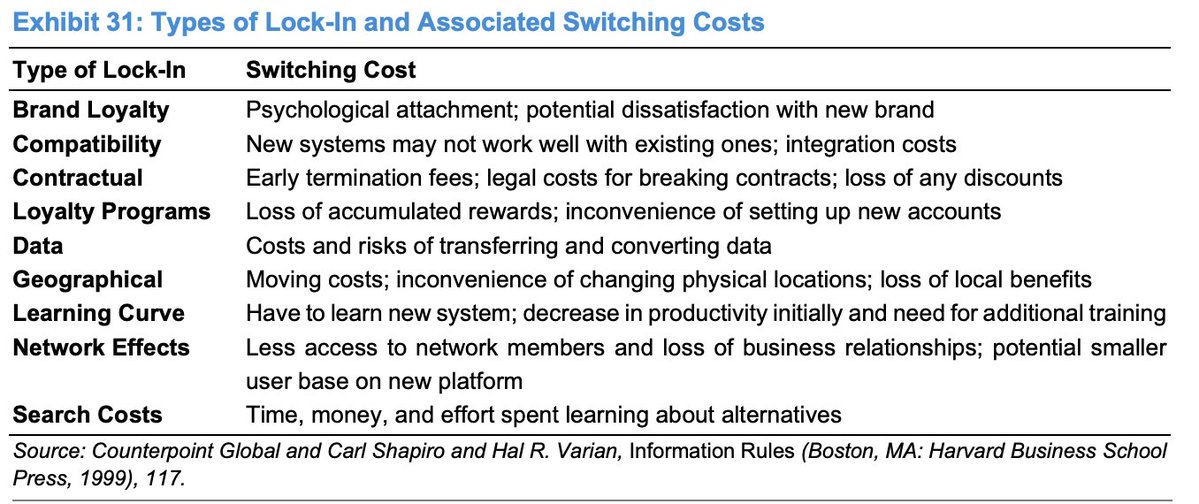
Not all switching costs are created equal. Some build genuine defensibility; others just create friction until a new technology erodes them.
Michael Mauboussin’s breakdown of the 9 types of customer lock-in 👇🏻
Which stock in your portfolio scores the highest across Mauboussin's matrix?