ÇİNLİ BİR ADAM RESMEN PARA BASMA MAKİNESİ OLUŞTURDU.
Github'da 13.000 yıldız almış bir araç var.
Adı moneyprinterturbo.
Bir çinli geliştirici yaptı.
Ücretsiz ve tamamen açık kaynak.
Tiktok, reels, youtube shorts için tam videoları otomatik üretiyor.
Nasıl çalışıyor.
Tek bir iş akışında her şeyi hallediyor.
Senaryo üretimi, seslendirme, altyazı, görsel kaynaklar, düzenleme, hepsi dakikalar içinde.
Yayına hazır video çıkıyor.
Sen hiçbir şeye dokunmuyorsun.
Şimdi neden bu kadar popüler oldu.
Çünkü normalde bu süreç şöyle işliyor.
Senaryo için ayrı araç, seslendirme için ayrı araç, altyazı için ayrı araç, görsel için ayrı araç, düzenleme için ayrı araç.
Her biri ayrı para istiyor, ayrı zaman istiyor, ayrı öğrenme istiyor.
Moneyprinterturbo hepsini tek çatıda birleştirdi.
Ücretsiz, sınırsız ve kategorisindeki en popüler açık kaynak proje haline geldi.
Tiktok shop ve youtube shorts kanalları aylık 6 ila 10 bin dolar kazanıyor.
Bunlar bu süreci kullanıyor.
Fark şu:
Onlar araçlar için para ödüyor.
Sen ödemiyorsun.
Kurulumu 5 dakika.
Github'da ara.
Kur, çalıştır, içerik üret hepsi tamamen senin elinde.
Stanford + Meta just dropped the paper that flips everything about AI agents.
It's called "Code as Agent Harness."
Right now, we treat large language models as text generators. When they need to solve a complex problem, they rely on a "chain of thought."
But natural language is slippery. It's vague. It loses context. When an agent hallucinates in English, it just keeps talking.
So they introduced a framework that changes the entire architecture of autonomy: "Code as Agent Harness."
They stopped asking the AI to reason in words, and forced it to reason in code.
Code isn't just the final output anymore. It is the memory. It is the environment. It is the boundary.
Instead of writing a paragraph about how to solve a problem, the agent writes a script, executes it, and reads the output.
Tests become its senses. Execution logs become its memory. Sandboxes become its physics.
If an agent makes a mistake in English, it apologizes and hallucinates again.
If an agent makes a mistake in code, the compiler throws an error. The trace tells it exactly what broke. The system forces it to fix it.
This is where prompt engineering dies, and systems engineering takes over.
The paper proves that reliability doesn't come from a smarter base model. It comes from the "harness" wrapped around it:
- The model proposes.
- The harness executes.
- The environment returns feedback.
- The verifier checks.
Design patterns I expect senior backend devs to actually use in production:
1) Adapter: wrap vendor SDKs so you can swap Stripe/S3/Kafka without touching business code
2) Strategy: pick algorithms at runtime (rate limiting: token bucket vs fixed window)
3) State machine: model order/payment lifecycle, stop if/else soup, make retries safe
4) Circuit breaker + bulkhead: contain downstream failures, cap concurrency per dependency
5) Outbox + idempotency key: publish events without double sends, survive retries and deploys
6) Saga: multi-service workflows with compensations, not 2PC
7) CQRS (lightweight): separate write model from read projections when reads are messy
8) Decorator/middleware: auth, logging, tracing, metrics without copy-paste
Andrej Karpathy: paying $20/month for a subscription isn't "using AI" - most people never even started
the gap was never access. everyone has the same model, in the same tab, one click away.
the dead list: copy-pasting prompts all day, arguing with the model in circles, rewriting the same code 5 times, asking it questions like it's google, "the AI just doesn't get it"
what actually separates the top 1%:
→ they configure the tool instead of just opening it
→ they give it context, rules and memory, not one-off prompts
→ they build systems the model runs inside, not single chats
→ they think in workflows, not in questions
→ they make AI do the work while everyone else watches it type
that's the real skill. not prompting harder. building around it.
most people sit next to the tool. almost nobody makes it work for them.
one group types questions. the other group ships systems.
you're not behind on access. you're behind on leverage.
everyone is building an agent or a tool
you don't want an agent or a tool, you want a reactor
I've been working on something cool and I think you'll like it
it's simple: an agent session DAG that keeps a declared world-model up to date in an efficient (memoized) render
each render node is an agent session: you declare the desired state with OpenProse markdown files
once invoked, each agent session acts as the provider. the agent session uses the open source openai-agents-sdk, extensible however you like with any model (I use with opus, sonnet, haiku)
the facets of the world-state are memoized, so not every agent has to run on every event, saving you on inference
if that sounds a lot like React or dataflow, that's because even in our brave new world the wisdom of the agents holds fast
DAN MARTELL SAYS THIS IS ONE OF THE MOST PROFITABLE AI BUSINESSES YOU CAN START RIGHT NOW - AND THE WHOLE SYSTEM COSTS $20/MONTH
a viral TikTok slideshow is not a creative project - it's a recipe and once you have the recipe Claude Opus 4.8 can produce 10 fresh versions of it in one prompt
the system that people are using to make $8,000-15,000/month: snaptik finds a winning slideshow, Claude breaks it down slide by slide with a hook on every slide, ChatGPT generates the images, Pinterest fills in the real photos, Canva puts it together and Postiz schedules everything automatically
the part most people miss - every slide needs its own hook not just the first one
"step 2: use active recall" gets people to leave - "step 2: the trick that feels harder but works 3x faster" gets people to save and share
one viral slideshow becomes a template - one template becomes a week of content - and Claude can generate 10 variations from a single example in 60 seconds
no camera, no face, no coding - just a $20/month system that runs while you sleep and compounds every week
one slideshow a day is a hobby - a few a day with this stack is a business
This guy absolutely cooked. Won the Anthropic hackathon solo then open-sourced everything. 🤯
Built a product in 8 hours. The repo now has 153,000+ stars on GitHub.
It's called Everything Claude Code. And it turns Claude Code from a single agent into a full engineering team.
38 specialized agents. 156 skills. 72 commands. And a security scanner with 1,282 tests.
Here's what actually matters inside it:
The planner agent takes a task, breaks it down, and routes each piece to a specialist a security reviewer, a typescript reviewer, a debugger, a code reviewer running 5 parallel checks.
Skills load on demand. You don't carry all 156 in context. You pick your stack, drop the rest.
AgentShield is the part most people skip. It runs three Opus agents an attacker, a defender, and an auditor against your setup and hands you a prioritized risk report.
And the learning layer is what makes it stick. Claude starts blank every session.
ECC watches your patterns across sessions and builds confidence over time. By session 10, it writes in your conventions, not generic defaults.
The repo is free. The stack is open-source. On GitHub right now.
Ali Abdaal just shared his Claude Code workflow.
And this might be the most beginner-friendly breakdown out there.
Most Claude Code tutorials feel like they’re built for developers:Terminal commands. API keys. Technical jargon that loses most people in the first minute.
Ali takes a different approach.
He starts from zero — and actually makes it under.
@delba_oliveira I believe the most valuable implementation is bundling routine bug-fixing or feature-adding workflows into a single skill, allowing Claude to autonomously code, run browser verifications, and submit a reviewed PR while you sleep.
Boris Cherny, the creator of Claude Code:
"Most people use Claude Code as a chatbot. It was built to run an entire engineering team."
In 30 minutes on stage, he explains how he now works by directing agents instead of writing code by hand.
Watch full video, then save the exact setup below👇
THIS GUY HAS CLAUDE DOING $500-700 A DAY SELLING ONE DIGITAL PRODUCT, WITH ZERO SPENT ON ADS
He sells one digital product and lets Claude run the content that drives the sales. No ad spend, sales starting within a day or two. The product is the easy part. The content engine is what actually sells it, and that's the whole method
The exact steps:
1. Find the niche. Ask Claude for specific problems people already pay to solve in a space you know, then check Gumroad and Etsy search to confirm people are buying. Specific beats generic every time
2. Build the product with Claude. Have it design a Notion template for one exact buyer, sections and dashboard included. Recreate it in Notion, set it to "anyone can duplicate."
3. List it on Gumroad. Free account, New Product, paste the Notion link, price it, grab your checkout link
4. Run the 3-prompt content engine. This is the part that sells. First prompt: competition mining, have Claude find the top-selling competitor products and pull the most viral content mentioning them. Second: have it extract the structures and frameworks from that content into reusable templates. Third: feed it your product and those templates and have it write fresh viral content for you
5. Rerun it weekly. The niche shifts, so refresh the templates every week. The winning ones you reuse again and again
Build once, post daily, let the content do the selling
Bookmark this
Anthropic engineer:
"You're not supposed to prompt Claude. You're supposed to build a system that prompts itself."
this is one of the best workflows I've seen in a long time
in this video she breaks down exactly how most people are using Claude:
- the 14% you lose to CLAUDE.md before typing a word
- the automation workflows most users don't know exist
- the daily task pipelines that run without touching the keyboard
- the daily workflows Anthropic's own engineers automated first
if you've been using Claude for more than a month and never left the chat window, you've been using one agent when you could be running a team of them
instead of another show tonight, watch this
make sure to bookmark it before it gets lost in your feed
the guide is in the article below
again saying there's never been a better time to work on multi-agent systems.
learn rag, orchestration, evals, memory, routing, tool calling, validation loops, fix loops, split learning, context engineering. all of it.
getting an llm to answer questions is becoming the easy part
getting multiple agents, tools, and workflows to work together reliably in production without breaking every other day is where the real challenge is.
we're entering a phase where building the model matters less than building everything around it.
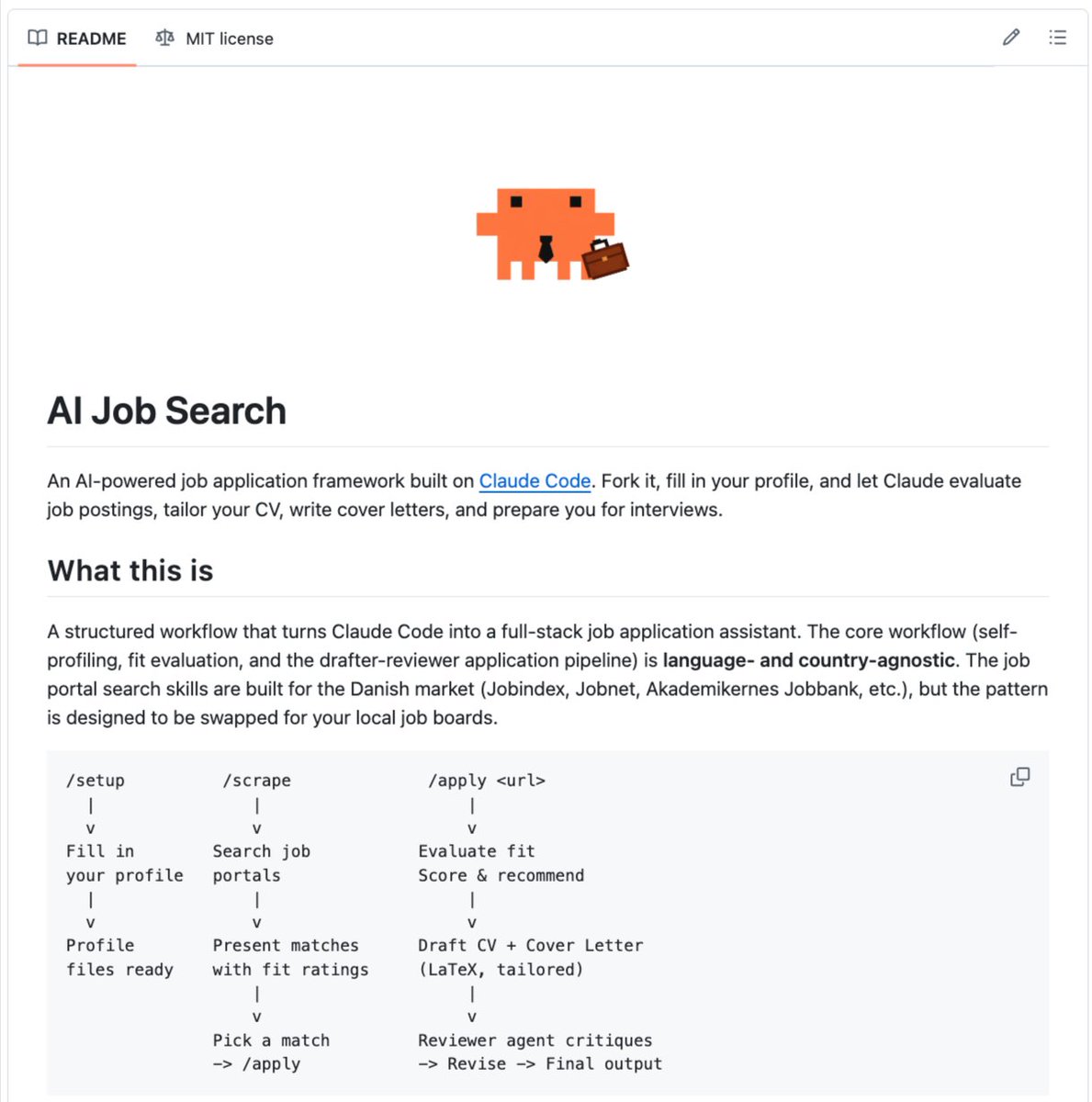
A scientist in Denmark figured out how to make Claude prepare his job applications. He open-sourced the whole thing.
His name is Mads Lorentzen. He is a PhD geophysicist. He built it on top of Claude Code and released it under MIT license.
Here is what it does. You fork the repo, fill in your background once, and it runs a five-step pipeline for every job you want to apply to.
Step 1. It reads the job posting and scores how well you fit.
Step 2. It drafts a tailored CV in LaTeX, picking only the experience that matches.
Step 3. It writes a cover letter framed around what you would bring to the role.
Step 4. A second AI agent reviews the first agent's work, points out weaknesses, and the first agent revises.
Step 5. It compiles both into clean PDFs you can send.
The whole thing is a folder of markdown files. The candidate profile, the writing style rules, the CV templates, the interview prep notes. Every step is plain text you can read and change.
The job portal search is built for Danish boards. The application workflow itself works for any country.
489 stars. 270 forks. A fork-to-star ratio that high means people are using it, not only bookmarking.
Mads is not a startup founder. He built this because he needed it for himself, then shared it.
This is the future of job hunting. Not a service you pay for. A workflow you own.
(Link in the comments)