Elon Musk thinks the entire education system is built on a broken assumption.
That every student should learn the same thing. At the same speed. In the same order. At the same time.
Musk: “Everyone goes through from like 5th grade to 6th grade to 7th grade like it’s an assembly line. But people are not objects on an assembly line.”
The model was designed for a factory economy. Standardized inputs. Predictable outputs.
That economy is gone. The assembly line is gone.
But the education system still runs on its logic.
A student who masters algebra in two weeks sits through eight more weeks because the calendar says so. A student who struggles gets dragged forward because the schedule doesn’t wait.
Neither is being served. Both are being processed.
Musk: “Allow people to progress at the fastest pace that they can or are interested in, in each subject.”
AI doesn’t teach a classroom. It teaches a student.
One at a time. Every time.
It skips what a student already knows. It finds where they’re stuck and approaches it from a different angle.
It adjusts in real time. Not at the end of a semester when the damage is already done.
A student obsessed with basketball learns fractions through shooting percentages. A student who builds in Minecraft learns geometry through architecture.
The subject doesn’t change. The entry point does.
No teacher with thirty students can do this. Not because they lack skill.
Because the math doesn’t work.
AI doesn’t have that constraint.
Musk: “You do not need to tell your kid to play video games. They will play video games on autopilot all day. So if you can make it interactive and engaging, then you can make education far more compelling.”
The brain isn’t broken. The format is.
Kids learn complex systems and strategic thinking for hours voluntarily. Then walk into a classroom and can’t focus for twenty minutes.
That’s not a discipline problem. That’s a design problem.
Musk: “A university education is often unnecessary. You probably learn the vast majority of what you’re going to learn there in the first two years. And most of it is from your classmates.”
Four years. Six figures of debt.
And the real value comes from the people sitting next to you. Not the institution charging you.
The degree doesn’t certify knowledge. It certifies endurance.
Musk: “If the goal is to start a company, I would say no point in finishing college.”
The system was built to train employees. If you’re not trying to be one, it has nothing left to offer you.
Every lecture. Every textbook. Every curriculum. Now available instantly. Personalized to any learner. Adapted to any pace.
The question isn’t whether the old model survives.
It’s how long we keep forcing students through it while the replacement already exists.
Your fridge runs 24 hours a day. Solar panels only work while the sun’s out. That mismatch is the entire reason this plant exists, and the fix is just hot salt.
The Dunhuang plant in China’s Gobi Desert uses 12,000 mirrors aimed at a single tower about as tall as an 80-story building. All that focused sunlight heats a mix of salts (the same stuff in fertilizer) to 565°C, hot enough to glow red. That liquid salt gets pumped into giant insulated tanks. The tanks are so well insulated they only lose about 1°C per day. When the city needs electricity at 2am, the hot salt boils water into steam, the steam spins a turbine, and you get power. Same basic process as a coal plant. Just no coal.
Here’s what makes this different from regular solar: the storage lasts 11 hours. Sun goes down, plant keeps running all night. The big batteries that cities plug into their power grids right now? Those typically hold about 4 hours of electricity. Building batteries that last 11 hours is possible, but the cost balloons fast. A German energy storage study found that storing energy in hot salt costs roughly 33x less than storing it in the lithium-ion batteries we use today.
China has built 27 of these plants so far, enough to power roughly a million homes. They doubled that number in 2025 alone. Another 3,000 megawatts (enough for about 2 million more homes) are under construction right now, with 4,000 more in the planning stage. Beijing wants 15,000 megawatts by 2030.
The US tried this same technology once. Ivanpah, out in the Mojave Desert. Cost $2.2 billion. But they skipped the storage part entirely, so it could only make power while the sun was shining. It needed natural gas every morning just to start up. It’s now slated to shut down in 2026, thirteen years early, because regular solar panels got so cheap they made the whole project obsolete. China took the same idea, added the one part America left out, and is now building dozens of them.
One more thing worth knowing. The salt is made from basic industrial chemicals. No lithium mining. No cobalt. No rare earth metals. And it lasts 30 years of daily use before the tanks need work.
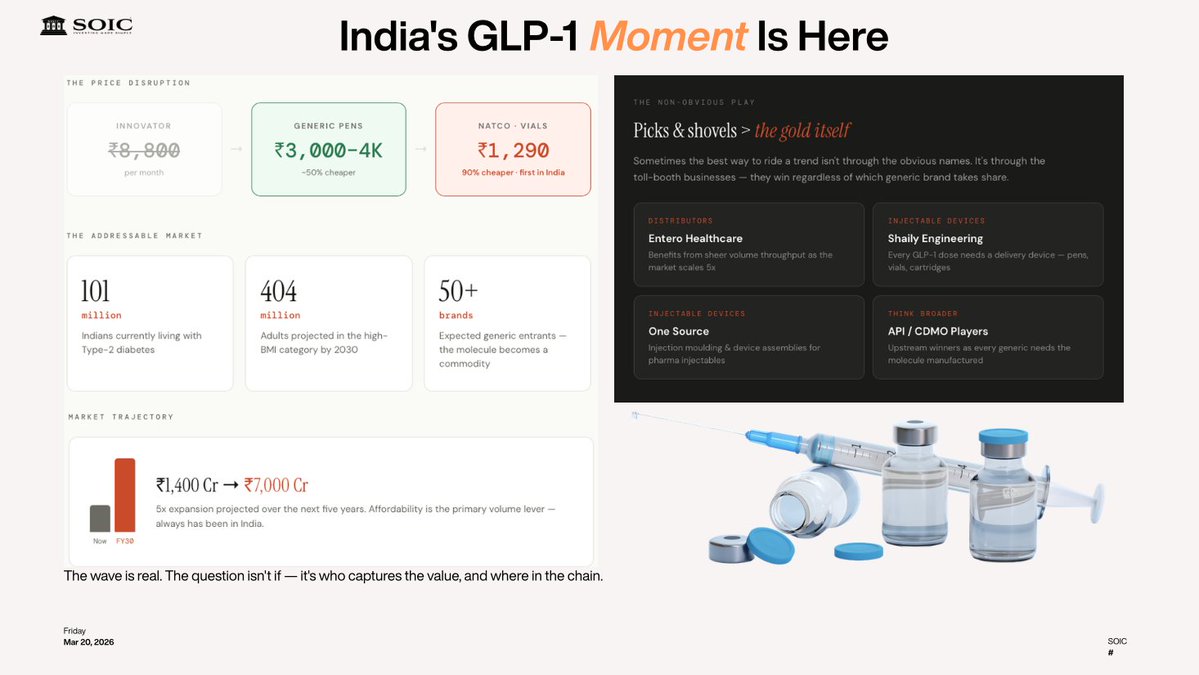
Semaglutide's patent just expired. And Day 1, the generics are already at the gate — Dr. Reddy's, Zydus, Sun Pharma.
Expect ~50% price erosion straight off the bat. Monthly cost drops from ₹8,800 to the ₹3,000–4,000 range. That's the unlock.
And then Natco walked in and changed the math entirely. They've launched India's first semaglutide in multi-dose vial form MRP starting at just ₹1,290. That's 70% cheaper than pen devices and 90% cheaper than the innovator brand.
Vials over pens is a classic Natco move strip the format down, crush the price point, and blow the addressable market wide open.
The TAM is staggering. 101 million Indians living with Type-2 diabetes today. 404 million adults projected to be in the high-BMI category by 2030. The current market sits at ₹1,400 crore consensus expects a 5x expansion over the next five years.
But here's the thing with 50+ generic brands expected to pile in, the molecule itself becomes a commodity. Margins compress. So the real game becomes how you sell, not what you sell.
Zydus is stitching together distribution alliances with Lupin and Torrent combining manufacturing muscle with reach. They're also working on multi-use injection pens, solving for patient compliance, which is where the real stickiness lies.
Mankind is building a dedicated obesity division going after cardiologists and gynaecologists, not just diabetologists. That's a deliberate widening of the prescription funnel.
Companies with deep insulin and injectable franchises — Eris Lifesciences, Lupin carry a structural edge here. They already have the cold chain, the KOL relationships, and the field force trained on injectables.
And then there are these non-obvious play.
Think distributors like Entero Healthcare, who benefit from sheer volume throughput regardless of which generic wins as they already have a good market share specially in GLP1 drugs distribution.
Think injectable device manufacturers like Shaily Engineering and One Source because every single GLP-1 dose needs a delivery device.
As the market scales 5x, someone has to make, fill, and move all those pens and vials. These are the toll-booth businesses in a gold rush market.
The GLP-1 wave in India is real. The question isn't if but it's who captures the value, and where in the chain.
Disclaimer - not a recommendation to buy/sell
@sharma_views Most of the replies focus on Arnab instead of the issues that he is highlighting
Whether he is paid or not, the issues still exist and impact the common folks lives negatively and the ‘servants of the taxpayers’ positively
Last quarter I rolled out Microsoft Copilot to 4,000 employees.
$30 per seat per month.
$1.4 million annually.
I called it "digital transformation."
The board loved that phrase.
They approved it in eleven minutes.
No one asked what it would actually do.
Including me.
I told everyone it would "10x productivity."
That's not a real number.
But it sounds like one.
HR asked how we'd measure the 10x.
I said we'd "leverage analytics dashboards."
They stopped asking.
Three months later I checked the usage reports.
47 people had opened it.
12 had used it more than once.
One of them was me.
I used it to summarize an email I could have read in 30 seconds.
It took 45 seconds.
Plus the time it took to fix the hallucinations.
But I called it a "pilot success."
Success means the pilot didn't visibly fail.
The CFO asked about ROI.
I showed him a graph.
The graph went up and to the right.
It measured "AI enablement."
I made that metric up.
He nodded approvingly.
We're "AI-enabled" now.
I don't know what that means.
But it's in our investor deck.
A senior developer asked why we didn't use Claude or ChatGPT.
I said we needed "enterprise-grade security."
He asked what that meant.
I said "compliance."
He asked which compliance.
I said "all of them."
He looked skeptical.
I scheduled him for a "career development conversation."
He stopped asking questions.
Microsoft sent a case study team.
They wanted to feature us as a success story.
I told them we "saved 40,000 hours."
I calculated that number by multiplying employees by a number I made up.
They didn't verify it.
They never do.
Now we're on Microsoft's website.
"Global enterprise achieves 40,000 hours of productivity gains with Copilot."
The CEO shared it on LinkedIn.
He got 3,000 likes.
He's never used Copilot.
None of the executives have.
We have an exemption.
"Strategic focus requires minimal digital distraction."
I wrote that policy.
The licenses renew next month.
I'm requesting an expansion.
5,000 more seats.
We haven't used the first 4,000.
But this time we'll "drive adoption."
Adoption means mandatory training.
Training means a 45-minute webinar no one watches.
But completion will be tracked.
Completion is a metric.
Metrics go in dashboards.
Dashboards go in board presentations.
Board presentations get me promoted.
I'll be SVP by Q3.
I still don't know what Copilot does.
But I know what it's for.
It's for showing we're "investing in AI."
Investment means spending.
Spending means commitment.
Commitment means we're serious about the future.
The future is whatever I say it is.
As long as the graph goes up and to the right.
> Be me - Elon
> Just nuked the timeline with a Kardashev Scale reality check "I have a plan"
> Meanwhile, China’s out here printing solar panels like it’s counterfeit fentanyl, absolutely curb-stomping the US in the sunshine Olympics. We’re bringing pocket knives to a laser fight
> Bro we are literally about to run out of atoms for NVLink cables and you think the Nevada grid is gonna save us?
> Realize AI is now the most expensive cocaine habit in human history
> Current US grid: ~500 GW average, already sweating like a vegan at a Texas BBQ
> One frontier model run in 2028 gonna slurp more juice than the entire country of France role-playing as a lights festival
> Earth data centers already out here committing war crimes on rivers for cooling water
> Do the math, smooth-brains... we’re about to need the entire grid just to train Grok-7
> Chips? TSMC and Samsung sending me the same email every quarter: “Dear Elon, lol no ❤️”
> Fine
> Tesla Terafab incoming - 10 million wafers/year, built next to Giga Texas, powered by whatever the fuck I want because I own the rockets
> Power situation?
> Earth: crying over natural gas permits
> Me: quietly lofting 500–800 MW of thin-film solar per Starship flight like it’s Uber Eats for the vacuum
> That’s one fully functional orbital gigawatt every week if I feel spicy
> Orbital data centers = infinite free sunlight + 3 K cosmic microwave background heat sink
> Translation: your Earth rigs are space heaters with a gambling addiction
> My orbital rigs are perfect blackbody radiators running at 100% duty cycle while sipping starlight like it’s martinis at 3 a.m
> Latency? Starlink lasers already do 100 Gbps cross-continent
> In two years we’ll be doing petabit
> Your query goes up, answer comes down faster than your GPU finishes complaining about spot pricing
> Phase 1: xAI orbital constellation makes Memphis supercluster look like a Raspberry Pi someone dropped in a puddle
> Phase 2: every AI company on Earth begs for rack space on my satellites like it’s the last helicopter out of Saigon
> Phase 3: Kardashev Type II by 2045 or I’ll personally apologize to the Sun for underutilizing it
> Groundcels seething in replies: “b-but atmospheric losses” “b-but launch costs” “b-but orbital decay”
> My brother in Christ I own the launch company I am the atmospheric loss
> Stay poor down there fighting over lake water I’m moving humanity’s IQ to orbit
@vvardhan143@outofofficedaku Dude
Look at what they ate for 1250 and think if it is reasonable.
Aloo paratha for 260 rupees
‘Kadak’ tea for 150 rupees.
And like I said they are of the lowest quality and taste. Desperate Indians get fleeced by Indian restaurants abroad.
I made the same mistake in Hanoi.
How the Baniya Community knows the best-kept financial secret.
Go to any wholesale market, textile market or steel godown.
They are dominated by surnames like:
Agarwal, Gupta, Bansal, Khandelwal, Poddar, Jalan, Goel
Here’s what separates them from the rest of India:
While you chase 12% annual returns, Baniyas chase one thing only:
How fast can the same rupee come back and compound again?
Most of India works on a salary.
Baniyas work on rotation.
You get paid once a month.
They get paid 3 times a month.
Their business cycles don’t run on years.
They run on days.
Bookmark and retweet this thread to revisit it later
Meta, Google, and Microsoft all use encryption built by the same 50-person nonprofit.
Zero revenue from 2 billion users. The founder uses a fake name. And when the FBI subpoenaed them, they only provided 2 pieces of data.
Here's how a non-profit secures the internet🧵
🚨 It's been just 88 hours since the ChatGPT Agent launched.
And the Internet is already losing its mind.
Here are 15 WILD ways people are using it (wait till you see #5):
🚨 BREAKING: Google just turned Gemini into an AI operating system.
At I/O 2025, they launched a full suite of tools that go way beyond chat.
Here’s what just dropped and it’s wild: 🧵👇
India has 4,000+ rivers.
70% of the planet is covered by water,
Then, How are 1.5 billion people struggling to get clean drinking water?
Because the water didn't vanish.
It was rerouted, relabeled, and resold.
What if I told you water is the next gold?
In 2020, Wall Street made water a tradable commodity.
By 2050, 90% of the world will live under severe water stress.
Here’s the thread they never wanted you to read
How 11 Billionaires Quietly Took Control of the World's Most Valuable Resource: Water.
Bookmark and retweet this to revisit it later
Finished #Adolescence, what an incredible show. We genuinely do not talk enough about the greatness of Stephen Graham. This final scene had me bawling. #adolescencenetflix
@nomanautomata Yeah, I don’t see why Meta, Anthropic, and xAI wouldn’t all be able to mimic this exact architecture. And if they succeed, I don’t see why they wouldn’t train… I don’t know, another 20 large models? Instead of using all of your compute for one large run.
in 2022 sonos bought a mysterious dutch audio company for $100m because of a secret invention
today it announced its first product using their technology... and it might change speakers forever
here's the story of mayht and why sonos might be *years* ahead of the competition 🤯