Mark your calendar 🗓️
We are delighted to announce that we will come together with our supporters and community for a special parade, starting from 2pm on Sunday 31 May 👇
3 things most Canadians should be able to agree on:
1. The pre-meditated murderer of Montreal depanneur owner Chong Woo Kim, previously murdered a mother of two, and stabbed a bystander 7 times..once charged with murder, was able to plea down to manslaughter and serve only 7 years. The parole board during his incarceration stated he was highly likely to commit more violent crime as he was a menace in prison and had a long violent history. This is not an isolated case. Pleading to lesser charges and serving little time in prison is standard in Canada.
2. Wait time to see doctors including every type of specialist are among the longest in the western world .
These are Fraser Institute numbers : Average wait times by specialist in Canada: Family Dr. 28 weeks, Neurosurgery: 49.9 weeks Orthopaedic Surgery: 48.6 weeks Otolaryngology: 43.8 weeks Plastic Surgery: 41.5 weeks Gynaecology: 40.6 weeks General Surgery: 31.8 weeks Ophthalmology: 20.8 weeks Urology: 25.7 weeks Cardiovascular Surgery (Elective): 19.6 weeks Internal Medicine: 21.2 weeks
3. What is the rush to issue a Canadian passport to newcomers to Canada? This is one of the most valuable assets in the world and should be earned and highly conditional. Most become permanent residents the day they arrive. The path to Canadian citizenship 3 years later is virtually guaranteed. That system is flawed.
The ultimate goal is asset seizure
There are better taxes that are not unrealized gains tax killing startups or a double taxation on assets you already paid taxes on
But if they can trick California into asset seizure, 0% chance it stops at billionaires
Full episode now on X:
My conversation with Dmitry Balyasny, founder and Chief Investment Officer of Balyasny Asset Management, one of the most successful and disciplined multi-manager hedge funds of the last two decades.
I sat down with Dmitry to talk about his journey from a 7-year-old immigrant from Kyiv who spoke no English to building a $30+ billion investment platform, and the hard-earned lessons about markets, talent, and human nature that shaped his path.
Dmitry founded Balyasny Asset Management in 2001 after cutting his teeth at Schonfeld Securities starting in 1994. He's built BAM into a dominant force in the multi-manager space, managing over $30 billion with a team of 2,300 employees worldwide. His approach combines rigorous risk management, systematic talent development, and a deep understanding of what separates great analysts from great portfolio managers.
Widely regarded as one of the most thoughtful operators in the hedge fund industry, Dmitry has spent three decades studying the psychology of trading, the evolution of market edge, and the organizational design required to scale excellence.
We spoke about:
- Immigrating from Kyiv at age 7 and how that shaped his worldview
- Reading Atlas Shrugged in college and how Ayn Rand's philosophy influenced his thinking
- Losing every dollar he made in his first year as a broker and why he persisted
- Building BAM from scratch and the most important decisions over 25 years
-Attracting and retaining talent in a hyper-competitive compensation environment
- How the nature of edge has changed over two decades
- What a day in the life of running a $30B hedge fund actually looks like
… and much more.
Links below
No Gary Government.
Economics is simple when you understand incentives.
Capitalism is an emergent system, a system built on millions of individual making decisions.
The Austrian know this, focusing on incentives, information and the unintended consequences of intervention (political idiots and their cheerleaders).
All modern economics exists to rationalise state power, justifying money printing, intervention and big government, rather than dealing with the core problem, that unconstrained political control over money and markets is destructive.
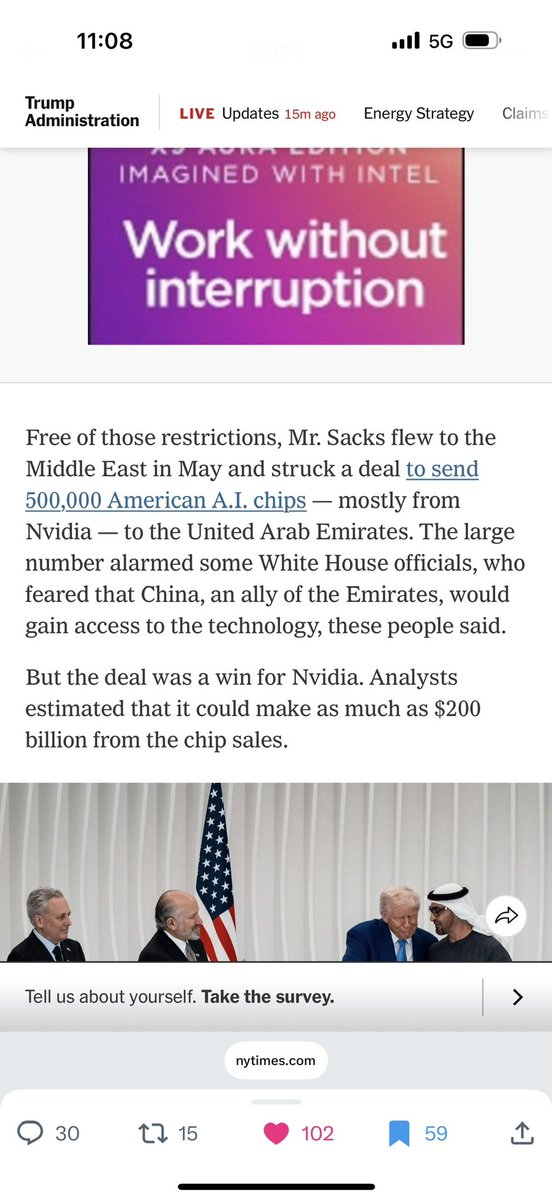
Deeply strange @nytimes article about @DavidSacks
Leading in AI is good for America. And there is no way for America to lead in AI without American investors in AI doing well. Irrespective of whether those investors are David’s friends or his enemies. And like everyone who has been in Silicon Valley for a long time, David has enemies in Silicon Valley who are also doing well by investing in AI.
The most disappointing part of the article is that there an interesting debate to be had about the wisdom of selling deprecated GPUs to China that are 18 months ahead of Chinese domestic alternatives and roughly 15 months behind our state of the art. As someone who is an active investor in national defense and super patriotic, I think this is a good idea but reasonable minds can disagree and zero attempt was made to engage with the relevant issues.
From a conflict of interest perspective, I think they are being appropriately managed and this has been to David’s economic detriment. His defamation attorneys letter to the NYTimes makes it clear that an exhaustive, good faith effort was made to divest from all potential conflicts. But it is quasi-impossible for David to fully divest from *every* company he and/or Craft has invested in that might *conceivably* benefit from good AI policy making. At the limit, theoretically every company in America and the American government itself (i.e. government bonds) benefit from good AI policy making.
I would guess that most of David’s assets are in private companies - if he were to leave the private sector entirely and put his assets into a blind trust he would still know what he owns as they are not liquid. Even if he were to do some dog and pony show of full divestment and a blind trust, does any reasonable person think he would not be able to walk back into Craft with his current economics intact?
And everyone who is even remotely qualified to shape AI policy has the same theoretical conflicts of interest.
I am 100% ok with talented citizens being able to have a dual role in the government and the private sector. That is actually the entire point of the SGE program. I think there is an argument to be made that it promotes and incentivizes ethical behavior. The downside of malfeasance for David is enormous and there is minimal upside relative to what he already has.
Separately, the @nytimes urgently needs to provide remedial math education for these journalists and their editors. The idea that 500,000 GPUs sold to the UAE could generate anywhere near $200 billion in revenue to Nvidia is ridiculous.
I look forward to the correction that will be assiduously posted to the @NYTimesPR account which has 90k followers vs. the main account with 52.8m followers.
I should note that while I do not know David well, we have many good friends in common and I like him personally. More importantly, I am grateful for his service, which has unquestionably cost him a vast amount of money. And my superstar sister-in-law is a partner at Craft, for which David is lucky.
SF Fed study examines 150 years of U.S. tariffs and find that they lead to lower inflation and weaker aggregate demand (which raises unemployment) https://t.co/d7d9WmIHHJ
A unique pre-processing facility operated by @PureCycleTech has made a big leap by eliminating all human sorters and delivering polypropylene (PP) bales that are more than 95 percent pure, using Machinex equipment. #recycling#plasticsrecycling
https://t.co/iiiosFqwYu
No clear evidence in the provided search results to support the claim that during the last administration, 35% of S&P 500 companies had issues with a regulatory body. (perplexity) @plaffont something you can quote: Currently, about 40% of the S&P 500 market cap is under Department of Justice antitrust investigations per https://t.co/XT9uGIg4an @theallinpod@Jason