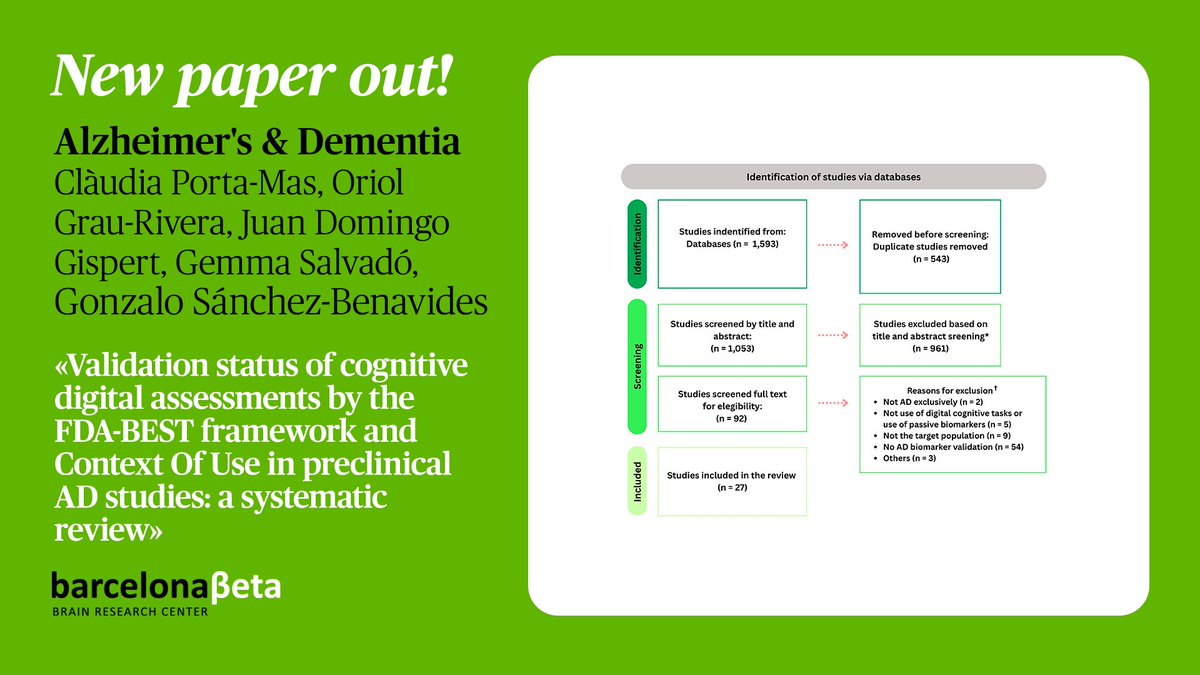
Digital tools are transforming #Alzheimer research. A new systematic review from researchers at the #BBRC (@claudiaportam & @GSBenavides) explores the validation status of digital cognitive assessments for AD.
Published in @alzdemjournals
@MichaelOkun@JAMANeuro@CamilloHolst Furthermore, evidence in humans revealed that the use of BBB highly permeable β-blockers is associated with lower levels of amyloid-β pathology compared to less permeable β-blockers doi:10.1177/13872877241293812
@MichaelOkun@JAMANeuro@CamilloHolst A recent study in HD mouse model has demonstrated significantly impaired cerebrospinal fluid clearance before phenotypic onset, which worsens with disease progression. doi:10.1172/jci.insight.172286
@MichaelOkun@JAMANeuro@CamilloHolst The proposed mechanism involves the modulation of the glymphatic system through the reduction of norepinephrine signaling. Similar to the effect of decreased norepinephrine levels during sleep, β-adrenergic antagonists reduce glial cell volume and increase the interstitial space
@MichaelOkun@JAMANeuro Beaman et al. (2023) demonstrated an association between blood–brain barrier (BBB) permeable β-blockers and a lower risk of Alzheimer disease.
@CamilloHolst
through the reduction of norepinephrine signaling. In the context of HD, the findings by Schultz and colleagues may also be revealing a potential role for the glymphatic system in the disease’s clinical onset and progression.
Here we link the epidemiological evidence demonstrating an association between blood–brain barrier (BBB) permeable β-blockers and a lower risk of Alzheimer disease and mechanism underlying such an effect involves the modulation of the glymphatic system @MaiNedergaard @camiloholst
Dear Dr @MichaelOkun I wish join a recently published commentary in @JAMANeuro explaining our point or view about "Possible mechanisms underlying the benefits of β-blocker use in Huntington disease" @GSBenavides
https://t.co/Qa8fujVJWn
We are very pleased to share our latest work from our neurodegenerative disease research group "Blood-brain barrier permeable β-blockers association with Alzheimer’s disease cerebrospinal fluid biomarkers levels in non-demented individuals"
https://t.co/lPKjp13nG0
🧠📉 At the beginning of #AAIC24, predoc researcher David López Martos (@dlopezmartos) offered a presentation about subtle #memory decline during a research session on technological advances in neuropsychology.
🎥 We've talked to him about the main highlights of this research.
🗞️ New paper out!
A new study led by the BBRC suggests that distinct meta-cognitive profiles can be identified in preclinical AD: hypernosognosia and anosognosia.
El Dr. @GSBenavides, investigador del @BarcelonaBeta, ha rebut un ajut Miguel Servet 2022, concedit per @SaludISCIII.
La beca permetrà a l'investigador avançar en el seu estudi sobre la detecció precoç de canvis cognitius en la fase preclínica de la MA.
https://t.co/EHt4VNuNrX
Hoy publicamos junto a @FundlaCaixa los resultados de un estudio que revela cambios cognitivos y cerebrales en personas que reúnen determinadas características vinculadas al declive cognitivo subjetivo https://t.co/W8Ib1QhHDZ
Un estudio de @fpmaragall identifica cambios cognitivos y cerebrales en personas con declive cognitivo @CIBERFES @CIBERBBN @FundlaCaixaCAT
https://t.co/iSCil7xX43