As part of our new data-centric AI focus (https://t.co/QvkWiGKF3G), we also introduce DC-Check: an actionable guide for practitioners & researchers to practically engage with DCAI for all stages of the ML pipeline: Data, Training, Testing, Deployment.
https://t.co/U3jkDVvP9Y
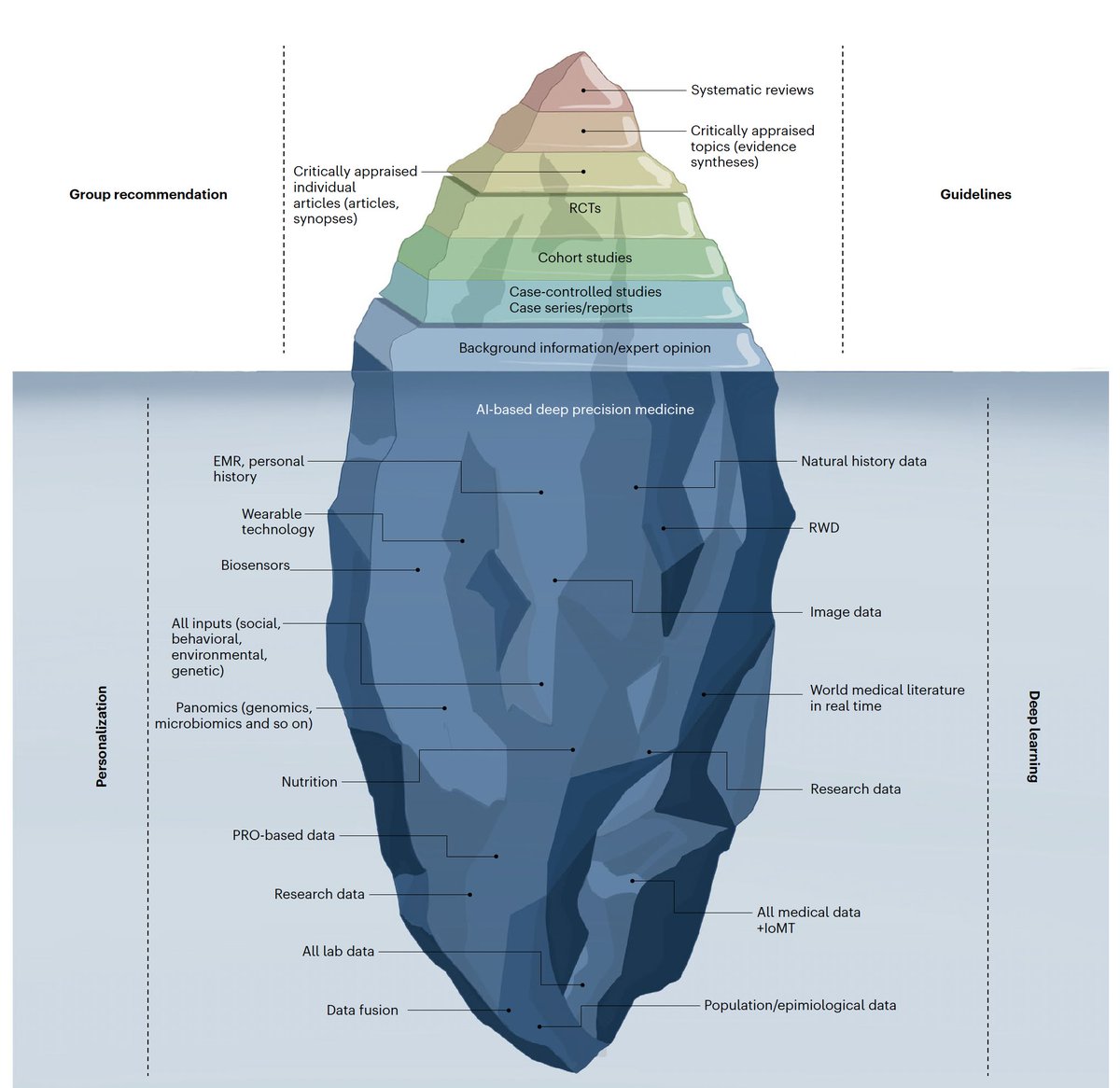
Just published @NatureMedicine
An astute take on the future of clinical trials and evidence-based medicine, in the digital and #AI era, by @VivekSubbiah
https://t.co/625WIwa6Qx
MIMIC-IV was published this week. The core dataset has been out for a while, but we've just published the deidentified free-text clinical notes: 300,000+ discharge summaries and 2.5 million radiology reports!
https://t.co/WVO2PFKij1
Weakly supervised deep-learning models for the analysis of whole-slide images from tumour biopsies perform better at prognostic tasks if the models incorporate context from the local microenvironment.
https://t.co/ebwnUmmhGX [N&V]
https://t.co/d7E0DdkhTI [Paper]
A phase 3 clinical trial evaluating the impact of a digital nurse navigator-led system in patients receiving oral #cancer treatment shows that remote monitoring with a smartphone results in improved patient experience & optimizes resources @GustaveRoussy https://t.co/N8fEXb00r7
What is the simplest yet robust and automatic way to segment #wound images? Read our latest work on robust wound image segmentation with deep neural networks! Paper link: https://t.co/Cw4yxWaBo4
We propose Detect-and-Segment, a two stage #DeepLearning approach to produce #wound#segmentation maps with high #generalization capabilities. The DS approach showed high performance on #OutOfDistribution testing and enabled the reduction of segmentation labels used for training.
MedMNIST v2 is a large-scale MNIST-like collection of standardized biomedical images, consisting of ~708K 2D images and ~10K 3D images in total. Supports research purposes in biomedical image analysis, computer vision and machine learning.
https://t.co/yzGtSTb7nm
Introducing SeqSNR, a new multi-task learning system that captures the complexities of a realistic ICU setting to predict adverse events, accounting for competing risks, along with the interdependencies between organ systems. https://t.co/8fwDKnUQW1
Soon you’ll be able to use Google Fit on Pixel to measure your heart rate and respiratory rate using just your phone’s camera. Learn more about this update, announced at today’s #TheCheckUp event → https://t.co/LAdMOE4oMy
In a major scientific breakthrough, the latest version of #AlphaFold has been recognised as a solution to one of biology's grand challenges - the “protein folding problem”. It was validated today at #CASP14, the biennial Critical Assessment of protein Structure Prediction (1/3)
If you're looking for Ph.D. positions in AI this year, consider applying to the new Fellowship program of the recently launched ETH AI Center: https://t.co/aYI5tWXUWK @ETH_en
Stanford has now conducted >360,000 video visits this year and utilization remains quite high since start of the pandemic.
The digital age of healthcare delivery has begun. @StanfordMed#digitalhealth
"I think telehealth is here to stay. ... But I think we’re discovering that, even as we go back to in-person visits, there’s a lot we’re going to retain in the virtual world." -Dean Lloyd Minor on #COVID19 and the future of medicine. https://t.co/rC7hYcaGH9
Working at the intersection of #AI and #Health? Here some overview articles I found useful:
(1) Comparison of deep learning performance against health-care professionals (Lancet Digital Oncology 2019):
https://t.co/lrsBtdRRqc
(Note: major criticism of validation standards)







![natBME's tweet photo. Weakly supervised deep-learning models for the analysis of whole-slide images from tumour biopsies perform better at prognostic tasks if the models incorporate context from the local microenvironment.
https://t.co/ebwnUmmhGX [N&V]
https://t.co/d7E0DdkhTI [Paper] https://t.co/93Y7yfaDJi](https://pbs.twimg.com/media/FbVVCyXXkAAKiHe.jpg)



