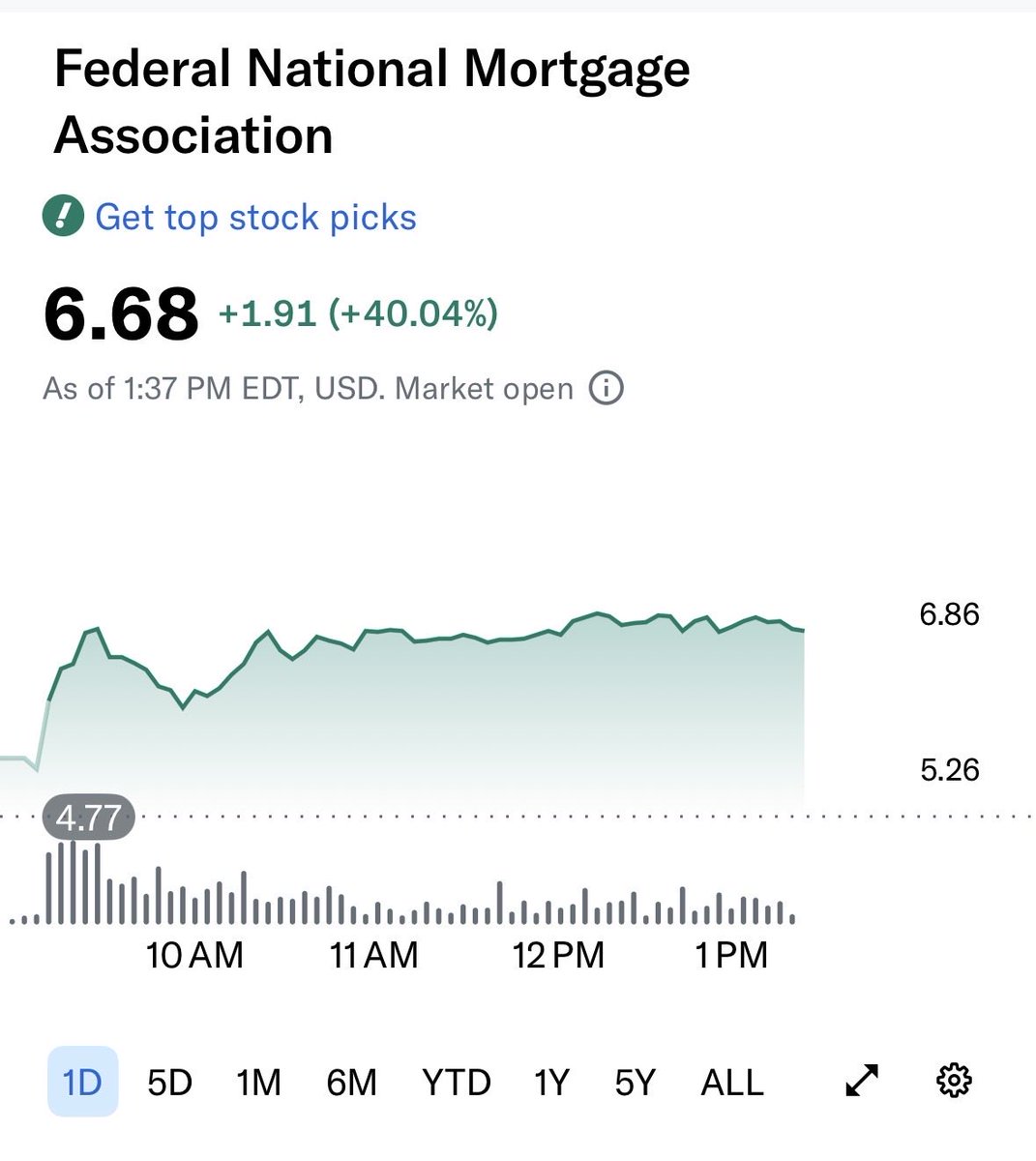
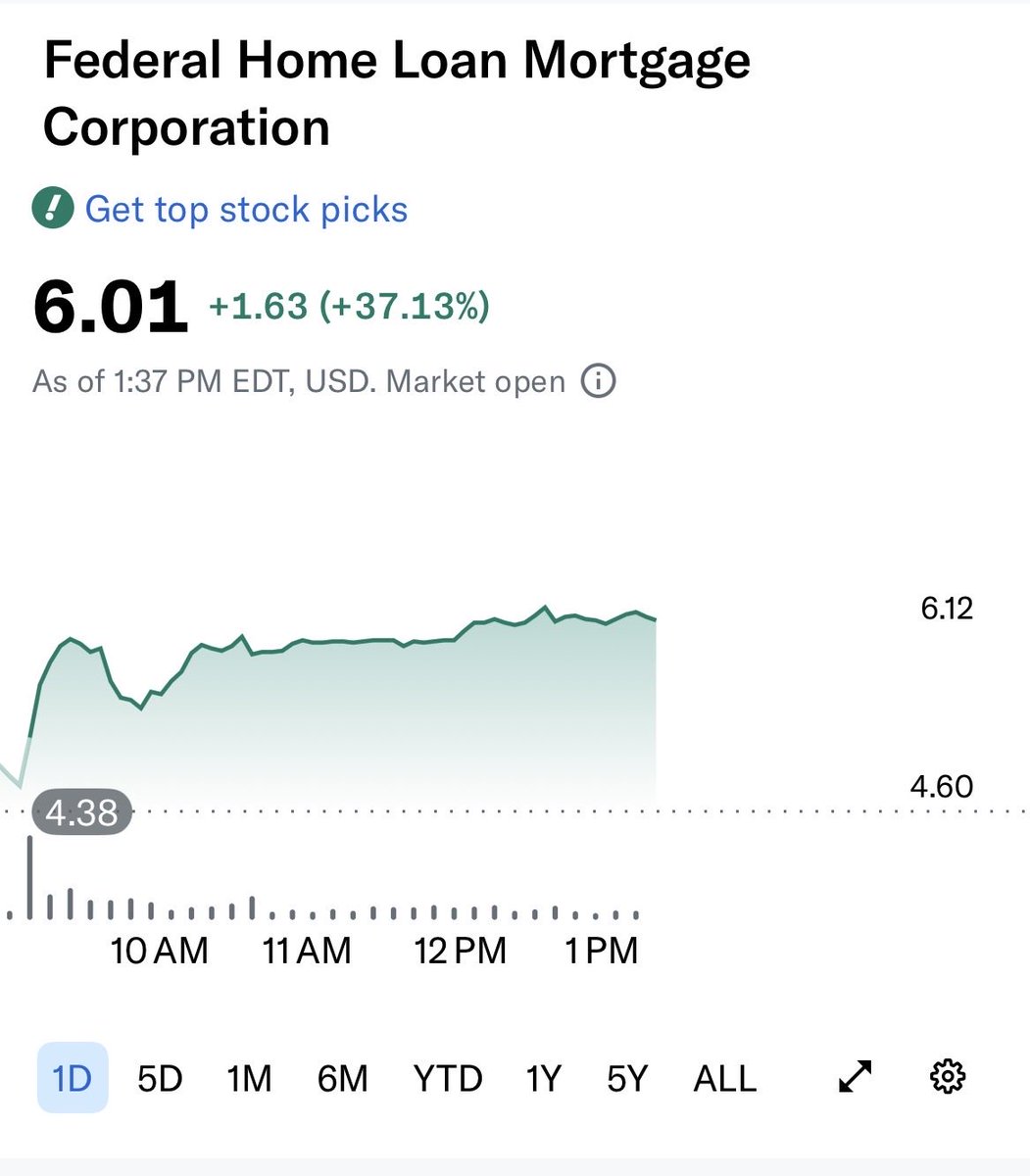
Hmm ASU 2016-01…I have a feeling there’s going to be a lot of acrimony about that one over the coming years. What a mess, what a mess…but I suppose brilliant for those in the know.
30K ft plane ride thought: fast forward a bit and I think we see MSFT, AMZN, SPCX / TSLA, ORCL, and other perceived vertically integrated platforms succumb to SOTP activists pushing for break ups. On (and off) balance sheet financing of CAPEX and the blended dilution to margin being the proximate cause. For betting sake, let’s call the timing YE 2030. I guess where I could be wrong is if they can all pull an AAPL and be remarkable at hardware/software integration.
@christinaqi As the old guy taking MFE courses during an MBA, I was blown away by how talented the MFEs I worked on projects with were. Citadel and Jane found a few of them, but many others were sadly under appreciated.
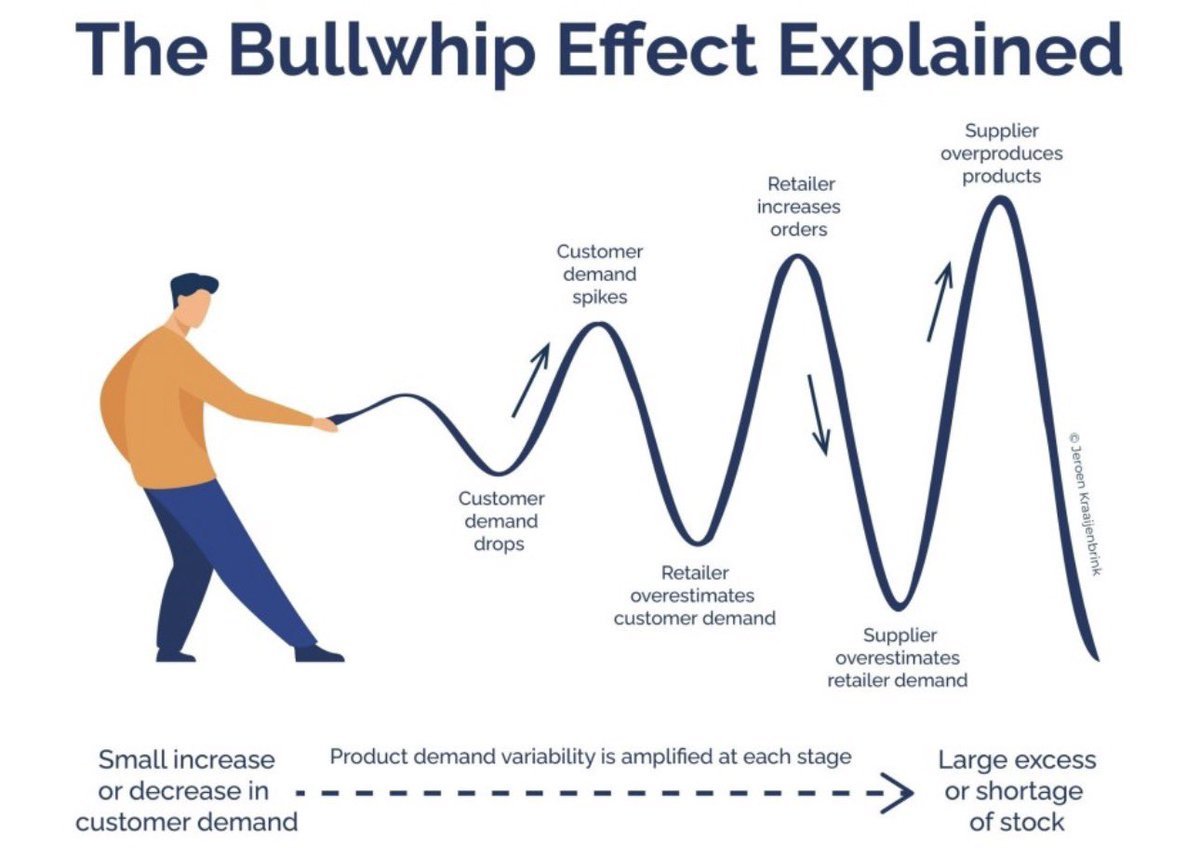
To be clear, the bullwhip effect does not require a change in real, baseline consumer demand to trigger massive, destructive supply chain oscillations. It is natively generated by a lack of coordination, localized rational hoarding, lag times, and systemic opacity. Be careful if you’re long $SOXX - it’s companies are prime candidates to be bullwhip casualties.
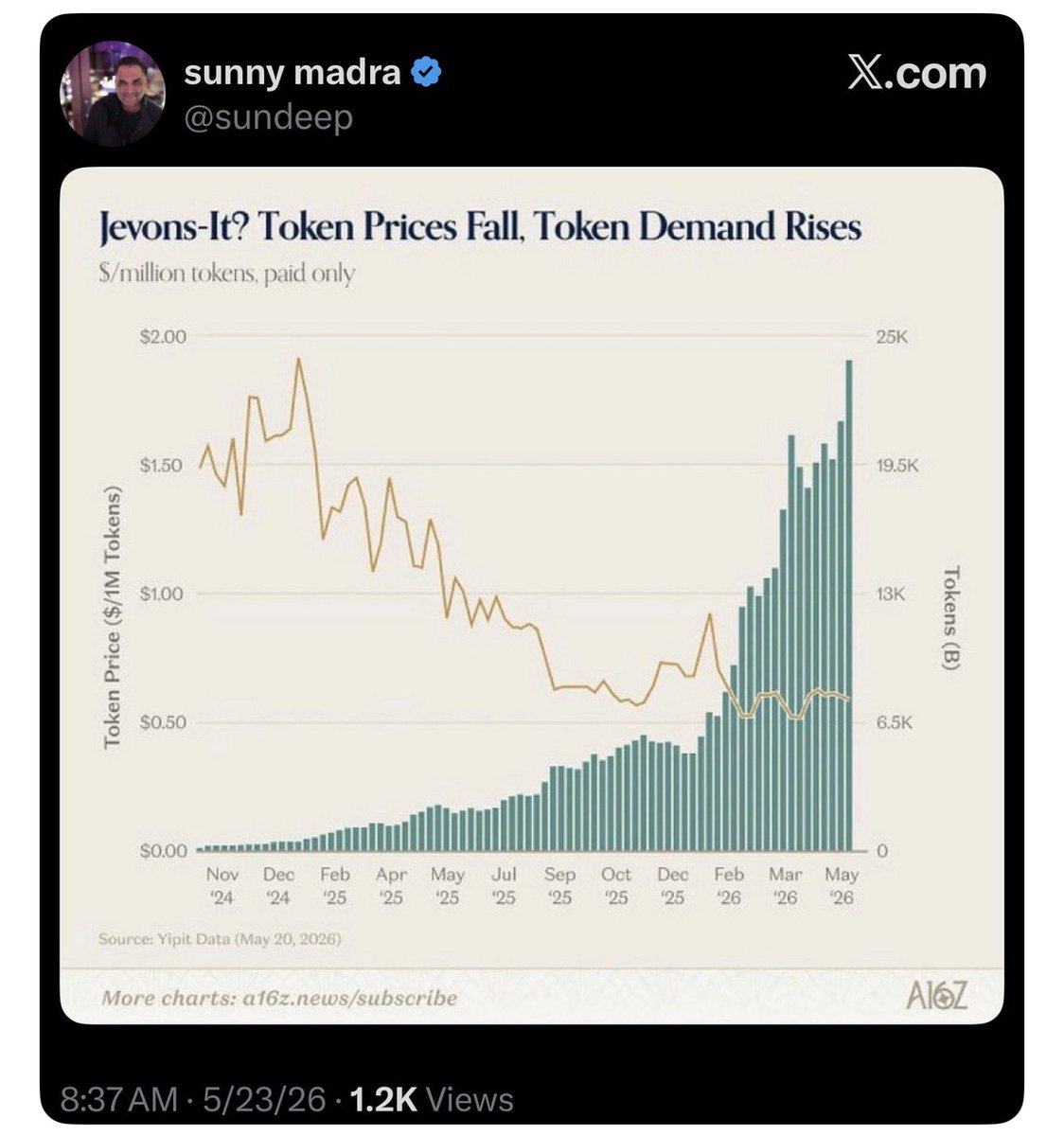
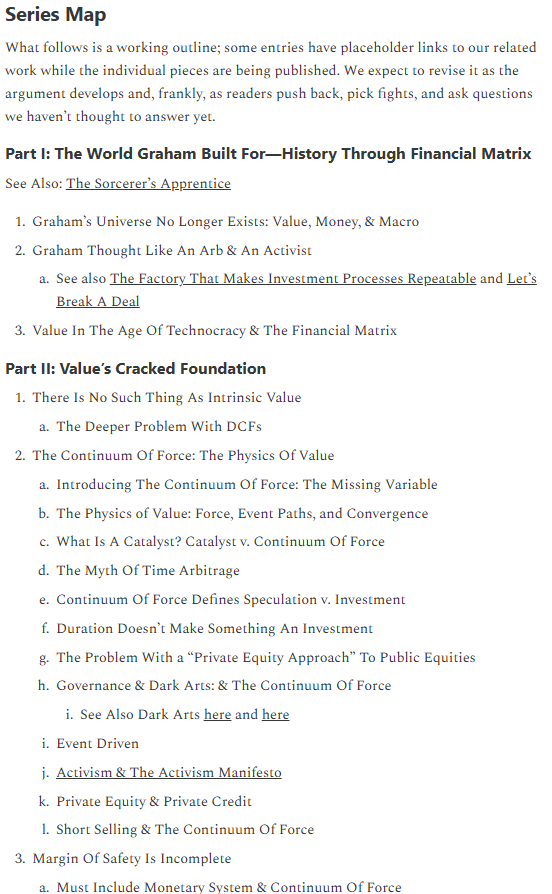
Many are using this chart to prove Jevons Paradox is working. They should look closer at the pattern and read Heretic’s Guide Part III.
https://t.co/nXIwGAuP6U
Prices had already fallen for some time when the big token demand lift happened. Tokenmaxxing and benchmarking are much better explanation than Jevons Paradox based on the timeline than prices of tokens falling.
In fact this chart may not show Jevons Paradox at all. And, if it does not, that is some massive benchmarking demand that is temporary and sending the wrong demand signal up and down the supply chain. Perhaps skipping a few cycles in the bullwhip effect.
https://t.co/5u6yVsa15H
Great read. I couldn’t help but note the parallels between LLMs and the story of the Tower of Babel. Upon further LLM assisted analysis (and publication), I came to the insight that the tower (due to entropic phenomenon) had to fragment, just as the story tells, leading to the synthesis that LLMs will as well. There will be many types of (very satisfying) bread.
@orrdavid No argument with you there. Really like what you’re doing, as I’ve gone down a similar track. Hope you achieve your ambitions with the financial services approach to an investment firm.
I can only speak with certainty to the period I highlight, and some overlap stats from the year prior and the year after (given how theses hit) and can say with certainty that the compounded return given to investors in a well constructed diversified manner was outstanding during that period (~3+ years). I’d argue it’s a different game than what you’ve discussed as your game, and investors can do really well in both.
Jim I agree on many fronts. Now the key (I think) is to contextualize with longstanding doctrinal frameworks. I use cavalry & main effort concepts, but open to various others with the key insight that most military and financial thinkers must spend more time on what happens after the large scale show of force (seizure)?
Dear Mr. Armin Papperger, CEO of Rheinmetall,
When you referred to Ukrainian drone manufacturers as “Ukrainian housewives with 3D printers” you revealed just how deeply the European defense establishment still fails to understand the nature of modern warfare.
This is not about emotion. It is about battlefield reality. Here are the facts your industry refuses to acknowledge:
In 2025 alone, Ukrainian drones carried out 819,737 confirmed strikes. They caused 90 percent of all Russian combat losses, more than all other weapons systems combined.
TAF alone produces up to 100к FPV drones monthly. In any given 90-day period, my company’s products alone achieve more confirmed strikes than your entire fleet of equipment has across its full combat history in every conflict. And most importantly, I built this company and achieved these results in two years, not fifty. Think about that.
Our drones generate more kinetic effect in three months than your flagship platforms have in half a century.
Why? Because the battlefield has changed, and your business model has not.
•Russian electronic warfare has made GPS-guided Western munitions such as Excalibur and GMLRS nearly ineffective.
•Expensive and complex systems designed for wars with air superiority and traditional peer-to-peer combat have become easy prey for drones costing $500, attacking them from above.
•The cost-to-effect ratio has been turned upside down: one 120 mm Rheinmetall shell or one anti-tank missile costs more than a dozen of our drones, and yet our drones still win.
This is not a “Lego game.” It is industrial Darwinism in real time. We iterate every week. We print parts in basements and ship 100к strike systems per month, while your engineers still require three to five years and hundreds of millions of euros in certification costs for even a minor upgrade.
The war in Ukraine is not a temporary anomaly. It is the first true drone-industrial war. And it has already proven that outdated European platforms, no matter how expensive or “serious” they may seem, are becoming less and less relevant unless they integrate the very technologies you mock.
So when you say, “this is not innovation,” I hear something else: “We do not want to admit that the future is being written in Ukrainian workshops, not in Düsseldorf boardrooms.”
#MadeByHousewives is trending for a reason. Because these “housewives” destroy more enemy equipment every month than entire European armies do in full campaigns. And they do it while your industry continues to sell 20th-century solutions at 21st prices.
The invitation remains open, Mr. Papperger. Stop laughing at the kitchen table. Come and learn how tomorrow’s war is actually being fought. Because the next time someone asks, “Who needs tanks in the age of drones?”, the answer may be simpler than you think: Whoever still believes in 1979 will lose to whoever is building in 2026.
With respect, but with facts,
Oleksandr Yakovenko “Ukrainian housewives”
Founder TAF
@ericweinstein I think this musing can help with why these two miscalculations are not as disparate as one may think. The “global cavalry” approach to warfare (and procurement) is alluring, but pretty consistently insufficient.