Conor Neill on the 3 best ways to start a speech (most people get this wrong):
"I guarantee if you go to conferences, 19 out of 20 speakers will start in one of these ways: 'My name is Conor Neill. I'm from Tango, and this talk is about the latest trend in monitoring strategies.' But all of you are sitting with a piece of paper that already says who I am and what I'm going to talk about. By repeating what you already know, I'm giving a signal that it's time to get your BlackBerry out."
Conor explains the three best ways to start instead:
Third best: A question that matters to the audience.
"How do you phrase a problem that the audience faces in a question?"
Second best: A factoid that shocks.
"There are more people alive today than have ever died. Every two minutes, the energy reaching the earth from the sun is equivalent to the whole annual energy usage of humanity. Does that change how you think about energy?"
The best way: Start like you'd start a story to a child.
"How do we start a story to a child? 'Once upon a time.' And what happens when you say once upon a time? My daughter leans forward, gets ready to hear, engages. We were all trained as kids to know when a story's coming. We also know when a teacher is about to deliver a 40-minute boring lecture."
He explains the grown-up version:
"In business, you don't hear Jack Welch saying 'once upon a time.' Steve Jobs doesn't start his speeches with 'once upon a time.' So there's a grown-up way of saying it: 'In October, the last time I was in this room, there were 120 people here. I was having a conversation with one of the world's experts on public speaking and he said something to me that changed what I think about what's important in speaking.' Now I can pause for 30 seconds, and you want to know what he said."
Conor concludes:
"Stories are about people. They're not about objects. They're not about things. If you want to tell a good story about your company, don't talk about the software talk about the people who built the software. What they do. How they are. What's important to them. What they sacrifice."
“Lord, when my heart is overwhelmed, give me Your peace.
Quiet my thoughts and remove my fear.
Remind me that You are with me, in every moment.
Fill me with strength, hope, and calm.
I trust You, even now. Amen.”
Delivering bad news as an ICU doctor is one of the harder parts of the job.
Here are some lessons I've learned along the way👇
1. Always sit down
2. Don't just jump into it. Spend the first couple of minutes with introductions to yourself, your team (if present), but more importantly who all is in the room (patient, family etc.)
3. If you will be needing consent for something (procedure, palliation etc.) as part of the discussion, ensure you know who the decision maker(s) are.
4. Preface the bad news "I have to share something that might be hard to hear"
5. Clearly in <30 seconds deliver the bad news then STOP TALKING.
The biggest mistake I see is people give the news and keep going. It takes time to process what may be the worst news they've ever received. Silence is the solution here. They will talk or ask questions when they are ready... it could be 10 seconds, 1 minute, or 10minutes. Give them the time they need before you proceed.
6. Ask if they have any questions about what you have delivered.
7. Be prepared to answer 'what comes next' ..
8. Ask about spirtual / religious beliefs when appropriate and offer support if that is available.
9. Let them know you or someone from your team will be available to answer questions that might come to mind... often in the moment, questions slip people's mind but come to them minutes after you leave. Make sure they know how they can have them clarified.
Just some thoughts here... any others?
Bonus: Don't construe family members becoming angry as them being angry at you or the team. Anger when faced with this news is common, normalize it and realize it likely isn't directed at you!
Are we over-utilizing helicopters for patient transport? Review of Level I #trauma center showed < 1/3rd of 🚁transport patients met criteria for it, and only 1% needed intervention within an hour. Time to decrease the use? @OhioStateSurg@ShachiSrivatsa
https://t.co/pDmhRmxNym
Okay so,
1) an American citizen exercises his First Amendment right to peaceably assemble and his Second Amendment right to bear arms, out of apparent concern that a tyrannical federal government is violating basic protections afforded under the Constitution
2) after coming to the aid of an unarmed woman who's been shoved to the ground by a masked federal agent, the citizen -- impaired by pepper spray, holding nothing but a cell phone -- is dragged to the ground by a group of other masked agents
3) during the scuffle, shortly after one masked agent removes the weapon from the restrained citizen's person, several other masked agents open fire, unloading 10 shots from close range and killing the unarmed citizen
4) despite video evidence, a spokesman for the federal government says the citizen approached agents with a gun, provoked a violent confrontation, and planned to "massacre" law enforcement
You really want to defend this? Go ahead. Just know, you look like an absolute fool.
People in the custody of law enforcement officers (LEO) have a right to medical care, including in the ICU.
As clinicians we we need to know:
- LEO is not a surrogate decision maker
- LEO have no right to medical info
- we can demand LEOs leave the room and remove restraints
More here:
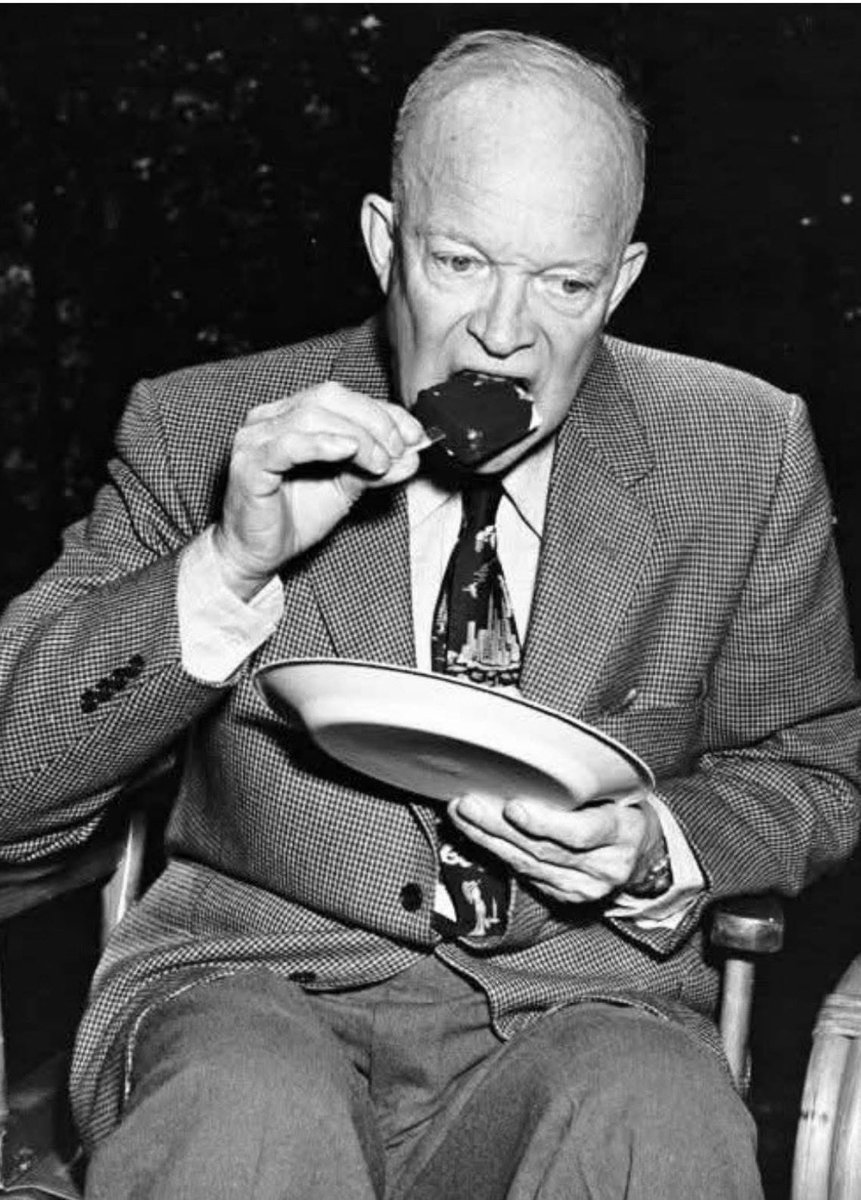
"On a freezing December morning in 1957, President Dwight D. Eisenhower was reviewing budget proposals when his secretary nervously informed him that a 73-year-old woman named Mrs. Eleanor Mitchell from Abilene, Kansas—his childhood Sunday school teacher—was in the White House lobby asking to see him without an appointment, and instead of having staff politely redirect her, Eisenhower literally ran down the hallway, swept this elderly woman into a huge bear hug, and cleared his entire afternoon to have tea with her in the residence.
What makes this moment so breathtakingly beautiful is that Mrs. Mitchell had taught a scrappy young Dwight Eisenhower Bible verses every Sunday from 1907 to 1911 in a tiny church basement, making him memorize Proverbs and Psalms when he'd rather be playing baseball, and she'd written him letters throughout his military career—through both world conflicts, through his rise to Supreme Commander, through his election—always addressing him simply as 'Dwight' and reminding him that 'character matters more than rank.' Eisenhower told his staff that Mrs. Mitchell once made him apologize to the entire Sunday school class for being prideful after he'd bragged about winning a spelling bee, teaching him a humility lesson that shaped his entire leadership philosophy, and he'd never forgotten how she'd pulled him aside afterward and said, 'Dwight, you're going to do important things someday, but never let success make you forget where you came from or who helped you along the way.'
During their White House tea, Eisenhower introduced Mrs. Mitchell to every cabinet member who passed by, saying with genuine reverence, 'This woman taught me everything that matters—respect this lady,' and she gently scolded him for not attending church regularly enough, which made the most powerful man in the world laugh and promise to do better.
When Mrs. Mitchell left that evening, Eisenhower walked her personally to her taxi, kissed her cheek, and pressed an envelope into her hand containing a check for her church and a note:
‘For the place that built my foundation—thank you for seeing potential in a troublemaker farm boy. Your student always, Dwight.'
What absolutely destroys you is understanding that Eisenhower commanded armies and led nations, but he never forgot the Sunday school teacher who taught him that true strength was moral courage, proving that the greatest leaders never outgrow gratitude and that honoring the people who shaped you when nobody knew your name is the most presidential thing you can do.
@FLTDOC1@thenewarea51 Has anyone looked at the acuity of the pts being transported? Flying patients 20 miles to a level 1 trauma center for a ground level fall with isolated hip fx is phenomenal use of resources. Flight costs more than the surgery.