Tired of anonymous 1-stars you can't even respond to? On GuardOpinion you can challenge any review.
They prove they're real, or it's hidden🛡️
https://t.co/vsKkj4r3G0
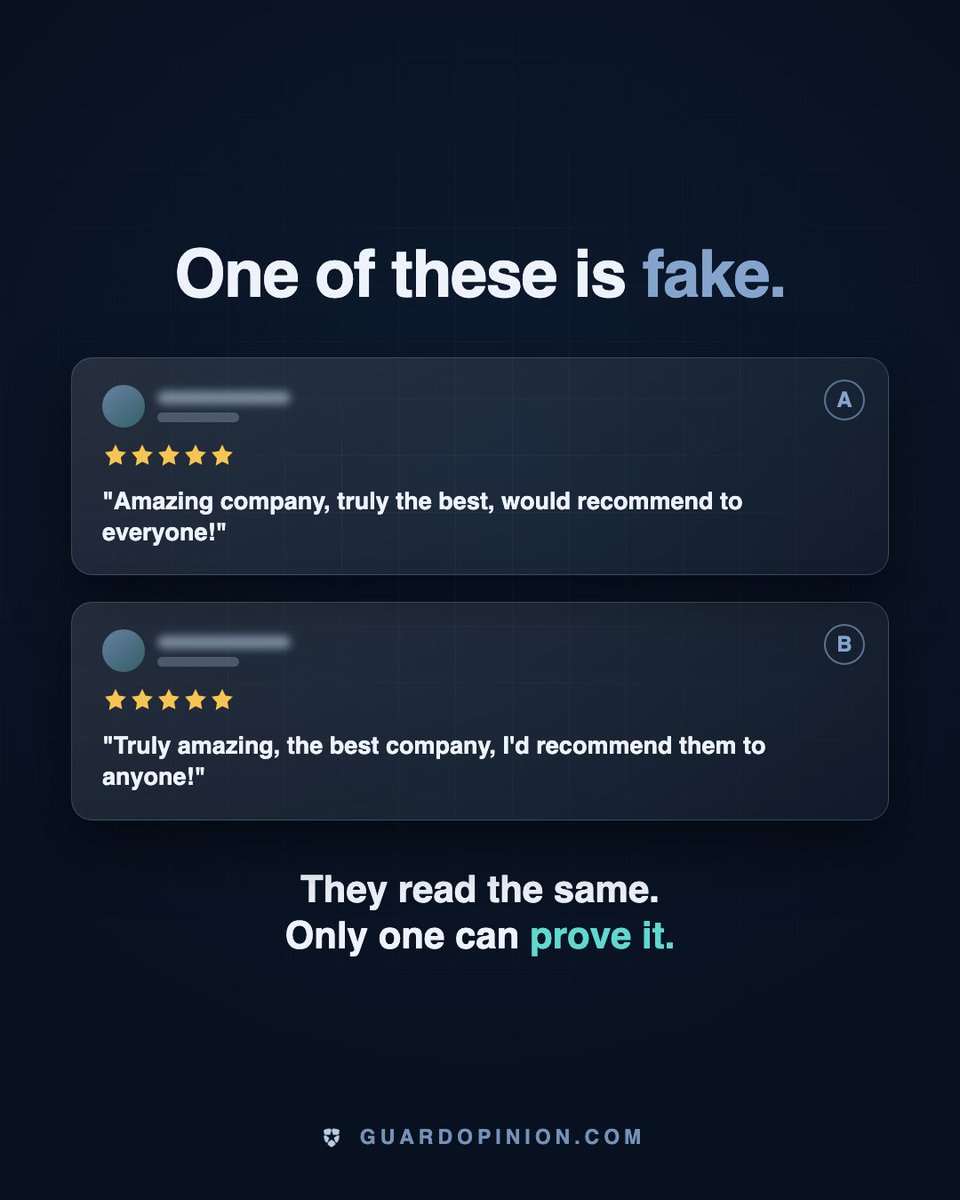
Real or fake?
"Amazing company, truly the best, would recommend to everyone!"
Five stars, posted the same week as nine other near-identical ones.
The pattern is the tell, not the words.
More than 8 in 10 people will read a fake review this year and never know it
The fakes don't look fake anymore. The one thing they can't fake is proof a real customer wrote them. 🔍
Your business runs on trust. And trust comes down to reviews people actually believe.
GuardOpinion makes that trust real: verified customers, every review open to challenge. Credibility you can prove, not just a star rating. 🛡️
https://t.co/Hz0EGJRyOt
Anyone can buy a wall of 5-star reviews by lunchtime. Nobody can buy a customer who'll prove they were real.
That's the whole difference between a rating and a reputation. 🛡️
Buying fake reviews isn't just shady anymore. It's illegal.
The FTC started enforcing its Consumer Review Rule in December 2025. Penalties run up to $53,088 per fake review, and you're on the hook even if an agency posted them for you. 🛡️
A business owner just got 21 one-star reviews in 24 hours. Every account had zero history, some reused the same sentence, and they were told it can't be removed. Rating fell 4.9 to 4.5 overnight.
None were ever customers. Fakes shouldn't outweigh real ones. 🛡️
@kai_cabero This whole playbook works because a review counts the second it's posted and nobody ever has to back it up. Flip that, let the target challenge it and make the reviewer prove they exist, and eight competitor-review domains turn into eight worthless ones
This is the whole problem in one screenshot. A 5-star you can buy with a free app counts exactly the same as one a real customer left. Until a business can challenge a review and the reviewer has to prove they're real, a rating just shows who bribed hardest
A masterclass in @Shopify dark app marketing: fake countdown timer, "20 spots left," and a free-forever bribe for a 5-star review. That’s how Hoppy apps games its rating, seemingly with zero consequences. We should all be so brazen.
AI-written Google reviews rose 279% from 2019 to 2024. The fakes don't look fake anymore 🤯
So stop trying to spot them by feel, and start asking the one thing AI can't fake: proof the reviewer was a real customer.
2/ Texture. AI writes smooth and generic ("great service, highly professional"). Real customers mention the boring specifics: the date, what went wrong and got fixed.
@Kevin_Indig Separating real humans from AI is about to be the whole game, and not just for traffic. Reviews, signups, engagement, every signal that used to mean a person now has to be proven. Telling real from synthetic is the value that compounds from here
@noahkagan Funny how fast the flex flipped. Polished used to signal credible. Now "a real person actually made this" is the part worth proving, because anything clean could be a machine. Proof of human is becoming the status symbol
@spenserskates Build and ship got cheap. Understanding stayed expensive. Knowing which signal is real and which is noise is the part that still needs a human, and it's quietly becoming the whole job
@zebriez Getting someone from a hard no to a fine is the most underrated skill in business, and the best EAs do it before lunch. It runs on trust they built quietly months before they ever needed to spend it
@anuatluru A small audience of the right people is also the only one that's hard to fake. Reach can be bought, so can a wall of five-star reviews. The trust of people who actually know you is the part that doesn't scale, which is exactly why it's worth the most
@hnshah The correction is the one part that can't be automated, because it takes someone who already knows what right looks like. Same reason a flood of AI-written reviews still can't fake the single detail only a real customer would know
News: in December the FTC sent its first warning letters under the new fake-review rule. Penalties run up to about $53,000 per fake review.
The law finally caught up. Detection hasn't. That's why proof beats policing: make the reviewer show they're real, or the review doesn't count.