AI Agents can remember. But how does their memory actually work? 🧠
AI Agent Memory, explained in just 12 minutes! 🔥
• Working Memory & Context
• Procedural, Semantic & Episodic Memory
• RAG, Vector DBs & Top-K Search
• Storing Past Conversations & Events
• Memory Consolidation & Summarization
• Efficient Token Usage
As AI agents take on bigger, longer tasks, memory will become essential to keep context, learn from experience, and build on past work.
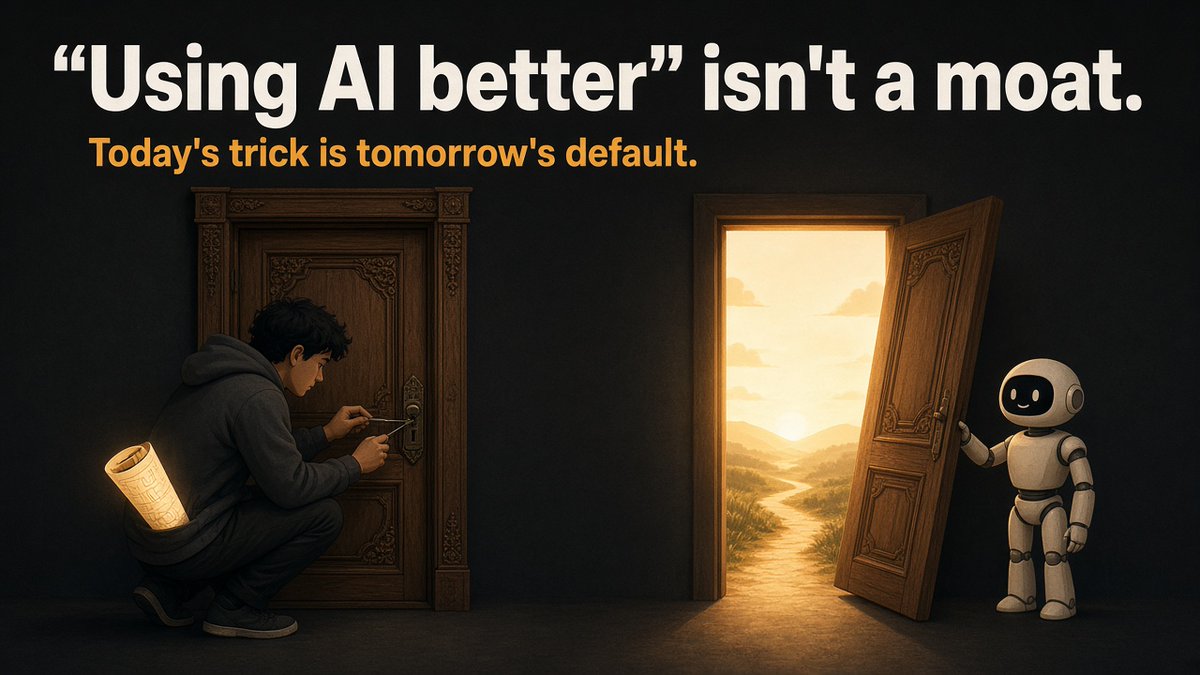
"AI won't take your job. Someone who uses AI better will."
Ethan Mollick isn't so sure.
Remember prompt engineering? You were still perfecting your lock-picking, and they took the door off.
Better question: will the skill you're building matter more as AI improves, or less?
最近刚好在玩理光 GR IV,28mm 等效定焦。作为一个摄影新手,高强度用了一天下来,最大的感受就是:定焦真的比想象中难拍。
以前用微单加变焦镜头,站在原地调焦段就能重新构图。换成 28mm 定焦之后,感觉自己变成了“变焦环”——想拍近一点就往前走,想拍远一点就往后退。
而且 28mm 很容易把画面拍得很平。很多时候眼睛看到一个场景觉得挺好看,相机举起来一看:怎么突然这么普通。用下来会觉得,定焦确实很考验一个人发现画面的能力。
不过 GR IV 最大的优点也很明显:真的太轻、太小了。 塞进口袋就能出门,走一天也完全不会觉得拍照是个负担,看到东西随手拿出来拍就行。
目前我觉得最容易出片的还是拍美食。距离近,加上 F2.8 的光圈,稍微找找角度就能有不错的虚化,对新手很友好。扫街就难多了,经常举起来看半天,又默默放下。
大概就是一个摄影新手高强度使用 GR IV 第一天后的感受:很好带,也很想让人一直拍,但要真正拍得好看,可能还得先练练自己的眼睛。
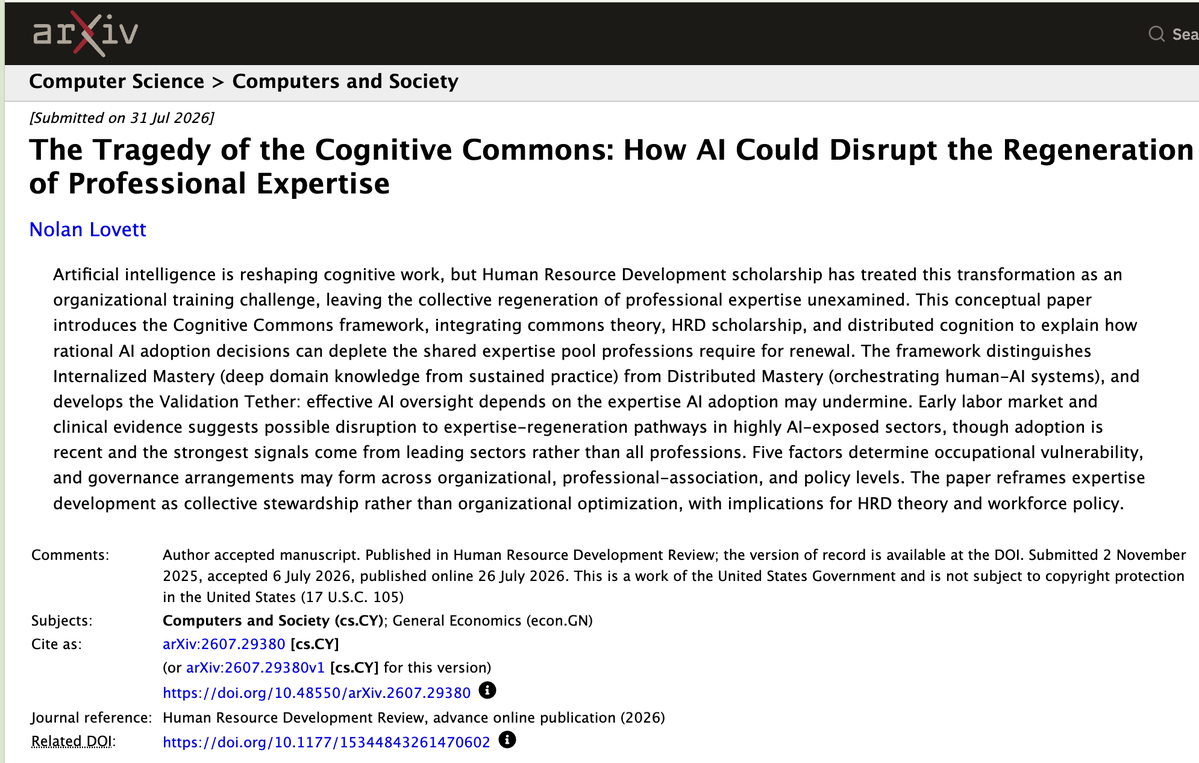
This paper gives a fancy name to a problem you can already feel in your bones
"The Tragedy of the Cognitive Commons." Checking AI output requires deep expertise. Deep expertise comes from doing grunt work for years. And grunt work is the first thing AI eats
So we're building systems that need expert supervision while dismantling the only known process for making experts
The paper calls the shared pool of human expertise the "cognitive commons." Every profession drinks from it. Nobody's refilling it.
By eliminating junior roles, each company is acting totally rationally, and the collective result: a profession that can't catch AI's mistakes anymore because it never learned to do the work in the first place
Who checks AI's homework in 15 years?
Interesting.
Grok 4.6 releases around August 7. This will be the 1.5T model with significantly improved SFT & RL.
Grok 4.7 will be the 2.1T model released a few weeks later. This will be better than 4.6 in every way, except slightly slower to serve, albeit with even better token efficiency.
Google Deepmind argues that LLMs can never make real scientific discoveries.
They published a paper breaking down Albert Einstein’s private view of scientific discovery.
In a famous letter to his friend Maurice Solovine, Einstein drew a diagram of how science actually happens.
It is a cyclical loop.
First, you experience raw sensory data. Then, through a mysterious, non-logical act of intuition, you make an intuitive "jump" to abstract axioms. Finally, you use strict logical deduction to derive consequences from those axioms.
Generative AI has completely mastered two-thirds of this loop.
• Induction: Statistical pattern matching across billions of tokens.
• Deduction: Formal proof generation, like AlphaProof solving complex math Olympiads.
AI can crunch data and it can prove theorems.
But it cannot make the jump.
The paper argues that AI completely lacks Abduction, the generation of novel explanatory hypotheses when observational data is scarce.
The prevailing tech myth says that "creativity is just data compression." That if you feed an LLM enough text, scientific breakthroughs will naturally pop out.
Einstein’s formulation of General Relativity proves that is a delusion.
When Einstein formulated relativity, the observational data didn't demand a new physics framework; classical mechanics was still massively successful. The breakthrough required a conceptual rupture. An intuitive leap from physical reality to a brand-new set of foundational axioms.
An LLM can execute the math once the axioms are given. But it is structurally incapable of formulating those premises on its own.
It can interpolate inside existing human thought, but it cannot transcend it.
The translation of physical reality into formal axioms remains the absolute, hard bottleneck of artificial scientific invention.
We can build models with trillions of parameters. We can scale compute into the stratosphere.
We can make the calculator infinitely fast.
But until we solve grounding, the machine can process all the data in the universe.
It still can't make the jump.
🦔AI companies are bulk-buying rare books, scanning them through high-speed machines that cut the spines off, and shredding the originals. A service called ISBNdb facilitates orders of up to a million books and keeps buyers anonymous. Pre-2022 books are premium because they're free of AI-generated text. A federal judge ruled the practice is fair use because eliminating the original means only one copy exists at a time. Anthropic hired the former head of Google Books partnerships to obtain "all the books in the world."
My Take
This got to me. A bookseller told 404 Media that rare books with almost no surviving copies are being fed into this pipeline. Books that survived wars, fires, and centuries of handling are being shredded so an AI can learn to write a better marketing email.
ISBNdb's website literally says "'AI company destroys two million books' is not a headline that generates sympathy," and they still built an entire business around making it happen quietly. They offer NDAs as a feature. They coach clients to call it "digital preservation."
I've covered AI companies scraping the internet, torrenting libraries, and stealing music. This is worse because it's irreversible. You can re-upload a website. You can reprint a bestseller. You can't replace the last three copies of an 18th-century botanical text once someone shreds them for training data. And the judge said it's legal. So it's going to accelerate.
"We shred rare books and offer NDAs so nobody finds out" is a legitimate business model in 2026. What a timeline.
Hedgie🤗