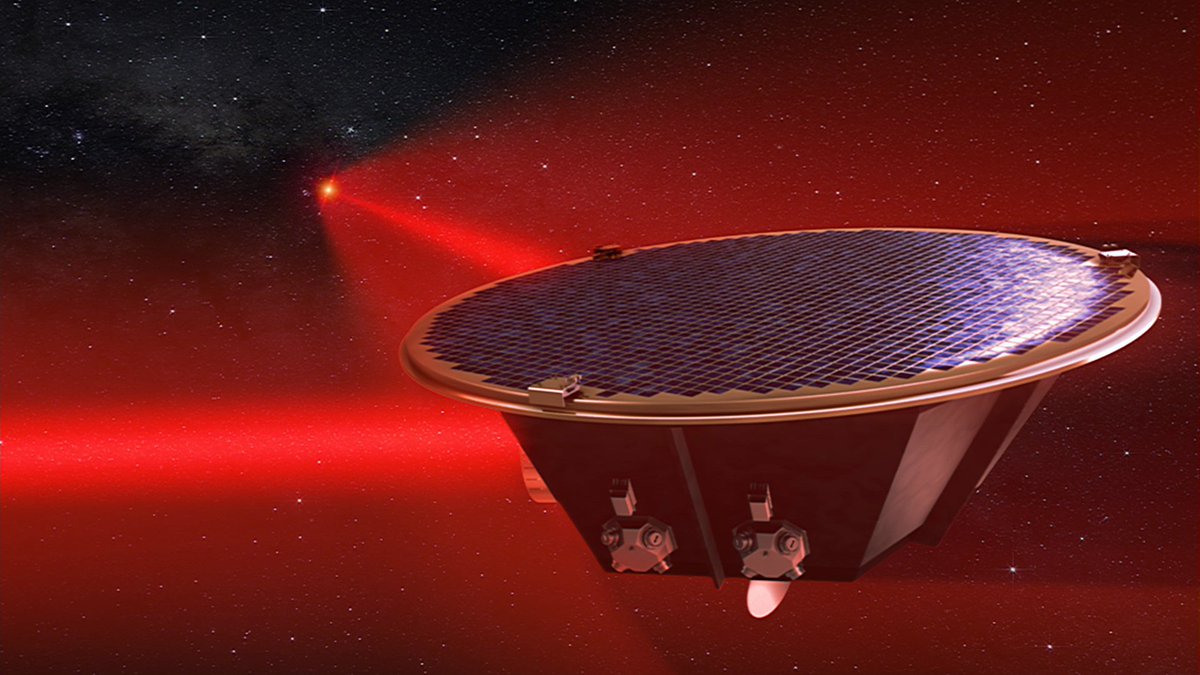
We have a mission! LISA just joined the future ESA fleet and will be ready to detect gravitational waves in the next decade. Now let's work to get this thing off the ground in 2035! #ESA_science#LISA_mission
DPG-Fortbildung für Lehrkräfte im @w_jahr „Unser Universum“ zum Thema „Gravitationswellen-Astronomie“ mit vielen Expert:innen aus der Forschung.
📅 26.6. - 30.6.2023
🏫 Physikzentrum Bad Honnef
ℹ️ https://t.co/rY6fCHnNY3
#Gravitationswellen#Astronomie#twlz#Physik#MINT
Our new paper is out: https://t.co/RgKRw8sdoq. It describes a typical interferometric noise: angular or lateral jitter being misinterpreted as distance variations. We speak of tilt-to-length coupling (in LISA), or angular control noise (ground-based gravitational wave detectors).
@nickkarnesis 😝 I doubt that. English: true, but I think we will have to wait a bit until national TV generally broadcasts bilingually. I don't expect that any time soon 😆
Unser Tipp für heute Abend: „Space Night science“. Mit dabei ist Dr. Gudrun Wanner vom Institut für Gravitationsphysik der @UniHannover. Sie forscht an @LISACommunity.
📺 5.3. um 19:00 Uhr auf ARD alpha
💻 jetzt in der Mediathek https://t.co/F7MHurSUic
#Wisskomm#SpaceNight
We would like to introduce you to our rising experts, our research group leaders. Therefore, we asked them to picture their research and their motivation in short interviews. Get to know the first six group leader portraits published on our website: https://t.co/Y4aSmx6ZMi
Time to celebrate again: another LISA Pathfinder paper was published yesterday: "Sensor noise in LISA Pathfinder: An extensive in-flight review of the angular and longitudinal interferometric measurement system" https://t.co/HAuVUXAfA6. Enjoy reading!
@benknispel Sieht gut aus! Bei uns sind es noch wenige - und wir haben gestern 2 Pflanzen herausnehmen müssen wegen Braunfäule :-( Aber sonst sieht es ähnlich aus wie bei dir + gelbe für die Farbe ;-)
New selected research highlight: The first sub-picometer laser interferometer in space – Analysing the in-flight performance of @ESA_LPF'S optical metrology system: https://t.co/ewZv2VwUUQ.
We got another paper on LISA Pathfinder out and published today, yay!! This one has a particular focus on the performance of the interferometry: https://t.co/KWxQ8Pxhwg
Montag Abend ist es wieder soweit und ich halte einen Vortrag über Gravitationswellen und LISA. Dieses Mal ganz Corona-konform als Online-Vortrag. Ich bin ganz gespannt, wie das so wird und hoffe inständig, dass Internetverbindung und Technik anständig mitmachen.
Vor dem #Wochenende noch ein Hinweis auf nächste Woche: Haltet euch Montag- und Freitagabend um 19 Uhr frei. Da starten wir nämlich mit unseren spannenden Online-Vorträgen #GravitationPhysikAdvent durch: https://t.co/jrYkQfEFRh #wisskomm
@morphp87 @meta_physik Sommerurlaubszeit... Die Welt der Physik und Gravitationswellen wird noch einige Tage ohne mich auskommen müssen. 😜 In der Zwischenzeit rede ich nur über Sommer, Sonne, Freizeit 🏝
That's quite a nice animation! Enjoy this nice clip to get a real impression of how big supermassive black holes can be: https://t.co/vQFsBq6Hjf via @businessinsider
My nature physics comment on LISA Pathfinder was just published: https://t.co/ifOwACa4oU or via https://t.co/eXgBBmL2LU if you have access for nature physics. One of the (many) things that kept me busy in the past weeks... Thanks to all who helped improve and fine-tune the text!
Just heard and very much enjoyed a wonderful lecture by Jocelyn Bell Burnell, speaking about her first observation of a radio pulsar in 1967. So amazing! Science has very much changed since the 60s, we can hardly imagine today how physics was back then!