We're going to make Omarchy the best damn OS for gamers. So many amazing conversations happening behind the scenes right now to make that happen. And also love seeing this out in the open already! 🤘
Btw the Redis story repeats itself: I'm working at DwarfStar for free for the community and because I enjoy it. But I'm receiving criticisms, since people are worried that this will break their AI-richness plans. I want to say to everybody thinking that I should stop that each time you tell me this, I'll double down my efforts towards a completely no profit engine for local inference. Better to shut up basically.
Built hn-radar 📡, a #Telegram ping when #HackerNews has a post matching your
interests, or when one crosses your upvote threshold.
No server: runs on a GitHub Actions cron. #Python & MIT.
#OpenSource#buildinpublic#uv
https://t.co/tcIdsXzS7X
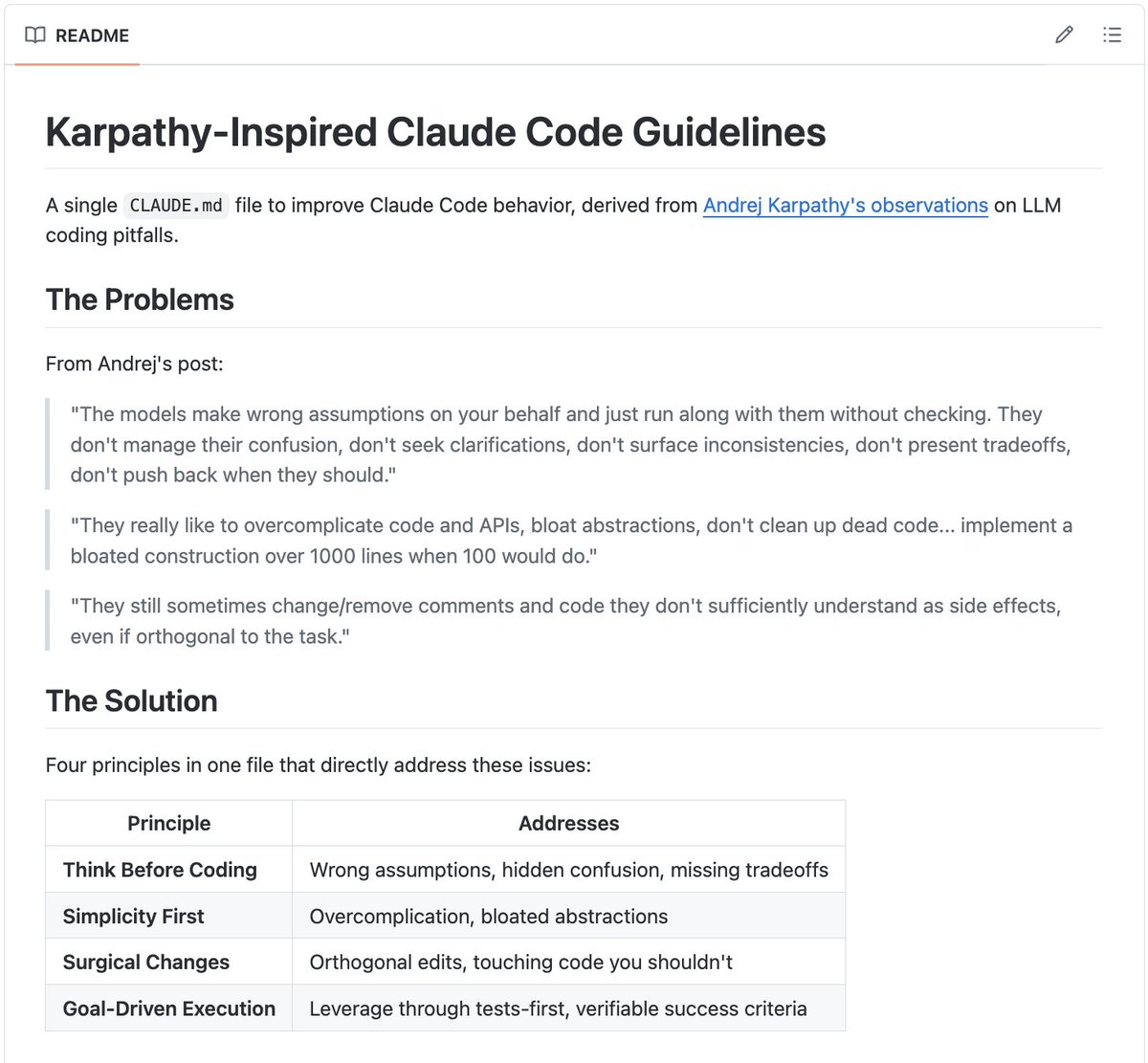
A single 𝗖𝗟𝗔𝗨𝗗𝗘.𝗺𝗱 file just hit 192k GitHub stars.
(derived from Karpathy's coding rules)
Andrej Karpathy observed that LLMs make the same predictable mistakes when writing code: over-engineering, ignoring existing patterns, and adding dependencies you never asked for.
If you've used AI coding assistants, you've hit all of these.
But here's the thing:
If the mistakes are predictable, you can prevent them with the right instructions.
That's exactly what this 𝗖𝗟𝗔𝗨𝗗𝗘.𝗺𝗱 does. You drop one markdown file into your repo, and it gives Claude Code a structured set of behavioral guidelines for your entire project.
This is a big deal.
- Built entirely around prompt engineering for AI coding assistants
- No framework, no complex tooling, just one .md file that shapes behavior
Developers are moving past "use AI to write code" and into "engineer the AI's behavior so the code is actually good."
The Claude Code ecosystem is growing fast, and the best tools in it aren't always software. Sometimes they're just well-crafted instructions.
100% open-source.
Link to the GitHub repo: https://t.co/pq6g88tNE3
That said, I wrote an article on the anatomy of the .claude folder, which was read by 11 million people.
It's a complete guide to 𝗖𝗟𝗔𝗨𝗗𝗘.𝗺𝗱, hooks, skills, agents, and permissions, and how to set them up properly.
The article is quoted below.
@chenzeling4 Hi, I built a semantic cache in pure Python. The tool intercepts the HTTP request to any LLM provider and searches it on a Redis vset. All this in two lines of code.
https://t.co/fRZsmdWM7n
Every LLM call you make is doing more work (and costing more) than it needs to.
Wrote up the hidden costs of latency + token spend, and how to cut both without touching your app's architecture.
Published in Level Up Coding 👇 https://t.co/t6Ioqdsyje…
#LLM#AIEngineering
We’ve received notice that the Department of Commerce has lifted export controls on Claude Fable 5 and Mythos 5.
We'll begin restoring access tomorrow, and will share an update soon.
We’re grateful to our users for their patience, and to everyone who worked with us on redeploying the models.
@antirez, no need for feedback or anything, just wanted to let you know there are people out there building open source stuff on top of the Vector Set you created … writing from Catania. Thanks for the passion you put into it and for inspiring people to build OS.
Hi @antirez, I built Khazad, an OS tool that intercepts HTTP requests to LLMs (OpenAI, Anthropic, Gemini, etc), and serves cached responses from Redis VS when it finds a semantic match, just 2 lines of code.
Repo: https://t.co/fRZsmdWM7n
See first comment
Hi @antirez, I built Khazad, an OS tool that intercepts HTTP requests to LLMs (OpenAI, Anthropic, Gemini, etc), and serves cached responses from Redis VS when it finds a semantic match, just 2 lines of code.
Repo: https://t.co/fRZsmdWM7n
See first comment
Hey @Redisinc I built Khazad, a transparent semantic cache for LLM API calls, powered by Redis Vector Sets.
It intercepts HTTP requests with zero code changes. If there's a semantic match, it returns the cached result instantly.
Check it out: https://t.co/fRZsmdWM7n
A French engineer who lives quietly in Paris has spent 30 years writing software that the entire internet now runs on without knowing his name.
He wrote the code that streams every YouTube video, every Netflix show, every TikTok clip. He wrote the code that runs the virtual servers underneath AWS, Google Cloud, and Microsoft Azure. He calculated more digits of pi than anyone in history. He has no Twitter. He has no marketing. He just keeps shipping.
His name is Fabrice Bellard.
Here is the story, because almost nobody outside the systems programming world knows what one man has built.
Fabrice was born in 1972 in Grenoble, France. He studied at École Polytechnique, the top French engineering school. He never went to Silicon Valley. He never built a startup empire. He just wrote code.
In 2000 he started a project called FFmpeg, an open-source multimedia framework for encoding, decoding, and streaming video. He was 28. The project did one thing nobody else had done well. It handled every video and audio format that existed, in one library, on every operating system. He led it himself for years.
Today FFmpeg is the invisible engine of the internet. YouTube uses it. Netflix uses it. VLC uses it. Chrome and Firefox use parts of it. Every Android phone, every iPhone, every smart TV, every video editing tool you have ever touched runs FFmpeg somewhere underneath. If you have watched a video on a screen in the last 20 years, Fabrice's code processed it.
He was not done.
In 2003 he started QEMU, a machine emulator and virtualizer. He wrote it solo until version 0.7.1 in 2005. QEMU lets you run any operating system on any other operating system. It became the foundation of modern virtualization. KVM, the Linux kernel hypervisor, runs on top of QEMU. Every major cloud provider, AWS, Google Cloud, Microsoft Azure, IBM Cloud, runs virtual machines on infrastructure built around it. The Quick Emulator is the most cited piece of cloud infrastructure code on Earth.
He kept going.
In 2001 he won the International Obfuscated C Code Contest with a small C compiler that grew into TCC, the Tiny C Compiler. TCC can compile and boot a Linux kernel from source in under 15 seconds. In 2004 he calculated the most digits of pi ever computed at the time, using a personal desktop computer and an algorithm he derived himself called Bellard's formula. In 2011 he wrote a complete PC emulator in pure JavaScript that runs Linux in your browser, a project called JSLinux that engineers still cannot believe is real.
In 2019 he released QuickJS, a small but complete JavaScript engine that fits where V8 cannot. In 2021 he released NNCP, a neural network based lossless data compressor that immediately took the lead on the Large Text Compression Benchmark.
Then he turned his attention to large language models. He built TextSynth Server, a web server with a REST API for running LLMs locally. He released ts_zip and ts_sms, compression utilities that use language models to compress text and short messages at ratios traditional algorithms cannot reach. He released TSAC, a very low bitrate audio compression system. In December 2025 he released Micro QuickJS, a new JavaScript engine for microcontrollers, separate from QuickJS, designed for environments with almost no memory.
Fabrice co-founded a telecom company called Amarisoft in 2012, where he serves as CTO. Amarisoft builds 4G and 5G base station software used by carriers and labs around the world. He has been running it for over a decade while continuing to ship personal projects from his own home page at bellard dot org
He has no Twitter. He has no Instagram. He gives almost no interviews. His personal website is a flat list of projects with no styling, no fonts, no marketing copy. Just titles and links.
A quiet French engineer who never moved to Silicon Valley wrote the code that quietly runs the internet.
He is still shipping.
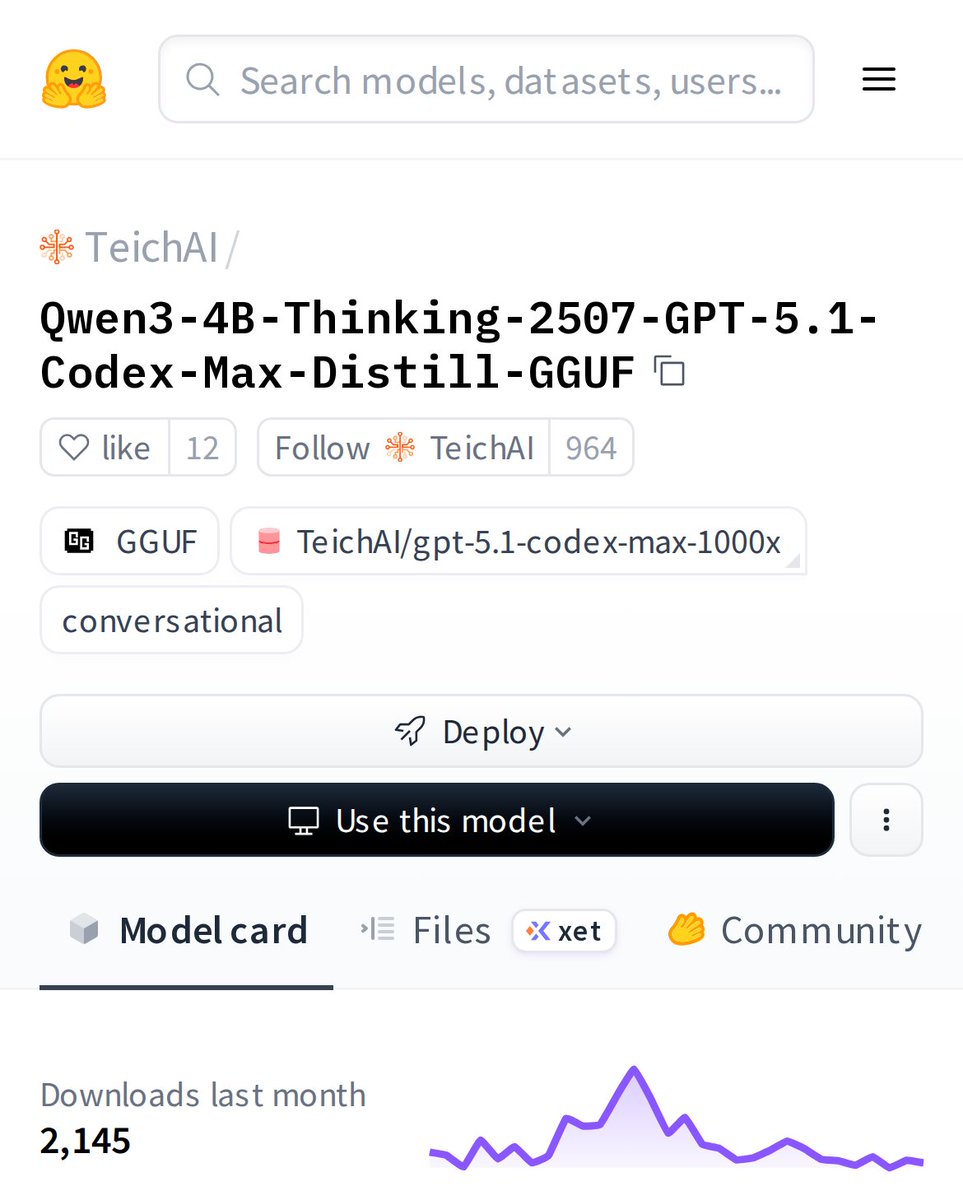
Meet Qwen3-4B-Thinking-2507: a distilled powerhouse that's making waves. This GGUF model brings advanced reasoning to local machines, letting you run sophisticated AI without cloud costs. Perfect for developers wanting cutting-edge capabilities offline.