I owned my first house at the age of 25.
At 15, I worked two jobs.
At 17, I became vegetarian and grew my own vegetables.
I never ate out at restaurants.
At 22, I sold my car and bought a bike.
I only ever bought second-hand clothes.
At 25, my parents gave me a house.
Anthropic AI engineer just showed how to give AI agents real memory in 4 steps - and it changes everything
in 28 minutes he shows exactly how agents can remember across sessions, completely free
worth more than any $500 AI engineering course
here's what he covers:
• why agents forget everything between sessions
• memory stores - agents read, write across sessions
• dreaming - agents that improve their own memory
• 95% cache hit rate, so it stays cheap
most people are still copy-pasting context into every new chat - while the people who figured this out are building agents that get smarter every single night
watch full video then read article below
Jane Street pays $700K/year for quants who know how to apply probabilities and time series analysis in quant trading.
This 1-hour MIT lecture on "Time Series Analysis" gives you the same edge quants get paid $58K/month for.
Bookmark & watch today. Then read the article below.
Always great to share discussions and perspectives with members on @RealVision 🙏
I learn a lot from others, but I’m always happy to share when I have something to contribute from my side.
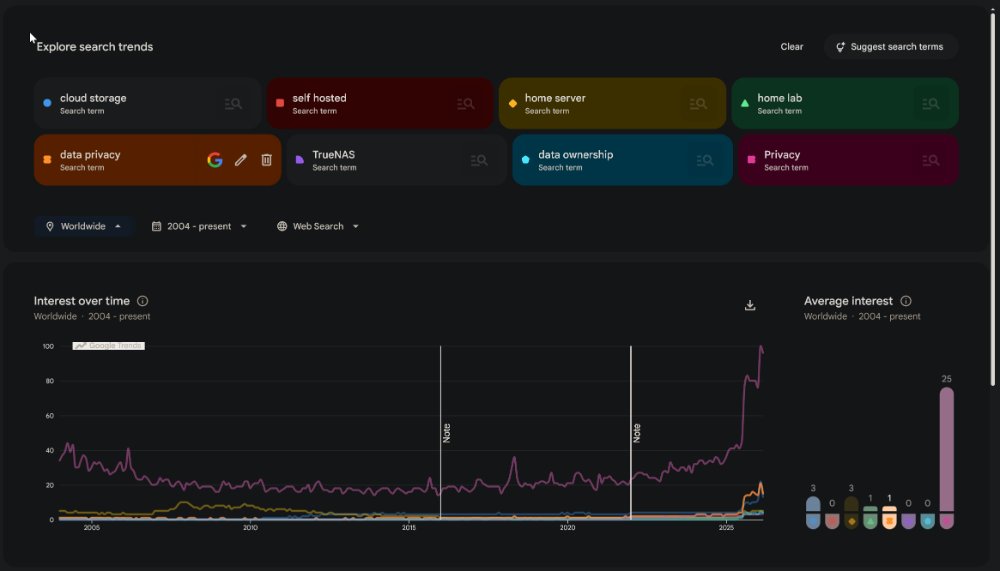
‘Self-hosted’: all-time high on Google Trends.
‘Cloud storage’: flat for a decade.
People aren’t waiting for a Wall Street thesis, they’re already unplugging.
The NAS market hit $5B in 2024 and is on track to 3x by 2033.
Something is moving that the models aren’t pricing.
Small additional thought.
When I was growing up in the 1980s, most neighborhoods had small local businesses — a butcher, a bakery, small shops. Over time many of those disappeared as large supermarkets and big retail chains centralized everything. The convenience increased, but economic power also concentrated in fewer and larger companies.
I sometimes wonder if technology might be entering a phase where part of that centralization could slowly reverse.
Today many businesses depend heavily on large platforms for storage, compute, and software services. But with the rapid improvement of AI tools, hardware efficiency, and small-scale infrastructure (local servers, NAS systems, edge computing), it might become possible for individuals or small groups to run meaningful digital services locally at relatively low cost.
Not necessarily competing with hyperscale infrastructure, but offering localized services, niche platforms, or community-based digital infrastructure.
In that sense, AI could lower the technical barrier enough for more people to build and operate their own tools rather than relying entirely on centralized platforms.
Curious whether others see any realistic path toward partial decentralization of digital infrastructure, or whether hyperscale platforms will remain overwhelmingly dominant.
I’ve been thinking about the Jevons paradox in the context of AI and infrastructure, and I’m curious how others see this playing out.
Historically, when technology becomes more efficient, total consumption often increases rather than decreases. Greater efficiency lowers costs, which encourages broader usage.
Instead of reducing demand, it can expand it.
AI seems like a good modern example.
As AI tools make complex tasks easier, more people can build software, launch services, generate media, run simulations, or automate workflows. In theory this could lead to an explosion of digital activity, not a contraction.
If millions more people are able to create or run computational processes, that could mean dramatically higher demand for:
- compute
- memory
- storage
- networking
- electricity
This might partly explain why infrastructure companies (storage, memory, networking, semiconductors, data centers) are seeing strong momentum recently.
At the same time, there are real constraints:
- energy availability
- grid capacity
- environmental limits
- geopolitical differences in energy strategy (US vs Europe vs China)
So I’m wondering:
Are we witnessing the early phase of a Jevons-style expansion of digital infrastructure, where AI efficiency leads to massively increased activity and therefore more hardware demand?
Or is the current infrastructure boom closer to a capital cycle overshoot that will normalize once supply catches up?
Curious to hear how people in the industry, tech, finance, energy markets, or semiconductor space are thinking about this.
Thanks!
HUGE: The $TRUMP and $MELANIA memecoin carnage is even worse than we thought.
A new report from CryptoRank reveals retail investors have lost a staggering $4.3 BILLION as these assets collapsed 90%+ from their highs.
The math is disgusting:
=> Retail: -$4.3 Billion (2M+ wallets underwater)
=> Insiders: +$600 Million cashed out
=> Ratio: For every $1 insiders made, ordinary people lost $20.
The "official" seal of approval was the ultimate liquidity trap. Be careful out there.
@RaoulGMI@zephyr_z9 People love immediate financial results, yet still watch videos from 6 months ago. With the actual situation, it's a bit of nonsense.
@RichardDias_CFA I can't wait to hear a talk on Nuclear Energy in the Loonie Hour! Or maybe the next one? ;)
"Denison Mines ($DNN) has received regulatory approval for the Phoenix in-situ recovery (ISR) uranium mine in Saskatchewan's Athabasca Basin. "
@DTAPCAP@scottmelker Not very @DanTapiero style
People need to stop adding fake AI-generated titles to try to get views. Create good conten,t and people will follow...
When do we get a update of @RaoulGMI and @DTAPCAP combined?
This is my 5th major crypto crash. If it's your first, I know it feels devastating. But nothing about Bitcoin's value proposition changed in the last 30 days. The infrastructure got better. The adoption grew. Real use cases have emerged—from payments with stablecoins to tokenized equities. Crypto will come back stronger.