@PaulinaGF5@LatinXChem Hello,
Coordination polymers and MOFs extended structures basically always present defects in the structure. Vacancies and conformational irregularities usually do not alter the luminescent properties significantly since the main mechanism is the antenna effect
@PaulinaGF5@LatinXChem A possible way to alter luminescent properties is by doping with luminescent ions during the synthesis. In the case of porous MOFs, luminescent compounds can be incorporated into the pores. Using post-synthethic modifications to tag a luminescent compound is also a possiblity
@Rock4daKing@LatinXChem Hello @Rock4daKing,
That property should be very interesting for a future study! We focused on the luminescent properties and applications for now, but we will definetely consider magnetic properties in the future since Ln(III) ions can exhibit this behavior.
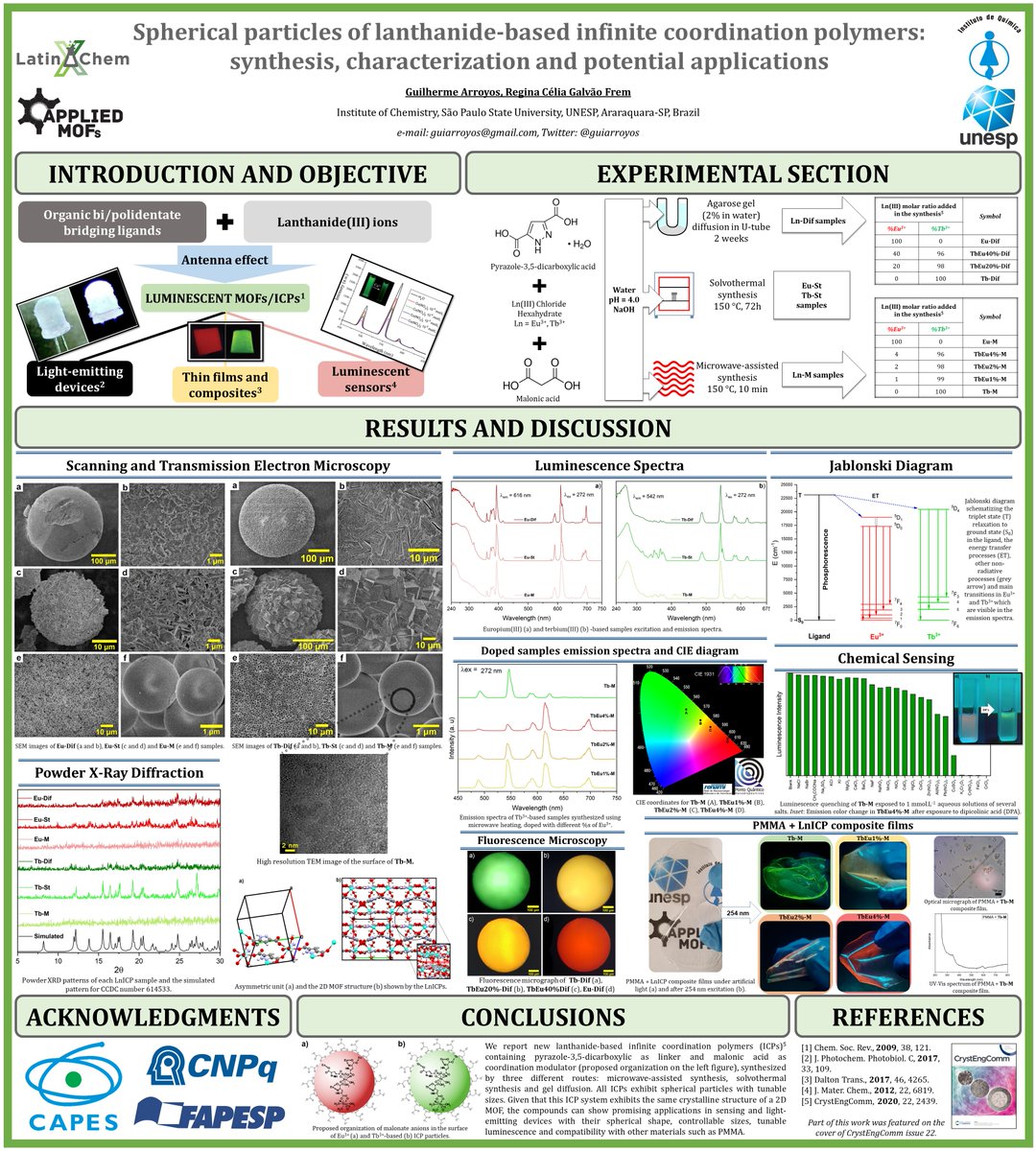
@CalvoRoggiani@LatinXChem The intense emission helps increasing sensitivity for sensing applications, and it is possible to have a wider concentration range to detect before complete extinction of luminescence.
@CalvoRoggiani@LatinXChem 1 - For pyrazole-3,5-dicarboxylate linker, Tb exhibits the highest emission intensity when compared with other Ln(III). According to Latva's rule, the energy gap between a sensitizer and Ln(III) excited state must lie within 2000-4000 cm–1. For Tb-M ICP, this gap = 2630 cm−1.
@CalvoRoggiani@LatinXChem We could observe 3 concentration regions where the concentration x emission intensity exhibited linear behavior, so we could use Stern-Volmer equation in order to quantitatively explain the quenching effect in the lowest concentrations.
@CalvoRoggiani@LatinXChem 2 - We are still exploring the quenching mechanism in detail. The most intense excitation wavelength for observing antenna effect in Tb-M compound is 272 nm (linker excitation), and this particular wavelength overlaps with Fe(III) UV absorption.
@CalvoRoggiani@LatinXChem Fe(III) could also interact with uncoordinated nitrogen sites in the linker, even though this interaction is expected to be weak since no significant changes in the FTIR spectra were observed before and after Fe(III) exposure.
@SandraPioquinto@LatinXChem Hello, for the sensing and for making composite films the microwave-assisted method is the most suitable, since it yields smaller particules. The smaller size gives more dispersibility in aqueous media and a higher contact surface.