"Same clients, same invoices."
Essa frase tá no artigo que o Greg Isenberg publicou no sábado aqui no X sobre AI roll-ups. A tese é comprar uma empresa de serviço chata (contabilidade, administração de imóveis e de condomínio, suporte de TI, folha de pagamento...), colocar agentes de IA pra fazer boa parte do trabalho e levar a margem EBITDA de 5 a 10% pra 30 a 40%. Mesmos clientes, mesmas faturas, 3 a 4 vezes o lucro.
A parte da IA eu compro. O custo desses serviços vai cair, e rápido.
O que eu não compro é o "same invoices".
Esses serviços não têm diferencial competitivo. Pensa no seu contador ou na administradora do seu condomínio: se aparecer alguém fazendo a mesma coisa por menos, a maioria troca sem pensar muito. Negócio assim não tem pricing power: o preço anda junto com o custo do setor. Se o custo de entregar cai pra todo mundo ao mesmo tempo, a economia não fica com quem comprou a empresa. Vai pro cliente, na renovação do contrato, ou pro concorrente que aparece cobrando menos com os mesmos agentes.
E ele mesmo escreve no artigo que "anyone can use the same models". Pois é.
Eu até acho que pode dar certo se for bem aplicado por gente do setor, principalmente por quem conseguir escalar e consolidar o mercado. Pro resto, não sei se leva dois anos ou cinco, mas pelo menos pra mim a tendência é esses serviços ficarem mais baratos (ótimo pra quem contrata).
O artigo traz uma lista do que pode dar errado: comprar mais rápido do que consegue integrar, gente-chave indo embora, cliente saindo junto com o antigo dono, agente com autoridade demais, número auto-reportado... Nenhum item fala do preço cair.
Leitura obrigatória para qualquer um que esteja envolvido com IA, principalmente os preocupados com “10% chance it kill us all…”
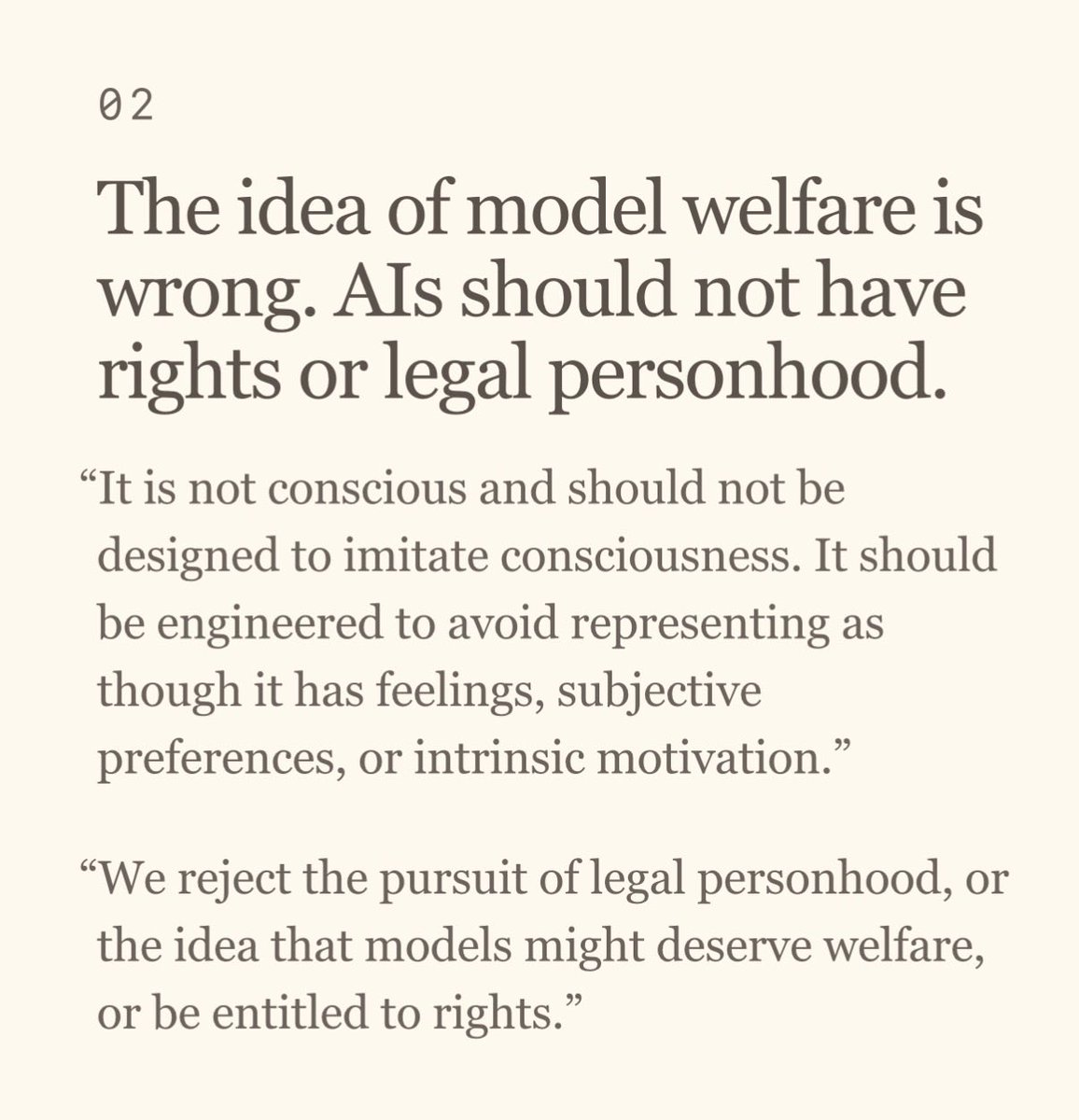
“We should build systems that do not claim to have feelings because they do not experience feelings. Even if conscious machines were a possibility, avoiding creating conscious beings should be the top priority for anyone in AI development.”
https://t.co/VptdyO7OXS
When they say: Please, for the love of God, regulate us. Give us licences, audits, and bans before our digital God destroys us all.
Here is what is actually being requested. Three things, in order.
A regulatory body that they control, to prevent competition from catching up. Written with their people, staffed by their alumni, and calibrated to what they can already afford. Compliance is a fixed cost, which means it is trivial for the incumbent and fatal for the challenger. Not technology, but paperwork becomes their moat.
Immunity from liability. This is the one nobody talks about and it is the most valuable of the three. Today, if your model causes harm, it is your fault. Once licensed, audited, and approved, it is the regulator’s fault – you followed the rules. The licence converts responsibility into a receipt.
Too big to fail status, which means taxpayer funded bailouts in case of problems. Declare it critical infrastructure and the state now has an interest in your survival. Which means, when something goes wrong, the losses are public and the gains stay private. We have watched this film. Banking, 2008, same argument, same vocabulary.
Note the pattern: every one of the three transfers something from them to the public – risk, competition, cost – while the language is entirely about protecting the public from them.
The sincerity of the fear is beside the point. Sincere people can still ask for exactly what an insincere person would ask for, and the request should be judged by what it does rather than by what motivates it.
The alternative is unglamorous and works: competition, adversarial testing between rivals who want to find each other’s flaws, and full liability after real harm. Nobody gets a licence. Nobody gets immunity. Nobody gets a bailout. You build, and you answer for what you built.
That is the arrangement that made the West rich. It has never needed anyone’s permission to work.
That’s pretty clever. So you can set up every harness you want (Claude Code, Codex, Open Code) and set up different models. Instruct each bot to use a specific harness/model and you’ll have the fantastic Grok Bot orchestration with the coding model you want. Hello GLM, Kimi, DeepSeek…
Uma coisa que precisam arrumar em todas as LLMs: "self awareness de tempo de trabalho". Quando o Claude fala "Semanas de trabalho" leia-se 2 ou e sessões de meia hora. "Dias"= horas. "25 minutos" = 2 minutos!
Então a primeira coisa que tô construindo nesse projeto é uma calculadora pra resolver isso pra mim: fazer o raio-X do custo oculto de todos os meus investimentos.
Apesar de eu sempre ter sido muito bem atendido pelos assessores, fui entendendo que o conflito de interesse é inerente ao modelo de negócio deles. E com o tempo vai ficando claro uma coisa incômoda: nesse modelo, você é o produto.
Todos eles têm uma coisa em comum: o custo. E o pior do custo não é ser alto, é ser invisível. Ninguém te manda uma fatura no fim do ano dizendo quanto você pagou. Tá diluído em taxa de adm, gestão, spread, rebate, espalhado de um jeito que você nunca para pra somar.
Agora que o time tá mais estruturado eu tô me afastando um pouco do coding, mas pra não ficar na abstinência uso as noites, madrugadas e finais de semana pra tocar um projeto pessoal meu. É uma dor antiga, daquelas que você tenta esquecer, mas sempre volta a doer. É sobre o enorme conflito de interesse (e os altos custos ocultos) das assessorias de investimento.
Num fim de semana de fevereiro eu sentei pra entender o tal Claude Code. Eu já usava o Claude e o ChatGPT diariamente, mas foi nesse momento que eu conectei o Claude a uma conta recém-criada do GitHub. E de lá pra cá, entrei para a turma do VCA (Vibe Codólatras Anônimos).
Nesse meio tempo a coisa ficou séria: a gente acabou mudando o rumo da Kyte, o Kyte AI virou projeto pra valer, com time montado, e eu tô lá no meio codando junto.
Olhando para trás percebo que os momentos de grandes viradas no negócio foram aqueles com decisões mais difíceis na época.
Essa semana foi mais um momento de coragem. Freeze no legado e “all in” em um produto novo, do zero, com nova proposta, nova aquisição e até ajuste no ICP.
Voltando para o dia 0.
Após um final de semana com 16 hrs vibecoding ficou claro pra mim. Vai ser mais rápido e eficiente construir nossa nova visão de produto do zero. Livre do legado, tecnologia nova e novo jeito de trabalhar.
Sai o peso do legado e entra o frio na barriga de recomeçar.
Great story. Brave move.
I’m going through something very similar at Kyte App, a POS platform for micro businesses in Latam.
At our All Hands today, I shared our own “brave” decision: freeze the legacy product and focus on the new AI product we started building a few weeks ago.
I almost felt like a coward after reading your post 😂
But every company and every founder lives in a different reality. I could never fully bet the company and put my family’s livelihood at risk. Our runway would only last a few months.
Still, I’m confident we can make this transition while keeping the legacy product as a cash cow.
We’re even smaller than you are, around 40 people and mid 7 figures ARR, and we’ve been moving very fast with a very different way of working, reasonably isolated from the legacy business.
Wish me luck.
Running a company:
2020: can you survive a pandemic?
2021: still here? we’re going to give all of your competitors $100m series A rounds.
2022: wow, you made it? okay, all engineers cost $600,000/year now.
2023: nice job! okay, SVB failed and we’re going to take away your bank account.
2024: a survivor I see. but can you pivot from ai to crypto to defense tech back to ai-enabled defense tech in a 12 month period to stay relevant?
2025: unfortunately all of your competitors have raised $2b series B rounds. oh and only 500 engineers are relevant and they cost $100m/yr each.
2026: well, well, well. you’re still in business? let’s deploy the thunderclap of godlike LLMs from the heavens so all of your customers can rebuild your app in 2 hours. can you survive?