Alryt time for me to chime myself back in , in case we pullback people will start throwing rubbish takes on the timeline but this time is different :
@solana disinflation proposal was just passed !
DeFi happening on robinhood chain is not just casinos or gambling or KOL led shillfest , it is genuine activity and intersection of stonk tokenisation
@virtuals_io is doing real progress in sectors of Robotics and development of digital agent societies
Projects like @AskVenice are among top 20 newly upcoming apps , which means non speculative / gambling apps are finally making there way in the outer market
@ethena recently killed VC overhang discourse and finally aligned tokenomics to token holder benefits and when such large projects take these measures it usually sets a precedent
Ideas like @MetaDAOProject are actively working to bring about token holder aligned incentives among ICO’s and new launches and it is a very positive development no matter how small it feels right now
Several real revenue generating products will surface like @Collector_Crypt , several projects that are building since multiple years are finally sitting at a very mature phase now and are cheaper than they ever were even if they are above some prices ( IFYKYK ) like @NEARProtocol , @Uniswap , @Zcash , @pendle_fi , @maplefinance
So no it’s not shit at all , crypto is 10 folds better than how it was 4 years ago in terms of intent , ethics , execution , transparency and ofcourse real PMF
New youtube video is out !! and on a topic that I always felt was very under discussed , LUCK or more precisely put - How to actually be lucky in crypto https://t.co/Rz8Nzr8gWF
Two weeks ago, Ethereum researchers met in Berlin to continue charting the protocol's long-term trajectory, following along discussions with client teams in Svalbard in April.
The updated strawmap is at https://t.co/9e2AQ6rhz6, and I attached a picture of it to this post.
My own high-level takeaways:
* "Lean Ethereum" is not a single one-shot upgrade, it is a collection of improvements that will come online to the Ethereum network over the course of three or four years. But make no mistake, this IS the third major iteration of Ethereum in the same way that the Merge was the second. Almost every major piece of the protocol will be replaced:
- Verification through recursive STARKs, rather than direct re-execution. Recursive STARKs become an enshrined first-class core component of the protocol
- Replacing everything quantum-vulnerable with quantum-safe alternatives
- Consensus: decoupled available chain and finality, one or two-round finality. Theoretically optimal security properties, simpler than today, and faster than today
- Multidimensional gas
- State: not just tree structure, but what *types* of state are available
- Changes to client architecture
...
At the same time, simplification, cleanup and future-proofing. And this will all be done in a way that minimizes disruption to existing application. We've done this before (the Merge), we can do it again.
* H-star (aka Hegota) is probably Ethereum's last thematically "pre-Lean" fork. Starting from I-star, most of everything we do will have a very strong "Lean" feel to it in one way or another.
* Privacy is no longer an afterthought, it is a first class goal. When designing Frames, the mempool, additions to the state tree, we explicitly ask the question "okay, how do quantum-safe, intermediary-free privacy protocol transactions go through this, and what is the overhead?"
* Formal verification of everything for security.
* FV also makes us much more comfortable with canonicalization (having pieces of the protocol that are directly defined as a piece of bytecode expressed in some language). evm-asm is being written in part to become a canonical proof system for the EVM.
* Quantum safety has shifted up a LOT in priority. This adds a lot of work (eg. finalizing a quantum-safe blobs design has become urgent; this work has already been ongoing for months)
* Probably the single most disruptive part of the plan is the changes to state. There is growing consensus around leaving present-day-style "dynamic state" mostly unchanged, but scaling it only a medium amount, and adding new types of state that are more scalability-friendly (eg. no need for builders to sync/store all of it) but more restrictive, and that will scale a large amount.
eg. possible Ethereum in 2030: 2 TB of present-day-style (dynamic) state, and 100 TB of new-style (scalable but restrictive) state
This "new-style" state would work very well for ERC20s, NFTs, many defi use cases, but not eg. highly "central" objects like Uniswap contracts, or onchain order books, or other complex things (which are crucial for Ethereum but which only take up a small percentage of state)
Hence, it will not be *necessary* to rewrite any apps, but it will be *very cost-effective* to eg. rewrite an ERC20 token into a newer design that uses a new type of UTXO storage that is currently being explored, so that it will have >10x lower txfees.
Design of these new state types (current ideas: keyed nonces, ring buffers, UTXOs, statically accessible state, temp state) is an area where we will need a lot of feedback from application developers (incl. privacy-friendly application developers) and probably several rounds of rethinking and iteration.
* In the context of a much larger total state size, we need to figure out the incentive issues around who stores this state and what motivates them to. Even saying "each node stores 1%" is not good enough - why do they store that 1% and why are they willing to serve it? This is being elevated as a first-class research area.
* Ethereum will need to have a "VM" other than EVM in one form or another - at the very least, we need something like leanISA for recursive STARKs - and the gains are large in exposing it to users so that we support programmable privacy and better scalability. Right now, the most likely contenders are leanISA and RISC-V.
My own ideal is that in this world, we adjust the protocol so that the EVM becomes a high-level-language compiler-level feature, and the protocol only "sees" RISC-V / leanISA directly. But this is still far away.
* Gas limit increases, blob increases and slot time decreases will happen many times over the next ~5 years. We expect a large gas limit increase with Glasterdam. Each step of increased scale or decreased slot time is a matter of getting to the point where it is safe to do it, which comes from a combination of client optimization and protocol changes.
Ethereum is CROPS.
Ethereum is scaling.
Ethereum is reinventing itself.
Onward.
Akash saw a major transformation from late 2025 to early 2026, upgrading its tech, economics, and positioning as a decentralized AI cloud.
Mainnet 14 (Oct 2025) was a massive infrastructure overhaul that removed years of technical debt. It upgraded the Cosmos SDK, improving speed and scalability, and introduced JWT authentication (Google/GitHub login), eliminating the need for crypto wallets—making it far more enterprise-friendly. Performance upgrades also made it better for high-frequency AI workloads.
AkashML (Nov 2025) marked a shift to AI-first strategy. It’s a serverless AI inference platform with an OpenAI-compatible API, allowing easy deployment of models like Llama and DeepSeek. It offers 70–85% lower costs than traditional providers and automatic scaling across decentralized GPUs.
Burn-Mint Equilibrium (BME) + Mainnet 17 (Mar 2026) revamped tokenomics. Users convert AKT into ACT (a USD-pegged compute credit), ensuring stable pricing. Unused ACT is burned, and AKT is minted only when needed—creating deflationary pressure tied to real usage. This aligns incentives for users, providers, and token holders while enabling smart contracts.
Homenode (Early 2026) expanded supply by letting individuals contribute GPUs (like RTX 4090s) with simple setup, earning from AI demand and increasing network capacity.
Growth: Deployments surged 466% in 2025, with over $5M compute spend in early 2026 and 1,000+ GPUs online. Easier payments and login improved enterprise adoption, while strong ecosystem momentum and recognition boosted growth.
Overall: Akash evolved into a scalable, AI-focused decentralized cloud with strong economics and rapid adoption.
Some of the catalysts coming in 2026 include :
1. Virtual Machine (VM) Support (KubeVirt):
Launching around March 2026, Akash will support full virtual machines alongside containers. This allows enterprises to run legacy applications without rewriting them for container environments. It makes Akash feel more like a traditional cloud while keeping decentralization, enabling full OS environments, databases, and complex workloads.
2. Lease-to-Lease Networking:
Expected by May 2026, this feature enables secure, direct communication between different deployments on the network. It’s critical for running advanced systems like microservices architectures and AI agent networks efficiently, making Akash viable for more complex applications.
3. Reserved & Preemptible Instances:
Coming around August 2026, Akash will introduce flexible pricing models similar to traditional clouds. Reserved instances offer predictable pricing for long-term workloads, while preemptible instances provide cheaper compute for flexible tasks. This improves cost efficiency and attracts enterprise users.
4. Shared Security Migration (AEP-79):
Planned by the end of 2026, this is a major architectural shift. Akash may move from its own Cosmos-based blockchain to a shared security model (potentially integrating with a larger ecosystem like Solana while retaining interoperability). This reduces validator overhead, improves liquidity and security, and allows the team to focus more on product innovation—especially AI and GPU features.
5. Bare Metal, Confidential Computing & Hardware Enhancements:
Rolling out through 2026, these upgrades focus on performance and security:
• Bare metal access removes virtualization overhead, improving performance by ~10–15%.
• Trusted Execution Environments (TEEs) enable secure, private computing with verifiable hardware.
• Expanded GPU support (including newer architectures and consumer GPU participation via Homenode) boosts AI training and inference capabilities.
Je crois qu'on ne mesure pas ce qu'Elon Musk est en train de construire avec X.
Tous les médias de l'histoire ont été couplés à une culture, une langue, une bulle géographique. Le Monde parle aux Français. Le NYT parle aux Américains. NHK parle aux Japonais. Chaque média filtre le réel à travers le prisme de sa culture locale.
X est en train de devenir le premier média de l'humanité. Pas d'un pays. De l'espèce.
Je le vis en temps réel. Mes posts en français se font RT par des Japonais, répondre par des Brésiliens, citer par des Américains. Des conversations qui n'auraient jamais existé il y a 5 ans. Un libertarien français qui débat avec un ingénieur de Tokyo et un entrepreneur de Sao Paulo sous le même tweet. Pas traduit par un éditeur. Traduit instantanément par l'IA, en un clic.
Les bulles de filtre culturelles sont en train d'exploser.
Et je pense qu'on sous-estime massivement les effets composés de ça.
Quand une idée peut traverser un océan en 3 secondes, quand un argument sourcé posté à Paris peut être vérifié par un économiste à Singapour et amplifié par un développeur à Austin dans la même heure, le coût de propagation d'une bonne idée tend vers zéro.
Et c'est catastrophique pour un type d'acteur très précis : les médias qui ont construit leur business model sur le monopole de l'information locale. Ceux qui pouvaient raconter n'importe quoi sur "ce qui se passe ailleurs" parce que personne ne pouvait vérifier.
Quand un journaliste français écrit que "le modèle américain ne marche pas", maintenant il y a 50 Américains dans les réponses avec des sources. Quand un éditorialiste dit que "le Danemark prouve que le socialisme fonctionne", il y a un Danois qui explique que le Danemark est 10e en liberté économique mondiale.
Le fact-checking n'est plus un département. C'est un effet réseau.
Les médias honnêtes n'ont rien à craindre de ça. Les médias qui vendaient une narration protégée par l'ignorance géographique de leur audience vont avoir un problème existentiel.
Parce qu'on ne peut plus mentir à l'échelle locale quand le monde entier regarde.
1/ Bio Protocol v2 introduces features that strengthen incentive structures and remove bottlenecks from V1’s multi-step, capital-intensive funding process.
However, even more interesting, is how these upgrades make DeSci more attractive as a sector for capital allocation. 🧵👇
"When you're taking a trade, it has to be the most important thing in the world to you, but when it's behind you- it's behind you. This mindset is really crucial. It frees you to fully commit to the next trade and the next trade after that with intensity, clarity and focus."
It's only a trade
Watchlist in easy mode !
Pumpfun
Troll – main runner
Tokabu – spirit of gambling
Dollo – all-in play
Clippy – cult movement
Bonkfun
67 – community-driven movement
Detective – strong meme potential on Twitter
Dstock – crazy active community on Twitter
Wire – beta to Clanker
Heaven
Light – main token with 100% buybacks
Halo – first big meme on Heaven
777 – iconic ticker and lucky number
Hachi – first animal ticker
Education Megathread
> all high value write ups and videos that I've put out publicly over the years; in one place
> new pieces will be added as they release
Watchlist for this week
#USELESS – Watching this one to see how the Bonk ecosystem performs. A new high here could spark nice moves in related coins like $IKUN and $GIB.
$IKUN – My favorite Bonk eco play. Will look to trade it if $USELESS shows strength.
$KITTY & $LABUBU – Fun “toy” coins, but not in right now since I’m not seeing ideal R/R setups.
$CDB – Pretty interessting coin. Not much hype around it yet, which I like.
#YOURSELF – Watching as a potential Believe eco play. If Launchcoin local bottom is here this could run.
Overall be more careful this week !
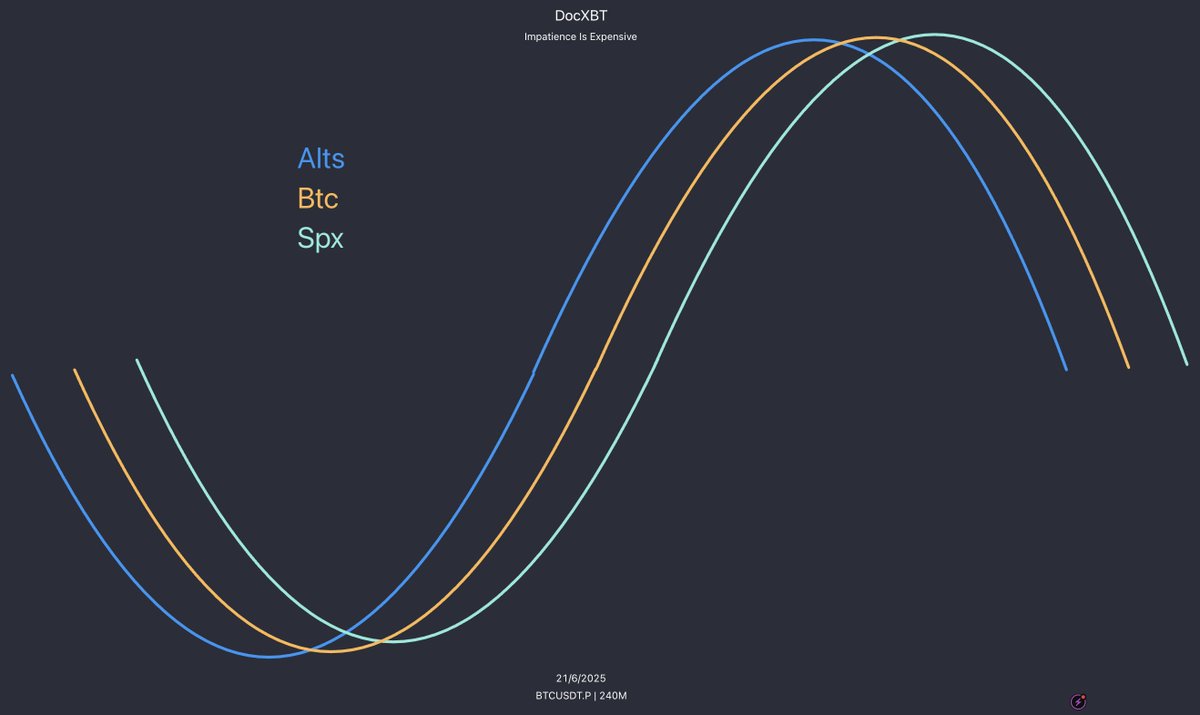
Market Selloff Dynamics + Bottoming
The goal of this write up is to give you a bit of insight on how I spot HTF pivot points in markets. We want to understand the psychology behind risk unwinding and use that to our advantage to potentially spot bottoms.
1. Low Conviction Sells First
- When uncertainty hits, sellers dump what they least desire i.e., lower conviction coins will top first and bleed early.
- Think about it logically. If you're in a pinch and needed cash irl, you're not going to sell your prized possessions, you're gunna sell the crap you never use.
- Likewise, traders will sell what they’re least emotionally invested in to build cash when uncertain or want to decrease risk.
- It’s not a coincidence that this has happened every HTF top this cycle. Alts don't rally after, they rally during. They also top weeks before BTC even shows an ounce of weakness.
- It’s an early warning. Smart traders de-risk before the crowd even knows what's happening.
2. Risk vs. Quality
- Let's go back to the earlier metaphor. People will hold onto their quality prized possessions for as long as they possibly can. It's not until they're desperate that they will part with them.
- The most desirable coins, more often than not, will attempt to hold their gains for as long as possible. This is why BTC always looks fine and you see dozens of "Why is everyone panicking, BTC looks great" tweets weeks before sell offs.
In selloffs:
a) Junk sells early
b) Quality sells late
c) Everything sells eventually
Watch the order of events. It’s a map of stress flow.
3. Reflexivity Kicks In
- Early weakness causes more weakness.
- Once a whale starts to unload into exhausted demand they begin to induce weakness. Classic signs of distribution, absorption, exhaustion, trend loss etc.
- A character shift in a risk asset will make the first order of experienced traders reassess.
- "I didn't sell top, but the character of the trend has shifted. Time to reduce exposure/close"
- “If this is nuking, what else am I exposed to?”
Suddenly:
Rebalancing triggers more selling
This is reflexivity.
A feedback loop of diminishing risk appetite.
4. Volatility: The Dance
Before many big selloffs in BTC, markets go quiet. Volatility drops. Trends become ranges. Complacency peaks.
Then, boom.
Let's talk a bit about balance and imbalance.
- Balance is achieved once the market begins to agree on what's expensive and what's cheap. It's a dance. Equilibrium.
- Equilibrium is calm. What's known is known. Speculation diminishes. Volatility compresses.
- The dance continues until one party gets bored, tired or wants to go to the bar to get another drink. i.e. buyers or sellers get exhausted; changes to supply/demand.
- Equilibrium is damaged- and once it breaks: Imbalance.
- Price displaces violently. Value becomes unclear; volatility explodes. The market craves balance and will actively seek it.
- Price often returns to areas where recent balance was formed- hvn, orderblock, composite value etc.
- This is where you get the sharpest bounces.
"First test, best test"
- Subsequent tests will provide diminishing reactions. Things become structural. Price accepts its new home. Volatility compresses. Balance is found once again.
5. The Flow of a Selloff & Spotting Bottoms
Capitulation isn’t the beginning of the end; it’s the end of the middle.
a) Alts vs. Bitcoin
- This cycle alts often do the bulk of their selling before BTC capitulates.
- Recent example: Fartcoin sold off 88% from its top before the late February BTC capitulation. Since this is true, we can begin to use it as an edge when looking for exhaustion (bottoming)
- The strongest alts will begin to show relative strength (exhaustion) earlier as BTC is still being hyper-volatile and looking for new balance.
- In order words, look for good alts to begin to achieve balance as BTC is in the later stages of imbalance.
As participants, our goal is to spot these divergences:
“Has momentum shifted?”
“Is volatility compressing?”
"Is the velocity of selling diminishing?"
“Is it holding while BTC makes new lows?”
Signs of bottoming in Q2:
- Momentum loss (Fartcoin)
- SFP/Deviation (Hype/Sui)
- Higher lows vs BTC’s lower lows (Pepe)
In short: alts front-load their pain, then decrease in velocity as BTC bottoms.
Remember this how we spot "good" alts.
The weak stay weak.
The strong start whispering before the market speaks.
b) Bitcoin vs. SPX
Now a little exercise for you all
Combine all the concepts in this thread and maybe the following begins to make sense:
Summer '23: BTC topped before SPX, bottomed earlier
Summer '24: BTC topped before SPX, absorbed the macro related SPX crash at range low
So far in '25: BTC topped before SPX, absorbed a 20% SPX crash at range low
TL;DR
Bottoms are a process, not a moment.
Alts First
Bitcoin Next
SPX Last
Watch for the structure, not just the sentiment.
[Disclaimer: Post not with purpose of calling the top or such stuff, but with purpose to remind that we are not early at all, in fact, in some way, we are pretty damn late. Can we go higher? Sure. Can we giga top now/in next few months? Absolutely.]
Zooming out often being interesting and useful.
2015-17 Bullcycle gave people ±71x upside on BTC from bear lows to bull highs.
2019-21 Bullcycle gave people ±22x upside on BTC from bear lows to bull highs. (71/22=3.22 times less than previous cycle)
2023-25 Bullcycle already gave people ±7.2x upside on BTC from bear lows to current highs. (22/7.2=3.06 times less than previous cycle).
Including in that - we already got multiple multi-billion valuation coins from both memes and AI categories, we got bunch of airdrops, like HL, LZ, ZKS, ARB, etc. So there have definitely been plenty of opportunities to capitalize. There will be more for sure(they always appear).
- - - - - - - - - - - - - - - - - - -
Outside of that some other stats bump of current 2023-25 Bullcycle:
On average as a whole we usually been having sharp green trends for around average 40 days, and chop/flat/down for average 120 days.
This latest trend since bottom to top was ±43-45 days. Unless we breakout straight from here - imo it's reasonable to be respecting statistics and be patient, as if we get 80-150 days of more chop - 99.8% of coins will be not just sent, but living in a goblin village.
- - - - - - - - - - - - - - - - - - -
Market is beautiful however since there are opportunities waiting to be grabbed every single day for those who find them, no matter if it's a bull or bear market out there.
Managing risks and expectations more and more is an important task to do however, the longer this multi-year show goes.
Yet I think the most optimal and safe way to approach next months is to be 90% stabled and just play narratives when they appear. Pretty much what I will be doing.
I think the long-term buys on HTF with actual portfolio size ideally to come on the next like -55-60% dd from BTC ATHs, whenever it comes, not now.
🚨 Bitcoin’s Ready for New Highs, But Altcoins are LAGGING 🚨
With #Bitcoin approaching all-time highs, the big question is: When will altcoins catch up?
I’ve uncovered a signal that predicted the last 3 altcoin cycles in 2017, 2019, and 2022 - and it might be flashing again.
After months of research, here’s why I think altseason could be just around the corner 🧵👇


![nosanityxbt's tweet photo. [Disclaimer: Post not with purpose of calling the top or such stuff, but with purpose to remind that we are not early at all, in fact, in some way, we are pretty damn late. Can we go higher? Sure. Can we giga top now/in next few months? Absolutely.]
Zooming out often being interesting and useful.
2015-17 Bullcycle gave people ±71x upside on BTC from bear lows to bull highs.
2019-21 Bullcycle gave people ±22x upside on BTC from bear lows to bull highs. (71/22=3.22 times less than previous cycle)
2023-25 Bullcycle already gave people ±7.2x upside on BTC from bear lows to current highs. (22/7.2=3.06 times less than previous cycle).
Including in that - we already got multiple multi-billion valuation coins from both memes and AI categories, we got bunch of airdrops, like HL, LZ, ZKS, ARB, etc. So there have definitely been plenty of opportunities to capitalize. There will be more for sure(they always appear).
- - - - - - - - - - - - - - - - - - -
Outside of that some other stats bump of current 2023-25 Bullcycle:
On average as a whole we usually been having sharp green trends for around average 40 days, and chop/flat/down for average 120 days.
This latest trend since bottom to top was ±43-45 days. Unless we breakout straight from here - imo it's reasonable to be respecting statistics and be patient, as if we get 80-150 days of more chop - 99.8% of coins will be not just sent, but living in a goblin village.
- - - - - - - - - - - - - - - - - - -
Market is beautiful however since there are opportunities waiting to be grabbed every single day for those who find them, no matter if it's a bull or bear market out there.
Managing risks and expectations more and more is an important task to do however, the longer this multi-year show goes.
Yet I think the most optimal and safe way to approach next months is to be 90% stabled and just play narratives when they appear. Pretty much what I will be doing.
I think the long-term buys on HTF with actual portfolio size ideally to come on the next like -55-60% dd from BTC ATHs, whenever it comes, not now.](https://pbs.twimg.com/media/GtxLCH6W0AEE2m3.png)


![nosanityxbt's tweet photo. [Disclaimer: Post not with purpose of calling the top or such stuff, but with purpose to remind that we are not early at all, in fact, in some way, we are pretty damn late. Can we go higher? Sure. Can we giga top now/in next few months? Absolutely.]
Zooming out often being interesting and useful.
2015-17 Bullcycle gave people ±71x upside on BTC from bear lows to bull highs.
2019-21 Bullcycle gave people ±22x upside on BTC from bear lows to bull highs. (71/22=3.22 times less than previous cycle)
2023-25 Bullcycle already gave people ±7.2x upside on BTC from bear lows to current highs. (22/7.2=3.06 times less than previous cycle).
Including in that - we already got multiple multi-billion valuation coins from both memes and AI categories, we got bunch of airdrops, like HL, LZ, ZKS, ARB, etc. So there have definitely been plenty of opportunities to capitalize. There will be more for sure(they always appear).
- - - - - - - - - - - - - - - - - - -
Outside of that some other stats bump of current 2023-25 Bullcycle:
On average as a whole we usually been having sharp green trends for around average 40 days, and chop/flat/down for average 120 days.
This latest trend since bottom to top was ±43-45 days. Unless we breakout straight from here - imo it's reasonable to be respecting statistics and be patient, as if we get 80-150 days of more chop - 99.8% of coins will be not just sent, but living in a goblin village.
- - - - - - - - - - - - - - - - - - -
Market is beautiful however since there are opportunities waiting to be grabbed every single day for those who find them, no matter if it's a bull or bear market out there.
Managing risks and expectations more and more is an important task to do however, the longer this multi-year show goes.
Yet I think the most optimal and safe way to approach next months is to be 90% stabled and just play narratives when they appear. Pretty much what I will be doing.
I think the long-term buys on HTF with actual portfolio size ideally to come on the next like -55-60% dd from BTC ATHs, whenever it comes, not now.](https://pbs.twimg.com/media/GtxLpD5XYAAKtK9.jpg)


