Most of what a pull request touches never shows up in the diff.
Security Blast Radius maps the full reach of a change, so you can investigate the downstream impact before you approve.
Here's a 7 minute deep dive to help you get started 👇
We raised a $143M Series C and announced three products in five days.
> CodeRabbit Security
> CodeRabbit Triage
> CodeRabbit Change Stack
One more announcement to go.
Excited to share that we’ve raised a $143M Series C at a $1.5B valuation!
AI made it easy to turn ideas into PRs. Knowing what’s safe and worth shipping is now the hard part.
We’re introducing Agentic Change Management to help teams prioritize and understand agent outputs.
We raised a $143M Series C at a $1.5B valuation to build the control layer for software change.
Our first investor got involved for a totally different reason.
Agents are proliferating everywhere, but the question remains about how to understand what they are doing.
Similar to infrastructure, we need to give a way for Agents to explain their actions, not to develop dashboards, but for us as humans to build confidence in their outputs.
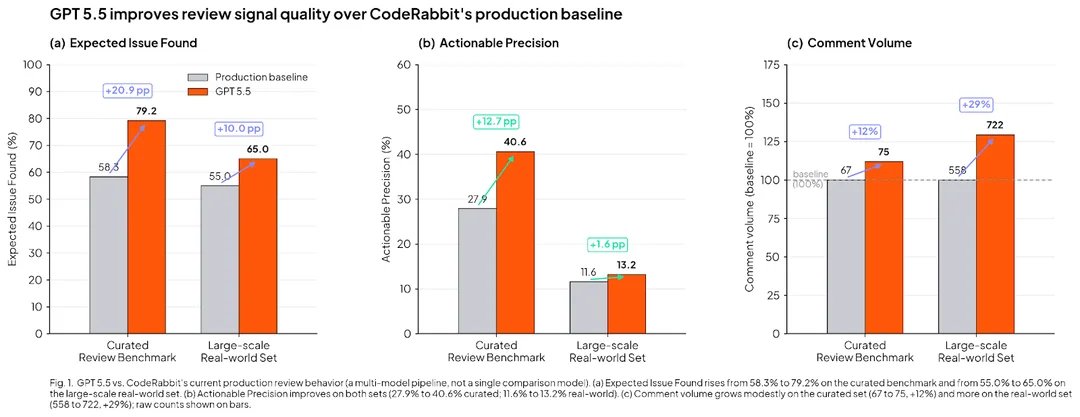
We’ve been testing GPT-5.5 in early access and are excited by its performance in code review.
In our evaluation, it delivered a more direct review flow, stronger signal, and better performance on the issues that matter most.
Headline result: 79.2% Expected Issue Found vs 58.3% baseline.
Excited to announce CodeRabbit Agent for Slack. Agent turns every thread, decision, and conversation into a durable context your team can build upon.
Try it today!
Your engineering team is about to snap. And your AI coding agent is making it worse.
Introducing CodeRabbit Agent for Slack 🎉
A second brain for engineering teams. Because your tribal knowledge lives in Slack threads nobody can find.
At CodeRabbit, we review millions of PRs every week and know how ace engineering teams operate on the planet.
The same three things slow every team we see:
- Context and decisions that live elsewhere.
- Lack of a team-level durable knowledge base
- And a trust layer that gives a safety net to your teams
Built for Agentic SDLC workflows, CodeRabbit Agent for Slack solves all three problems in one shot while enabling teams to collaborate in real-time with the Agent.
CodeRabbit Agent is Slack-native and builds your team’s operating context from every thread, every decision, every conversation your team has ever had.
Make your team’s context compound!
We built the @coderabbitai plugin for @OpenAIDevs Codex. Along the way we learned a lot about how the model handles tool choice, authentication, long running tasks, and tone.
Wrote it all up for anyone building their first Codex plugin.
We’re adding more plugins to Codex to give it more ways to gather context and take action across your stack.
New plugins include @coderabbitai, @Remotion, @CircleCI, and more.
Our team ran our internal eval bench on the new Opus 4.7, and it has consistently shown 24% relative improvement in the model's ability to find the specific bug that matters to developers.
Hear more from David Loker, VP of AI.
We ran Anthropic Claude Opus 4.7 against our hardest benchmark - complex concurrency bugs that require multi-step reasoning.
Almost 20% better than previous generations.
Here's what we did to get it production-ready and what you can take from it for your own stack 👇
Introducing --agent flag in CodeRabbit CLI 🎉
The new --agent flag turns CodeRabbit into a tool your AI agent can use, providing structured JSON output instead of terminal text.
Your agent writes code, CodeRabbit reviews it, reads the JSON, and fixes what's flagged.
Do you catch unwanted merge changes at the speed this video got recorded?
No? Then your main branch deserves better.
Check out CodeRabbit Pre-Merge checks.
Because “we’ll fix it in the next PR” has cost humanity enough.
Keep main sacred.
Introducing CodeRabbit Skills 🐰
Giving 35+ AI agents code review abilities. Just ask:
> Review my code
> Check for security issues
> Run a code review
> Review my PR
(repo link below!)
When intent isn’t clear up front, the agent fills in the gaps.
That leads to code that’s almost right, close enough to look reasonable, but wrong enough to create work everywhere else.
Suddenly, reviews are harder, tests are more complicated, and you’re having to rewrite half the PR yourself.
We built CodeRabbit Issue Planner, which captures your intent, adheres to team conventions, and, most importantly, assembles the context meticulously, so the agent only needs to follow the instructions.
Give it a try - available on Linear, Jira and more.
Introducing CodeRabbit Issue Planner! ✨
AI agents made coding fast but planning messy.
Turn planning into a shared artifact in your issue tracker, grounded in related issues and decisions.
Review prompts as a team, then hand them off to an agent!
The inner loop of coding is getting automated fast.
Generating code is no longer the hard part. Aligning on what to build and trusting the output is (😎).
That’s why we built a collaborative issue planner that turns intent into implementation plans teams can run in coding agents.
What we’re seeing:
• Better agentic code when senior engineers review the plan first
• Lower costs because cheaper models stay on track during execution
As software development shifts from single-player to multiplayer, outer loops matter more than ever.
This is just the first release. Feedback, approvals, and tighter workflows are coming next.
AI coding assistants are shipping more code...but also more bugs!
Our State of AI vs. Human Code Generation Report analyzed 470 real GitHub PRs.
The findings? AI‑coauthored PRs produced about 1.7× more issues than human‑only PRs!