The Mahalanobis distance is the natural metric for Gaussian signals. But how can it be generalized to arbitrary probability densities? And how should a solution be tested? We address these questions in a new paper with @pe_fiquet@FlorentinGuth Jona Ballé, and @EeroSimoncelli
@DimitrisPapail 100%
Perhaps historically people should have insisted on calling it communication theory instead, which is exactly how Shannon called it in his article from 1948. Communication theory, by design, doesn’t tell us anything about the structure of data.
I'm at #ICLR2026!
- Learn how information, denoising, and geometry combine to define distance metrics adapted to the data: Poster P3-#210 Friday morning with @guy__ohayon@pe_fiquet
- Using scientific methods to understand deep learning: Sci4DL workshop Sunday in 101-B @scifordl
Who's in #ICLR2026 ? Let's chat!
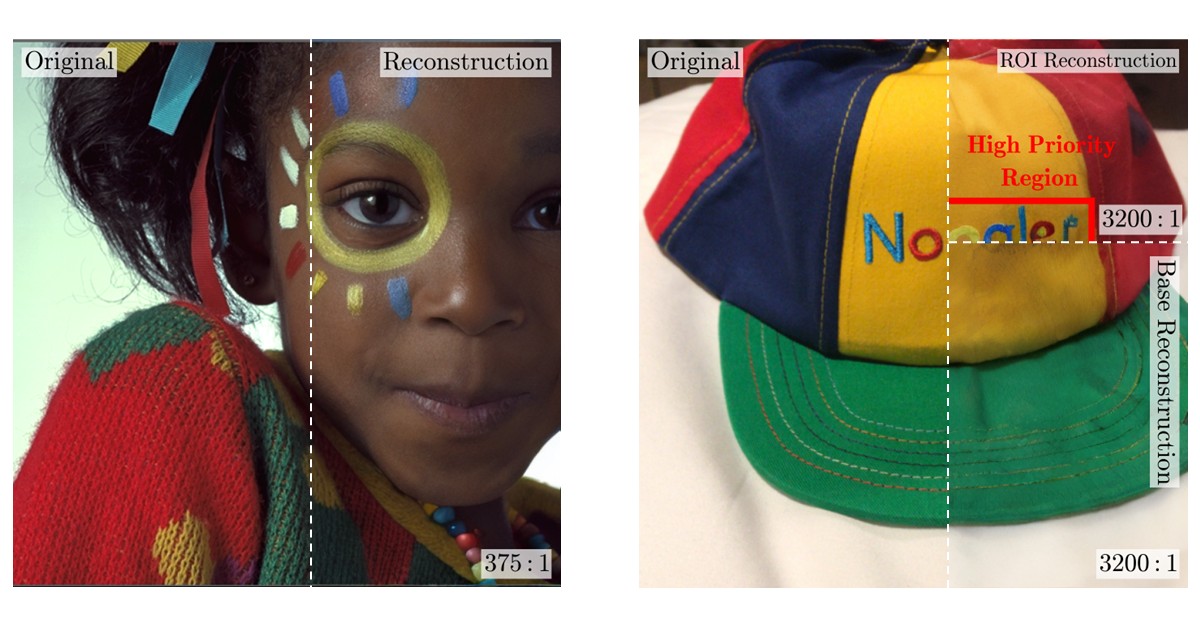
Turbo-DDCM: Fast and Flexible Zero-Shot Diffusion-Based Image Compression,
Thursday 10:30AM, Pavilion 4 P4-#3015
Learning a distance measure from the information-estimation geometry of data,
Friday 10:30AM, Pavilion 3 P3-#210
Can image compression using pre-trained diffusion models be fast enough for real-world use?
In our new paper, together with @guy__ohayon, @hila8manor, Michael Elad and @t_michaeli, we show that it is possible and even leads to intresting variants.
webpage: https://t.co/p8vWWTl75N
The Mahalanobis distance is the natural metric for Gaussian signals. But how can it be generalized to arbitrary probability densities? And how should a solution be tested? We address these questions in a new paper with @pe_fiquet@FlorentinGuth Jona Ballé, and @EeroSimoncelli
🌟 Excited to share our new paper: “ELAD: Blind Face Restoration using Expectation-based Likelihood Approximation and Diffusion Prior” presented today in #SIGGRAPHAsia2025 (13:40pm, room S423)
🧵[1/8]
It’s hard to overstate how great it is to work at the Flatiron Institute. This is an incredible opportunity for both undergraduate and graduate students to come work in one of the most fun and collaborative research environments you’ll find in the world! Come work with us!
Applications are now open for our summer research internships! Positions are available for undergrad + grad students interested in computational #science research. https://t.co/02R80lc3L2
It’s quite amazing that we can now compress images in about 2 seconds using a pre-trained denoising diffusion codebook model (i.e., our diffusion-based compression engine is zero-shot). And yet our rate-distortion-perception curves are still SoTA. Check out Turbo-DDCM!
Can image compression using pre-trained diffusion models be fast enough for real-world use?
In our new paper, together with @guy__ohayon, @hila8manor, Michael Elad and @t_michaeli, we show that it is possible and even leads to intresting variants.
webpage: https://t.co/p8vWWTl75N
@sedielem@sedielem@docmilanfar Are we certain that images live on a low-dimensional manifold (in the mathematical sense)? 🤔 Or is it just a way of saying that images are “highly structured” signals? This paper shows some contradicting evidence:
https://t.co/KCiu0wquaL
All the great breakthroughs in science are, at their core, compression. They take a complex mess of observations and say, "it's all just this simple rule".
Symbolic compression, specifically. Because the rule is always symbolic -- usually expressed as mathematical equations. If it isn't symbolic, you haven't really explained the thing. You can observe it but you can't understand it.
Diffusion models learn probability densities by estimating the score with a neural network trained to denoise. What kind of representation arises within these networks, and how does this relate to the learned density? @EeroSimoncelli@StephaneMallat and I explored this question.
T2I models excel at realism, but true creativity means generating what doesn't exist yet. How do you prompt for something you can't describe? 🎨
We introduce VLM-Guided Adaptive Negative Prompting: inference time method that promotes creative image generation.
1/6
The Mahalanobis distance is the natural metric for Gaussian signals. But how can it be generalized to arbitrary probability densities? And how should a solution be tested? We address these questions in a new paper with @pe_fiquet@FlorentinGuth Jona Ballé, and @EeroSimoncelli
@YouJiacheng This work by @ZKadkhodaie and @EeroSimoncelli was the first to discuss score-based generative modeling without time conditioning: https://t.co/T2BAmCbuh7. It appeared in 2020.