A key challenge for interpretability agents is knowing when they’ve understood enough to stop experimenting.
Our @NeurIPSConf paper introduces a self-reflective agent that measures the reliability of its own explanations and stops once its understanding of models has converged.
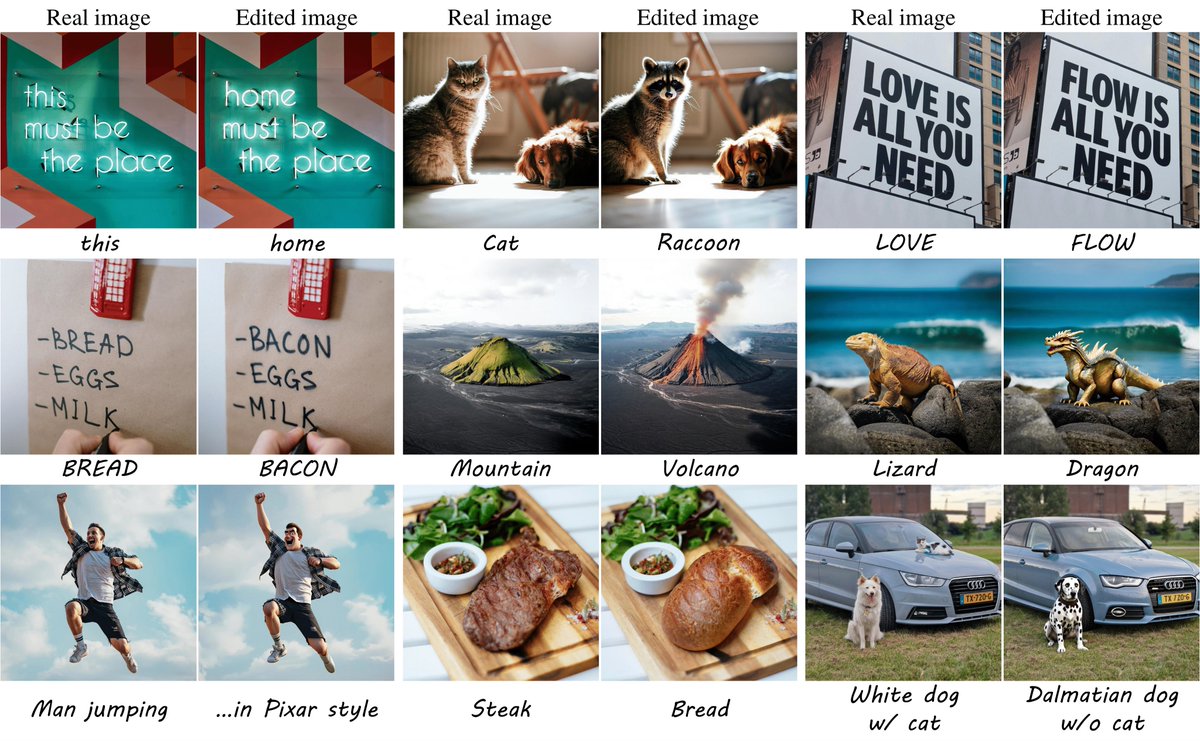
📷 FlowEdit has been accepted to @ICCVConference
Edit real images with text-to-image flow models!
Check out:
code https://t.co/AxIZkCPUFH
webpage https://t.co/ZENFdmjVcR
space to edit your images - https://t.co/ei6YCJgDNt
great ComfyUI plugins (@logtdx) https://t.co/NXrV43EqTS
@hila8manor and I will present our work tomorrow at @icmlconf, 4:30PM😊 Stop by our poster to learn more about compressed image generation using diffusion models!
Excited to share that "TokenVerse: Versatile Multi-concept Personalization in Token Modulation Space" got accepted to SIGGRAPH 2025!
It tackles disentangling complex visual concepts from as little as a single image and re-composing concepts across multiple images into a coherent result.
https://t.co/MMr8Ssv9cx
#SIGGRAPH2025
Excited to present DDCM📖 with @guy__ohayon, @t_michaeli & M. Elad🎉
DDCM is a new generative approach that achieves SotA compression and is extendable to compressed conditional synthesis, all just w/ pre-trained diffusion models.
Webpage &🤗Demo: https://t.co/xY0EZI0lUu
FlowEdit allows editing real images with pre-trained text-to-image flow models.
It is:
- Optimization free
- Model agnostic
- Doesn't rely on inversion!
@inbarhub, @vd_kulikov, @MatanKleiner
🎉We are excited to present FlowEdit🎉
Edit real images with flow models!
Paper: https://t.co/Qu8oQQKXGR
Website: https://t.co/ZENFdmjVcR
Code: https://t.co/AxIZkCPUFH
Space: https://t.co/ei6YCJgDNt
Thanks to the amazing team: @vd_kulikov, @MatanKleiner and @t_michaeli.
#cvpr2024
Want to see me as wonder woman, @vd_kulikov as superman, and @t_michaeli as ironman?
DDPM inversion poster, tomorrow, Thursday 10:30 am, poster no 275!
How many input-output pairs from a trained model are required for stealing it?
It turns out that for many image-restoration and image-to-image translation models, the answer is - ONLY ONE!
Check out our paper (w/ @NuritSpingarn):
https://t.co/hOzcff5gj3
@2ptmvd The catch is that predictors with this property are necessarily not consistent with the measurements.
The only predictor that achieves perfect perceptual quality and is also consistent with the measurements is the posterior sampler.
https://t.co/TVG6Q6dJyA
@guy__ohayon
@2ptmvd Posterior sampling indeed leads to perfect perceptual quality at the cost of a 2x increase in MSE w.r.t. the posterior mean predictor.
But you can often get perfect perceptual quality with a smaller increase in MSE.
A closed form for the P-D function:
https://t.co/F63BZkvoDG
Excited to be in Vienna presenting our paper "From Posterior Sampling to Meaningful Diversity in Image Restoration" at #ICLR2024! (poster #77 at session 1)
Grateful to my amazing co-authors @hila8manor@YuvalBahat@t_michaeli
project page: https://t.co/FJQZK2dknU
Excited to share that our (@t_michaeli) paper, "On the Posterior Distribution in Denoising: Application to Uncertainty Quantification", was accepted to #ICLR2024!
I'm going to be at @iclr_conf all week, come to my poster on May 8th (session 3, #218)!
https://t.co/i6AgvHf6E7
Everything THREE! Claude and Stable Diffusion! Plus: Music Editing w/ Zeta (ft @hila8manor), and a look at Relighting in @skyglassapp from @beeble_ai
LINK: https://t.co/llhUqCe6En
Our (@t_michaeli) Text-Based Audio Editing method now has an interactive space🤗
🎶Try it out on your own audio🎶: https://t.co/vrsc8cKzWC
Paper: https://t.co/Kn8LHLiqlH
Project page: https://t.co/MQvYZl1GOy