co-founder @act2financial; tech/fin services focus; advisor to founder-led and family run technology companies; fmr corporate dev/start-up-transactional law
Trump ripped up the walkway between the West Wing and the mansion to replace it with polished African granite carved in Italy. "Paid for by me," he claimed. Except that's not true. Taxpayers paid $689,232, per documents obtained by @michaelscherer https://t.co/7l2bkD0MIH
From the Navy SEAL officer who planned and executed the Bin Laden raid: “In recent months, President Trump, upon advice from Secretary of Defense Pete Hegseth, has relieved or forced the retirement of some of the finest officers that have ever served this nation. I have personally worked with most of them in combat….And this week, in an egregious decision, the president forced General Chris Donahue to step down from his position in command of U.S. Army Europe. Donahue is without question one of the most brilliant officers I know. He is strategically focused, tactically aggressive, personally courageous, exceptionally thoughtful in his planning and execution, and compassionate with his troops. He has the respect of every man and woman who ever served with him—and you can put me at the top of that list.”
This is a photograph I took yesterday when I visited Tilton House, Keynes’s final home and place of death. The house is in a sad state of disrepair.
Tilton sits at the foot of Firle Beacon, in the South Downs. It began as a Sussex farmhouse and was given a Georgian face in the eighteenth century. It has always been a lease from the Gage Estate.
In August 1925, after Maynard Keynes married Lydia Lopokova, he took the lease on Tilton. From then on, Keynes divided his life: London in the week, Cambridge for working weekends, and Tilton for the rest.
The Treatise on Money (1930) and, above all, The General Theory of Employment, Interest and Money (1936) took shape here.
Keynes was moderately wealthy and gave the house electric light, central heating, and French paintings. He added substantial acreage and farmed it through a manager, playing the “gentleman farmer” à la Clarkson.
He loved the place enough to take its name. Raised to the peerage in 1942, he became Baron Keynes of Tilton. He died here in April 1946, and his ashes were scattered on the Downs above. Lydia stayed on, increasingly alone, until her own death in 1981.
Robert Skidelsky, Keynes’s great biographer, took the lease in 1986 and wrote at Keynes’s own desk. When he was ennobled in 1991, he took the name of Baron Skidelsky of Tilton.
More recently, Tilton became a yoga-and-writing retreat, but the business moved to a different location some time ago.
Standing in front of Tilton yesterday, I thought how odd it is that we let this happen at all. The National Trust already keeps Monk’s House, where the Woolfs lived. The Charleston Trust keeps Charleston, a few minutes down the same lane. Tilton is the missing corner of that triangle.
Surely someone, the National Trust or a smaller foundation, could take Tilton on and open it. It would not take much, and it is worth doing.
Reuters: A federal appeals court has blocked the Trump admin's plans to immediately slash the workforce at the Consumer Financial Protection Bureau by about two-thirds.
240 years ago today, the most underrated general in American history died. From a sunburn.
Nathanael Greene was never supposed to be a soldier. He was a Quaker from Rhode Island who ran his family's iron forge. He had asthma, a stiff leg that gave him a permanent limp, and zero combat experience. His own church suspended him just for going to watch a military parade.
So how did he end up commanding the entire Southern army? He read. He bought every book on warfare he could find and taught himself strategy from scratch. Washington noticed, and trusted him more than almost anyone.
By 1780 the war in the South was a disaster. The previous American general got beaten so badly he fled 200 miles on horseback. Congress let Washington pick the replacement, and he picked Greene without hesitation.
Greene's plan was insane. He looked at his small, starving, half-naked army and decided he could not win, so he would lose correctly. He ran Cornwallis all over the Carolinas until the British were exhausted, far from supply, and bleeding men they could not replace. "We fight, get beat, rise, and fight again."
At Guilford Courthouse, Cornwallis technically won the battle and lost a quarter of his army doing it. That was the whole point. Greene lost almost every fight on paper and won the entire South. Cornwallis limped off to a little tobacco port to rest and refit. The port was called Yorktown.
Here's the part that should make you angry. To feed and clothe his men, Greene personally co-signed for war supplies because the government wouldn't pay. When the bills came due, Congress refused to honor them. The man who saved the South came home buried in debt that wasn't his.
Georgia gave him a plantation near Savannah as thanks. He finally had peace. Then one hot afternoon in June 1786 he spent the day walking a neighbor's rice fields with no hat. He collapsed from sunstroke and a week later he was dead at 43.
One last twist. After he died, his widow Catharine took in a broke young houseguest tinkering with an idea. His name was Eli Whitney, and the cotton gin was invented at the dead general's home.
June 19, 1786. Remember the name. Nathanael Greene.
Dear Donald,
I sincerely congratulate you, such a bright, extraordinary person and politician, on the occasion of your 80th birthday!
I highly value the mutual understanding that has developed between us, which allows us to directly and frankly discuss any, even the most complex, issues on the bilateral and international agenda.
I am confident that through joint efforts we could truly give Russian-American relations a new quality, and also do much to ensure security and stability on the global stage.
I sincerely wish you good health, happiness, prosperity, and success. Please convey my best wishes to Melania and all members of your family.
Vladimir Putin
One hell of a letter in The Times today from General Sir Nick Carter, a former head of the armed forces
He warns that Britain risks becoming ‘Belgium with nuclear weapons’ unless it spends more on defence
‘Successive governments have hollowed our armed forces out to such a degree that if we do not spend what is needed now to arrest that decline, and transform them for the modern world, we risk becoming Belgium with nuclear weapons. And our enemies are watching’
Times letters: Britain’s slide down the Nato league table
https://t.co/wwL5HT5fFy
NEW: China arrested a US citizen after Trump met with Xi in Beijing and accused him of endangering national security — a rare charge against an American. The detainee, U Min Zin, is a grad student at @UCBerkeley who researches Myanmar. This adds a new strain to US-China ties.
The defence chief of the Philippines said on Friday he would continue to do his duty in the face of "wickedness" committed by China, a day after he was sanctioned by Beijing for what it described as repeated "erroneous remarks". https://t.co/rHVgfF1biZ
The Securities and Exchange Commission proposed eliminating a rule that aims to ensure investors get better prices for their transactions https://t.co/ppwsjM8MAR
Here is John Sipher methodically laying out why not only Bill Pulte is a dangerous choice to succeed Tulsi Gabbard, but really why the whole US IC is in extreme peril.
https://t.co/iAPoTAxEqd
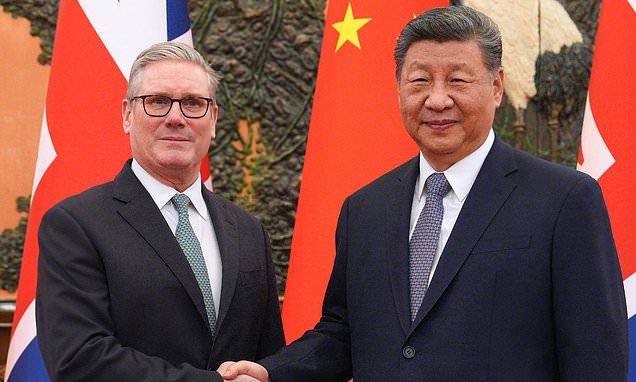
A hidden tracker inside the British Prime Minister’s official vehicle was quietly transmitting real-time location data back to China.
Veteran China analyst and former diplomat Charles Parton OBE exposed this security breach during a House of Commons committee session. In late 2022, a senior government official confirmed that a Chinese-manufactured cellular tracking module was discovered embedded deep inside a sealed component of the Prime Minister's car. The alarming find triggered an immediate emergency security sweep, forcing intelligence mechanics to surgically strip down ministerial and diplomatic fleets to their bare parts to root out further surveillance devices.
The technology behind this vulnerability is as simple as it is dangerous. Modern vehicles depend heavily on small communication computers called cellular IoT modules to handle data transmission and remote updates. Because these components are imported pre-sealed from massive Chinese suppliers under strict commercial warranties, car manufacturers routinely install them without inspecting the internal circuitry. Once integrated, these rogue modules can seamlessly map daily travel patterns, log active routes, and potentially harvest sensitive audio data from synced personal smartphones.
This compromise exposes a systemic vulnerability that stretches far beyond the political elite. Chinese components dominate the global internet-of-things market, finding their way into everyday passenger vehicles, infrastructure systems, and consumer electronics. By embedding espionage capabilities directly into the global electronics supply chain, Beijing has turned routine manufacturing into a widespread national security challenge that traditional counter-intelligence cannot easily contain.
#NationalSecurity #Espionage #UKPolitics #SupplyChain #CyberSecurity #Geopolitics2026 #IoT #TechWar
Admiral McRaven says he is “worried” about America’s future: “If we’re going to keep American democracy moving for another 250 years, then we have to expect better from our leaders.”
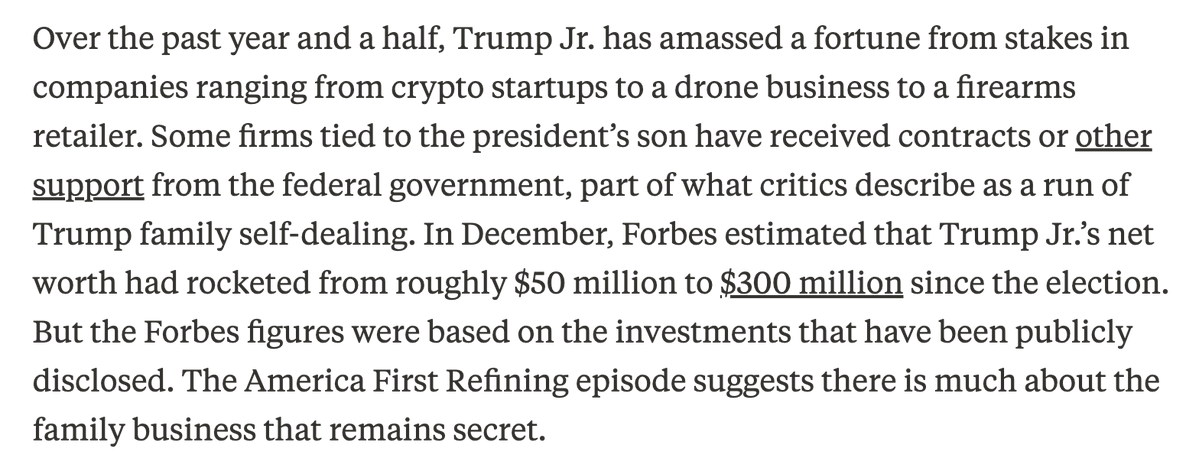
NEW: Donald Trump Jr. invests in a co. trying to build an oil refinery in the U.S.
Then the richest man in Asia invests... in the same company.
Then... his co. gets policy concessions from the Trump Admin.
@js_kaplan & @JustinElliott: