Deribit Executive: Bitcoin Break Below $60K Could Trigger Liquidations
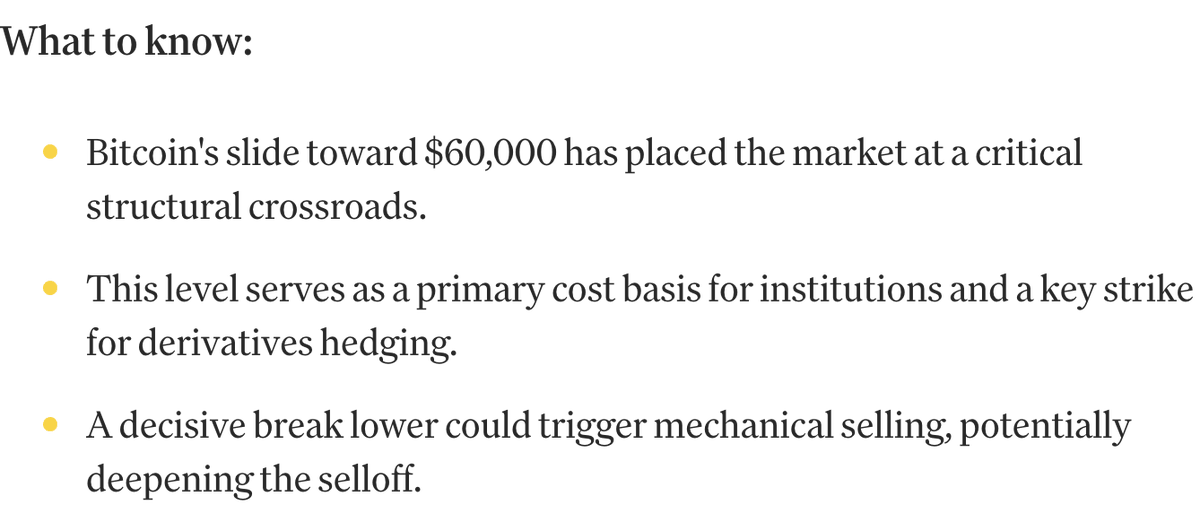
CoinDesk reported that Deribit Chief Commercial Officer Jean-David Péquignot said $60,000 is a key Bitcoin level, with more than $1.2 billion in notional open interest tied to put options at that strike on Deribit. He noted that a move below $60,000 could force market makers to hedge short gamma exposure by selling spot or futures, while elevated leverage may trigger a cascade of long liquidations.
Turns out ZEC did have a hidden infinite inflation bug. The price action historically was consistent with it. If someone is sitting on infinite ZEC they had minted, they’d slowly liquidate to not reveal this fact.
Oh you mean $ZEC the coin whose HQ is 5min from CIA
had an "exploit" in it that could mint infinite coins
And was mentioned multiple times in the epstein files?
HAD AN "SECRET" EXPLOIT
SUUUUUUUUUUUUUUUUUUUUUUREEEEE
👉For 4 years, 1 day, and 10 hours, anyone who understood the Orchard circuit could have minted ZEC out of thin air, silently, with no on-chain signature. The bug was disclosed this week. It was found by an AI-driven audit running Opus 4.8, not by an attacker.
1. Call the bug what it is
Two lines in halo2's variable-base scalar multiplication gadget used assign_advice() where copy_advice() was required. As a result, the diversified-address integrity check pk_d = [ivk]·g_d could be satisfied for arbitrary inputs. A malicious prover could spend the same note multiple times with different nullifiers, i.e. counterfeit ZEC inside the Orchard pool, undetectable on-chain because the privacy of the ZK proof hides exactly the inputs that would reveal the attack.
We do not know whether it was exploited. We will probably never know.
2. Four years. Multiple audits. Top-tier reviewers.
Orchard was reviewed by some of the strongest cryptographers in the field before activation. They missed it. Earlier automated audits with Opus 4.7 missed it. Opus 4.8 catches it in roughly 1 in 4 runs when prompted generically. The bug is hard.
And ZK inflation bugs are not new. Zcash itself shipped a counterfeiting vulnerability in Sprout (BCTV14) that survived years before being silently neutralized during Sapling. Similar soundness issues have appeared in circom, halo2, and rollup verifiers since. The pattern is consistent: when the protocol is private, exploitation is undetectable. You patch the bug and hope.
3. What Zcash did right
This was a textbook decentralized incident response:
▶️Audit: a full AI-assisted soundness audit of halo2 + Orchard, scoped end-to-end.
▶️Discover: the agent flagged the missing constraint and worked out the algebra to turn it into an exploit. A working RPC-level PoC in ~6 hours, mostly waiting on tokens.
▶️Coordinate: a soft fork disabling Orchard, prepared and distributed without leaking the bug, activated 2 days and 15 hours after acknowledgement. Coordinating a soft fork across miners, exchanges, and nodes without disclosing why is genuinely hard. They did it.
▶️Disclose: timeline, code lines, math, open questions. No spin.
Worth naming explicitly: Zcash's turnstile invariant caps the value that can ever leave a shielded pool by the value that entered it. Privacy and verifiability inside the same protocol. That is not an accident. That is good engineering, and it is what kept the worst case bounded.
4. The economics of security just changed
AI does not change whether bugs like this exist. It changes the cost of finding them. I wrote about this https://t.co/AeurraJXhB: a missing constraint in a 4-year-old production ZK circuit used to require a top-tier cryptographer with months of context. It now requires a few tokens, an API key, and a well-framed prompt.
The defender benefits. The attacker benefits more, they only need to find it once, and they never disclose.
Orchard is the optimistic version of this story: defense got there first. The pessimistic version is the one we cannot rule out, because the chain is private by design.
5. The only real exit
You do not patch your way out of this asymmetry. You raise the floor.
Formal verification of consensus-critical circuits, every assign_advice audited by SAT solvers and AI for under-constraint, as the reporter himself recommends. Proof-grade engineering that used to be too expensive is now cheap enough to be mandatory.
Hardware roots of trust, secure enclaves, certified secure elements, WYSIWYS. Cryptographic guarantees the user can actually verify, not promises a host can lie about.
Continuous AI-assisted audit of every consensus-critical commit, re-run immediately on the release of any new frontier model.
Zcash didn't just patch a bug. They demonstrated the new defensive playbook: AI-driven audits, decentralized coordination, radical transparency, verifiable invariants. That is the direction the rest of the industry needs to follow.
And those who don't raise the bar for security will be rekt in this new world.
Stay safe. Stay honest about your trust assumptions.
@0xdoug@blknoiz06 So ZEC is either going to be not private, or the shielded pool could become an insolvent pump and dump with no accountability.
Even if they added a turnstile counter, the first to exit the pool post-exploit will benefit, and those who exit late will get rugged.
No wonder $ZEC nuked 25%, pretty wild to not know whether the token was mass printed
Privacy becoming a bug not a feature
TL;DR
i) Bug found: May 29, 2026 by Taylor Hornby (AI-assisted audit - Opus 4.8 showing us what it’s made of!) in Zcash’s Orchard shielded pool
ii) Issue: Under-constrained circuit (present since 2022) allowed unlimited undetectable counterfeit ZEC creation
iii) Response: Fully disclosed & fixed ecosystem-wide by June 2, 2026
iv) Exploitation risk: Unprovable due to privacy, but considered unlikely
v) Next steps (Shielded Labs):
New shielded pool + turnstile for verifiable supply
Hopefully there’s a clearer image in the coming days





![P3b7_'s tweet photo. 👉For 4 years, 1 day, and 10 hours, anyone who understood the Orchard circuit could have minted ZEC out of thin air, silently, with no on-chain signature. The bug was disclosed this week. It was found by an AI-driven audit running Opus 4.8, not by an attacker.
1. Call the bug what it is
Two lines in halo2's variable-base scalar multiplication gadget used assign_advice() where copy_advice() was required. As a result, the diversified-address integrity check pk_d = [ivk]·g_d could be satisfied for arbitrary inputs. A malicious prover could spend the same note multiple times with different nullifiers, i.e. counterfeit ZEC inside the Orchard pool, undetectable on-chain because the privacy of the ZK proof hides exactly the inputs that would reveal the attack.
We do not know whether it was exploited. We will probably never know.
2. Four years. Multiple audits. Top-tier reviewers.
Orchard was reviewed by some of the strongest cryptographers in the field before activation. They missed it. Earlier automated audits with Opus 4.7 missed it. Opus 4.8 catches it in roughly 1 in 4 runs when prompted generically. The bug is hard.
And ZK inflation bugs are not new. Zcash itself shipped a counterfeiting vulnerability in Sprout (BCTV14) that survived years before being silently neutralized during Sapling. Similar soundness issues have appeared in circom, halo2, and rollup verifiers since. The pattern is consistent: when the protocol is private, exploitation is undetectable. You patch the bug and hope.
3. What Zcash did right
This was a textbook decentralized incident response:
▶️Audit: a full AI-assisted soundness audit of halo2 + Orchard, scoped end-to-end.
▶️Discover: the agent flagged the missing constraint and worked out the algebra to turn it into an exploit. A working RPC-level PoC in ~6 hours, mostly waiting on tokens.
▶️Coordinate: a soft fork disabling Orchard, prepared and distributed without leaking the bug, activated 2 days and 15 hours after acknowledgement. Coordinating a soft fork across miners, exchanges, and nodes without disclosing why is genuinely hard. They did it.
▶️Disclose: timeline, code lines, math, open questions. No spin.
Worth naming explicitly: Zcash's turnstile invariant caps the value that can ever leave a shielded pool by the value that entered it. Privacy and verifiability inside the same protocol. That is not an accident. That is good engineering, and it is what kept the worst case bounded.
4. The economics of security just changed
AI does not change whether bugs like this exist. It changes the cost of finding them. I wrote about this https://t.co/AeurraJXhB: a missing constraint in a 4-year-old production ZK circuit used to require a top-tier cryptographer with months of context. It now requires a few tokens, an API key, and a well-framed prompt.
The defender benefits. The attacker benefits more, they only need to find it once, and they never disclose.
Orchard is the optimistic version of this story: defense got there first. The pessimistic version is the one we cannot rule out, because the chain is private by design.
5. The only real exit
You do not patch your way out of this asymmetry. You raise the floor.
Formal verification of consensus-critical circuits, every assign_advice audited by SAT solvers and AI for under-constraint, as the reporter himself recommends. Proof-grade engineering that used to be too expensive is now cheap enough to be mandatory.
Hardware roots of trust, secure enclaves, certified secure elements, WYSIWYS. Cryptographic guarantees the user can actually verify, not promises a host can lie about.
Continuous AI-assisted audit of every consensus-critical commit, re-run immediately on the release of any new frontier model.
Zcash didn't just patch a bug. They demonstrated the new defensive playbook: AI-driven audits, decentralized coordination, radical transparency, verifiable invariants. That is the direction the rest of the industry needs to follow.
And those who don't raise the bar for security will be rekt in this new world.
Stay safe. Stay honest about your trust assumptions.](https://pbs.twimg.com/media/HKCPArbWMAAT2O-.png)


