Final training session at #THSCA 🏈
@CoachPhelps11 from Melissa HS is sharing their offensive philosophy and how they use ANSRS to make smarter decisions:
“Every play call is a decision. Every decision needs a reason.”
From pre-ANSRS to the ANSRS era:
✅ Self-scout first
✅ Reports becoming questions
✅ Turning data into better decisions
A great session on how the right information can change the way you prepare, plan, and coach.
#ANSRS #TXHSFB #FootballTechnology #DataDriven #FBANSRSFASTER
#CoachesHelpingCoaches
@joevidev@hwchase17 Is more than just Langraph and Loops. The Ontology powers both. Palantir $PLTR has been doing this for years. Others are catching on.
https://t.co/wWMUI5dAEF -
The goal is simple:
Help people understand what goes inside a graph before they buy or build the graph database.
Microsoft has released an open-source tool that helps teams learn ontology design before choosing a knowledge graph platform.
It is called Ontology Playground.
The project is a fully static React app, which means it does not need a backend, account system, database, or hosted service to run.
The goal is simple:
Help people understand what goes inside a graph before they buy or build the graph database.
Ontology Playground includes six pre-built domain ontologies:
→ Retail
→ Healthcare
→ Finance
→ Manufacturing
→ E-Commerce
→ Education
Each one gives users a starting point for understanding entities, relationships, properties, and how domain knowledge gets structured.
The app also includes a live visual designer, structured learning paths, hands-on labs, and RDF/XML export for Fabric IQ.
Because it is static, it can be deployed almost anywhere.
No backend.
No vendor lock-in.
No platform commitment upfront.
This matters because many teams jump into knowledge graphs too early.
They focus on the database first.
But the harder question is usually:
What should the graph actually know?
Ontology Playground teaches that layer first.
Live now! ⏰ #THSCA
ANSRS Adjust: Set Up and Best Practices In Game
📍 Training Room 352C
See how coaches are using ANSRS Adjust for a faster, more efficient game day experience.
#FBANSRSFASTER#ANSRS
That’s a wrap on #THSCA Day 1! 🏈
We truly enjoyed every conversation and appreciated every coach who stopped by today. Thanks for talking ball with us, sharing your experiences, and asking great questions.
Let’s do it again tomorrow! See you at Booth #751. 🤝
#ANSRS
@mitchellh This is fire 🔥 simplicity! I love simple solutions to problems that are taken for granted by the masses. Like @RickRubin or @kanyewest would say, the hard things look simple and are forgotten. Like the STOP 🛑 sign. It just exists for eternity. Thanks for your work @mitchellh
@mvernal Amazing morning read! I believe you still need a wedge, something that holds the door open as you build everything. Mike, would love to connect. Thanks for sharing.
$GRAB CTO on AI and Everything in-house Software🆕
How Grab is rebuilding its engineering culture around AI speed. This change forces leaders to rebuild management, hiring and physical operations in South-east Asia before speed causes problems
GRAB’S chief technology officer Suthen Thomas Paradatheth argues that artificial intelligence makes writing code cheap while making checking code rare.
This change forces leaders to rebuild management, hiring and physical operations in South-east Asia before speed causes problems.
As Grab to releases new software tools at a record pace, leaders must now figure out which numbers show a better business instead of just a busy staff.
Old ways of measuring work can push companies toward the wrong goals, meaning executives can no longer rely on legacy metrics to track actual output.
“Ninety per cent of our engineers are using some form of AI coding assistance daily,” said Paradatheth. “We did not mandate anything. We made the tools available, taught people the skills on how to use them effectively, and then cut them loose.”
“Engineering productivity always has a bunch of caveats and asterisks,” he added.
Still, the numbers tell a story. Using merge requests as a proxy, Grab has seen around a 40 per cent increase in output per person, with turnaround time for similar-sized tasks dropping by 20 to 30 per cent.
He adds that engineering output represents only a small piece of the puzzle, noting that true AI effectiveness requires company-wide institutional change alongside individual improvements.
The risk of easy coding
Giving more people the ability to build software speeds up work, but it raises new questions about hiring and oversight. “Software engineering fundamentals still matter,” said Paradatheth.
On hiring, he draws a line. “You cannot come in and say, ‘I could ask any agent to do this, but I do not know what it has done.’ We also look for AI fluency and a sense of ownership, acting like an owner rather than waiting for instructions.”
The legal team built an automated tool to slash first-pass NDA reviews from hours to minutes, while the design team created a similar tool called Mosaic to generate brand-specific illustrations in a fraction of the usual time.
“If a tool is going to go out in production, if our end customers are going to be exposed, then it needs a review by production engineers,” he said. “For internal use, we do not want engineering to be gatekeepers.”
Removing internal gatekeepers speeds up development, but it shifts the pressure elsewhere. Weak checking mechanisms risk turning high engineering output into fragile systems.
To combat this, Grab structures its workflow around four operational steps:
~Change engineering work from typing direct prompts to handing off tasks, allowing systems to operate on their own
~Organise business and technical data cleanly so independent systems can pull context without crashing
~Expand checking processes with automated testing to prevent software bugs and verify unexpected behavior
~Use secondary models to check outputs, monitor the automated judges, and assign final responsibility to a specific human.
This workflow shifts how software is generated. An engineer now assigns a task to an agent and steps away, returning later to review the generated code, which amplifies speed through asynchronous workflows.
“Code can be generated in reams. The new bottleneck is people cannot review all the code that is created,” Paradatheth warned. “Ultimately, we say you are accountable for what gets to production. So, how do you review it?”
To manage this, the company invests heavily in “harness engineering,” keeping the codebase legible for AI while scaling automated tests to catch errors before they reach production.
“The accountability chain does not end with an AI; it ends with a human being,” he said. “Every leader in my organisation is expected to deliver a change to production using agentic engineering.”
Building rules directly into the software
Keeping humans accountable for checking code relies on controlled platforms, presenting leaders with the challenge of giving computing power to staff while maintaining oversight.
Grab’s answer is GrabGPT, which grew out of a failed internal chatbot. When AI excitement surged in 2022 and 2023, external tools posed a clear security risk, so the infrastructure team built a secure in-house interface instead.
“Despite the name, GrabGPT is not just using one vendor,” Paradatheth said. “You can use closed models like Gemini, Claude, and GPT, and open-weight models like Qwen.”
GrabGPT also acts as a router and abstraction layer, with an audit log, controlled onboarding, usage metering, and cost control.
Finding hidden software problems faster
Using this centralised router moves the security focus away from individual tool choice and toward overall system behavior, preparing leaders for an environment where structural weaknesses can grow much faster.
“A useful mental model is that AI is an amplifier of everything,” Paradatheth said. “If you have great software engineering practices, it will amplify that. If there was latent risk in your system, that risk is now amplified.”
“You need to start thinking in the context of latent risk. Vulnerabilities may have always been there, but now you have an agent that acts in a non-deterministic way. You cannot ship code into production and hope for the best.”
That same power, however, can work in reverse, automated reviews can now spot and fix weaknesses far faster than human reviewers alone.
This bandwidth for risk assessment extends into the physical logistics network connecting businesses to consumers, where robotics is seen as a tool to eliminate wasted operational time, not replace human workers.
“A robot could be loaded at the counter, meet the driver at the curb, and on the other end, deliver straight to the door, handling the first and last meters of the journey,” Paradatheth said.
Since these walking stages consume roughly ten percent of a driver’s time, removing them lets couriers complete more orders and increase their earnings.
Adapting autonomous systems to varied city streets
While robotic extensions can fix walking delays, achieving full self-driving capabilities requires navigating economic and regulatory conditions that vary drastically between cities.
“For autonomous vehicles, it is going to be a journey before it expands more widely in South-east Asia,” he said.
The road ahead is complex. “Challenges include unit economics and adapting to the diversity of conditions. Cities are packed with motorbikes and bicycles, and there often are not dedicated bicycle lanes,” he said.
For autonomous delivery robots, the company builds everything in-house. For passenger vehicles, it takes a multi-partner approach to integrate them smoothly into the existing marketplace.
Source: https://t.co/qFozaDGqDZ
@MikeLongTerm@AnthonyPY_Tan Founder-led companies are built for generations, not quarterly reports. Anthony has a relentless longterm vision that builds true trust. I trust the $GRAB team.
@KenLaCorte It’s all connected!
The urban vs. rural dynamic heavily dictates social values, which drives the pro-life/pro-choice divide as well. The collapsing birth rate is the downstream result of these exact political and cultural fractures. Technology is the accelerant!
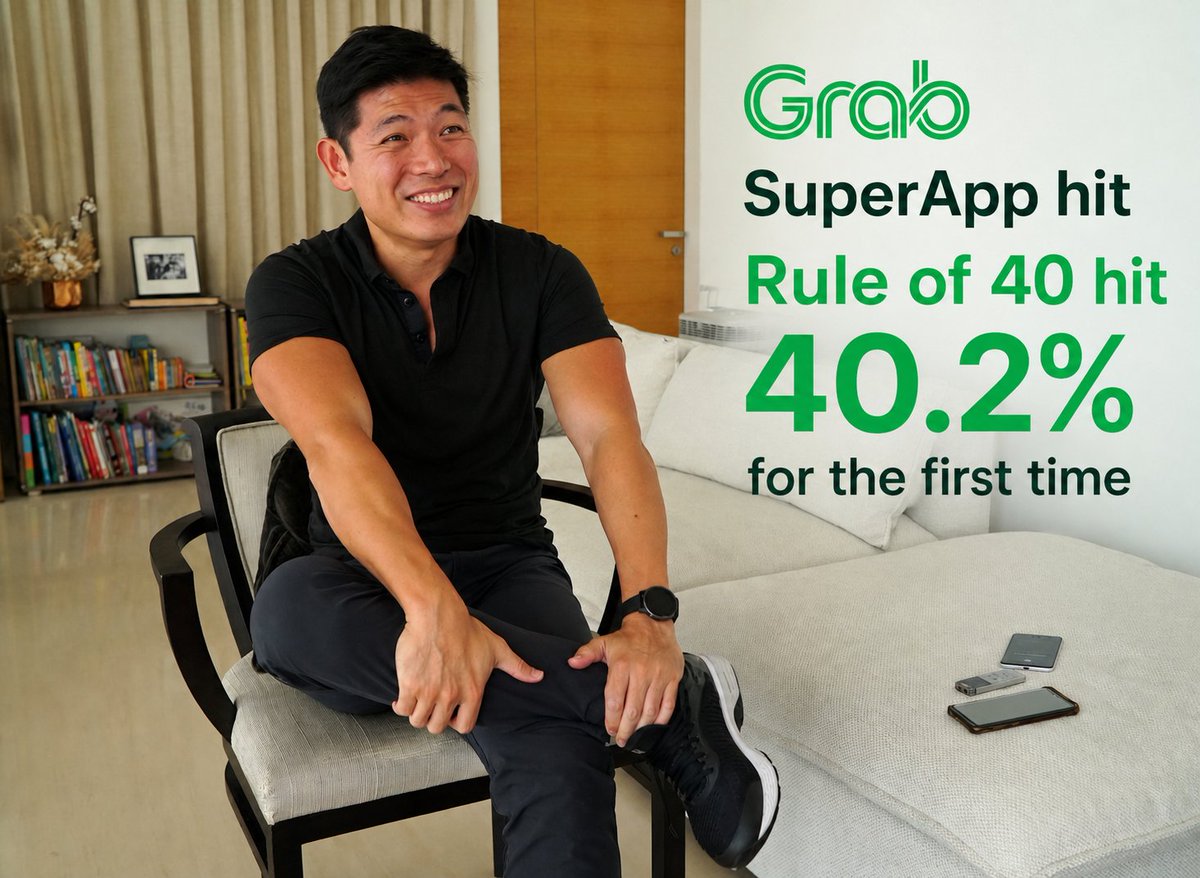
BREAKING $GRAB Rule of 40 hit 40.2% 🚀🚀🚀
Early last year, when I started my initial position on $GRAB I wrote a thread that I see GRAB as a software company and I said it should break above 40% in 2026. And I was right
Fun fact: 70-80% of US SaaS companies have lower than 40% Rule of 40 btw. This tiny SEA company is winning most US public companies!!!!!
And here we are at 40.2%. A tiny SEA company with big ambition, to uplift 5 billion people out of the bottom of pyramid, to join the world digital economy.
Grab (GRAB) reported strong Q1 2026 results on May 5, 2026, with revenue of $955 million (up 24% YoY, or 19% on a constant currency basis) and record Adjusted EBITDA of $154 million (up 46% YoY), equating to an Adjusted EBITDA margin of ~16.2%.
The Rule of 40 is a key SaaS/high-growth metric:
Revenue growth rate (%) + Profit margin (%) ≥ 40% is generally considered healthy (balancing growth and profitability). Variations often use Adjusted EBITDA margin or operating margin instead of GAAP net margin.
Q1 2026 Revenue Growth: +24% YoY
Adjusted EBITDA Margin: ~16.2%
Rule of 40 Score (using Adj. EBITDA):
24% + 16.2% = ~40.2%
Rule of 40 will grind upward to 100% very soon within 4-5 quarters.
I know I know u gonna say, Mike is playing with his magical crystal again. This is a bold call. And I will repost this.
This is significant, and all long term shareholders should celebrate this milestone.
Congratz to all!
Not Financial Advice!
@LazaroInvestor @KaiXCreator The $GRAB management team is strong! I trust they will continue to execute with a long term vision. Along for the long ride. 🎢
@Carlos348972434 Anthony Tan has an active Rule 10b5-1 trading plan (established Nov. 11, 2025), under which he filed to sell up to 1.2 million shares, with proceeds earmarked for tax payments.
For agentic systems founders and dev tools founders:
People do not want to pay for raw markdown and they shouldn't have to.
But they may pay for orchestration, hosting, updates, collaboration, portability, analytics, and managed execution.
These can be great businesses.